

Social Security, a pension, disability benefits, an annuity, or regular retirement-account withdrawals can all support an FHA home purchase in Texas. The real question isn’t your age. It’s whether an FHA-approved Mortgagee can document the income, its current amount, and, where HUD requires it, that it’s likely to continue. That’s the practical core of FHA retirement income rules.
At The Texas Mortgage Pros, a Texas mortgage broker, I encourage buyers living on benefits or retirement income to start with paperwork, not assumptions. A current award letter, benefits letter, bank statement, pension letter, or retirement-account statement makes the conversation much clearer. Federal fair lending rules also protect you from being treated differently because of your age or because your income comes from a public assistance program.
TL;DR
- Your age isn’t the test; documenting your benefits, pension or distributions is.
- Social Security, SSI, disability, pension, IRA/401(k) and annuity income each have their own HUD paper trail.
- Most of these sources must be likely to continue at least three years; an award letter with no end date generally covers that.
- HUD bars the Mortgagee from asking about the nature of your disability or your medical condition.
- Nontaxable income may be grossed up, and a COLA or retirement income starting within 60 days of closing may count.
- In Texas, check the extra $60,000 school homestead exemption for 65+ or disabled owners and whether your tax ceiling can move with you.
TexasFHA
Buying on Social Security or Retirement Income?
Talk with a mortgage broker about your award letters, pension, and statements before you make an offer.
Older buyers are driving the market, and 2027 COLA notices are on the way
Older households are a big part of today’s purchase market. In its November 2026 look at the 2026 Profile of Home Buyers and Sellers, the National Association of REALTORS® reported that the median age of repeat buyers held at a record 62, and the typical seller was 63. Repeat buyers now largely consist of retirees, and moving to be closer to family and friends is a growing reason to buy. Thirty percent of repeat buyers paid all cash, which means most still used financing.
For Social Security recipients, the timing matters right now. The Social Security Administration has announced a 3.6% cost-of-living adjustment for 2027. Higher Social Security payments begin in January 2027, and SSI increases begin on December 31, 2026. If you have a my Social Security account and enroll in paperless notices by November 18, you can view your COLA notice online starting in late November; otherwise, it arrives by mail in December.
That notice can be a useful document when you’re buying around the turn of the year. It doesn’t replace HUD’s documentation rules, though, and a future amount isn’t automatically counted. Both the timing and the evidence are reviewed.
FHA retirement income: the documentation rule that drives the review
HUD defines retirement income as income from pensions, 401(k) distributions, and Social Security. For most of these sources, the central test is whether the income is likely to continue for at least three years. The exact rules for each source are in HUD Handbook 4000.1, and the FHA-approved Mortgagee applies them to your actual documents. For the bigger picture on what counts as income, see our guide to FHA income requirements.
Social Security retirement income and SSI
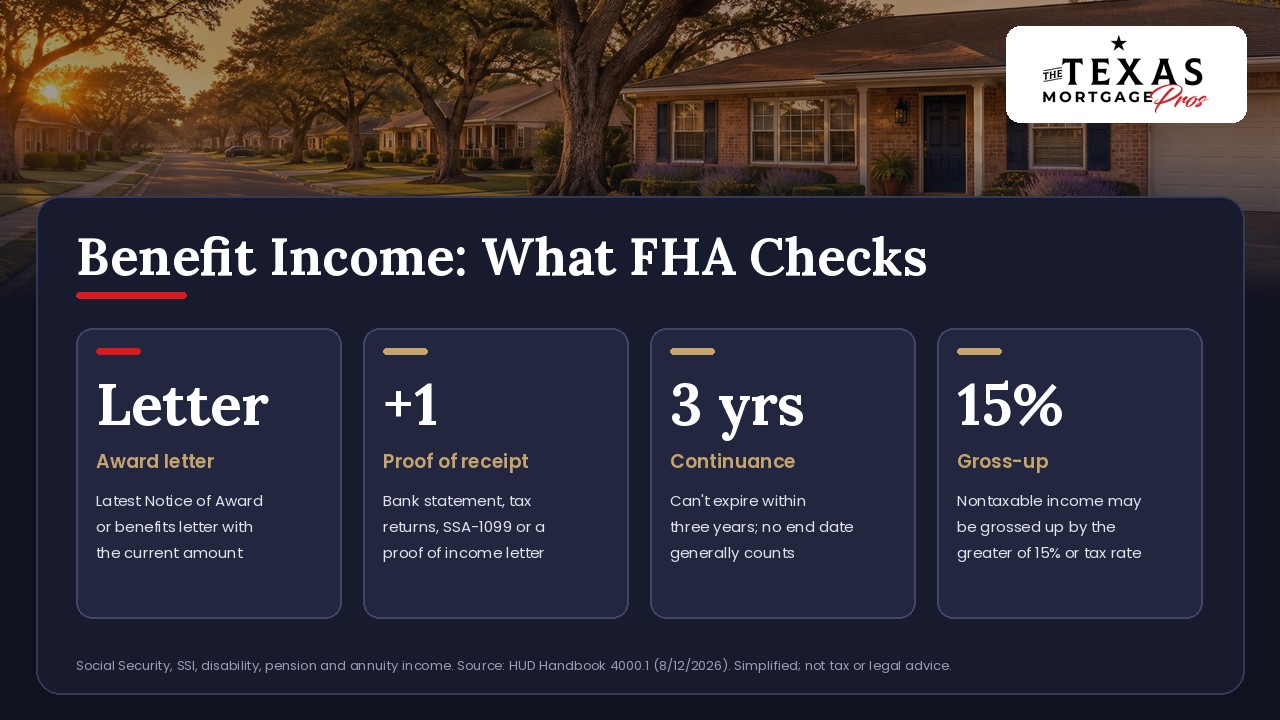
For Social Security retirement income or SSI that isn’t disability income, the Mortgagee verifies that you receive it and that it’s likely to continue for at least three years from the date the FHA case number is assigned. Receipt can be shown with any one of these:
- federal tax returns
- your most recent bank statement showing the SSA deposit
- a Proof of Income Letter from SSA, also called a Budget Letter or Benefits Letter
- your SSA-1099 or SSA-1042S
Continuance is documented with your last Notice of Award letter or an equivalent document. HUD is clear on what happens next: if that document has no defined expiration date, the Mortgagee must consider the income effective and reasonably likely to continue, and may not ask you for more documentation to prove continuance. If any SSA income is due to expire within three years of case number assignment, it can’t be used. If the award letter shows a future start date, the income counts only from that date.
The Mortgagee uses the current amount you receive.
Social Security disability and SSI disability
Disability benefits can be qualifying income when they’re documented correctly. For Social Security disability or SSI, the Mortgagee needs your last Notice of Award (or an equivalent document) plus one item showing receipt: tax returns, your most recent bank statement, a Proof of Income Letter, or your SSA-1099/1042S.
If the award has no defined expiration date, the Mortgagee may consider the benefit reasonably likely to continue. Disability income that’s due to expire within three years of your mortgage application can’t be used. HUD also draws two firm lines:
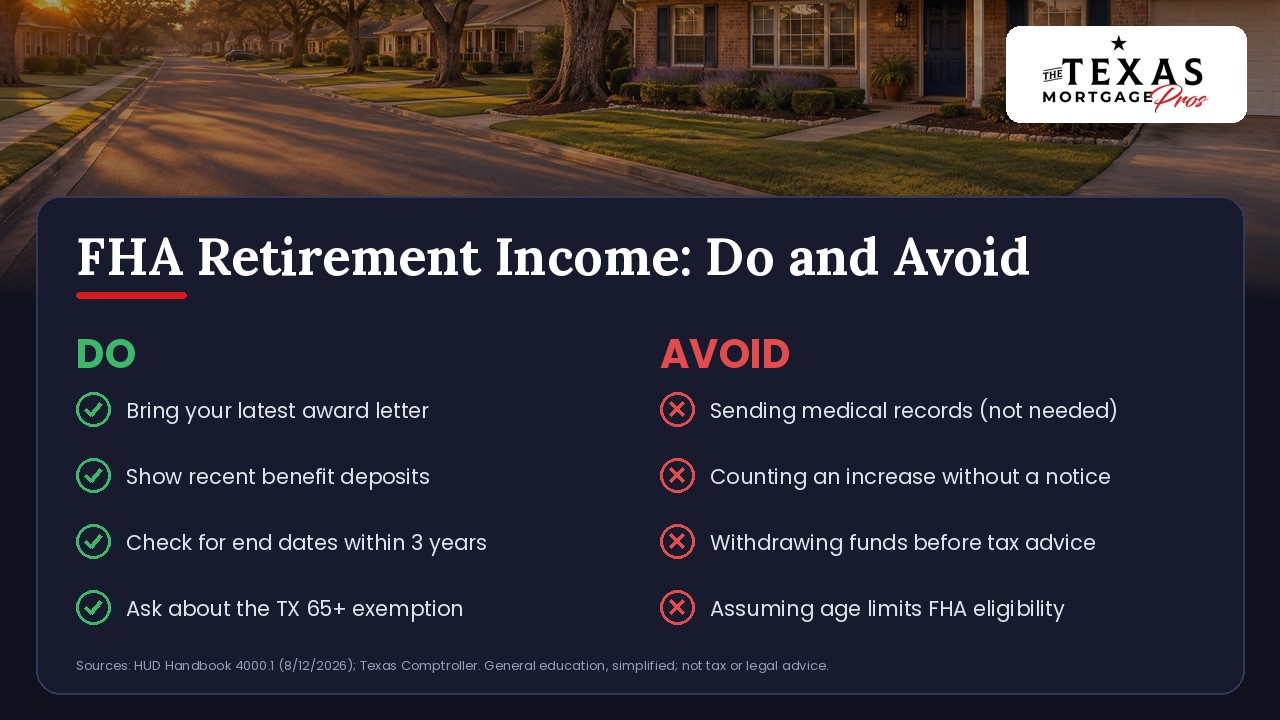
- The Mortgagee may not treat a pending or current medical eligibility review as evidence that your benefits won’t continue.
- Under no circumstance may the Mortgagee ask about, or request documentation of, the nature of your disability or your medical condition.
Your file is about award terms and payment records, not your health.
VA disability benefits
For VA disability compensation, the Mortgagee needs your most recent VA Benefits Letter showing the amount, plus tax returns or your most recent bank statement showing receipt. If the Benefits Letter has no defined expiration date, the income may be considered reasonably likely to continue for at least three years.
Private disability insurance
Private disability benefits can count too. The insurance provider’s documentation must show the benefit amount and the expiration date, if one exists, along with tax returns or a recent bank statement showing receipt. As with other disability income, the review is limited to the benefit terms and documentation.
Pensions, IRA distributions and annuities have different paper trails
Not every retirement source is reviewed the same way, and knowing which documents apply can save you a round of last-minute requests.
Pension income from a former employer
For a pension, the Mortgagee verifies that you receive periodic payments and that they’re likely to continue for at least three years. Any one of these works: tax returns, your most recent bank statement showing the deposit, or the pension or retirement letter from your former employer. The current payment amount is used.
IRA and 401(k) distributions
A retirement account balance isn’t automatically monthly income. For recurring IRA or 401(k) distributions, the Mortgagee verifies that they’re reasonably likely to continue for three years, using your most recent account statement plus tax returns or a recent bank statement showing receipt.
If your distributions have been consistent, the current amount is used. If they fluctuate, the Mortgagee averages what you received over the previous two years, or over the time you’ve received them if that’s less than two years. That’s a good reason to bring both your account statements and your deposit history to an early conversation.
Annuity income
For an annuity, the Mortgagee needs the legal agreement establishing the annuity and guaranteeing its continuation for the first three years of the mortgage, plus a bank statement or transaction history showing receipt. The current annuity rate is used.
Can FHA gross up nontaxable Social Security or disability income?
Sometimes. HUD allows the Mortgagee to “gross up” documented nontaxable income, which can include some portion of Social Security income, some federal and state government retirement income, Railroad Retirement benefits, certain disability and public assistance payments, and military allowances.
Grossing up is an underwriting calculation, not extra money in your pocket. It recognizes that a nontaxable dollar goes further than a taxable one. The Mortgagee must document the amount and the applicable tax rate. The adjustment can’t exceed the greater of 15% or your appropriate tax rate for the previous year, and if you weren’t required to file a tax return for that year, the Mortgagee may gross up by 15%. No extra adjustment is made for the number of dependents. Grossed-up income matters most when your debt-to-income ratios are tight; our post on FHA manual underwriting in Texas explains how those ratios work.
Whether a particular benefit is taxable, and how withdrawals are taxed, are tax questions. This isn’t tax or legal advice, so talk with a tax professional before you take retirement-account withdrawals or change a distribution plan.
Expected income: a COLA or a retirement start date can count, with timing rules
HUD lets the Mortgagee consider expected income, which includes cost-of-living adjustments, raises, a new job, or retirement income you haven’t received yet but will receive within 60 days of closing.
For expected retirement income, the Mortgagee verifies the amount and that it’s guaranteed to begin within 60 days of closing. The file also has to show that you’ll have enough income or cash reserves to cover the mortgage payment and your other obligations until that income starts.
This can help if you’re retiring shortly after your move or closing near the start of a new benefit year, but it depends on the documents and the dates. If your retirement income starts further out, it doesn’t fit this provision.

Retirement accounts can help as assets, not just income
IRAs, Thrift Savings Plan accounts, 401(k)s, and Keogh accounts can also be counted as assets. The Mortgagee may include up to 60% of the account value, less any existing loans against it, unless you show conclusively that you can withdraw a higher percentage after federal income tax and any withdrawal penalties.
The Mortgagee needs your most recent monthly or quarterly statement, your withdrawal eligibility, and the withdrawal terms. If you need part of the account to close your funds, you’ll need evidence that it was liquidated. What’s left after taxes and penalties can count as reserves.
Selling your current home is often part of the plan. Net proceeds from that sale are an acceptable source of funds when they’re documented with a fully executed Closing Disclosure from an arm’s-length sale. If family wants to help, read our guides to FHA gift funds in Texas and to buying with a non-occupant co-borrower, such as an adult child.
Your age and your income source shouldn’t decide the application
HUD’s documentation standards still apply, but so do federal fair lending rules. Under Regulation B (12 CFR 1002.6), a creditor generally can’t consider your age (as long as you can enter into a contract) or whether your income comes from a public assistance program, except in the limited ways the rule allows. A creditor also may not discount or exclude income because it comes from part-time work or is an annuity, pension or other retirement benefit; it may look at the amount and probable continuance of that income. The CFPB’s official interpretation gives a plain example: a creditor may not reject an application because the applicant is 60 years old.
In practice, the review should be individual and evidence-based. Retirement, disability, or benefit income isn’t a reason to assume anything about anyone’s ability to buy a home. If you still work part-time, see our guide to FHA part-time income.
Texas property tax breaks to check before you buy
A Texas purchase can also change your property tax picture, especially if you’re 65 or older or have a qualifying disability. According to the Texas Comptroller, school districts must provide a $140,000 residence homestead exemption, plus an additional $60,000 exemption for homeowners who are 65 or older or disabled under the Social Security disability definition. Local taxing units may offer more. You apply with your county appraisal district, generally before May 1, and if you buy after January 1, you may receive the homestead exemption for the applicable part of that year once you qualify, as long as the previous owner didn’t have the same exemption.
If you already have an over-65 or disability school tax ceiling on your current Texas homestead, Texas Tax Code Section 11.26(h) lets you take it with you as a percentage, not a dollar amount, when you move to a new Texas homestead and qualify for the same exemption there. Ask your current appraisal district for a tax ceiling transfer certificate.
These are separate from FHA underwriting, and the details belong with your appraisal district or a tax professional. They still matter for your monthly budget; our overview of Texas property taxes and your mortgage payment explains why.
Your FHA retirement income document checklist
Bring what applies to you:
- Your most recent Social Security, SSI, SSDI, or VA Notice of Award or benefits letter
- Your 2027 COLA notice once it arrives
- Recent bank statements showing benefit, pension, or distribution deposits
- Your SSA-1099 or SSA-1042S and tax returns, if you filed
- Your pension or retirement letter from your former employer
- Your most recent IRA, 401(k), TSP or Keogh statement and your distribution history
- Your annuity contract and transaction history
- Your private disability provider’s letter showing the amount and any expiration date
- Written confirmation of a retirement income start date, if it begins within 60 days of closing
- The Closing Disclosure from selling your current home, if you’re using the proceeds
A review of your credit report fits here too. Starting with FHA case numbers assigned on or after January 1, 2027, FHA will accept more credit score models; our post on mortgage credit score changes explains what that means. You can also review the basics on our FHA loan requirements page.
FAQ: FHA retirement income in Texas
Q: Can Social Security retirement income be used for an FHA purchase?
A: It can, when the FHA-approved Mortgagee verifies that you receive it and documents continuance with your Notice of Award or an equivalent document. If that letter has no defined expiration date, HUD says the income must be considered effective and reasonably likely to continue.
Q: Will the Mortgagee ask about my disability or medical condition?
A: No. HUD requires documentation of the benefit, the amount, your receipt of it, and any expiration date, and it specifically prohibits the Mortgagee from asking about or requesting documentation of the nature of your disability or your medical condition.
Q: Can my 2027 Social Security COLA count before the higher payment arrives?
A: Possibly. HUD’s expected income rules cover cost-of-living adjustments you will receive within 60 days of closing, as long as the amount and timing are documented. Your current payment records still matter.
Q: Can I use my 401(k) for both monthly income and my down payment?
A: It depends on your documents. Recurring distributions may be reviewed as income when they’re likely to continue, and the account may be reviewed as an asset under HUD’s separate asset rules. Money you withdraw to close is no longer available to support future distributions, so ask how your file will treat both.
Turn your award letters into a Texas purchase plan
A retirement or disability income file isn’t about fitting you into an age bracket. It’s about documenting real, stable income carefully and treating every buyer fairly. If you’re planning a Texas purchase on Social Security, a pension, disability benefits, an annuity, or retirement-account distributions, the most useful next step is gathering your letters and statements before you start shopping seriously.
As a licensed loan originator, I can help you organize those documents and spot the FHA questions to raise early, without assumptions. To talk through your plan, contact us, start on our FHA pre-qualification page, or call (281) 801-6965. If you’re 62 or older, HECM for Purchase is a different FHA program; you can read about it in our overview of reverse mortgage requirements in Texas.
— Gerry Nicodemus
Sources
- U.S. Department of Housing and Urban Development, Single Family Housing Policy Handbook 4000.1 (last revised August 12, 2026): Retirement Income (Social Security Income, Pension, IRA/401(k)); Disability Benefits (Social Security, VA, private); Annuities or Similar; Nontaxable Income (Grossing Up); Expected Income; Retirement Accounts; Sale of Real Property (TOTAL and Manual)
- National Association of REALTORS®, Older Buyers, Sellers Are Cashing in on the Housing Market (November 9, 2026), on the 2026 Profile of Home Buyers and Sellers
- Social Security Administration, Social Security Announces 3.6 Percent Benefit Increase for 2027 (October 14, 2026)
- Consumer Financial Protection Bureau, Regulation B, 12 CFR 1002.6 (Rules concerning evaluation of applications) and official interpretation
- Texas Comptroller of Public Accounts, Property Tax Exemptions (Tax Code Sections 11.13(b), 11.13(c) and 11.13(d))
- Texas Tax Code Section 11.26(h) (transfer of school tax ceiling for homeowners 65 or older or disabled)
Recommended Reading
- FHA Mortgage Insurance in Texas: How Long You Pay MIP
- Buying a Home After Divorce in Texas With an FHA Loan: What Counts and What to Document
- Texas Closing Costs: State Rules and County Tax Swings
TexasFHA.org is not affiliated with or endorsed by the U.S. Department of Housing and Urban Development, the Federal Housing Administration, the Social Security Administration, the Department of Veterans Affairs, the Consumer Financial Protection Bureau, the National Association of REALTORS®, the Texas Comptroller of Public Accounts, the State of Texas or any other government agency, and this is not a government document.
The Texas Mortgage Pros, LLC | Company NMLS #2665861 | Gerry Nicodemus, NMLS #286371 | Equal Housing Opportunity | www.nmlsconsumeraccess.org | (281) 801-6965
Equal Housing Opportunity. We do business in accordance with federal fair lending laws.

Gerry Nicodemus (NMLS #286371) is a licensed Texas loan originator with more than 25 years of mortgage experience. He specializes in FHA loans and explains credit, down payment, gift fund, and appraisal rules in plain English so Texas buyers know exactly where they stand. Gerry is also a digital marketer who builds agentic AI systems that help mortgage and real estate professionals get found online and serve borrowers better.