

FHA gift funds let a Texas homebuyer use money from an acceptable donor, such as a parent, toward the cash needed to buy a home with an FHA loan. HUD allows it, but only from certain donors, only when no repayment is expected, and only with a signed gift letter and a paper trail showing exactly how the money moved from the donor to you or to the title company. Money from the seller, the real estate agent, or anyone else who profits from the sale does not count as a gift, and cash with no record of its source is a problem. Plan the gift with your mortgage broker before any money moves.
TL;DR:
- HUD defines a gift as cash or equity given with no expectation of repayment. If you have to pay it back, it is not a gift.
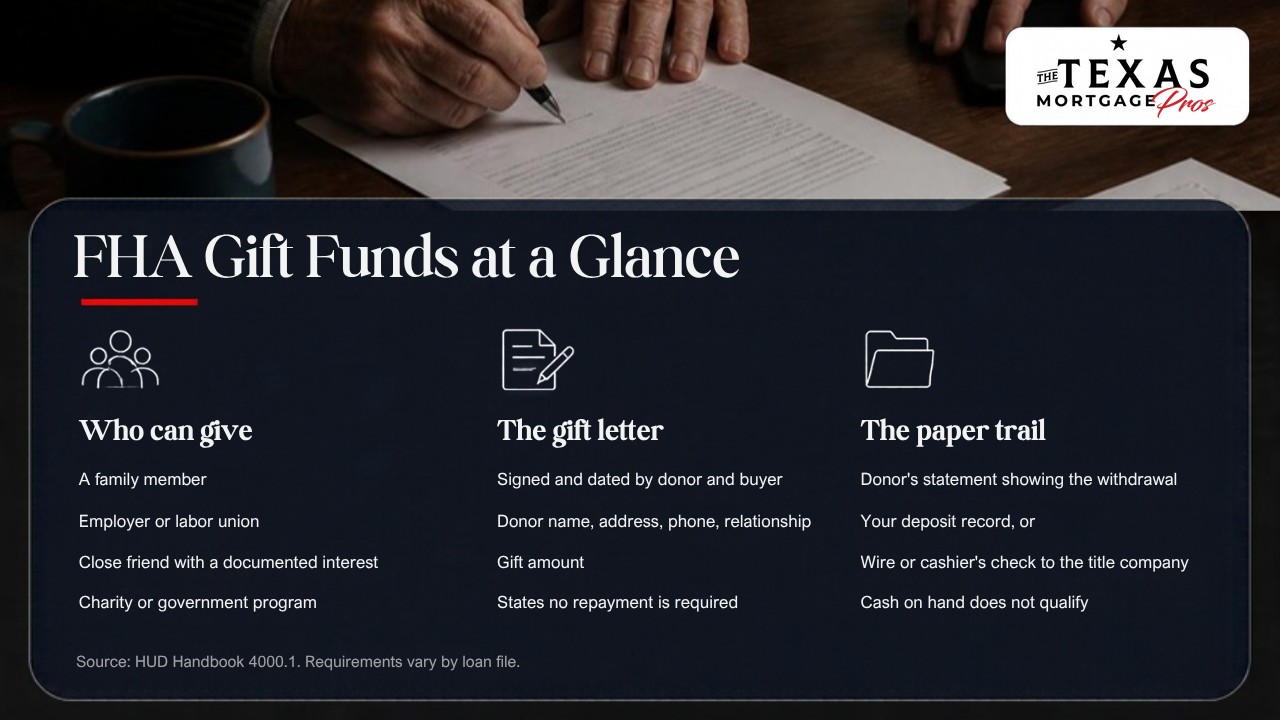
- Acceptable donors include a family member, your employer or labor union, a close friend with a clearly defined and documented interest in you, a charity, and certain government homeownership programs.
- The donor and you both sign and date a gift letter listing the donor’s name, address, phone number, relationship to you, the gift amount and a statement that no repayment is required.
- The transfer has to be documented from the donor’s account to yours or to the settlement agent. HUD says cash on hand is not an acceptable source of donor gift funds.
- Your required investment cannot come from the seller or anyone else who benefits from the sale. Seller help with closing costs follows separate rules.
Table of Contents
- Why Are More Texas Buyers Asking About Gift Funds?
- What Counts as an FHA Gift?
- Who Can Give FHA Gift Funds?
- What Money Cannot Be an FHA Gift?
- What Goes in an FHA Gift Letter?
- How Do You Document the Gift Transfer?
- Can Family Give a Gift of Equity?
- Texas Tips for Using Gift Funds
- Questions to Ask Your Mortgage Broker
- FHA Gift Funds Do’s and Don’ts
- Talk Through Your Options
- Sources
Why Are More Texas Buyers Asking About Gift Funds?
Family help is a normal part of buying a home. Zillow’s Consumer Housing Trends Report 2026, published October 14, found that about 30% of mortgage buyers used a gift or a loan from family or friends toward their down payment, down from 35% the year before. Younger buyers lean on that help the most: 45% of Gen Z buyers said they used a gift or loan from family or friends.
In Houston, the market is giving buyers more time to plan. The Houston Association of Realtors’ September 2026 Housing Market Update showed 7,030 single-family home sales, down 5.7% from a year earlier, with active listings up 6.3% and 5.5 months of inventory. HAR’s chair said higher mortgage rates are making buyers look more closely at what they can comfortably afford, with people taking more time and weighing their options.
That extra time is useful if a parent or other relative plans to help. A gift that arrives late, lands in the wrong account, or comes without paperwork can hold up an otherwise solid FHA file. A gift that is planned and documented from the start is usually just one more item on the checklist.
What Counts as an FHA Gift?
HUD’s Single Family Housing Policy Handbook 4000.1 defines gifts as contributions of cash or equity with no expectation of repayment. Three ideas follow from that definition:
- It has to be a true gift. If the donor expects you to pay the money back, even informally, it is a loan, not a gift. Borrowed money is handled under different FHA rules, so tell your mortgage broker how the arrangement really works.
- It can be cash or equity. Most gifts are funds sent from a donor’s account. A family member selling you a home can also gift you a portion of their equity, which we cover below.
- It can cover more than one need. HUD’s rules address gifts used for your earnest money deposit and for your cash to close, and the same gift standards apply to both.
Gifts are not a way around underwriting. You still need to qualify on your own credit, income, and debts. If you want to see what else an FHA file includes, our guide to mortgage pre-approval in Texas walks you through the documents.
Who Can Give FHA Gift Funds?
According to HUD Handbook 4000.1, gifts may be provided by:
- A family member. HUD’s definition, regardless of sex or legal marital status, includes a child, parent, or grandparent (including step and foster parents and grandparents); a spouse or domestic partner; a legally adopted child or foster child; a brother, stepbrother, sister or stepsister; an uncle or aunt; and a son-in-law, daughter-in-law, father-in-law, mother-in-law, brother-in-law or sister-in-law.
- Your employer or labor union.
- A close friend with a clearly defined and documented interest in you. A friendship is not enough on its own. Expect to explain and document the relationship.
- A charitable organization.
- A governmental agency or public entity that has a program providing homeownership assistance to low- or moderate-income families or first-time homebuyers. Our roundup of Texas first-time homebuyer programs covers state and local options. Each program sets its own rules.
If the relative who wants to help is not on HUD’s family list, such as a cousin, ask your mortgage broker before the money moves whether the gift can be documented under another category, such as a close friend with a documented interest.
What Money Cannot Be an FHA Gift?
The most important rule is who benefits from the sale. HUD says the part of the purchase you are required to invest yourself, called your minimum required investment, must not come from:
- The seller of the property;
- Anyone else who financially benefits from the transaction, directly or indirectly, such as a real estate agent, builder or developer with a stake in the deal; or
- Anyone who is or will be reimbursed by the seller or another party who benefits.
That means a seller cannot hand you money and call it a gift, and a relative cannot pass along money that really came from the seller. Sellers, agents, and builders can still help in a different way: HUD allows interested parties to contribute toward your actual closing costs and prepaid items, within FHA limits, but those credits may not be used toward your minimum required investment.
A few other things trip up gift files:
- Cash from under the mattress. HUD says cash on hand is not an acceptable source of donor gift funds. The donor needs money in a documented account.
- Gifts with strings attached. A side agreement to repay the donor turns the gift into a loan.
- Counting leftover gift money as savings. On manually underwritten FHA files, HUD says surplus gift funds may not be counted as cash reserves.
What Goes in an FHA Gift Letter?
HUD requires a gift letter signed and dated by both you and the donor. It must include:
- the donor’s name, address, and telephone number;
- the donor’s relationship to you;
- the dollar amount of the gift; and
- a statement that no repayment is required.
Your mortgage broker will usually provide a gift letter form. Make sure every detail matches the bank records. If the letter says one amount and the transfer shows another, or the donor’s name on the letter does not match the account the money came from, expect questions. If the gift amount changes, ask for an updated letter signed and dated again by both of you.
How Do You Document the Gift Transfer?
HUD requires the mortgage company to verify and document the transfer of the gift from the donor to you. How that is done depends on when the money arrives.
If the gift is deposited before closing, the file needs one of these:
- the donor’s bank statement showing the withdrawal, plus evidence of the deposit into your account;
- a copy of the donor’s canceled check, plus evidence of the deposit into your account;
- a copy of the donor’s withdrawal receipt, plus evidence of the deposit into your account; or
- evidence of the electronic transfer from the donor’s account to your account.
If the gift goes straight to closing, the file needs evidence of payment to the settlement agent in the form of one of the following: an electronic transfer from the donor’s account, a bank certified check, a cashier’s check, or another official bank check.
HUD adds that, regardless of when the gift arrives, the mortgage company must be able to reasonably determine that the funds did not come from an unacceptable source. In practice, you may be asked for more than one statement.
Watch your own statements, too. HUD requires documentation of large individual deposits into your checking and savings accounts, measured against your monthly income, and the underwriter verifies that the deposits align with your income and savings history. A gift that lands in your account with no letter attached can look like an unexplained deposit. Tell your mortgage broker about the gift before it arrives, and keep every page of your statements.
Can Family Give a Gift of Equity?
Yes, in a family sale. HUD says that only family members may provide an equity credit as a gift for a property being sold to other family members. For example, a parent selling a house to an adult child may be able to gift a portion of the home’s equity instead of giving cash. The same gift letter is required: the donor’s name, address, and phone number; relationship; the dollar amount of the gift; and a statement that no repayment is required.
Family sales also bring in FHA’s identity-of-interest rules, which can affect how the purchase is structured. Our guide to what FHA identity of interest means for your down payment explains those rules. A gift of land from a family member is handled differently again: HUD requires proof that the donor owned the land and evidence that title transferred to you.
Texas Tips for Using Gift Funds
A few practical steps help Texas buyers keep a gift from becoming a closing-week scramble:
- Decide early whether the gift goes to you or to the title company. In Texas, the title company usually handles the closing as settlement agent. Ask your mortgage broker which route best fits your file and timeline, and give the donor enough notice to arrange a wire transfer or an official bank check.
- Verify wiring instructions by phone. The Consumer Financial Protection Bureau (CFPB) warns that scammers send fake emails posing as real estate or settlement agents with false wiring instructions. Before the donor wires anything, confirm the instructions with the title company using a phone number you already know, and never rely on wiring instructions from email alone.
- Have the donor think about taxes. The IRS says gifts that do not exceed the annual exclusion for the year are generally not taxable gifts, and it lists the 2026 annual exclusion as $19,000 per recipient. The IRS also says the donor is generally responsible for paying any gift tax. Larger gifts may raise reporting questions, so the donor should consult a tax professional.
- Keep the donor’s money in an account. A relative who keeps savings at home will need to deposit them and wait for them to appear on a statement first. Talk with your mortgage broker about how much history the underwriter will want to see.
- Do not move money between several accounts. Every extra hop is another statement to explain. A direct transfer from the donor’s account to yours, or to the title company, is the simplest trail.
Questions to Ask Your Mortgage Broker
Use this list before the donor sends anything:
- Is my donor on HUD’s list of acceptable gift sources? If not, is there another way to document the gift?
- Which gift letter form do you use, and who needs to sign it?
- Should the gift go into my account before closing or straight to the title company?
- Which statements will you need from the donor and from me? Ask about withdrawal and deposit records.
- Will a gift deposit into my account require additional documentation?
- Can gift funds be used for my earnest money deposit, and how should that be documented?
- If a family member is selling me the home, can a gift of equity work, and how do identity-of-interest rules apply?
- Is the seller offering help with closing costs, and how is that kept separate from the gift?
FHA Gift Funds Do’s and Don’ts
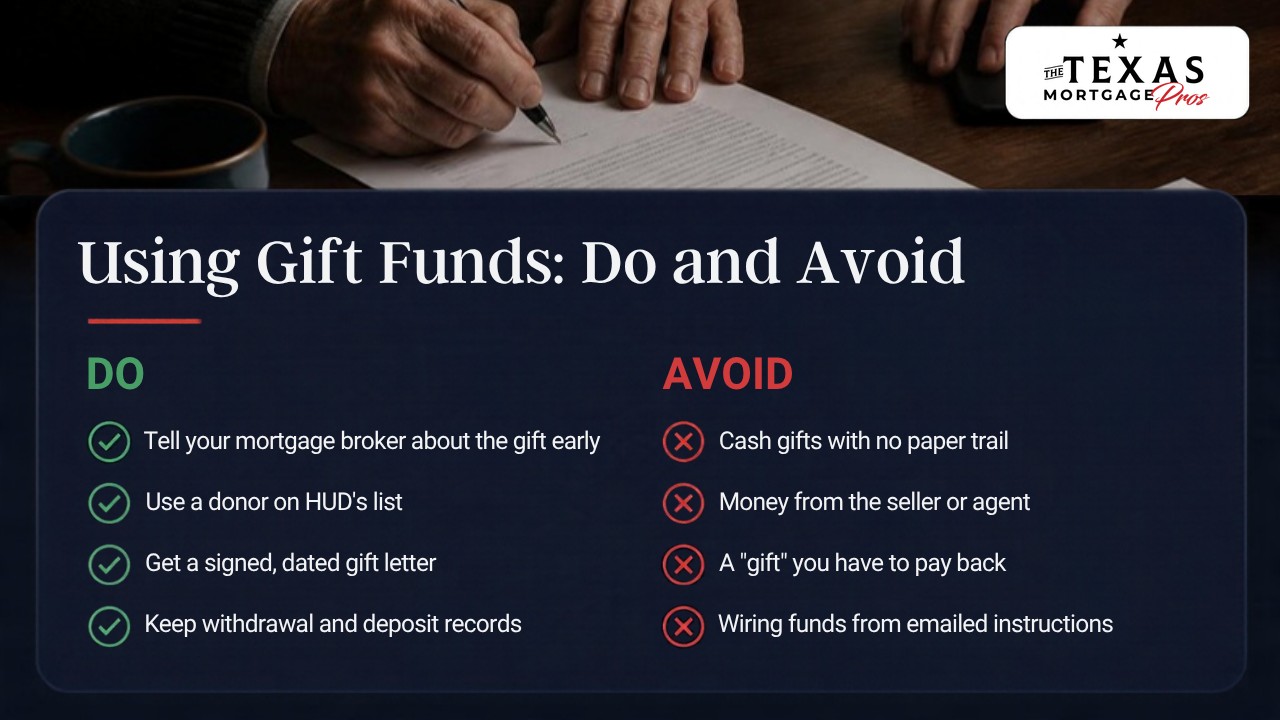
Do:
- Tell your mortgage broker about the gift early, before the money moves.
- Use a donor on HUD’s list and be ready to document the relationship.
- Get a signed, dated gift letter that matches the bank records.
- Keep withdrawal and deposit records for every step of the transfer.
Avoid:
- Cash gifts with no paper trail. HUD does not accept cash on hand as a source of donor gift funds.
- Money from the seller or agent. Seller help belongs in the contract as an interested party contribution, not as a gift.
- A “gift” you have to pay back. That is a loan and must be treated as one.
- Wiring funds from emailed instructions. Confirm by phone with the title company first.
— Gerry Nicodemus
Talk Through Your Options
FHA gift funds can make a real difference for Texas buyers, but the gift only helps if the donor, the letter and the paper trail all line up. If a family member, employer, or program is helping with your purchase and you want to plan the gift before anyone sends money, call (281) 801-6965 to talk with a mortgage professional at The Texas Mortgage Pros, a mortgage broker. You can also review our FHA loan requirements to see where you stand today.
Last verified: October 16, 2026. FHA gift fund rules, documentation requirements, and IRS limits change. Check HUD Handbook 4000.1, the IRS, and each source for the latest details.
This article is general information, not legal, tax, or financial advice. It is not a commitment to lend or an offer of credit. Loan approval and terms are subject to underwriting, program guidelines, and eligibility, and the use of gift funds does not guarantee approval. Gift documentation requirements can vary by loan file. Donors should consult a qualified tax professional, and buyers should consult a qualified real estate attorney or financial professional about their own circumstances before acting on anything here.
The Texas Mortgage Pros is not affiliated with, endorsed by, or sponsored by HUD, FHA, the IRS, the CFPB, Zillow, the Houston Association of Realtors, Houston Agent Magazine, or any other organization named in this article. Third-party names are used only to cite their published information.
The Texas Mortgage Pros, LLC | Company NMLS #2665861 | Gerry Nicodemus, NMLS #286371 | Equal Housing Opportunity | www.nmlsconsumeraccess.org | (281) 801-6965
Sources
- U.S. Department of Housing and Urban Development, Single Family Housing Policy Handbook 4000.1 (Gifts, Sources of Funds and Minimum Required Investment, II.A.4 and II.A.5; Family Member definition, II.A.1; Update redline posted August 12, 2026)
- Internal Revenue Service, Frequently Asked Questions on Gift Taxes (annual exclusion table updated December 2025)
- Consumer Financial Protection Bureau, Mortgage Closing Scams: How to Protect Yourself and Your Closing Funds (June 3, 2019, archived blog)
- Zillow Research, Buyers: Results from the Consumer Housing Trends Report 2026 (October 14, 2026)
- Houston Agent Magazine, HAR: Housing Market Activity Cools in Houston Amid Higher Mortgage Rates (October 15, 2026; citing HAR’s September 2026 Housing Market Update)
Recommended
- Texas First-Time Homebuyer Programs
- What FHA Identity of Interest Means for Your Down Payment
- Mortgage Pre-Approval in Texas: Your 2026 Buying Guide

Gerry is a licensed mortgage loan originator and digital marketer with 25+ years in the mortgage business, specializing in conversion rate optimization, SEO, AI Overviews, and generative engine optimization (GEO) for the mortgage and real estate industry. Today he builds agentic intelligent systems, meaning AI agents that research, create content, nurture leads, and handle follow-up, to help mortgage and real estate business owners get found online, convert more leads, and scale. Gerry pairs decades of hands-on industry knowledge with the latest AI tools, so his clients stay a step ahead of the market.