

Texas buyers typically pay 2% to 5% of the purchase price in closing costs. On a $300,000 home, that ranges from $6,000 to $15,000; on a $400,000 home, expect roughly $8,000 to $20,000. Your exact number shifts with loan type, lender fees, and which county collects your property taxes.
TL;DR:
- Buyers should budget between 2% and 5% of the purchase price for closing costs, with actual expenses depending on loan type and county taxes.
- Title insurance premiums are fixed by state regulation, costing roughly $2,000 to $2,600 for a $300,000 loan, regardless of the title company chosen.
- Property tax prorations and county-specific rates can cause significant differences in the cash needed at closing, sometimes by thousands of dollars.
- Typical Texas closing takes 30 to 45 days, with fees like appraisal and inspection paid early, while most other costs are settled at closing day.
- Seller closing costs generally exceed buyers’ costs, mainly due to agent commissions, and can reach $21,000 to $28,000 on a $350,000 sale.
Table of Contents
- Average Closing Costs Texas Buyers Should Budget For
- What Are the Line Items in a Texas Closing Cost Breakdown?
- What Texas-Specific Rules Change Your Closing Costs?
- How Do County Property Taxes Change Your Cash to Close?
- How Can You Estimate Your Own Closing Costs Before You Buy?
- How Can You Lower or Negotiate Closing Costs in Texas?
- Cash-to-Close Checklist: What to Bring on Closing Day
- How Are These Closing Cost Examples Calculated?
- Who Pays What at Closing, and When Do You Find Out?
- What Do Sellers Typically Pay in Closing Costs?
- What Exactly Are You Paying For in Lender Fees?
- How Long Does Closing Take in Texas, and When Are Fees Due?
- A Publisher’s Note on Managing Closing Costs
- Get a Personalized Closing Cost Estimate
- Sources
Average Closing Costs Texas Buyers Should Budget For
That 2% to 5% band is wide because it has to cover very different transactions. A cash buyer skipping loan-related fees lands near the bottom. A buyer financing with a low down payment, paying discount points, and closing in a county with a high effective tax rate lands near the top. Loan type matters too: FHA loans add an upfront mortgage insurance premium rolled into the loan (not typically a cash-to-close item), while VA loans strip out some fees entirely but may carry a funding fee.
Here’s how the range plays out in dollars for common Texas price points, approximately:
- $300,000 home: low to higher-end closing costs
- $350,000 home: moderate range
- $400,000 home: higher range
- $500,000 home: highest range
Exact costs vary by loan type, lender fees, and county property taxes.
Conventional loans with 20% down tend to sit in the lower half of each range since there’s no monthly mortgage insurance to escrow. FHA loans often land in the middle to upper half because lenders collect more prepaid items upfront, even though the down payment itself is smaller. VA loans, available to eligible veterans and service members, frequently come in lightest since sellers can cover more of the buyer’s costs and certain fees are waived by rule.
What Are the Line Items in a Texas Closing Cost Breakdown?
Your Loan Estimate groups charges into categories, and each one behaves a little differently. Knowing what’s negotiable and what’s fixed saves you from either overpaying or panicking over a number that’s actually standard.
Lender fees range from $1,500 to $3,000 combined and include origination, underwriting, and processing fees. Appraisal costs $450 to $700 for a standard single-family home. Inspections are paid outside of closing in most Texas contracts, typically $400 to $600 for a general home inspection, more if you add specialized checks like foundation or septic.
Title insurance deserves its own paragraph because it’s the item most buyers misunderstand. In Texas, both the owner’s and lender’s title policy premiums are set by a state-promulgated rate schedule through the Texas title insurance rate information system. That means every title company charges the identical premium for the same coverage amount. On a $300,000 loan, expect a combined premium in the $2,000 to $2,600 range, which varies with the sale price rather than the company you pick.
Escrow and title company fees (the settlement or closing fee, separate from the premium itself) typically run $300 to $700. Recording fees are minor. Many Texas counties charge around $30 for the first page of a deed plus smaller per-page fees, according to county recording fee examples. A survey, if the seller doesn’t already have one that qualifies for reuse, costs $400 to $600. Prepaid property taxes and homeowners insurance premiums vary the most and are covered in the next section. Prepaid interest covers the days between closing and your first mortgage payment, usually $10 to $40 per day depending on loan size and rate. A credit report fee runs $30 to $75, and a flood certification adds $15 to $25.
Statistic Callout: Title insurance premiums in Texas follow a fixed, state-set schedule, meaning a $300,000 policy costs the same dollar amount whether you close with a large national title company or a small local one, per the Texas title insurance rate information.
Pro Tip: Ask your title company for a written premium quote based on your exact sale price early in the process. Since the rate is fixed by the state, this number won’t move, and it’s one of the few closing figures you can lock in before you even find a house.
What Texas-Specific Rules Change Your Closing Costs?
Texas has legal and regulatory quirks that don’t show up in generic national closing-cost calculators, and they cut costs in some ways while limiting your options in others.
- No state real estate transfer tax. Texas charges $0 in state transfer tax, while some states charge 1% to 2% of the sale price at closing. On a $350,000 home, that’s a savings of $3,500 to $7,000 compared to a transfer-tax state.
- Title insurance rates are promulgated, not competitive. You can’t negotiate the premium itself, but you can still shop for service quality, responsiveness, and which company handles your escrow.
- No mandatory closing attorney. Unlike some states, Texas doesn’t require a lawyer to preside over closing. Title and escrow companies routinely handle settlement, though you’re always free to hire your own attorney to review documents.
How Do County Property Taxes Change Your Cash to Close?
Property tax prorations create the biggest county-to-county swing in Texas closing costs, and this is where two buyers with identical loans can have cash-to-close figures that differ by thousands. Sellers owe taxes for the portion of the year they owned the home, and buyers get credited that amount at closing. But your lender also collects an escrow cushion, commonly 2 to 4 months of property taxes upfront, so a higher local tax rate means a bigger prepaid deposit due at the table.
The table below illustrates the swing using representative effective tax rates on a $350,000 home with 3 months of tax escrow collected.
These are illustrative, not exact quotes for your parcel. County-level examples confirm this variance is real and material. Check your county appraisal district’s site for the actual rate on your specific address, and ask your lender directly how many months of escrow they’re collecting.
How Can You Estimate Your Own Closing Costs Before You Buy?
You don’t have to wait for a lender to hand you numbers. A rough estimate early in your search helps you set a realistic savings target.
- Pull your Loan Estimate first. Lenders must provide this within three business days of application, and the CFPB’s guide walks through which lines to scrutinize, especially “Cash to Close” on page one.
- Compare it with your Closing Disclosure, which is delivered at least three business days before closing. Line items should be nearly identical; big jumps deserve a phone call to your lender.
- Run your own numbers using key inputs: purchase price, loan amount, county, loan program, expected seller credits, and months of tax escrow.
- Adjust one variable at a time. Raising your seller credit request from $3,000 to $6,000 on a $350,000 purchase can cut your cash-to-close nearly in half, depending on your other costs.
Pro Tip: Run the math with both an FHA and conventional scenario side by side before you fall in love with a house. The prepaid requirements differ enough that your cash-to-close can shift by $1,000 or more between programs.
How Can You Lower or Negotiate Closing Costs in Texas?
Some costs bend. Others don’t, and knowing the difference keeps your negotiating energy focused where it actually pays off.
- Ask for seller concessions. Sellers can often contribute toward your closing costs, though FHA and conventional loans cap the percentage based on your down payment and occupancy.
- Compare lender credits versus discount points. A lender credit lowers your cash-to-close today in exchange for a slightly higher rate. Discount points work the opposite way: you pay more upfront to lower your rate over the life of the loan. Choose based on how long you plan to keep the loan.
- Shop the items you can shop for. Inspection fees and survey costs vary by provider, so get two or three quotes. Don’t waste time trying to negotiate the title premium, since it’s set by the state schedule.
- Look into assistance programs. The Texas State Affordable Housing Corporation lists down payment and closing cost assistance options for eligible Texas buyers.
Pro Tip: If a seller won’t budge on price, ask for a closing-cost credit instead. Sellers who are firm on their number are sometimes flexible about how it’s applied.
Cash-to-Close Checklist: What to Bring on Closing Day
Walking in prepared turns closing from a stressful scramble into a routine appointment.
- Government-issued photo ID for every person on the loan.
- Proof of funds for your down payment and closing costs, matching the source your lender verified during underwriting.
- Homeowners insurance binder showing coverage starts on or before your closing date.
- Certified check or wire transfer for your remaining balance. Never send a personal check for a large sum.
- Confirm wiring instructions by phone using a number you look up independently, never one from an email, since wire fraud targeting real estate closings is a real and growing risk.
Watch for last-minute adjustments too: additional per diem interest if closing shifts by a few days, updated tax prorations if the county reissues a bill, or an unpaid HOA balance the title search turns up late. Keeping funds in an FDIC-insured account until closing day protects the cash while it waits to be moved.
Pro Tip: Ask your title company for the final Closing Disclosure numbers 24 hours before your appointment, not just the legally required three days before. It gives you one more chance to catch a discrepancy before you’re sitting at the table.
How Are These Closing Cost Examples Calculated?
These estimates draw on CFPB Loan Estimate guidance, the HUD portal, Texas’s promulgated title premium schedule, and county assessor data, assuming 3 months of tax escrow and a typical 1% origination fee. Your actual Loan Estimate and Closing Disclosure are the only authoritative figures for your transaction. Ask a lender or FHA loan specialist for a personalized estimate before you budget.
Who Pays What at Closing, and When Do You Find Out?
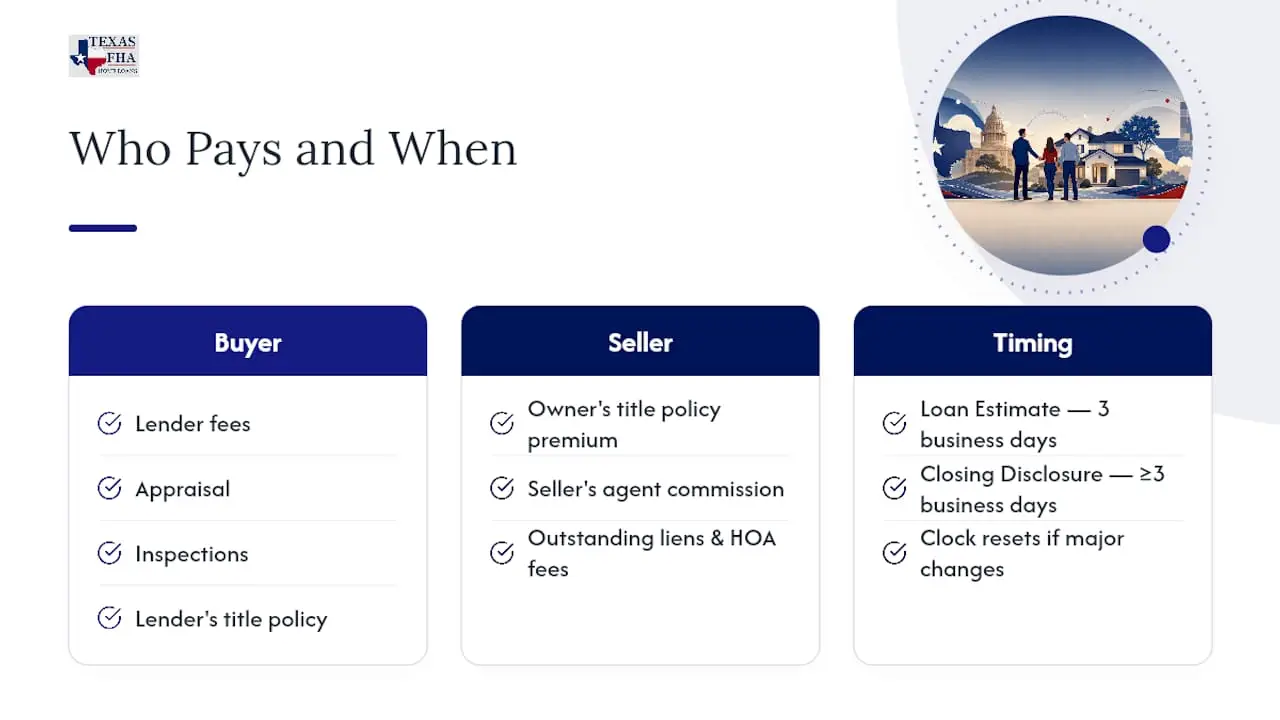
Buyers and sellers split closing costs by category, and Texas custom follows fairly predictable lines even though everything is technically negotiable in the contract. Buyers typically cover lender fees, appraisal, inspections, the lender’s title policy, prepaid taxes and insurance, and recording fees tied to their loan documents. Sellers typically cover the owner’s title policy premium, their own agent’s commission, and any outstanding liens or HOA fees discovered during the title search.
Timing is where federal rules step in. Your lender must send a Loan Estimate within three business days of receiving your completed application, giving you a first look at projected costs before you’re locked into anything. That document isn’t final. It’s a good-faith projection based on the information available at that point.
The Closing Disclosure arrives later and carries more weight: federal rules require it at least three business days before your scheduled closing date, and it reflects the actual negotiated numbers. If your loan amount, rate, or certain fees differ by more than small tolerances between these two documents, that three-day clock resets, pushing your closing date back. This is exactly why reading your Closing Disclosure the moment it arrives matters more than most buyers realize. It’s your last real window to catch an error or an unexpected charge before you’re at the table signing.
What Do Sellers Typically Pay in Closing Costs?
Seller closing costs in Texas tend to be higher as a percentage than buyer costs, largely due to the real estate agent commission. Commission generally represents the largest portion of the seller’s closing expenses.
Beyond commission, sellers typically pay the owner’s title insurance premium (again, set by the same state-promulgated schedule that applies to the lender’s policy), their prorated share of property taxes up to the closing date, any HOA transfer or resale certificate fees, and payoff costs on their existing mortgage if one exists. Sellers may also agree to cover a portion of the buyer’s closing costs as a negotiated concession, which appears as a credit on the Closing Disclosure rather than as a separate seller expense category.
On a $350,000 sale, a seller might reasonably expect total costs of $21,000 to $28,000, including commission. That’s a useful comparison point for buyers, since it explains why sellers are sometimes reluctant to also absorb a large buyer credit request on top of their own six-figure cost load.
What Exactly Are You Paying For in Lender Fees?
Lender fees get lumped together on a Loan Estimate, but they cover three distinct services, and understanding each one helps you spot an outlier when comparing quotes from different lenders.
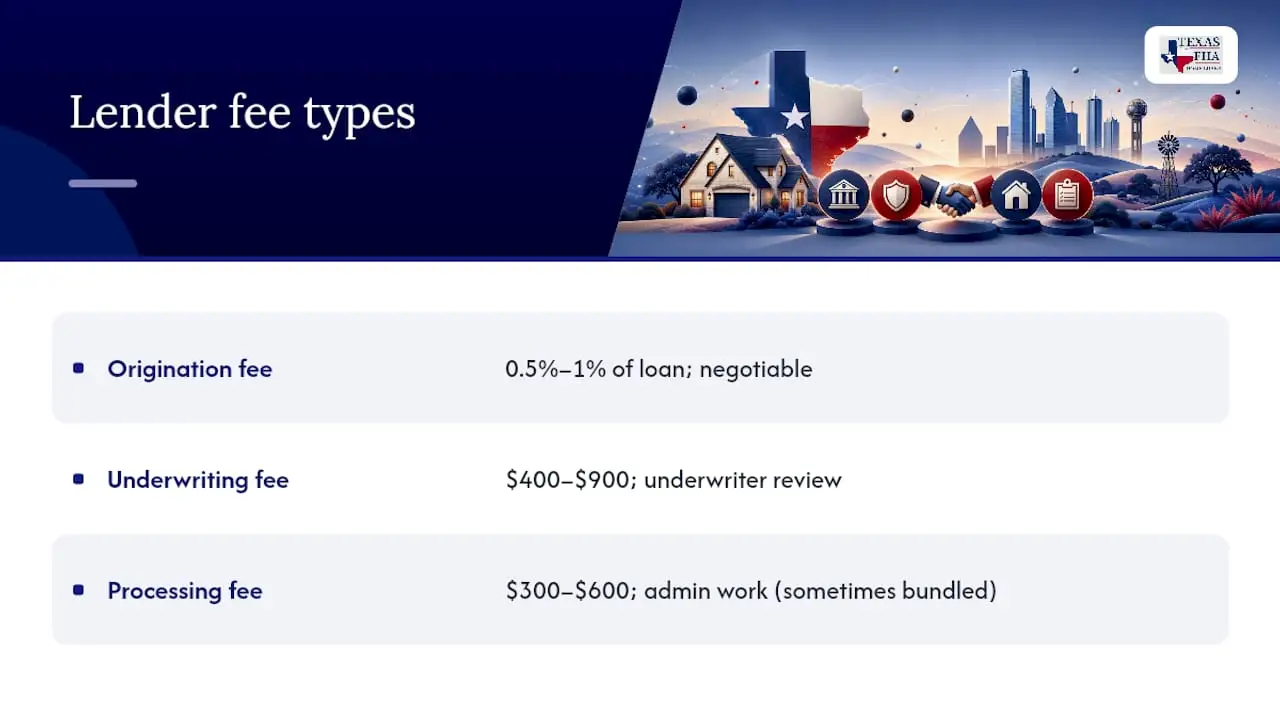
The origination fee compensates the lender for creating and processing your loan and is typically priced as a percentage of the loan amount, often around 0.5% to 1%. It’s the single largest lender-charged fee and one of the more negotiable fees, especially when comparing offers from multiple lenders.
Underwriting fees, usually $400 to $900, cover the cost of the underwriter who reviews your income, assets, credit, and the property itself to confirm the loan meets program guidelines. This isn’t a rubber-stamp process. FHA, conventional, and VA loans each have different underwriting standards, which is why FHA loans can be more forgiving of lower credit scores while still requiring thorough documentation.
Processing fees, typically $300 to $600, cover the administrative work of collecting documents, ordering verifications, and moving your file through each stage. Some lenders bundle processing into the origination fee rather than listing it separately, so don’t assume a lender with a lower origination percentage is automatically cheaper until you compare the full lender fee total on the Loan Estimate.
How Long Does Closing Take in Texas, and When Are Fees Due?
Texas closings typically take 30 to 45 days from contract execution to keys in hand, though FHA and VA loans can run closer to the 45-day mark due to additional appraisal and underwriting steps. Cash purchases can close in under two weeks.
Most fees aren’t due in a lump sum until closing day itself, but a few arrive earlier. Your appraisal fee and inspection fee are typically paid out of pocket within the first one to two weeks after your contract is signed. Your earnest money deposit, usually 1% to 2% of the purchase price, is due within a few days of contract execution and gets credited toward your total at closing. Everything else, including lender fees, title premiums, and prepaid escrow items, gets settled in a single cash-to-close figure on your Closing Disclosure, due at or before your closing appointment depending on your title company’s requirements.
A Publisher’s Note on Managing Closing Costs
TexasFHA focuses specifically on first-time Texas buyers navigating FHA loans, and closing costs are where confusion runs highest. A personalized cash-to-close estimate from a specialist beats any generic calculator. As a Full Eagle FHA-approved lender, we build that estimate around your actual numbers, not statewide averages.
— Gerry Nicodemus
Get a Personalized Closing Cost Estimate
Generic ranges get you in the ballpark. A personalized Loan Estimate gets you the real number. We can produce a customized cash-to-close worksheet based on your actual purchase price, county, and loan program, rather than a statewide average.
If you’re weighing FHA against conventional financing, our breakdown of FHA versus conventional loan costs shows how each program treats prepaids differently. First-time buyers can start with our step-by-step buying guide to understand qualification alongside cost planning. When you’re ready to see real numbers instead of estimates, request a rate quote or review FHA loan requirements to see where you stand today.
This article is general information, not a substitute for advice from a qualified financial advisor. Consult a qualified financial professional about your own circumstances before acting on anything here.
Recommended
- FHA Closing Costs: Your Guide to FHA Loans | What You Need to Pay For
- FHA Loan Limits and Market Shifts to Watch in Texas This October
- Exploring Texas FHA Loans for Aspiring Homeowners in the Lone Star State
- How Texans Can Lock in Lower FHA Rates Before the Year Ends

Over 25 years of experience in the Mortgage business. A Digital Marketer specializing in Conversion Rate Optimization, Search Engine Optimization, and Artificial Intelligence Overview Optimization for the Mortgage and Real Estate industry.