

An FHA non-occupant co-borrower is usually a parent or other relative who signs on to your FHA loan to help you qualify but won’t live in the home. More Texas families are looking at this as prices and payments stretch first-time buyers. Before a parent joins your loan, it helps to know what FHA requires, how a co-borrower differs from a co-signer or a gift, what it means for the parent’s own finances, and how it can affect your Texas homestead exemption.
TL;DR:
- FHA lets a borrower who won’t live in the home join the loan, as long as at least one borrower moves in within 60 days and plans to stay at least a year.
- A non-occupant co-borrower goes on the title, signs the Note and signs the security instrument. A co-signer signs the Note but doesn’t own the home. A gift giver isn’t on the loan at all.
- Every borrower’s credit is reviewed, and FHA uses the lowest decision credit score in the group.
- Family members can get FHA’s standard maximum financing. Non-relatives, 2-4 unit homes and purchases where the non-occupant co-borrower is buying from a family member face a much lower limit.
- In Texas, a parent on the deed who lives elsewhere can shrink the homestead exemption on the home.
Table of Contents
- Why Are More Families Buying Together?
- What Is an FHA Non-Occupant Co-Borrower?
- How Is a Co-Borrower Different From a Co-Signer or a Gift?
- What FHA Rules Apply When a Parent Joins the Loan?
- What Does Co-Borrowing Mean for the Parent’s Own Finances?
- How Can a Co-Borrower Affect Your Texas Homestead Exemption?
- Questions to Ask Your Mortgage Broker
- Buying With a Parent: Do’s and Don’ts
- Talk Through Your Options
- Sources
Why Are More Families Buying Together?
Parents are increasingly lending their income and credit, not just cash. Yahoo Finance reported on October 27 that a Rocket analysis of public mortgage data found the share of buyers under 35 who bought with a co-applicant over 55 rose 21% from 2018 to 2025. About 1 in 30 purchases, or 3.3%, now include an older co-applicant, likely a parent or other relative, while home purchases by buyers under 35 were down 15% from 2018 levels.
A day later, USA Today reported that parents without cash on hand are “increasingly offering their credit.” The experts it quoted shared the same message: the parent on the loan is responsible for the full amount, it can affect the parent’s ability to borrow later, and the family needs an exit plan before anyone signs.
FHA allows this kind of family help, but its rules on who signs, who owns, and how much can be financed are specific.
What Is an FHA Non-Occupant Co-Borrower?
It’s a borrower on your FHA loan who won’t make the home their principal residence. HUD’s Single Family Housing Policy Handbook 4000.1 still requires at least one borrower to move in within 60 days of signing the security instrument and to intend to live there for at least one year. In a parent-and-child purchase, that’s usually the child. Our post on FHA occupancy requirements covers the move-in rules in more detail.
HUD requires all occupying and non-occupying borrowers and co-borrowers to take title to the property in their own name (or a living trust) at closing, be obligated on the Not,e and sign all security instruments. In plain terms, a parent who co-borrows becomes a co-owner of the home and is responsible for the entire debt.
HUD’s definition of a family member is broad. It includes a child, parent, or grandparent (including step- and foster relationships); a spouse or domestic partner; an adopted or foster child; a brother or sister (including step-siblings); an uncle or aunt; and in-laws.
How Is a Co-Borrower Different From a Co-Signer or a Gift?
People often use these terms loosely, but FHA treats them differently:
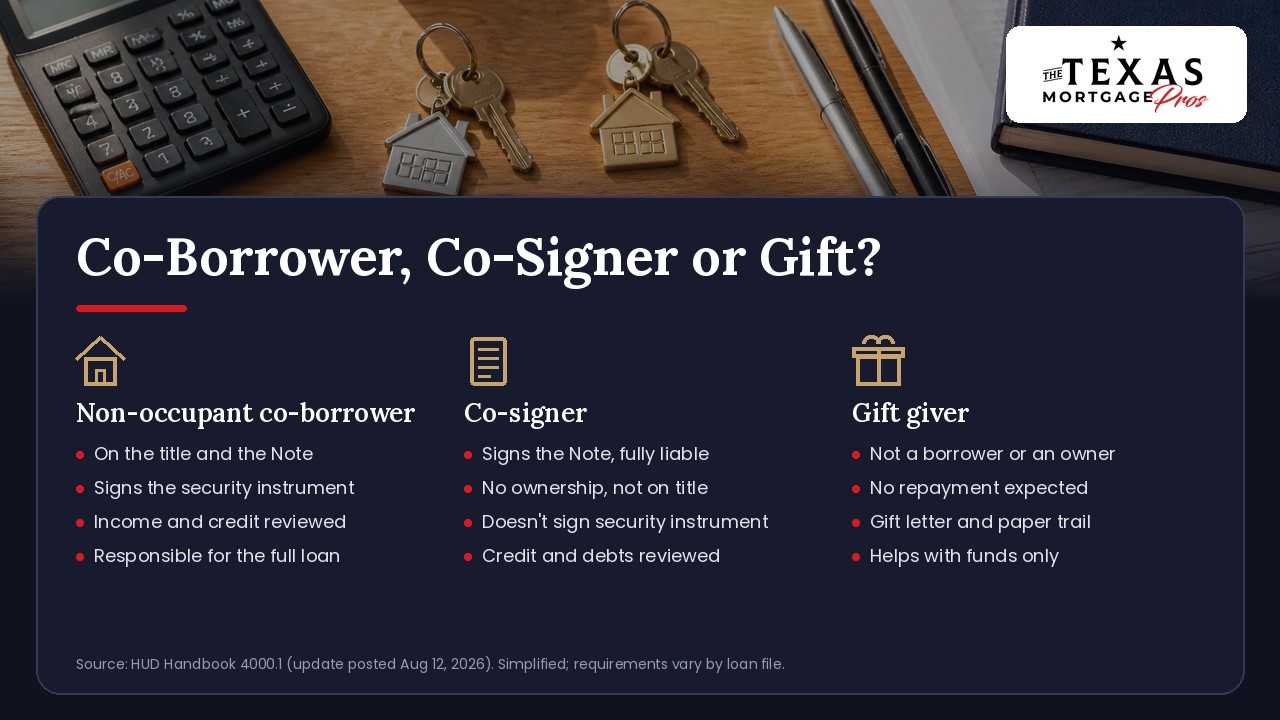
- Non-occupant co-borrower: on the title, obligated on the Note, and signs the security instrument. The loan file includes their income, assets, debts, and credit.
- Co-signer: signs the Note and is liable for the debt, but has no ownership interest in the home and does not sign the security instrument.
- Gift giver: provides money with no expectation of repayment. A gift giver isn’t a borrower or an owner, and the gift needs a gift letter and a paper trail. Our guide to FHA gift funds in Texas covers the documentation.
Some families combine different kinds of help, such as one parent co-borrowing and a grandparent giving a gift. The real question isn’t only “Can Mom or Dad help?” but “Do we want them to own part of the home, owe the whole debt, or both?” Your mortgage broker can explain the loan roles, and an attorney or tax professional can help with ownership and tax questions.
What FHA Rules Apply When a Parent Joins the Loan?
Residency. A non-occupying co-borrower or co-signer must be a U.S. citizen or have a principal residence in the United States.
Credit. The mortgage company pulls a credit report for each borrower, and FHA uses the lowest decision credit score among all the borrowers. A parent’s high income doesn’t erase a weak score elsewhere in the file, and a parent’s lower score can become the one that counts. FHA’s October 8 Mortgagee Letter 2026-11 updates how it chooses that score when newer credit score models are used, starting with case numbers assigned on or after January 1, 2027, but it still uses the lowest score among all borrowers. Our post on mortgage credit score changes explains the new models.
Income. A co-borrower’s income can help your debt-to-income ratios, but their debts come with them. There’s one exception: when a loan is manually underwritten for borrowers with no credit score, HUD says the ratios use income only from borrowers who will live in the home, so you can’t count a non-occupant co-borrower’s income.
Maximum financing. When the non-occupant co-borrower is a family member, FHA allows its standard maximum financing. When the co-borrower isn’t a family member, FHA’s maximum is much lower, so the buyers would need a much larger down payment. The family-member allowance doesn’t apply to a two- to four-unit property, or when a family member sells the home to a relative who will be the non-occupying co-borrower (for example, a grandparent selling to the parent who co-borrows). If you’re buying from a relative, our post on FHA identity of interest explains the related rules.
No interested parties. Someone with a financial interest in the sale, such as the seller, build,er or real estate agent, may not be a co-borrower or co-signer. HUD says exceptions may be granted when that person is a family member, so disclose every relationship early.
Married parents in Texas. Texas is a community property state. If a married parent co-borrows without their spouse, HUD requires the non-borrowing spouse’s debts to be included in the qualifying ratios unless state law specifically excludes them, though the spouse’s credit history isn’t a reason to deny the application.
What Does Co-Borrowing Mean for the Parent’s Own Finances?

A co-borrowing parent owes the full loan, not half of it. “It also means each person is responsible for the full loan amount,” Rocket Mortgage’s Bill Banfield told USA Today. A late payment can also show up on the parent’s credit.
The loan can also follow the parent into their next mortgage. Under HUD’s contingent-liability rules, an FHA mortgage company must count a debt the borrower could have to repay if the other legally obligated person defaults, unless it documents that the creditor can’t pursue the borrower or that the other person has made 12 months of timely payments. USA Today quoted Melissa Cohn of William Raveis Mortgage making the same point: a parent seeking a new mortgage will generally need to show the child made 12 consecutive on-time payments to exclude that payment. Other loan programs set their own rules.
Plan the exit, too. “Getting off the loan usually means your child has to refinance on their own, so talk through the exit plan before you sign,” real estate executive Mary Lee Blaylock told USA Today. A future refinance isn’t guaranteed. It depends on your income, credit, the home’s value, and the options available at the time.
How Can a Co-Borrower Affect Your Texas Homestead Exemption?
Because FHA requires a co-borrower to take title, a parent who co-borrows ends up on the deed. In Texas, that can reduce your homestead exemption. Under Texas Tax Code Section 11.41, when a person who qualifies for an exemption isn’t the sole owner, the exemption is multiplied by that person’s share of the property. Community ownership between spouses is treated as full ownership by the qualifying spouse.
The Bexar Central Appraisal District lists “a parent and child co-own a home, but only one lives there” as a common case. If you own half the home and your parent lives elsewhere, the exemption may apply to only your half of the value. Before closing, ask the title company how title will be held and check with your county appraisal district about the exemption. Our post on Texas property taxes and your mortgage payment explains why the exemption matters.
Questions to Ask Your Mortgage Broker
Bring both of your credit and income details to the first conversation:
- Should my parent be a co-borrower, a co-signer, or a gift giver in our situation?
- Whose credit score will FHA use, and how do my parent’s debts affect our ratios?
- Does our property type or a family sale change the maximum FHA financing?
- Will my parent’s income count if any of us has no credit score?
- My parent is married. How will their spouse’s debts be handled in Texas?
- What will my parent need to sign at closing, and how will title be held?
- How could this loan affect my parent’s next mortgage?
Before you shop, our guide to mortgage pre-approval in Texas covers what to have ready.
Buying With a Parent: Do’s and Don’ts
Do:
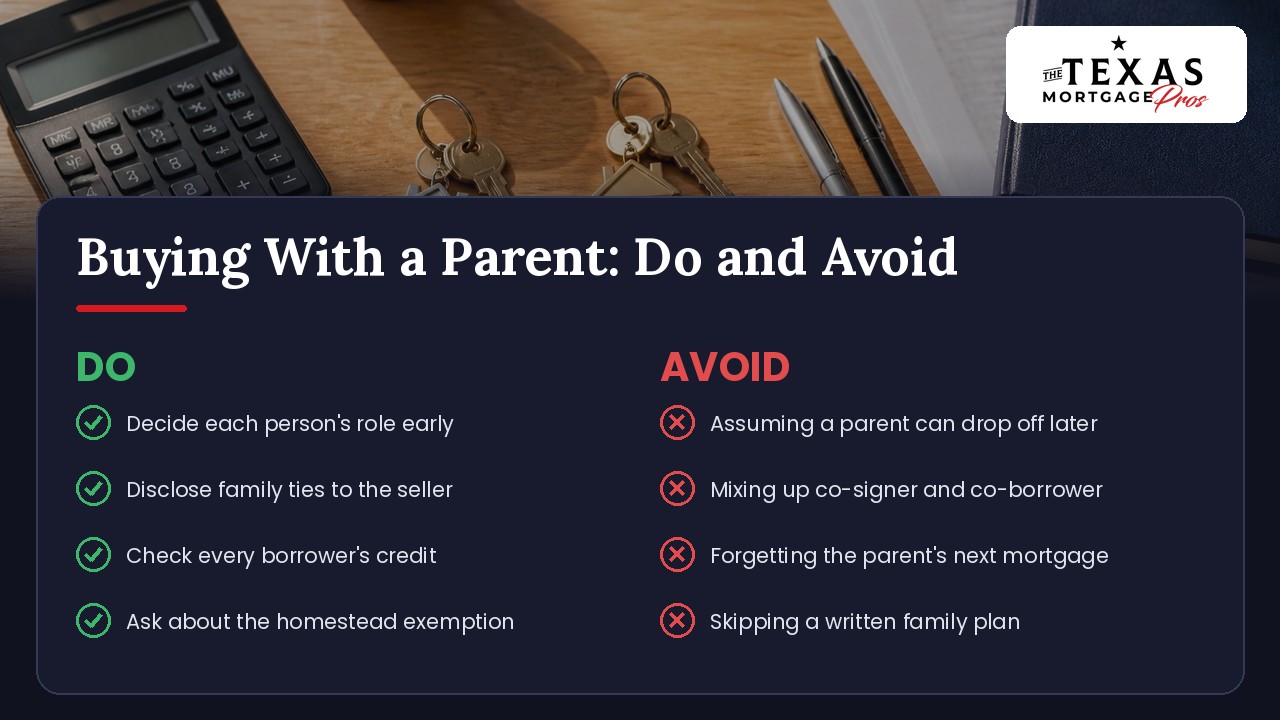
- Decide each person’s role early: co-borrower, co-signer, gift giver, or a mix.
- Disclose family ties to the seller, builder, or real estate agent up front.
- Check every borrower’s credit before you apply, since the lowest score counts.
- Ask your county appraisal district about the homestead exemption before closing.
Avoid:
- Assuming a parent can drop off later. Removing a co-borrower usually takes a refinance.
- Mixing up co-signer and co-borrower. One owns part of the home; the other doesn’t.
- Forgetting the parent’s next mortgage. Your loan may count in their ratios.
- Skipping a written family plan. Put who pays what, and what happens if plans change, in writing.
— Gerry Nicodemus
Talk Through Your Options
An FHA non-occupant co-borrower can help a family buy a first home, but it works best when everyone understands that helping you qualify also means shared ownership and shared responsibility. If you’re thinking about buying with a parent or relative, call (281) 801-6965 to talk with a mortgage professional at The Texas Mortgage Pros, a mortgage broker. You can also review our FHA loan requirements, get FHA pre-qualified, or contact us online.
TexasFHA.org is not affiliated with, endorsed by, or sponsored by HUD, FHA, the State of Texas, the Bexar Central Appraisal District, Rocket Mortgage, William Raveis Mortgage, Yahoo Finance, USA Today, or any other organization or government agency named in this article. Third-party names are used only to cite their published information.
The Texas Mortgage Pros, LLC | Company NMLS #2665861 | Gerry Nicodemus, NMLS #286371 | Equal Housing Opportunity | www.nmlsconsumeraccess.org | (281) 801-6965
Sources
Each source below is linked once in the article above.
- Yahoo Finance, Claire Boston, More young people are buying houses by putting older co-borrowers on their mortgages (October 27, 2026)
- USA Today, Medora Lee, How parent co-applicants keep the American dream alive (October 28, 2026)
- U.S. Department of Housing and Urban Development, Single Family Housing Policy Handbook 4000.1 (Borrower Eligibility and Co-Borrower Ownership, Co-signer and U.S. Residence Requirements, II.A.1.b.ii; Principal Residence, II.A.1.b.iii; LTV Limitations Based on Non-Occupying Borrower Status, II.A.2.b.ii(B); Non-Borrowing Spouse Debt and Contingent Liabilities, II.A.4.b.iv; Manual Underwriting Ratios, II.A.5; update posted August 12, 2026), and FHA Mortgagee Letter 2026-11 (October 8, 2026)
- Texas Legislature, Texas Tax Code Section 11.41, Partial Ownership of Exempt Property
- Bexar Central Appraisal District, How Multiple Owners of One Property Can Affect Your Homestead Exemption
Recommended
- FHA Occupancy Requirements: Rules Every Buyer Must Know
- FHA Gift Funds in Texas
- FHA Income Requirements: What Texas Buyers Need to Qualify

Gerry Nicodemus (NMLS #286371) is a licensed Texas loan originator with more than 25 years of mortgage experience. He specializes in FHA loans and explains credit, down payment, gift fund, and appraisal rules in plain English so Texas buyers know exactly where they stand. Gerry is also a digital marketer who builds agentic AI systems that help mortgage and real estate professionals get found online and serve borrowers better.