

To qualify for a reverse mortgage in Texas, you must be at least 62 years old, own and occupy the home as your principal residence, complete mandatory HUD-approved counseling, and demonstrate the ability to stay current on property taxes, homeowners insurance, and basic maintenance. Most Texas seniors will pursue a Home Equity Conversion Mortgage (HECM), the federally insured product backed by the FHA and governed by HUD guidelines. Texas adds its own layer of rules through Article XVI, Section 50 of the Texas Constitution and the Texas Department of Insurance’s Reverse Mortgage Endorsement (Form T-43), making the state’s framework slightly more specific than the federal baseline.
Here are the non-negotiable requirements at a glance:
- Age: You must be 62 or older. If there is a co-borrower or eligible non-borrowing spouse, the youngest borrower’s age drives the calculation.
- Ownership and equity: You must own the home outright or have enough equity to pay off any existing mortgage balance at closing.
- Primary residence: The home must be your principal residence. You cannot use a vacation property or investment home.
- HUD-approved counseling: Completing a session with a HUD-approved housing counselor is required before any HECM application moves forward.
- Ongoing obligations: You must be able to pay property taxes, homeowners insurance, and maintain the property. Failure to do so is the most common reason reverse mortgages go into default.
The Consumer Financial Protection Bureau (CFPB) and the Federal Trade Commission (FTC) both publish consumer-protection guidance on reverse mortgages, and the Texas Department of Insurance oversees title insurance rules specific to these loans in Texas.
Table of Contents
- What are the reverse mortgage requirements in Texas?
- Which reverse mortgage products are available in Texas?
- How do Texas-specific laws affect your reverse mortgage?
- What does a reverse mortgage cost in Texas, and how much can you borrow?
- What is the step-by-step process for getting a reverse mortgage in Texas?
- What are your ongoing obligations, and what happens when the loan comes due?
- What disqualifies applicants, and what red flags should you watch for?
- Key Takeaways
- What Texas seniors often get wrong about reverse mortgages
- TexasFHA helps Texas seniors prepare and apply with confidence
- Authoritative sources and HUD-approved counseling resources for Texas borrowers
What are the reverse mortgage requirements in Texas?
Eligibility for a reverse mortgage in Texas covers several distinct categories, and each one has real consequences if it is not met. Understanding them before you apply saves time and prevents surprises at closing.
Age and co-borrower rules
The minimum age is 62, and it applies to every borrower on the loan. When two spouses are both 62 or older, both can be listed as co-borrowers, which provides stronger protections. If one spouse is under 62, that person cannot be a co-borrower but may qualify as an eligible non-borrowing spouse under HUD rules, which allows them to remain in the home after the borrowing spouse dies or moves to a care facility, provided they continue meeting occupancy and obligation requirements.

Ownership and existing mortgage payoff
You do not need to own the home free and clear, but you must have enough equity to pay off any existing mortgage, home equity loan, or other lien at closing. The reverse mortgage proceeds can cover that payoff, but if the balance owed exceeds what the HECM will provide, you would need to bring cash to closing. Subordinate liens must also be cleared before the loan closes.
Occupancy and principal residence
The home must be your primary residence, meaning you live there the majority of the year. Lenders typically require an annual occupancy certification. You can travel or spend time away, but if you are absent for 12 consecutive months, the loan becomes due and payable. A move to an assisted living facility or nursing home for more than 12 months also triggers repayment.
Property eligibility
Not every property qualifies. Eligible types include:
- Single-family homes
- Two-to-four unit properties where the borrower occupies one unit
- HUD-approved condominiums
- Manufactured homes that meet FHA standards (built after June 15, 1976, on a permanent foundation)
The property must also meet FHA minimum property standards. If an appraisal reveals required repairs, those typically must be completed before the loan closes, or the lender may set aside funds to cover them.
Properties held in trusts
If your home is held in a living trust, it can still be eligible, but the trust must meet HUD requirements. HUD cautions that adding an heir to the title while the loan is active can create complications, including potentially voiding the post-death 95% payoff protection that heirs would otherwise receive.
Documents you will need
Lenders will ask for a standard set of documents when you apply:
- Government-issued photo ID and Social Security card
- Deed or title documentation
- Recent mortgage statements (if a balance remains)
- Proof of homeowners insurance and property tax payment history
- Recent bank statements and income documentation
- Social Security award letter or other benefit statements
Pro Tip: Gather your property tax payment history for the past two years before your counseling session. Counselors use tools like FIT (Financial Interview Tool) and BudgetCheckUp to assess whether you can realistically maintain ongoing obligations, and having that documentation ready makes the session more productive.
Which reverse mortgage products are available in Texas?
Texas seniors have access to several types of reverse mortgages, though the vast majority of transactions involve the HECM. Understanding the differences helps you ask the right questions.
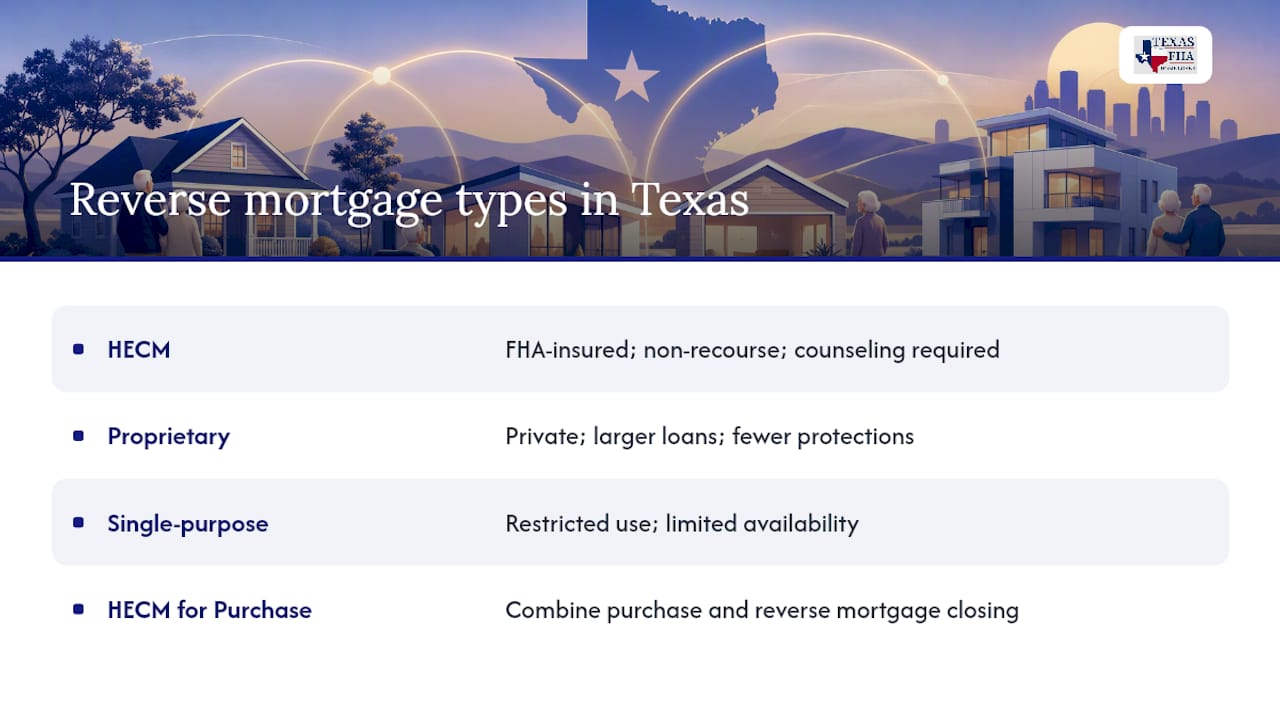
HECM (Home Equity Conversion Mortgage): The most common product, federally insured by the FHA and governed by HUD’s HECM guidelines. HECMs carry the strongest borrower protections, including the non-recourse feature (you or your heirs will never owe more than the home is worth at the time of sale) and the 95% payoff rule for heirs. Counseling is required as mandated by HUD. Loan limits are set by FHA annually.
Proprietary reverse mortgages: Private products not insured by the FHA, typically designed for higher-value homes that exceed the HECM loan limit. They may offer larger loan amounts but carry fewer federal protections. Counseling requirements vary by lender and state.
Single-purpose reverse mortgages: Offered by some state and local government agencies or nonprofits for a specific, lender-approved purpose such as home repairs or property tax payments. These tend to have lower costs but limited availability and restricted use of funds.
HECM for Purchase: Allows borrowers 62 or older to buy a new primary residence using a reverse mortgage in a single transaction, combining the purchase and the reverse mortgage closing. This can be useful for downsizing or relocating without taking on a monthly mortgage payment.
For most Texas homeowners, the HECM is the product they will encounter. Its federal insurance, standardized counseling requirement, and non-recourse protection make it the most transparent and well-regulated option available.
How do Texas-specific laws affect your reverse mortgage?
Texas has a distinct legal history around home equity lending, and that history directly shapes how reverse mortgages work here.
Section 50, Article XVI of the Texas Constitution
Texas homestead protections are among the strongest in the country. For decades, Texas law restricted home equity lending in ways that made certain reverse mortgage structures legally uncertain. The passage of a constitutional amendment to Article XVI, Section 50 resolved this by explicitly authorizing home equity line-of-credit advances under reverse mortgages on Texas homesteads. This matters because many HECM borrowers choose a line-of-credit disbursement option, and that option’s legal validity in Texas rests on this constitutional authority.
The T-43 title endorsement
The Texas Department of Insurance adopted the Reverse Mortgage Endorsement (Form T-43) to reflect the constitutional changes and standardize how title insurance companies handle reverse mortgage transactions in the state. When you close a reverse mortgage in Texas, your title insurance policy will include this endorsement. It protects both the lender and the borrower by confirming the lien’s validity under Texas law.
How federal and state rules interact
Federal HECM protections, including the non-recourse feature and FHA mortgage insurance, apply in Texas just as they do in every other state. The Texas-specific layer adds homestead protections and title insurance requirements on top of those federal rules. In practice, this means your closing will involve both federal HECM disclosures and Texas-specific title documentation. Confirm with your lender and title company that the T-43 endorsement is included in your closing package.
Pro Tip: If your home is held in a living trust or you are considering adding a family member to the title, consult a Texas real estate attorney before closing. Changes to title while a HECM is active can affect your heirs’ ability to use the 95% payoff option after your death.
What does a reverse mortgage cost in Texas, and how much can you borrow?
Costs and loan amounts are two of the most common questions Texas seniors have, and both depend on factors specific to your situation.
What determines how much you can borrow?
The principal limit, which is the maximum amount you can access, is set by three factors:
| Factor | How it affects the principal limit |
|---|---|
| Borrower age | Older borrowers receive a higher principal limit for the same home value |
| Appraised home value | Higher value increases the available limit, up to the FHA loan limit |
| Current interest rates | Lower rates increase the principal limit; higher rates reduce it |
| FHA loan limit | Sets the maximum appraised value the calculation uses |
As a practical illustration: a 75-year-old borrower with a $400,000 home will generally access a larger percentage of that value than a 63-year-old with the same home, because the older borrower’s shorter expected loan term reduces the lender’s risk. The Texas Real Estate Research Center frames HECMs as a product where the principal limit reflects actuarial assumptions about how long the loan will remain outstanding.
Pro Tip: Use the TexasFHA reverse mortgage calculator to run scenarios with different ages, home values, and interest rate assumptions before you speak with a lender. Seeing the numbers in advance helps you evaluate whether the available amount meets your financial goals.
What is the step-by-step process for getting a reverse mortgage in Texas?
The process from first inquiry to loan closing typically takes 30–60 days, depending on how quickly documentation is gathered and whether property repairs are needed.
- Complete HUD-approved counseling. This is the required first step for any HECM. A HUD-approved counselor will review your financial situation, explain loan options, discuss alternatives, and provide a certificate of counseling. Counselors use tools like FIT and BudgetCheckUp to assess your ability to meet ongoing obligations. Find a counselor through the HUD HECM resources page or by calling HUD’s housing counseling line.
- Choose a lender and submit your application. With your counseling certificate in hand, you can formally apply. Bring your ID, deed, mortgage statements, tax and insurance records, bank statements, and benefit documentation.
- FHA appraisal. An FHA-approved appraiser will assess the home’s value and condition. If repairs are required to meet FHA minimum property standards, they must be completed before closing or funded through a repair set-aside.
- Underwriting. The lender reviews your financial assessment, which examines your history of paying property taxes and homeowners insurance. If the assessment reveals a pattern of non-payment, the lender may require a Life Expectancy Set-Aside (LESA), which reserves a portion of the loan proceeds to cover future taxes and insurance.
- Closing. You will sign the loan documents, including Texas-specific disclosures and the T-43 title endorsement. There is a three-business-day right of rescission after closing for owner-occupied refinances.
- Disbursement. Choose how you receive funds:
- Lump sum (fixed-rate loans only)
- Line of credit (grows over time if unused)
- Monthly payments (tenure or term)
- A combination of line of credit and monthly payments
The HUD HECM counseling protocol covers each of these steps in detail and is the authoritative reference for what counselors are required to explain during your session.
For general FHA qualification documentation guidance, the TexasFHA qualification overview provides a useful parallel reference.
What are your ongoing obligations, and what happens when the loan comes due?
A reverse mortgage does not eliminate financial responsibility for the home. The obligations that remain are the most common source of problems for borrowers.
Foreclosure triggers
The loan becomes due and payable when:
- The last borrower dies
- The last borrower permanently moves out (including to a care facility for more than 12 consecutive months)
- The home is sold
- The borrower fails to meet ongoing obligations (taxes, insurance, maintenance)
Federal guidance consistently identifies failure to maintain taxes and insurance as the leading cause of reverse mortgage foreclosure while borrowers are still living in the home.
What happens after the borrower dies?
When the last borrower dies, heirs have 30 days from notification to decide how to handle the loan, with possible extensions of up to six months in some cases, according to CFPB guidance on heirs’ options. Their choices are:
- Sell the home and use the proceeds to repay the loan balance
- Refinance the balance into a traditional mortgage to keep the home
- Deed the property to the lender (deed instead of foreclosure)
If the home is worth less than the loan balance, FHA mortgage insurance covers the difference. Heirs will never owe more than the home’s appraised value at the time of sale.
The 95% rule
The 95% rule allows heirs to satisfy the HECM debt by paying the lesser of the outstanding loan balance or 95% of the home’s current appraised value. This protection applies when title transfers after the borrower’s death. However, if an heir is added to the title before the borrower dies, HUD may interpret that as a sale or conveyance, which can void the 95% option. This is a significant planning consideration for Texas homeowners who want to protect their heirs.
What disqualifies applicants, and what red flags should you watch for?
Consumer-protection red flags
The FTC warns consumers to watch for several warning signs when evaluating reverse mortgage offers:
Questions to ask any lender before proceeding:
- Are you a HUD-approved HECM lender?
- What is the total cost of the loan, including origination fees, MIP, and closing costs?
- Will you provide a Good Faith Estimate or Loan Estimate before I commit?
- How will a Life Expectancy Set-Aside affect my available proceeds?
- Can you explain the T-43 endorsement and how it applies to my closing?
A lender who cannot answer these questions clearly or who discourages you from completing HUD counseling is a lender to avoid.
Key Takeaways
To qualify for a reverse mortgage in Texas, you must be 62 or older, occupy the home as your primary residence, complete HUD-approved counseling, and maintain property taxes, insurance, and upkeep throughout the life of the loan.
| Point | Details |
|---|---|
| Age and occupancy are absolute | You must be 62+ and live in the home as your primary residence; no exceptions apply to either rule. |
| HUD counseling comes first | Complete a session with a HUD-approved counselor before submitting any HECM application. |
| Texas adds a legal layer | Article XVI, Section 50 and the T-43 title endorsement govern reverse mortgage lines of credit and title insurance in Texas. |
| The 95% rule protects heirs | Heirs can settle the HECM debt by paying the lesser of the loan balance or 95% of appraised value, but adding an heir to title before death can void this protection. |
| TexasFHA guides you through it | TexasFHA’s HECM specialists help Texas seniors assess eligibility, prepare documentation, and navigate the application from counseling to closing. |
What Texas seniors often get wrong about reverse mortgages
Most of the confusion I see around reverse mortgages in Texas comes from two misconceptions: that the loan is risk-free because no monthly payment is required, and that the process is simple enough to handle without preparation.
The no-payment feature is real, but it does not mean the loan is obligation-free. Property taxes in Texas are substantial, and a borrower who falls behind on them faces the same foreclosure risk as any other homeowner. The difference is that with a reverse mortgage, there is no monthly statement reminding you of what is owed. That invisibility is exactly what catches people off guard.
The second misconception is about preparation. Borrowers who arrive at the HUD counseling session without their tax payment history, insurance records, or a clear picture of their home’s current value tend to leave with more questions than answers. The counseling session is genuinely useful, but only if you treat it as a working meeting rather than a formality to check off.
Texas-specific rules add another layer that borrowers elsewhere do not face. The T-43 endorsement and the constitutional basis for reverse mortgage lines of credit are not just legal footnotes. They affect how your title is insured and how your heirs can handle the loan after your death. A lender who does not proactively explain these rules is not giving you the full picture.
The strongest protection a Texas senior has in this process is a HUD-approved counselor who explains alternatives and a lender who welcomes the questions that counseling raises. If either of those is missing, slow down.
TexasFHA helps Texas seniors prepare and apply with confidence
Qualifying for a reverse mortgage in Texas involves more moving parts than most seniors expect: federal HECM rules, Texas constitutional requirements, title endorsements, financial assessments, and a counseling step that sets the tone for everything that follows. TexasFHA’s reverse mortgage specialists work specifically with Texas homeowners 62 and older, guiding them from the first eligibility check through HUD counseling referrals, documentation preparation, appraisal coordination, and loan closing.
Before you contact a lender, gather these items: your government-issued ID, deed or title documents, two years of property tax payment records, current homeowners insurance declarations page, recent mortgage statements if a balance remains, and your most recent Social Security award letter or benefit statement. Having these ready means your first conversation with a specialist moves directly to your options rather than a document checklist.
TexasFHA is a Full Eagle FHA-approved lender with deep experience in Texas-specific HECM requirements, including the T-43 endorsement and the financial assessment process. To review eligibility criteria and start a conversation with a specialist, visit the TexasFHA loan requirements page.
Authoritative sources and HUD-approved counseling resources for Texas borrowers
Use these official resources to verify rules, find a counselor, and review the full HECM framework before you apply:
- 7610.0 HECM Protocol
- Home Equity Conversion Mortgage for Lenders (HECM)
- What is the 95% rule on a reverse mortgage? – CBS News
- With a reverse mortgage loan, can my heirs keep or sell my home after I die? – CFPB
- Reverse Mortgages – FTC Consumer Advice
- Texas Department of Insurance rule adoption — Reverse Mortgage Endorsement (T-43)
- Home Equity Conversion Mortgage (HECM) resources on HUD.gov
- Home . . . A Loan | Texas Real Estate Research Center
This article provides general information about reverse mortgage requirements in Texas and is not legal, financial, or tax advice. Rules and loan limits change periodically. Confirm current requirements with HUD, the Texas Department of Insurance, or a qualified mortgage professional before making any decisions.
Recommended
- Reverse Mortgage Calculator for Seniors: 2026 Guide
- News and Blog Articles Archives – Texas FHA Home Loans | First Time Buyer Loans
- Mortgage Pre-Approval in Texas: Your 2026 Buying Guide
- Best Mortgage Lender in Texas: 2026 Buyer’s Guide

Over 25 years of experience in the Mortgage business. A Digital Marketer specializing in Conversion Rate Optimization, Search Engine Optimization, and Artificial Intelligence Overview Optimization for the Mortgage and Real Estate industry.