

FHA residency requirements determine who can use an FHA loan, and they are stricter than many Texas buyers expect. You don’t have to be a U.S. citizen, but since May 2025, FHA only accepts U.S. citizens, lawful permanent residents, and citizens of three Pacific island nations. Starting December 3, HUD also plans to check borrowers’ Social Security numbers directly with the Social Security Administration, so it pays to have your documents in order before you make an offer.
TL;DR:
- FHA doesn’t require U.S. citizenship, but the borrower must be a U.S. citizen, a lawful permanent resident (green card holder) or a citizen of Micronesia, the Marshall Islands or Palau.
- Non-permanent residents, including people on work visas, are no longer eligible for FHA case numbers assigned on or after May 25, 2025.
- Each borrower generally needs a valid Social Security number, and a Social Security card alone doesn’t prove immigration or work status.
- A new HUD and Social Security Administration matching program is scheduled to start December 3, 2026, to verify borrowers’ SSNs.
- If FHA isn’t available, conventional or Non-QM programs may be worth asking about.
Table of Contents
- Why Are FHA Residency Rules in the News?
- What Are FHA Residency Requirements Today?
- What Changed in 2025 for Non-Permanent Residents?
- What Documents Prove Your Status?
- Why Does FHA Need a Social Security Number?
- Does Texas Law Limit Who Can Buy a Home?
- What Are the Options if FHA Isn’t Available?
- Questions to Ask Your Mortgage Broker
- Residency Documents Do’s and Don’ts
- Talk Through Your Options
- Sources
Why Are FHA Residency Rules in the News?
Two federal updates landed in the past few weeks. On November 3, HUD and the Social Security Administration published a Federal Register notice of a new computer matching program. Under it, HUD will send each consenting borrower’s name, Social Security number, and date of birth to the SSA, and the SSA will send back a match or no-match result. The notice says the program will apply starting December 3, 2026, will run for 18 months, and can cover borrowers, non-borrowing spouses, and others on the application whose information has to be verified.
Earlier, on October 9, HUD shared new data on the 2025 residency change, citing HousingWire’s reporting on Intercontinental Exchange (ICE) origination data. Before the change, non-permanent residents made up about 5.8% of FHA purchase originations. Afterward, their share fell to about 0.1%. Their share of purchase mortgages across all loan types dropped 2.2 percentage points to 3.4%, and the ICE data suggests conventional loans haven’t fully made up the difference.
For Texas families, the takeaway is simple: lenders now check residency status and SSN details closely, so sort them out at the start, not the week of closing.
What Are FHA Residency Requirements Today?
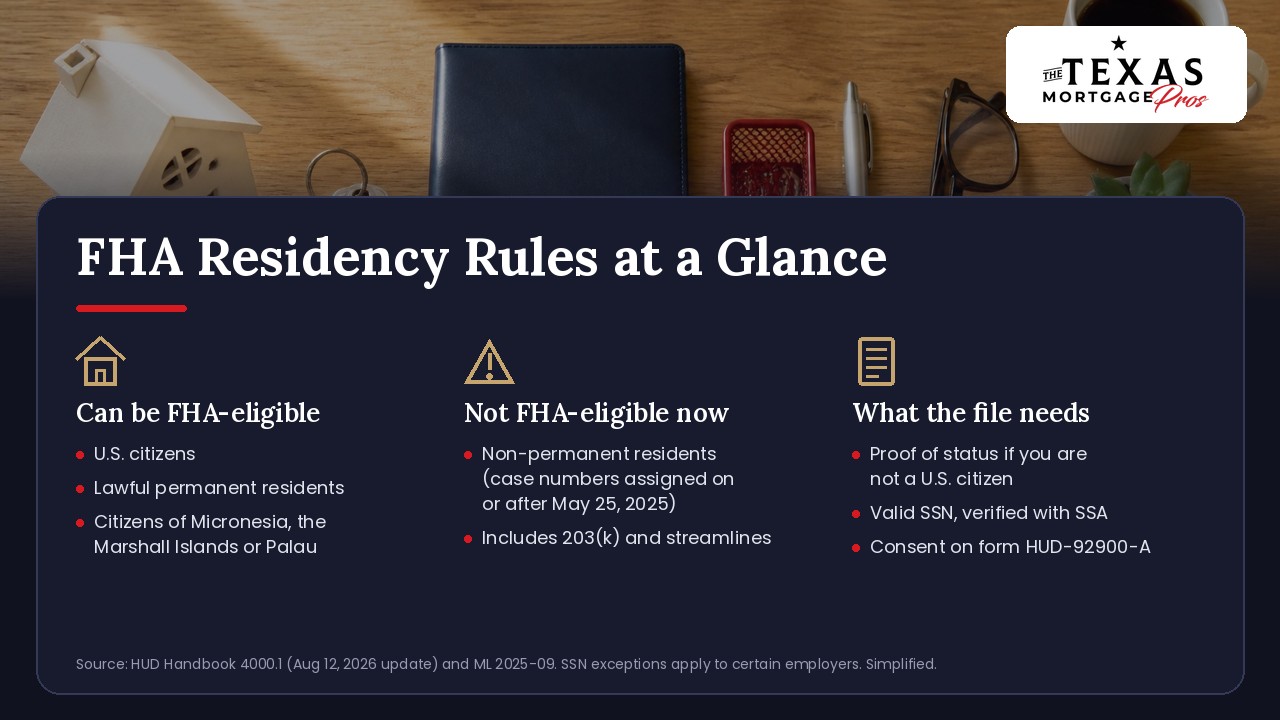
FHA’s rules are in HUD Handbook 4000.1. The handbook says plainly that U.S. citizenship is not required. The mortgage company must decide each borrower’s residency status from the loan application and supporting documents. Today, these borrowers can be eligible:
- U.S. citizens. You still have to meet FHA’s credit, income, property, and occupancy rules.
- Lawful permanent residents. Green card holders can be eligible under the same requirements, terms, and conditions as U.S. citizens. The loan file must include evidence of lawful permanent residence, and the loan application must show that status.
- Citizens of the Federated States of Micronesia, the Republic of the Marshall Islands, or the Republic of Palau. They are treated the same as U.S. citizens, with citizenship evidence in the file.
Co-borrowers count too. Every borrower on an FHA loan has to fit one of these categories, and a non-occupying co-borrower or co-signer must be a U.S. citizen or have a principal residence in the United States. If you’re thinking about buying with a parent, our guide to FHA non-occupant co-borrower rules covers the rest.
What Changed in 2025 for Non-Permanent Residents?
HUD’s Mortgagee Letter 2025-09 removed the non-permanent resident category from FHA’s rules. It applies to FHA case numbers assigned on or after May 25, 2025, across FHA’s forward mortgage programs and reverse mortgages (HECMs).
In practice, that means someone lawfully in the United States but without a green card, such as someone on a work visa, can’t get a new FHA-insured loan. The change applies to purchase loans, FHA 203(k) loans, and even non-credit-qualifying streamline refinances, which used to skip this review. If you already have an FHA loan and are considering an FHA streamline refinance, the citizenship and residency questions on the application now apply to you, too.
This is a loan program rule, not an immigration decision. If you aren’t sure which category you fall into, talk with an immigration attorney or a DOJ-accredited representative before you apply.
What Documents Prove Your Status?

HUD says U.S. Citizenship and Immigration Services (USCIS) provides evidence of lawful permanent resident status, and for most buyers that means the green card itself. A few situations come up often:
- An expired or expiring green card. USCIS says you must renew a green card that has expired or will expire within six months by filing Form I-90. While the renewal is pending, the I-90 receipt notice, together with the expired card, serves as evidence of your status for 36 months from the card’s expiration date.
- A two-year conditional green card. Conditional permanent residents file Form I-751 to remove the conditions before the card expires. Ask your mortgage broker early what the mortgage company will want to see if your card is close to its end date.
- Name changes. If your name differs across your green card, Social Security records, pay stubs, and tax returns, bring the marriage certificate or court order that connects them.
Bring originals or clear copies of current documents, answer the citizenship question on the application accurately, and never guess.
Why Does FHA Need a Social Security Number?
Under HUD’s handbook, each borrower must give the mortgage company evidence of a valid Social Security number. The mortgage company validates it through FHA’s system and compares it with your pay stubs, W-2s, tax returns obtained from the IRS, or other documents used to underwrite the loan. If the records show different numbers or don’t match, the mortgage company must resolve it with the SSA. You also sign a consent form (form HUD-92900-A, Part II) so the SSA can verify your number.
Two details trip people up:
- A Social Security card doesn’t prove status. HUD says it isn’t enough to show immigration or work status, so a green card holder still needs separate proof of permanent residence.
- The exceptions are narrow. People employed by the World Bank, a foreign embassy or an equivalent employer identified by HUD, state and local government agencies, instrumentalities of government, and HUD-approved nonprofits don’t have to provide an SSN. Ask before you assume one applies.
Texas is a community property state, so FHA generally counts the debts of a spouse who isn’t on the loan (except debts state law excludes) when it calculates your debt-to-income ratios. The new SSA notice also lists non-borrowing spouses among the people whose information can be verified, so make sure your spouse’s details are accurate too.
Does Texas Law Limit Who Can Buy a Home?
For most buyers, no. Texas Property Code Section 5.005 says a person who isn’t a U.S. citizen has the same property rights as a citizen, except as provided in a newer subchapter. That subchapter, added by Senate Bill 17 and in effect since September 1, 2025, limits purchases by certain governments, companies, and individuals tied to countries designated under the law. Texas Property Code Section 5.252 says those limits don’t apply to U.S. citizens or lawful permanent residents, and the law also exempts some people who are lawfully present and living in the U.S. from buying a home they will use as their homestead.
Under Texas law, being allowed to own property isn’t the same as qualifying for FHA. If you think SB 17 could apply to you, talk with a Texas real estate attorney before you sign a contract.
What Are the Options if FHA Isn’t Available?
Not qualifying for FHA doesn’t automatically mean you can’t buy. Fannie Mae’s Selling Guide (B2-2-02) says Fannie Mae buys loans made to lawful permanent and non-permanent residents on the same terms available to U.S. citizens, and the mortgage company decides what documentation shows the borrower is legally present. Loan officers quoted in HousingWire’s report said many non-permanent residents now use conventional loans or Non-QM programs. Non-QM documentation and terms vary by investor, so compare carefully. Our article on buying a house in the U.S. as a foreign national covers more of those paths.
Whichever route you take, start with a mortgage pre-approval in Texas to see which programs fit before you fall in love with a house.
Questions to Ask Your Mortgage Broker
Bring your ID, your residency documents, and your recent income paperwork to the conversation:
- Based on my documents, is FHA an option for me today?
- If not, which conventional or Non-QM programs should we look at?
- What proof of residency will the mortgage company need?
- Do my name, SSN, and date of birth match across my documents?
- My green card expires soon. What should I bring?
- Does my co-borrower meet the residency rules?
- What will you need from my spouse if they aren’t on the loan?
Residency Documents: Do’s and Don’ts
Do:
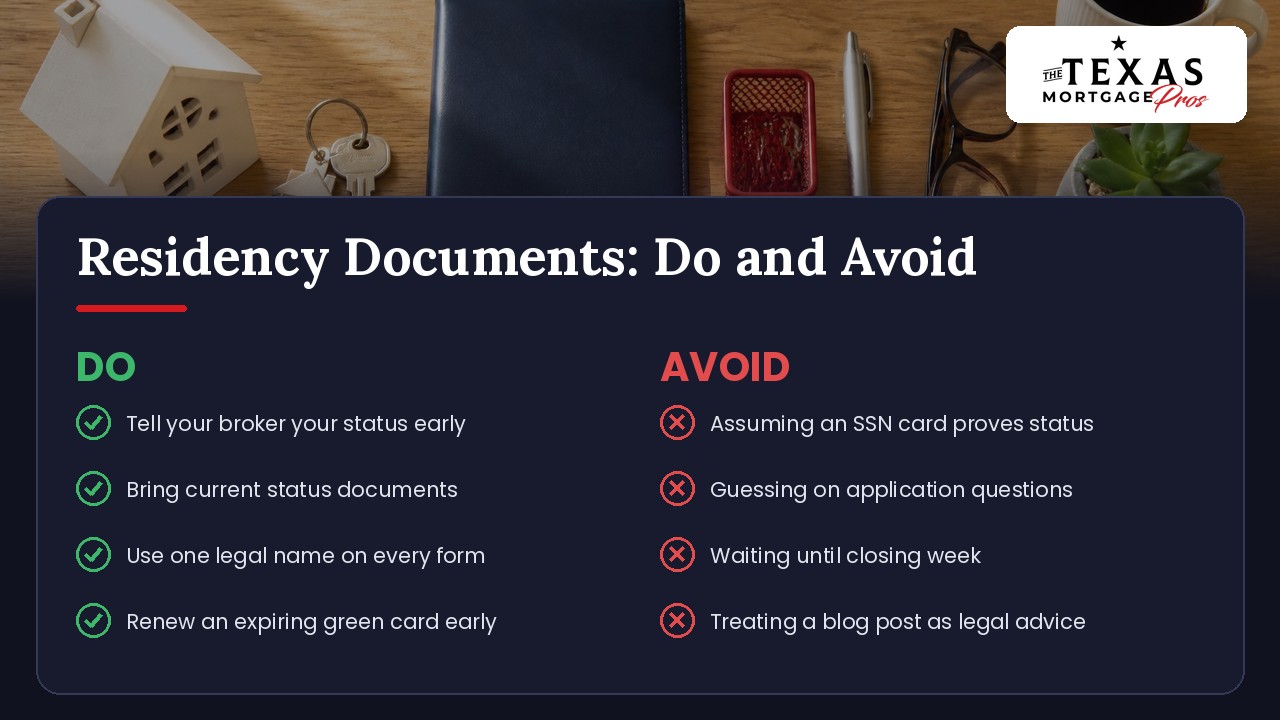
- Tell your broker your status early, before you shop for a home.
- Bring current status documents, such as your green card or USCIS receipt notice.
- Use one legal name on every form, and bring proof of any name change.
- Renew an expiring green card early, so the paperwork is ready when you need it.
Avoid:
- Assuming an SSN card proves status. HUD says it doesn’t.
- Guessing on application questions. Ask if you aren’t sure how to answer.
- Waiting until closing week. Document problems take time to fix.
- Treating a blog post as legal advice. Status questions belong with an immigration attorney.
— Gerry Nicodemus
Talk Through Your Options
FHA residency requirements are narrower than they were before May 2025, but U.S. citizens, green card holders, and citizens of Micronesia, the Marshall Islands, and Palau can still use FHA on the same terms. If you’re not sure where you stand, call (281) 801-6965 to talk with a mortgage professional at The Texas Mortgage Pros, a mortgage broker. You can also review our FHA loan requirements, get FHA pre-qualified, or contact us online.
TexasFHA.org is not affiliated with, endorsed by, or sponsored by HUD, FHA, the Social Security Administration, U.S. Citizenship and Immigration Services, Fannie Mae, Freddie Mac, Intercontinental Exchange, HousingWire, the Federal Register, the State of Texas, or any other organization or government agency named in this article. Third-party names are used only to cite their published information.
The Texas Mortgage Pros, LLC | Company NMLS #2665861 | Gerry Nicodemus, NMLS #286371 | Equal Housing Opportunity | www.nmlsconsumeraccess.org | (281) 801-6965
Sources
Each source below is linked once in the article above, except USCIS and Fannie Mae, which are cited by name only.
- Federal Register, Department of Housing and Urban Development, Privacy Act of 1974; Matching Program (91 FR 69268, Docket No. FR-7106-N-40, November 3, 2026)
- U.S. Department of Housing and Urban Development, ICYMI in HousingWire: HUD Action Ensures FHA Loans are for Americans Only (HUD No. 26-084, October 9, 2026), citing HousingWire and Intercontinental Exchange origination data
- U.S. Department of Housing and Urban Development, Single Family Housing Policy Handbook 4000.1 (Social Security Number, Principal Residence in the United States, Citizenship and Immigration Status and Residency Requirements, II.A.1.b.ii(A); Borrower’s Authorization, form HUD-92900-A; Non-Borrowing Spouse Debt in Community Property States; update posted August 12, 2026)
- U.S. Department of Housing and Urban Development, Mortgagee Letter 2025-09, Revisions to Residency Requirements (March 26, 2025)
- Texas Legislature, Texas Property Code Sections 5.005, 5.252 and 5.253 (Subchapter H, added by S.B. 17, effective September 1, 2025)
- U.S. Citizenship and Immigration Services, Replace Your Green Card (Form I-90 and Form I-751 guidance)
- Fannie Mae Selling Guide, B2-2-02, Non-U.S. Citizen Borrower Eligibility Requirements
Recommended
- FHA Non-Occupant Co-Borrower Rules: Buying With a Parent in Texas
- Mortgage Credit Score Changes: What Texas Buyers Should Know About VantageScore 4.0
- FHA Gift Funds in Texas: Rules for Using Family Money

Gerry Nicodemus (NMLS #286371) is a licensed Texas loan originator with more than 25 years of mortgage experience. He specializes in FHA loans and explains credit, down payment, gift fund, and appraisal rules in plain English so Texas buyers know exactly where they stand. Gerry is also a digital marketer who builds agentic AI systems that help mortgage and real estate professionals get found online and serve borrowers better.