

Yes. FHA lenders can count part-time income toward mortgage qualifying when that income is stable and reasonably likely to continue. HUD Handbook 4000.1 is the controlling standard that lenders use to make that call, and it hinges on documented history rather than the number of hours on your schedule. Before you get into the math, know that your file will typically include:
- Recent paystubs
- W-2 forms
- A written Verification of Employment (VOE)
- IRS transcript authorization forms
Key Takeaways
FHA loans can count part-time income as qualifying income when the work history spans two years and the job is reasonably likely to continue.
| Point | Details |
|---|---|
| Stability beats hours | FHA cares about continuity and likelihood of continuance, not whether a job is full-time or part-time. |
| Two-year averaging is standard | Lenders average part-time earnings over 24 months unless a documented permanent raise triggers the 12-month exception. |
| Documentation drives approval | Paystubs, two years of W-2s, a written VOE, and IRS transcript authorization form the core file. |
| Second jobs need history | Secondary W-2 income generally requires roughly 24 months of simultaneous employment to count. |
| Get a pre-submission review | TexasFHA specialists check your file against HUD Handbook 4000.1 before it reaches underwriting. |
Table of Contents
- FHA Part-Time Income Rules Under HUD Handbook 4000.1
- What Documents Do Lenders Need to Verify Part-Time Income?
- How Do Lenders Calculate Effective Income From Part-Time Pay?
- How Are Second Jobs, Recent Hires, and Seasonal Work Treated?
- How Does Part-Time Income Change Your DTI and Borrowing Power?
- How Can You Improve Your Chances of FHA Approval With Part-Time Income?
- How Does an FHA-Approved Lender Review Part-Time Income Files?
- Get Your Part-Time Income Reviewed Before You Apply
- Frequently Asked Questions
- Sources
FHA Part-Time Income Rules Under HUD Handbook 4000.1
HUD defines part-time employment generally as work under 40 hours per week, and the agency doesn’t penalize borrowers simply for working fewer hours. What matters is continuity. A mortgagee may use employment income from part-time work as Effective Income when the borrower has worked that job uninterrupted for two years and the position is reasonably likely to continue.
The core standard: lenders average part-time earnings over the trailing two years, unless a permanent pay increase is documented, in which case a 12-month average at the new rate may apply.
A few specifics worth flagging:
- Hourly employees with steady hours get calculated at their current rate.
- Employees with fluctuating hours may see averages calculated using pre-event and post-event comparisons under COVID-era exception language still referenced in the Handbook’s part-time employment sections.
- Update 15, issued in May 2024, refined definitions and documentation language lenders now follow.
What Documents Do Lenders Need to Verify Part-Time Income?
Your loan officer will build your file around a fairly predictable set of paperwork; see this guide on what documents do subcontractors need for a mortgage to understand typical documentation for nonstandard income sources. HUD’s guidance spells out both the traditional route and the electronic alternative.
- Paystubs covering a minimum of 30 consecutive days
- W-2 forms for the past two years
- A written VOE spanning two years of employment history
- IRS Form 4506 or 4506-T (or Form 8821) to authorize transcript pulls
- Third-Party Verification (TPV) through an approved vendor, when your lender uses electronic verification instead of paper VOEs
HUD’s 2019 guidance on employment, income, and asset verification permits TPV as a substitute for paper documentation, provided the mortgagee follows re-verification timing rules and the borrower has authorized the pull. Lenders typically re-verify employment shortly before closing to confirm the job still exists and pay hasn’t changed unexpectedly. Gather your two most recent years of W-2s and a recent pay stub before you apply. It saves a week of back-and-forth later.
How Do Lenders Calculate Effective Income From Part-Time Pay?
The math starts with a two-year average, but the exceptions matter as much as the base rule.
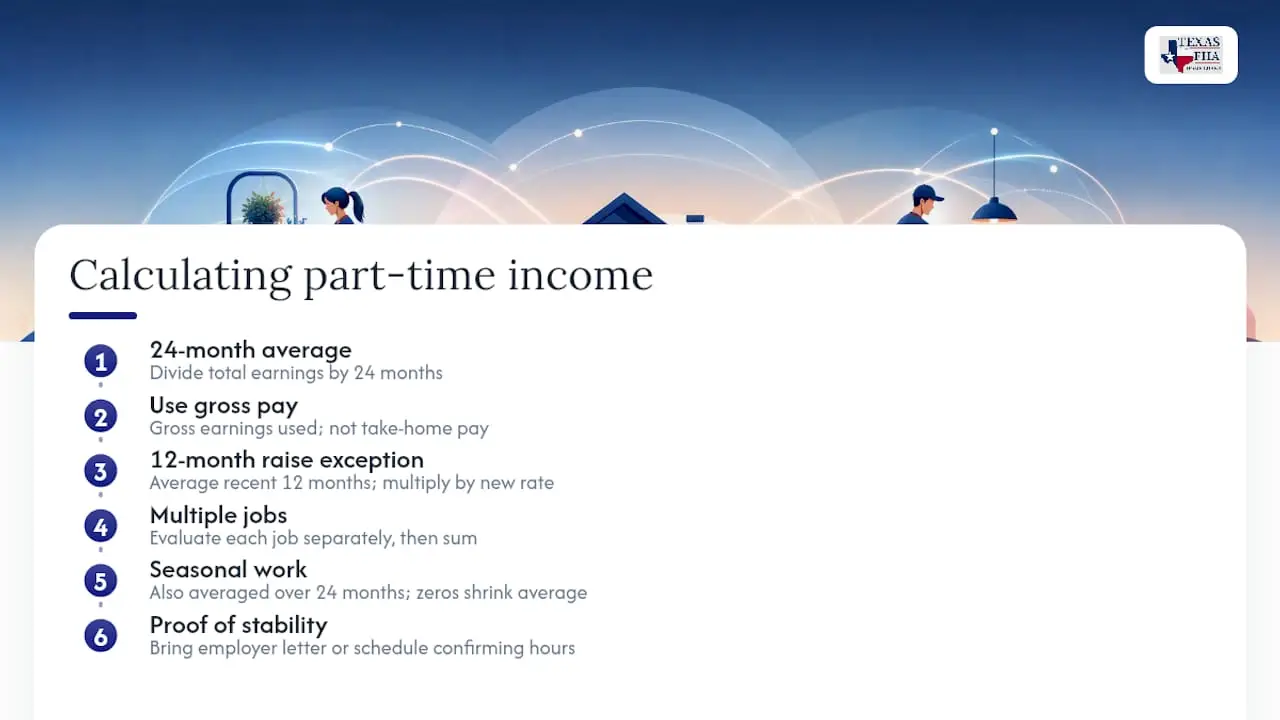
Lenders typically average part-time income over a 24-month period, dividing the total earnings by 24 to arrive at a qualifying monthly income figure. Taxes and withholding don’t reduce that number. Underwriters work from gross earnings, not take-home pay.
The 12-month exception changes the picture when a borrower’s employer documents a permanent raise. In that case, the lender may average only the most recent 12 months of hours, multiplied by the new hourly rate, rather than blending in a full second year at the old wage.
Two part-time jobs get evaluated separately, then summed, provided both meet the same continuity standard. Seasonal work gets averaged over 24 months too, which can shrink the number sharply if one of those years included a stretch of zero income.
Pro Tip: A raise alone rarely moves the needle. Underwriters want proof that the hours worked at the new rate are stable, not just that the hourly wage went up. Bring a written schedule or employer letter confirming continued hours.
How Are Second Jobs, Recent Hires, and Seasonal Work Treated?
Underwriting outcomes shift depending on which scenario describes your situation.
- Second W-2 job: Mortgage professionals commonly apply a 24-month simultaneous employment standard, meaning the second job needs roughly two years of overlap with your primary job before it counts.
- Recent hire: Income from a job held less than a year is often excluded unless you’re a recent graduate entering your field or you can document a signed offer letter with guaranteed hours.
- Variable hours, tips, or commission: These require averaging plus supporting documentation, such as tip logs or bank deposit records, since a single pay period tells the underwriter almost nothing.
- Seasonal work: Averaged across two years; a zero-income year drags the average down substantially, so lenders look for a documented pattern of recurring seasonal employment rather than a one-off gig.
How Does Part-Time Income Change Your DTI and Borrowing Power?
Counting part-time income raises your qualifying monthly income, which lowers both your front-end and back-end debt-to-income ratios and can meaningfully increase your maximum loan amount.

Add $700 in averaged part-time income, following the 24-month averaging approach used for secondary jobs, and that ratio drops closer to 31%, often enough to open up loan approval room that didn’t exist before.
Keep in mind that individual lenders sometimes apply overlays stricter than baseline FHA guidelines, particularly around how much history they’ll accept for a second job. Review your income qualifications with your loan officer early.
How Can You Improve Your Chances of FHA Approval With Part-Time Income?
A little preparation goes a long way with underwriters who are trained to look for gaps.
- Request a written VOE and an employer letter confirming your schedule and likelihood of continued work.
- Pull two years of W-2s and authorize your lender to request IRS transcripts through Form 4506-T if asked.
- If your hours vary, collect schedules or booking logs; for tips or commissions, keep deposit records and logs handy.
- Ask your lender whether wholesale investors or program overlays might accept a shorter work history if you bring compensating factors like reserves or strong credit.
Pro Tip: Don’t wait until underwriting to gather documents. Loan officers who receive a complete file up front can often flag stability concerns and fix them before they become a denial.
How Does an FHA-Approved Lender Review Part-Time Income Files?
When a borrower reports part-time income, our FHA loan specialists start by reviewing employment history, checking for documentation gaps, and running the numbers against your existing debt to see the real DTI impact.

From there, the team builds your file the way an underwriter will read it: paystubs, VOEs, calculation worksheets, and a pre-submission check against HUD Handbook 4000.1 standards. That groundwork catches problems, like a missing signature on a VOE or an averaging error, before they slow down your closing timeline. TexasFHA holds Full Eagle FHA-approval status, meaning the underwriting review happens in-house rather than being routed through a third party.
A Loan Specialist’s Take on Common Mistakes
The mistake we see most often: borrowers report gross deposits without adjusting for tax treatment or, for self-employed applicants, without reconciling against Schedule C. The fix is simple. Gather two years of W-2s, close any VOE gaps with an employer letter, and request a pre-qualification review early.
Get Your Part-Time Income Reviewed Before You Apply
TexasFHA reviews part-time income files the way underwriters actually read them, not the simplified version many online calculators assume. That means catching averaging errors, VOE gaps, or documentation shortfalls before they slow down your closing, instead of after an underwriter flags them.
Our FHA loan specialists start with a file review: your pay history, employer verification status, and how your part-time earnings affect your debt-to-income ratio. From there, we build a document checklist specific to your situation and run a pre-submission calculation workup against current HUD Handbook standards. If you’re ready to see where you stand, review the FHA loan requirements page and request a pre-qualification conversation with a specialist. There’s no cost to find out where your file needs work before you formally apply.
Frequently Asked Questions
Does FHA require a minimum number of work hours for part-time income to count?
No. HUD doesn’t set a minimum hour threshold. The requirement is two years of uninterrupted work history and reasonable likelihood the job continues.
Can I count a brand-new part-time job I started this year?
Usually not, unless you’re a recent graduate entering a related field or you have a signed offer letter documenting guaranteed hours and pay.
What if my part-time hours vary week to week?
Lenders average your income using pay history and, in some cases, compare pre-event and post-event averages, then use supporting documents like schedules to confirm the pattern.
Does a raise at my part-time job help me qualify for more?
Only if your lender can document that it’s a permanent increase and your hours at the new rate are stable enough to use a 12-month average instead of the standard two-year average.
Will seasonal part-time work hurt my FHA application?
It can lower your averaged income if one of the two years included little or no work, though consistent seasonal patterns with solid documentation are still workable.
This article is general information, not a substitute for advice from a qualified financial advisor. Consult a qualified financial professional about your own circumstances before acting on anything here.
Sources
These sources back every rule cited above and are worth reading directly if you want the full regulatory text.
- HUD Handbook 4000.1 (2022) — Part-Time Employment sections
- Mortgage qualification with multiple jobs (FHA Mortgages guide)
These documents are the primary regulatory basis underwriters use nationwide, which is why every calculation and documentation rule in this article maps directly back to them.
Recommended
- FHA Loan Requirements | FHA Loan Qualifications in Texas
- What is an FHA Loan? – Check Eligibility for a FHA Home Loan
- Is An FHA Mortgage Good For You? – Texas FHA Home Loans | First Time Buyer Loans
