

Texas property taxes can affect your monthly mortgage payment in ways the list price doesn’t show. Texas has no state property tax, so the school district, county, city, and special districts where the home is located set the rates, and on many mortgages, the tax bill is collected in small monthly installments through an escrow account. Before you make an offer, budget for the taxes the home is likely to carry once you own it, not the bill the seller paid, and know how the homestead exemption and the 10% homestead cap can help after you move in.
TL;DR:
- Property taxes are often part of your monthly payment. Your mortgage servicer collects them through escrow along with homeowners insurance and pays the bills when they are due.
- The seller’s tax bill is not your tax bill. Exemptions and the homestead cap belong to the owner who qualifies for them, so plan around the home’s current value and the local tax rates.
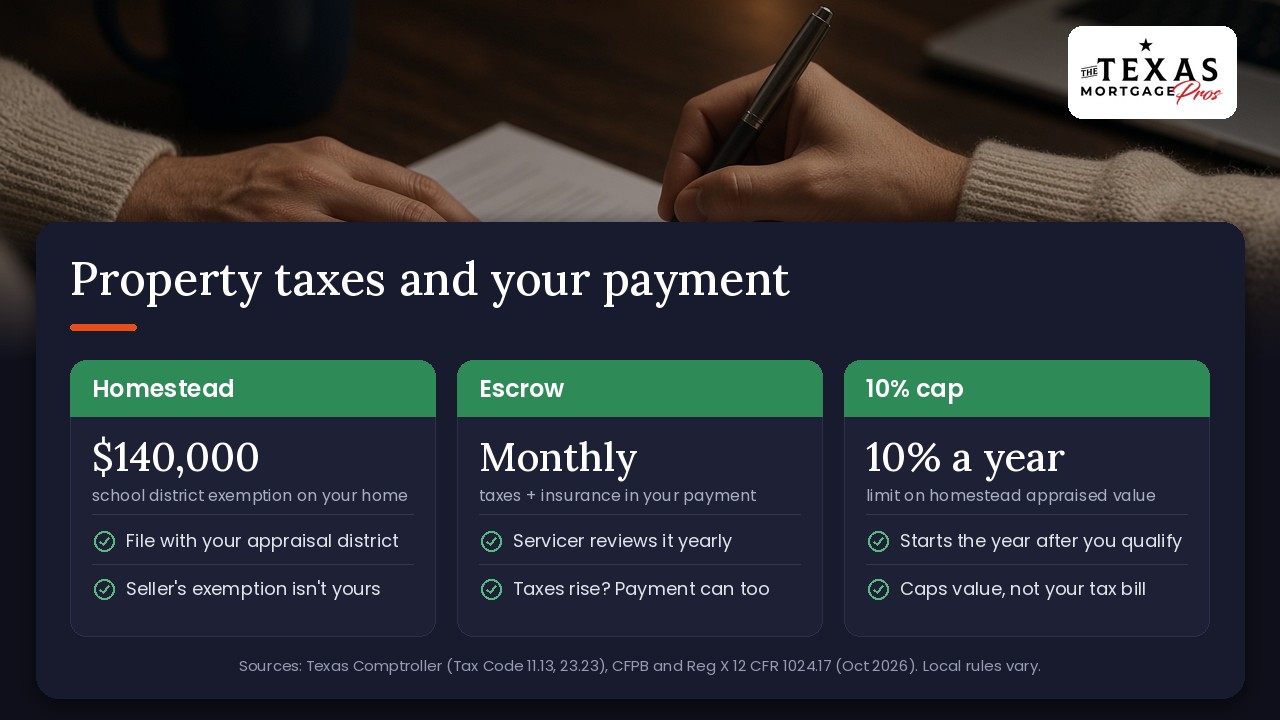
- School districts must give a $140,000 residence homestead exemption, and other local exemptions may apply. You apply with your county appraisal district.
- The 10% homestead cap limits how fast your home’s appraised value can rise each year, starting the year after you qualify. It does not cap your tax bill.
- Your escrow is reviewed every year, so a higher tax bill can raise your payment. Read the annual escrow statement and your spring appraisal notice.
Table of Contents
- Why Are Property Taxes Catching Texas Buyers Off Guard?
- How Do Property Taxes Fit Into Your Mortgage Payment?
- Why the Seller’s Tax Bill Is Not Your Tax Bill
- How Does the Texas Homestead Exemption Work?
- When Does the 10% Homestead Cap Start?
- What to Check Before You Make an Offer
- Property Tax Do’s and Don’ts for Texas Buyers
- Get a Full Payment Review
- Sources
Why Are Property Taxes Catching Texas Buyers Off Guard?
Texas buyers have more room to shop this year, but the monthly math is tighter. In the 2026 Texas Homebuying Experience Report released October 6, Texas REALTORS® said 69% of members had buyer clients who did not compete against other offers, up from 57% last year. In open-ended comments, many agents described buyers who were surprised by how much property taxes, homeowners insurance and mortgage interest rates affected what they could comfortably afford, and who adjusted their expectations once they saw the full monthly payment.
Borrowing costs are part of that picture. The Mortgage Bankers Association said mortgage rates reached their highest level in almost three years in the week ending October 2. The Texas Real Estate Research Center’s October 2026 Texas Economic Outlook, published October 9, pointed to slowing job gains, rising interest rates, and oil-driven inflation as sources of uncertainty, even as Texas job growth continued to outpace the nation in August.
When the interest portion of a payment is higher, the tax portion has less room to surprise you. Property taxes are also the part of the payment that is set locally. According to the Texas Comptroller, more than 4,796 local taxing units, including school districts, cities, counties, and special districts such as hospital, junior college, and water districts, levy property taxes in Texas. Two homes at the same price in different parts of the same metro area can carry very different tax bills.
How Do Property Taxes Fit Into Your Mortgage Payment?
Most buyers pay property taxes through an escrow account, sometimes called an impound account. The Consumer Financial Protection Bureau (CFPB) explains that part of each monthly mortgage payment goes into an escrow account, and your mortgage servicer uses it to pay property taxes and homeowners insurance for you, so you do not face one large bill once or twice a year. Many loans require escrow, and the CFPB suggests considering one even when it is optional.
Here is how the pieces fit together:
- Your monthly payment has layers. Principal and interest are the core, but the CFPB’s Loan Estimate explainer notes that your total monthly payment will typically be higher due to taxes, insurance, and mortgage insurance, if your loan has it. Insurance is its own line item; our guide to Texas homeowners insurance costs covers that side.
- Check the tax estimate on your Loan Estimate. Page 1 shows “Estimated Taxes, Insurance & Assessments” and whether each item is in escrow. The CFPB says property taxes are set by local government and suggests checking now whether they were estimated accurately by contacting the local tax authority or asking your real estate agent.
- Escrow starts at closing. Under the federal escrow rule in Regulation X (12 CFR 1024.17), the account can be funded at closing to cover upcoming bills, plus a cushion of no more than one-sixth of the estimated yearly escrow payments.
- Escrow is reviewed every year. The servicer runs an escrow analysis each year and sends an annual statement. If the account comes up short, a shortage of one month’s escrow payment or more can be left in place or spread over at least 12 months, and smaller shortages may be due within 30 days. A surplus of $50 or more is generally refunded within 30 days if your payments are up to date.
- Your payment can change even with a fixed-rate loan. The CFPB notes that property taxes and insurance premiums can change from year to year, and your escrow payment and total monthly payment change with them.
Texas tax timing matters, too. The Comptroller says tax bills are generally mailed around October 1, and taxpayers generally have until January 31 of the following year to pay before penalties and interest begin on February 1. When taxes are paid from escrow, the tax bill can be sent to the mortgage company that holds the escrow account, so watch for your annual escrow statement rather than a bill in your mailbox.
Why the Seller’s Tax Bill Is Not Your Tax Bill
The listing may show what the seller paid last year. That number is a starting point, not a forecast for you. Three things can make it lower than what you will pay:
- The seller’s exemptions are personal. Each homestead exemption depends on the owner’s eligibility, based on ownership and use of the home as a principal residence. A seller’s age 65 or older or disability exemption will not carry over to you unless you qualify yourself. In the year of the sale, the bill is still figured with the seller’s exemption status if the seller already claimed it, and you apply for your own.
- The seller’s cap is personal, too. The 10% homestead cap expires on January 1 of the tax year after the owner no longer qualifies for the homestead exemption. A home that has been capped for years may be appraised closer to market value once it changes hands.
- Values are set every January 1. Appraisal districts appraise property at market value as of January 1 each year and use recent sales of similar homes to value typical properties. A home bought this fall will be appraised again for next year.
New construction needs extra care. If a home or lot has not yet been fully assessed, last year’s bill may reflect only part of its value. Regulation X lets servicers estimate escrow for unassessed new construction from comparable homes in the area, so ask how the tax estimate was built and plan for the bill on the finished home.
How Does the Texas Homestead Exemption Work?
If the home will be your principal residence, the homestead exemption is the most powerful tool you have to lower your taxes. According to the Comptroller’s property tax exemptions page:
- School districts must give a $140,000 exemption on a residence homestead (Tax Code Section 11.13(b)). The Comptroller’s example: on a home appraised at $300,000, you would pay school taxes as if it were worth $160,000.
- Other taxing units may add a local option exemption of up to 20% of the appraised value, and it cannot be less than $5,000 (Section 11.13(n)). Counties that collect farm-to-market or flood-control taxes must provide a $3,000 exemption.
- Homeowners age 65 or older or disabled get an additional $60,000 school district exemption, and taxing units may offer more.
- You must apply. Exemption applications are filed with the appraisal district in the county where the home is located. The general deadline is before May 1, and the chief appraiser decides whether the property qualifies.
- You need ownership and occupancy. You must have an ownership interest, use the home as your principal residence, and not claim a homestead exemption on another home in or outside Texas.
Buying partway through the year? The Comptroller says a buyer who acquires a home after January 1 may receive the exemption for the applicable portion of that tax year, but only if the previous owner did not receive the same exemption that year. If the seller already had a homestead exemption for the year, that year’s bill is still figured with the seller’s exemption, and you apply for your own for the next tax year, Travis CAD explains. Either way, file soon after you move in so it is in place for the next bill.
Exemptions lower the taxable value, not the tax rate. Each taxing unit still sets its own rate every year. For local budgets and rates, the Comptroller points homeowners to the individual taxing units and to texas.gov/propertytaxes.
When Does the 10% Homestead Cap Start?
Texas limits how quickly a homestead’s appraised value can rise. Under Tax Code Section 23.23, the appraised value of a qualifying homestead in a given year cannot exceed the lesser of the home’s market value or last year’s appraised value plus 10% plus the market value of any new improvements, the Comptroller explains. Repairs and ordinary maintenance are not new improvements.
The timing is what surprises new owners:
- It does not start right away. The cap applies when the owner qualified the homestead exemption in both the preceding and current year. It takes effect on January 1 of the tax year after you first qualify.
- It caps value, not taxes. The limit applies to appraised value. Tax rates are set separately by each taxing unit, and exemption amounts can change, so your bill can still go up or down.
- Additions count. A new room, pool, or other improvement that adds market value can be added on top of the 10% limit.
If the value on your notice looks wrong, you can protest. The appraisal district must send a notice of appraised value by April 1 for a residential homestead, or as soon as practicable when the value increases. In most cases, the protest deadline is May 15 or 30 days after the notice is mailed, whichever is later.
What to Check Before You Make an Offer
A few minutes of homework can keep the tax line from changing your budget after you are under contract:
- Look up the home on the county appraisal district’s website. Note the market value, the appraised value, any exemptions on the account, and the list of taxing units. If the appraised value is well below market value, the seller may be subject to a homestead cap. Exemptions result in a lower taxable value.
- List every taxing unit. Include the school district, county, city, and any special districts. In many fast-growing suburbs, water districts such as municipal utility districts (MUDs) add to the bill.
- Estimate taxes at today’s value without the seller’s exemptions. Then estimate again with the homestead exemptions you expect to qualify for, so you can see your first-year and later-year range.
- Compare your estimate to the Loan Estimate. Ask how the escrow figure was built and whether it uses the seller’s last bill.
- Ask about new construction. If the home or lot was not fully assessed last January 1, ask how the estimate accounts for the finished home.
- Plan for the calendar. Appraisal notices arrive in spring; protests are generally due by May 15; bills go out around October 1; and taxes are generally due by January 31.
- Talk numbers before you offer. Your mortgage broker can help you compare the full monthly payment, including taxes and insurance, across the homes you are considering. If a seller is open to helping with costs, our guide to Texas seller concessions explains how buyers are negotiating this fall.
If you have not been pre-approved yet, our Texas mortgage pre-approval guide covers the steps, and our Texas Mortgage Credit Certificate guide explains a federal tax credit program that eligible first-time buyers may want to ask about.
Property Tax Do’s and Don’ts for Texas Buyers
Do:
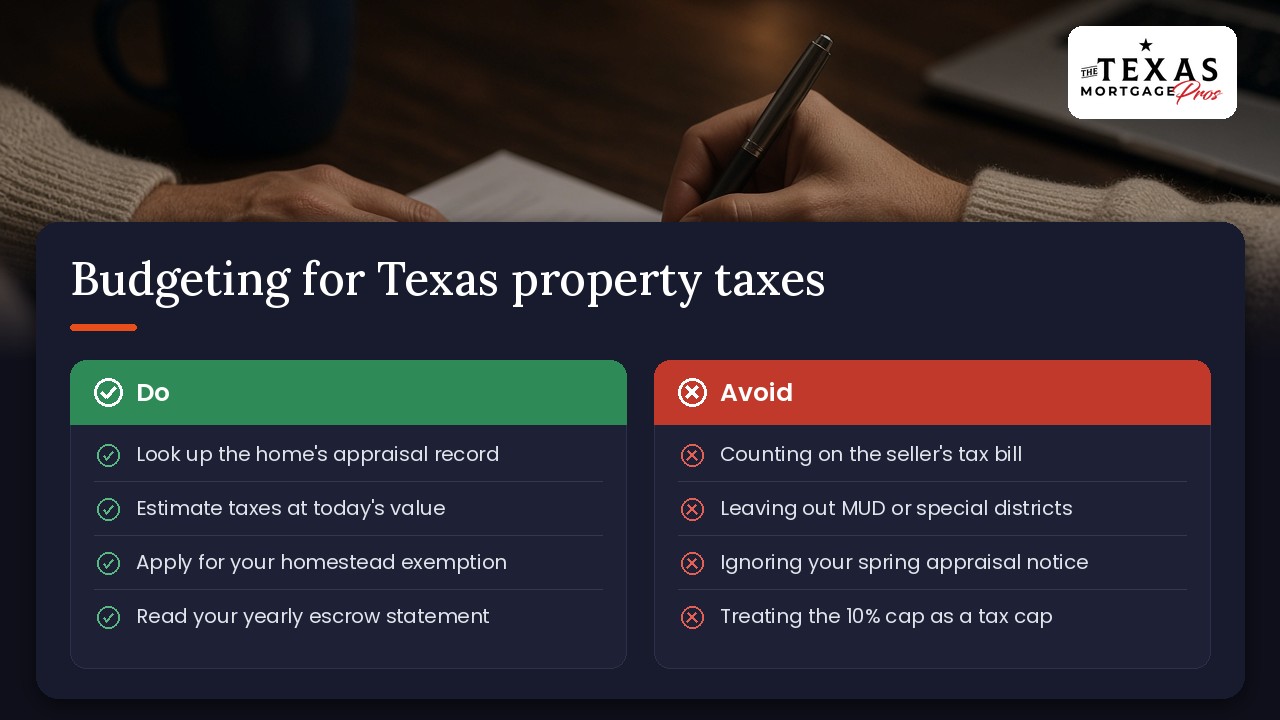
- Look up the appraisal record for every home you are serious about, not just the one you love most.
- Estimate taxes at today’s value and without the seller’s exemptions, then build in the exemptions you expect to qualify for.
- Apply for your homestead exemption with the appraisal district after you close and move in.
- Read your yearly escrow statement and compare it with your tax bill so a change does not catch you off guard.
Avoid:
- Counting on the seller’s tax bill. Their exemptions and cap do not transfer to you.
- Leaving out MUD or special district taxes. They can be a meaningful part of the total.
- Ignoring your spring appraisal notice. The protest window is short.
- Treating the 10% cap as a tax cap. It limits appraised value only, and only after you qualify.
— Gerry Nicodemus
Get a Full Payment Review
Every home’s tax picture is different, and the right budget depends on the full payment, not just the price. If you are weighing an FHA loan or another home loan in Texas and want help estimating how property taxes, escrow, and insurance could fit your budget before you make an offer, call (281) 801-6965 to talk with a mortgage professional at The Texas Mortgage Pros, a mortgage broker. You can also review our FHA loan requirements to see where you stand today.
Last verified: October 13, 2026. Property tax exemptions, appraisal rules, tax rates, deadlines, and escrow requirements change. Check with your county appraisal district, tax office, and each source for the latest details.
This article is general information, not legal, tax, or financial advice. It is not a commitment to lend or an offer of credit. Loan approval and terms are subject to underwriting, program guidelines, and eligibility. Property tax amounts, exemptions, and appraised values are set by local taxing units and appraisal districts, not by The Texas Mortgage Pros, and no estimate guarantees a particular tax bill, escrow amount, or monthly payment. Consult a qualified tax or financial professional about your own circumstances before acting on anything here.
The Texas Mortgage Pros is not affiliated with, endorsed by, or sponsored by the Texas Comptroller of Public Accounts, Travis Central Appraisal District, or any other appraisal district, the CFPB, HUD, FHA, the Mortgage Bankers Association, Texas REALTORS, the Texas Real Estate Research Center, or any other organization named in this article. Third-party names are used only to cite their published information.
The Texas Mortgage Pros, LLC | Company NMLS #2665861 | Gerry Nicodemus, NMLS #286371 | Equal Housing Opportunity | www.nmlsconsumeraccess.org | (281) 801-6965
Sources
- Texas REALTORS (via PR Newswire), Texas Homebuyers Had Less Competition and More Choices This Year, According to a Survey of Realtors (October 6, 2026)
- Texas Real Estate Research Center at Texas A&M University, Texas Economic Outlook, October 2026 (October 9, 2026)
- Mortgage Bankers Association, Mortgage Applications Decrease in Latest MBA Weekly Survey (October 7, 2026)
- Texas Comptroller of Public Accounts, Property Tax Exemptions
- Texas Comptroller of Public Accounts, Valuing Property
- Texas Comptroller of Public Accounts, Property Tax System Basics
- Texas Comptroller of Public Accounts, Property Tax Bills
- Texas Comptroller of Public Accounts, Appraisal Protests and Appeals
- Texas Comptroller of Public Accounts, Form 50-114, Application for Residence Homestead Exemption
- Travis Central Appraisal District, Pro-Rated Homestead Exemptions (Property Owner Toolkit)
- Consumer Financial Protection Bureau, What Is an Escrow or Impound Account? (last reviewed September 11, 2024)
- Consumer Financial Protection Bureau, Loan Estimate Explainer
- Consumer Financial Protection Bureau, Regulation X, 12 CFR 1024.17, Escrow Accounts
Recommended
- Texas Homeowners Insurance Costs: What Buyers Should Know This Fall
- Texas Seller Concessions: How Buyers Can Negotiate as Competition Cools
- Mortgage Credit Score Changes: What Texas Buyers Should Know About VantageScore 4.0
- Mortgage Pre-Approval in Texas: Your 2026 Buying Guide

Gerry is a licensed mortgage loan originator and digital marketer with 25+ years in the mortgage business, specializing in conversion rate optimization, SEO, AI Overviews, and generative engine optimization (GEO) for the mortgage and real estate industry. Today he builds agentic intelligent systems, meaning AI agents that research, create content, nurture leads, and handle follow-up, to help mortgage and real estate business owners get found online, convert more leads, and scale. Gerry pairs decades of hands-on industry knowledge with the latest AI tools, so his clients stay a step ahead of the market.