

Your FHA debt-to-income picture is not just one number. FHA looks at two ratios: your proposed housing payment versus your income, and your total monthly obligations versus your income. Most FHA files are first run through HUD’s automated TOTAL Mortgage Scorecard. When a file is referred or downgraded to FHA manual underwriting, a published ratio matrix and a short list of compensating factors take center stage.
If you are a Texas buyer carrying credit card balances, a car note, student loans, or other monthly obligations, knowing what FHA counts before you apply can help you prepare a cleaner file and avoid surprises.
TL;DR
- FHA checks two ratios: your housing payment to income (PTI) and your total monthly obligations to income (DTI).
- In Texas, property taxes, homeowners insurance, MIP and HOA dues all sit inside the housing ratio.
- Credit card payments on your report count, and a spouse’s debts generally count too because Texas is a community property state.
- A TOTAL Refer, or certain triggers on an Accept, sends a file to manual underwriting.
- Manual files follow HUD’s matrix: 31/43 standard, up to 37/47, 40/40 or 40/50 with a 580+ score and documented compensating factors.
- Compensating factors can’t make up for derogatory credit.
TexasFHA
Not Sure How Your Debts Will Count?
Talk with a mortgage broker about your FHA ratios before you make an offer.
Why your monthly card payments deserve a closer look right now
The Federal Reserve’s October 2026 Senior Loan Officer Opinion Survey, released November 2, 2026, reported stronger demand for credit card loans in the third quarter. Asked about the past year, banks most often cited customers’ spending needs in response to price changes as the reason for that demand. Banks also reported tightening how often they grant credit card and other consumer loans to borrowers who don’t meet credit-score thresholds, and tightening credit card limits. Standards for most residential mortgage categories were basically unchanged.
That does not mean FHA’s ratio rules changed. It does mean the monthly payment that shows up on your credit report may matter more to your homebuying plan than you expect. A relatively small balance with a high required payment can move your ratio more than a larger balance with a lower payment. As a mortgage broker, I encourage buyers to look at their required monthly payments early, not just their balances.
FHA uses two ratios, not one
HUD’s Single Family Housing Policy Handbook 4000.1 calls the two calculations:
- Total Mortgage Payment to Effective Income (PTI). This is often called the housing ratio, or front-end ratio.
- Total Fixed Payment to Effective Income (DTI). This is the total, or back-end, ratio. It adds your required monthly debt and liability payments to the proposed housing payment.
Both ratios compare against your monthly effective income, which is the income HUD allows for qualifying once it is verified, documented, and likely to continue. The Consumer Financial Protection Bureau has a plain-language explanation of how a debt-to-income ratio is calculated if you want a refresher on the math. For FHA’s standard ratios with and without compensating factors, see our FHA debt-to-income ratios guide.
What goes into the FHA housing ratio?
Under HUD’s manual underwriting rules, the total mortgage payment includes:
- principal and interest
- real estate taxes
- hazard (homeowners) insurance
- flood insurance, when applicable
- FHA mortgage insurance premium (MIP)
- HOA or condominium fees
- ground rent and special assessments
- payments on any acceptable secondary financing
- any other escrow payments
That is why a Texas buyer shouldn’t judge affordability from a home’s price or a principal-and-interest estimate alone. Property taxes and homeowners insurance can materially move the housing ratio here. See our guides to Texas property taxes, your mortgage payment, and Texas homeowners insurance costs.
A ratio-only illustration
Suppose, for illustration only, that a household’s projected total mortgage payment would equal 30% of its monthly effective income, and its other required monthly debt payments add up to another 10% of that income. The housing ratio (PTI) is 30%. The total ratio (DTI) is 30% + 10% = 40%.
This is arithmetic only. It isn’t an approval standard, a payment quote, or a prediction of how any specific FHA file will be reviewed.
What counts as debt for FHA DTI?
The total fixed payment is the total mortgage payment plus the monthly obligations on all debts and liabilities. The underwriter reviews the credit report, your loan application, and supporting documents. A few rules surprise buyers more than others.
Credit cards and other revolving accounts
FHA uses the monthly payment shown on the credit report. If the report doesn’t show a payment, the underwriter uses the payment on your current statement or 5% of the outstanding balance. So a card that shows no payment on the report isn’t simply ignored.
Installment debts that may be left out
A closed-end debt, such as a car loan, may be left out of the ratio only if it will be paid off within 10 months of closing and the combined payments of all such debts are no more than 5% of gross monthly income. HUD doesn’t allow a borrower to pay down a balance to meet the 10-month rule.
Authorized-user accounts
Accounts where you are an authorized user generally count in your DTI unless you can document the primary account holder’s on-time payments for the previous 12 months. If you are an authorized user on a parent’s or spouse’s card, bring it up early.
Collection accounts
In a manually underwritten file, if collection balances on the credit reports add up to $2,000 or more, HUD requires one of three things: the collections are paid in full at or before settlement from an acceptable source of funds, you have a payment arrangement with the creditor, or a monthly payment equal to 5% of each collection balance is included in your DTI.
Texas is a community property state
This one is specific to buyers here. Because Texas is a community property state, FHA requires the debts of a non-borrowing spouse to be included in your qualifying ratios, except obligations specifically excluded by state law. The underwriter will typically pull a credit report for the spouse who isn’t on the loan. HUD also says the non-borrowing spouse’s credit history isn’t, by itself, a reason to deny the application. In manual files, a non-borrowing spouse’s collection accounts count toward the $2,000 threshold unless state law excludes them.
Other obligations that can matter
Depending on the file, the underwriter may also count auto loans and leases, personal loans, student loans, court-ordered child support or alimony, and payments on other real estate you own. Student loans have their own FHA payment rules; see FHA student loan guidelines for Texas buyers.
TOTAL Scorecard: Accept, Refer, and when a file goes manual
All FHA transactions are scored through TOTAL, except a short list HUD names: Streamline Refinances, assumptions, mortgages to nonprofit or governmental entity borrowers, and certain borrowers without Social Security numbers. TOTAL is a risk tool, not the final word. HUD says the Mortgagee may not accept or deny an FHA-insured mortgage based solely on the TOTAL result.
When manual underwriting is required
A Refer result, or any result other than Accept, must be manually underwritten. An Accept must also be downgraded to manual underwriting in situations such as:
- the file contains information TOTAL can’t evaluate, or new information affects insurability
- $1,000 or more, combined, in disputed derogatory credit accounts
- a bankruptcy discharge within two years of the FHA case number assignment date
- a short sale, foreclosure, or deed-in-lieu title transfer within three years of case number assignment
- a mortgage payment history or undisclosed mortgage debt that requires a downgrade under HUD rules
- business income that declined more than 20% over the analysis period
That isn’t the whole handbook, just the triggers buyers most often run into. If you’ve had a bankruptcy, see our guide to FHA bankruptcy waiting periods.
There is no single published maximum DTI for TOTAL Accept files
You may hear one FHA DTI percentage described as a universal cap. That is incomplete. HUD doesn’t publish one maximum ratio for every file that receives a TOTAL Accept; the full file still has to meet HUD’s requirements. For manually underwritten files, though, HUD does publish a ratio matrix.
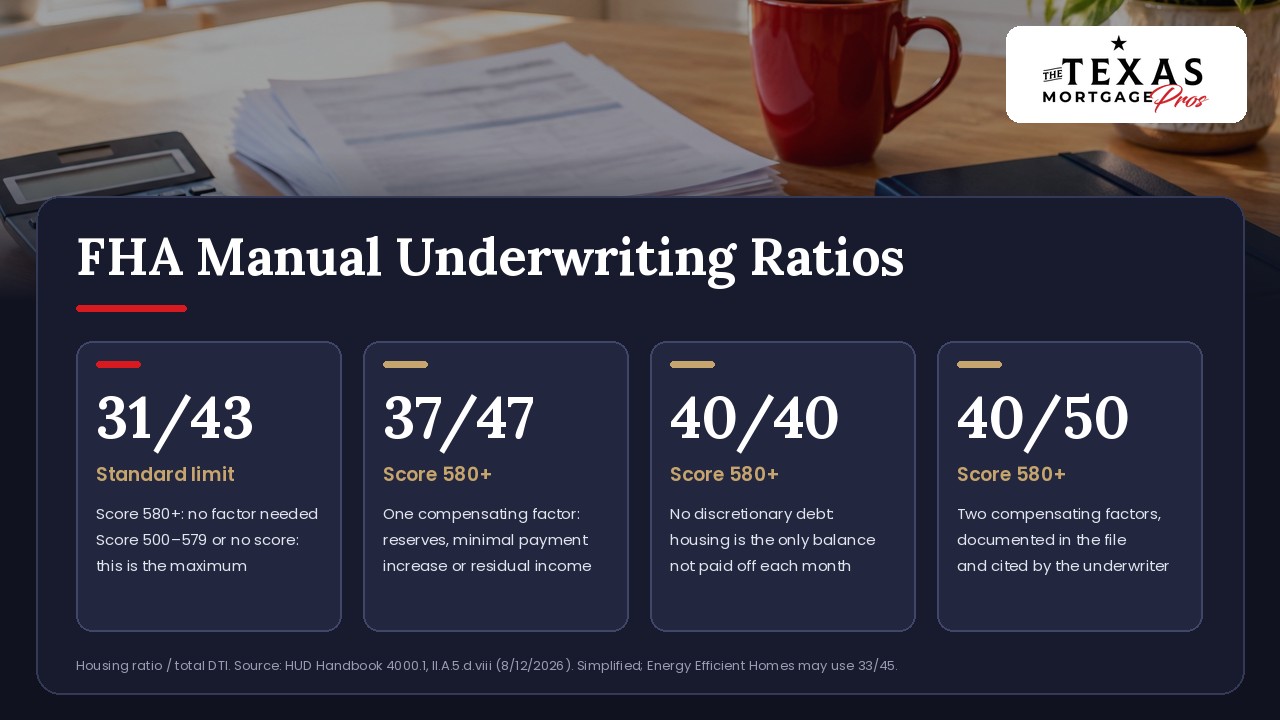
The FHA manual underwriting ratio matrix
Here is HUD’s Approvable Ratio Requirements (Manual) chart, summarized. Ratios are shown as housing ratio / total DTI. “MDCS” is the minimum decision credit score used for the file. (HUD’s October 2026 credit-score update, effective for case numbers assigned on or after January 1, 2027, aligns the terminology in this chart but doesn’t change the ratios; see our post on mortgage credit score changes.)
| Minimum decision credit score | Maximum ratios (PTI / DTI) | What is required |
|---|---|---|
| 500–579, or no credit score | 31% / 43% | No higher ratios allowed through compensating factors (Energy Efficient Homes: 33% / 45%) |
| 580 and above | 31% / 43% | No compensating factors required (Energy Efficient Homes: 33% / 45%) |
| 580 and above | 37% / 47% | One compensating factor: verified cash reserves, minimal increase in housing payment, or residual income |
| 580 and above | 40% / 40% | No discretionary debt |
| 580 and above | 40% / 50% | Two compensating factors from: reserves, minimal housing payment increase, significant additional income not in effective income, residual income |
For borrowers with no credit score, the ratios are calculated using income only from borrowers who will occupy the home and are obligated on the mortgage. A non-occupant co-borrower’s income can’t be included. If a parent is planning to help, read our non-occupant co-borrower guide before assuming their income solves a ratio issue.
What FHA counts as a compensating factor
A compensating factor is a documented strength that supports higher ratios in a manually underwritten file. It is not a workaround for missing documentation, and HUD is explicit that compensating factors cannot be used to compensate for derogatory credit.

Verified and documented cash reserves
Reserves must equal at least three total monthly mortgage payments for a one- or two-unit home, or at least six for a three- or four-unit home. Money needed to close, gift funds, and borrowed funds don’t count toward reserves.
Minimal increase in housing payment
Your new total mortgage payment can’t exceed your current total housing payment (rent or mortgage) by more than $100 or 5%, whichever is less. You also need a documented 12-month housing payment history with no more than one 30-day late payment. If you have no current housing payment, this factor isn’t available.
No discretionary debt
Your housing payment must be the only open account with a balance that isn’t paid off monthly. You need credit lines in your own name that have been open at least six months and that you can document were paid in full every month for at least the past six months. Authorized-user accounts don’t qualify.
Significant additional income not reflected in effective income
Overtime, bonus, part-time or seasonal income that isn’t already counted as effective income can be cited if it has been received for at least one year and will likely continue, and if adding it would bring the ratios to 37% / 47% or lower. It can only be used with another compensating factor for files between 37%/47 % and 40%/50 %. Income from a non-borrowing spouse or anyone not obligated on the mortgage can’t be used here. For more on part-time earnings, see whether FHA accepts part-time income.
Residual income
Residual income is what’s left of the occupying borrowers’ effective income after taxes, retirement and Social Security deductions, the total fixed payment, estimated maintenance and utilities, and job-related costs such as child care. To count as a compensating factor, it must meet the amount for your household size, loan amount, and region in the Department of Veterans Affairs residual-income table (VA Pamphlet 26-7, Chapter 4). Everyone in the household counts toward family size, whether or not they are on the loan, with a narrow exception HUD describes.
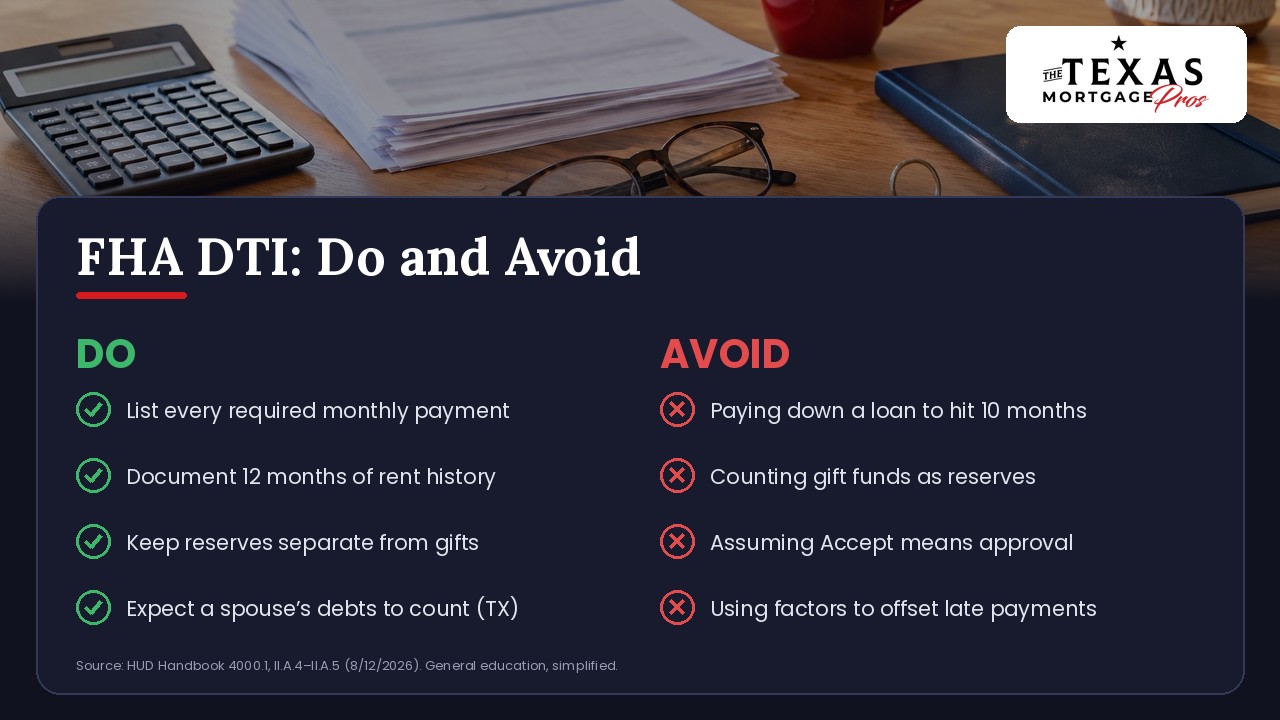
Before you apply: an FHA manual underwriting checklist
- Pull current statements for every credit card and line of credit, and note the required monthly payment, not just the balance.
- List car loans, personal loans, student loans, and any other installment debts, with payoff dates.
- Don’t pay down, open, or close accounts to change a ratio without first talking through timing and documentation with your broker.
- If you are married and your spouse won’t be on the loan, expect their debts to be reviewed because Texas is a community property state.
- Be ready to document authorized-user accounts and any collection accounts.
- Gather 12 months of rent or mortgage payment history.
- Keep closing funds separate from money that may count as reserves, and remember gifts don’t count as reserves.
- If you earn overtime, bonus, part-time, or seasonal income, collect records that show at least a year of history.
- Disclose every mortgage and property you own.
- Ask early whether your file is likely to need manual underwriting.
Start with our overview of FHA loan requirements or request a conversation through our FHA pre-qualification page.
FAQ: FHA manual underwriting and DTI in Texas
Q: Does FHA use gross income or take-home pay?
A: FHA ratios use monthly effective income, which is income before taxes that has been verified, documented, and judged likely to continue under HUD rules. They don’t use take-home pay.
Q: Can a car payment that ends soon be left out?
A: Possibly. It has to be paid off within 10 months of closing, and the combined payments of all debts you leave out can’t exceed 5% of your gross monthly income. Paying down the balance to meet the 10-month rule isn’t allowed.
Q: Does a TOTAL Accept mean my loan is approved?
A: No. HUD says the Mortgagee can’t accept or deny a loan based solely on TOTAL. Your documentation, the property, and the rest of the file still have to meet FHA requirements.
Q: Can compensating factors make up for late payments or other derogatory credit?
A: No. HUD states that compensating factors can’t be used to compensate for derogatory credit. They support higher ratios, not credit problems.
Know your ratios before you fall for the house
An FHA ratio is more than a quick percentage from an online calculator. In Texas, the housing side includes property taxes, homeowners insurance, MIP, and any HOA dues, and the debt side can include a spouse’s obligations even when that spouse isn’t on the loan. If your file is manually underwritten, HUD’s matrix and the exact definitions behind reserves, payment history, discretionary debt, additional income, and residual income all matter.
The best next step isn’t guessing at a maximum ratio. It’s reviewing your actual monthly obligations, income documents, and credit with a mortgage broker before you’re under contract. To talk through your FHA plan, contact us or call (281) 801-6965.
— Gerry Nicodemus
Sources
- U.S. Department of Housing and Urban Development, Single Family Housing Policy Handbook 4000.1 (last revised August 12, 2026): II.A.4 Underwriting the Borrower Using the TOTAL Mortgage Scorecard; II.A.5 Manual Underwriting of the Borrower, including Calculating Qualifying Ratios, Approvable Ratio Requirements (Manual), Documenting Acceptable Compensating Factors, Collection Accounts and Non-Borrowing Spouse debt in community property states
- HUD Mortgagee Letter 2026-11, Updated Minimum Decision Credit Score Methodology for the Implementation of Alternative Credit Scores (October 8, 2026; effective for case numbers assigned on or after January 1, 2027)
- Board of Governors of the Federal Reserve System, The October 2026 Senior Loan Officer Opinion Survey on Bank Lending Practices (released November 2, 2026)
- Consumer Financial Protection Bureau, What is a debt-to-income ratio?
- U.S. Department of Veterans Affairs, VA Pamphlet 26-7, Chapter 4 residual income tables (as referenced by HUD Handbook 4000.1)
Recommended Reading
- FHA Mortgage Insurance in Texas: How Long You Pay MIP
- FHA Gift Funds in Texas: Rules for Using Family Money
- FHA Income Requirements: What Texas Buyers Need to Qualify
The Texas Mortgage Pros, LLC is not affiliated with or endorsed by the U.S. Department of Housing and Urban Development, the Federal Housing Administration, the Federal Reserve, the Consumer Financial Protection Bureau, the Department of Veterans Affairs, or any other government agency, and this is not a government document.
The Texas Mortgage Pros, LLC | Company NMLS #2665861 | Gerry Nicodemus, NMLS #286371 | Equal Housing Opportunity | www.nmlsconsumeraccess.org | (281) 801-6965
Equal Housing Opportunity. We do business in accordance with federal fair lending laws.

Gerry Nicodemus (NMLS #286371) is a licensed Texas loan originator with more than 25 years of mortgage experience. He specializes in FHA loans and explains credit, down payment, gift fund, and appraisal rules in plain English so Texas buyers know exactly where they stand. Gerry is also a digital marketer who builds agentic AI systems that help mortgage and real estate professionals get found online and serve borrowers better.