

What mortgage pre-approval really means for Texas homebuyers
Mortgage pre-approval is a lender’s verified commitment to loan you a specific amount, based on documented proof of your income, assets, credit, and debt. It is not a guess or an estimate you fill out yourself. A lender reviews your actual financial records, runs a hard credit check, and issues a letter stating how much you qualify to borrow.
That distinction separates pre-approval from pre-qualification, which is an informal estimate based on self-reported numbers and carries no lender commitment. In Texas’s competitive housing market, sellers treat pre-approval letters as proof of serious buying capability. A pre-qualified buyer and a pre-approved buyer are not the same thing to a seller reviewing multiple offers.
The benefits of getting pre-approved before you start shopping are concrete:
- You know your exact budget before you fall in love with a house you cannot afford.
- Sellers take your offers more seriously, giving you real negotiation leverage.
- You can move faster when the right home appears, since the financial vetting is already done.
- You identify credit or income issues early, while you still have time to fix them.
- Your real estate agent can target homes within your verified range, saving everyone time.
How to get mortgage pre-approval in Texas
The process follows a clear sequence, and knowing each step prevents surprises.
-
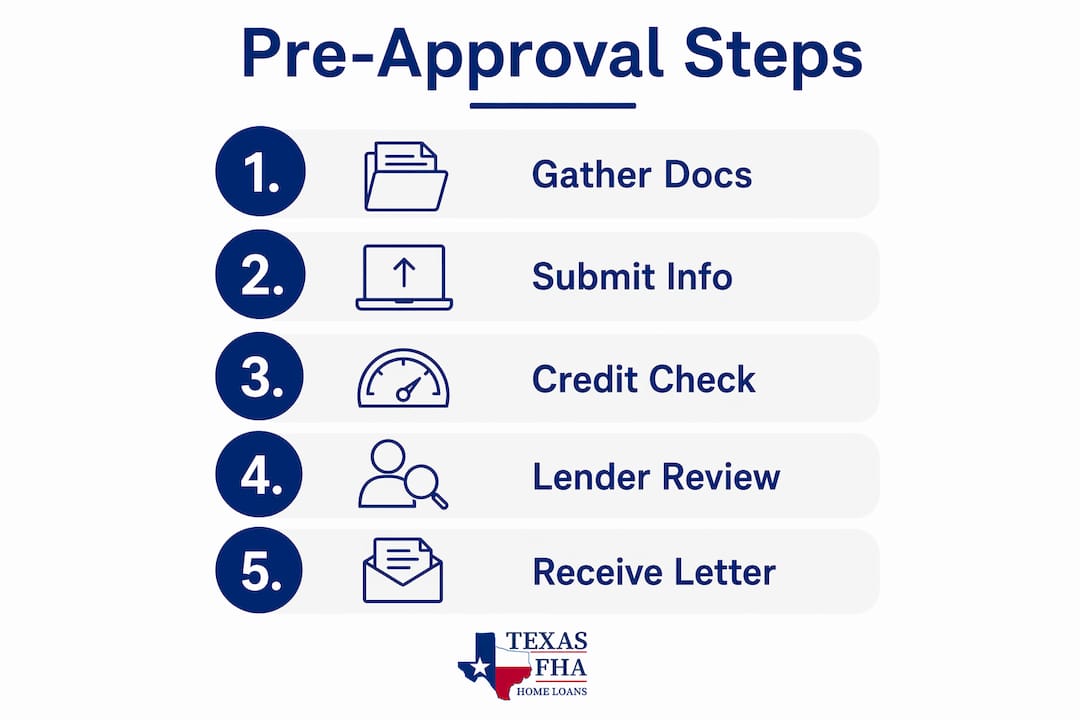
Check your credit score. Pull your credit reports from all three bureaus (Equifax, Experian, TransUnion) and dispute any errors before applying. A higher score expands your loan options and lowers your rate.
-
Gather your financial documents. Lenders request pay stubs, tax returns, bank statements, W-2s, and documentation of any other income sources. Self-employed buyers typically need two years of tax returns and profit-and-loss statements.
-
Calculate your debt-to-income ratio. Add up all monthly debt payments and divide by your gross monthly income. Most Texas lenders require this figure to stay below 43% to approve a loan.
-
Choose a lender and submit your application. Complete the Uniform Residential Loan Application (Form 1003) with your chosen Prosper Home Loans lender. Texas-licensed lenders must comply with the Texas Mortgage Compliance Guide, which requires pre-approval letters to be signed by the licensed mortgage loan originator who issued them.
-
Undergo lender verification and underwriting review. The lender verifies every document, orders a credit report, and evaluates your full financial profile. This step is what separates pre-approval from pre-qualification.
-
Receive your pre-approval letter. The letter states the approved loan amount, loan type, and expiration date. Pre-approval letters in Texas usually remain valid for a limited period; check with your lender for specifics, so time your home search accordingly.
Key financial factors that affect your pre-approval amount
Lenders do not look at any single number in isolation. They weigh several factors together to arrive at the maximum loan amount they will commit to.

Your credit score sets the floor for what loan programs you can access. FHA loans require a minimum score of 580 for the standard 3.5% down payment, while conventional loans generally require higher scores. A stronger score also unlocks better interest rates, which directly affects how large a loan you can afford monthly.
Your debt-to-income (DTI) ratio is often the deciding factor in how much you get approved for. If your monthly debts already consume a large share of your income, the lender reduces the loan amount to keep the total DTI within acceptable limits.
Other factors that shape your pre-approval amount:
- Income stability. Lenders prefer two or more years of consistent employment in the same field. Recent job changes, gaps in employment, or variable commission income require additional documentation.
- Down payment size. A larger down payment reduces the loan amount needed and can eliminate private mortgage insurance (PMI) on conventional loans.
- Assets and reserves. Lenders want to see that you have funds beyond the down payment to cover closing costs and a few months of mortgage payments.
- Existing debts. Student loans, car payments, and credit card balances all count against your DTI and reduce the loan amount you qualify for.
Pro Tip: Pay down revolving credit card balances before applying. Reducing your credit utilization below 30% can lift your score meaningfully in 30–60 days, sometimes enough to qualify for a better loan program.
How to choose the right mortgage lender in Texas
The lender you choose affects your rate, your closing timeline, and how smoothly the entire process goes. Texas homebuyers have access to a wide range of lenders, from large national banks to local specialists, and the right fit depends on your specific situation.
Start by identifying your loan type. First-time buyers with limited savings often benefit most from FHA-specialized lenders like TexasFHA, which operates as a Full Eagle FHA-approved lender with specialists dedicated to guiding buyers through every step. Veterans should prioritize lenders with strong VA loan programs. Buyers purchasing higher-priced Texas properties need a lender experienced with jumbo loan underwriting.
Key criteria to evaluate when comparing lenders:
- Rate transparency. Ask for a Loan Estimate on the same day from multiple lenders so you can compare on equal terms.
- Fee structure. Origination fees, discount points, and third-party costs vary. A lower rate with high fees can cost more than a slightly higher rate with minimal fees.
- Local underwriting knowledge. Lenders who underwrite in-house and know the Texas market tend to close faster and handle appraisal issues more effectively.
- Customer service responsiveness. You will have questions during underwriting. A lender who returns calls and emails promptly prevents costly delays.
Pro Tip: Ask your lender directly: “Do you underwrite in-house, and what is your average closing timeline?” A lender who can commit to a specific number of days and explain their process is far more reliable than one who gives vague answers.
Comparing current mortgage rates across lenders before you apply takes less than an hour and can save you thousands over the life of the loan.
What to do after you receive your pre-approval letter
Pre-approval is the starting line, not the finish line. How you behave between pre-approval and closing determines whether the loan actually funds.
The most important rule: do not change jobs, open new credit accounts, or take on new debt after receiving your letter. Lenders run a second credit check before closing, and any material change to your financial profile can trigger a denial even after your offer is accepted.
Steps to take after pre-approval:
- Search within your approved budget. Your pre-approval amount is the ceiling, not a target. Factor in property taxes, homeowner’s insurance, and HOA fees when evaluating what you can comfortably afford monthly.
- Make offers backed by your letter. Include your pre-approval letter with every offer. In competitive Texas markets, this signals to sellers that your financing is verified.
- Schedule inspection and appraisal promptly. Once your offer is accepted, move quickly on the inspection and appraisal to keep the transaction on schedule.
- Stay in contact with your lender. Respond to underwriting requests within 24 hours. Delays in document submission are one of the most common reasons closings get pushed back.
- Prepare your closing funds. Confirm the exact amount needed for closing costs and down payment at least a week before closing day, and avoid moving large sums between accounts without documentation.
Trusted mortgage lenders serving Texas homebuyers
Texas homebuyers have access to a strong group of licensed lenders, each with distinct specializations. Here is a brief profile of notable options:
- Town Square Mortgage offers competitive rates and a fast closing process for Texas home loan seekers, with a focus on purchase and refinance transactions.
- TexasLending.com provides custom-designed home loans covering purchase, refinance, and home equity products, with mortgage calculators and rate quote tools available online.
- Supreme Lending Dallas serves the Dallas-Fort Worth market with a broad product menu including FHA, VA, and jumbo loans, plus down payment assistance programs.
- Clear Lending focuses on first-time homebuyer loans with an emphasis on accessible qualification criteria and buyer education.
- Texas Loan Star Inc covers both residential and commercial lending, with renovation loans, VA loans, and jumbo products suited to a range of buyer profiles.
- Texas United Mortgage is a Houston-based lender rated highly for its variety of government and conventional loan options, including USDA and down payment assistance programs.
- South Texas Lending operates with in-house underwriting and a 21-day close guarantee, earning recognition as a National Mortgage News Top Producer in 2025.
- Home Loans by Texas Best Loan Officer (NMLS# 414166) provides live market pricing for conforming, jumbo, FHA, VA, and USDA loans, with real-time rate updates.
- Texas Home Loans and Mortgage Lending takes an education-based approach, offering a full range of residential loan programs with a straightforward application process.
- AsertaLoans serves Texas buyers with a focus on accessibility and personalized guidance through the home loan process.
- Texas Top Mortgage, LLC provides purchase and refinance lending with competitive positioning for Texas homebuyers across multiple loan types.
- TexasFHA specializes in FHA loans for first-time buyers across Texas, with low down payment options, flexible credit requirements, and dedicated FHA Loan Specialists guiding buyers from application through closing.
For buyers weighing FHA against conventional financing, understanding the FHA loan requirements specific to Texas is a practical first step before choosing a lender.
Ready to find out exactly how much home you can afford in Texas? TexasFHA’s FHA Loan Specialists can walk you through your pre-approval options, explain your loan choices, and help you move forward with confidence. Visit texasfha.org to get started.
Key Takeaways
Mortgage pre-approval in Texas requires verified financial documentation, a DTI below 43%, and a credit score meeting the minimum threshold for your chosen loan type, and your pre-approval letter typically remains valid for 60–90 days.
| Point | Details |
|---|---|
| Pre-approval vs. pre-qualification | Pre-approval uses verified documents and lender review; pre-qualification relies on self-reported figures only. |
| DTI threshold | Most Texas lenders require your debt-to-income ratio to stay below 43% to approve a loan. |
| Credit score floor | FHA loans require a minimum score of 580; conventional loans generally require higher scores. |
| Letter validity | Pre-approval letters in Texas usually remain valid for a limited period; check with your lender for specifics; confirm the exact period with your lender. |
| Financial stability after approval | Changing jobs or opening new credit accounts after pre-approval can void your loan before closing. |
Recommended
- Buying a Home in Texas: How To Finance Your Purchase – Texas FHA Home Loans | First Time Buyer Loans
- Your Texas Homeownership Plan for 2026 – Texas FHA Home Loans | First Time Buyer Loans
- News and Blog Articles Archives – Texas FHA Home Loans | First Time Buyer Loans
- A Guide To Loan Programs For First-Time Homebuyers In Texas – Texas FHA Home Loans | First Time Buyer Loans
