

When you buy FHA new construction in Texas, the builder’s paperwork is part of your loan file, not just the contract you sign at the sales office. That applies whether you are choosing a completed quick move-in home, buying while construction is underway, or selecting a home before construction begins.
As a licensed loan originator, I encourage buyers to ask about the construction stage, builder documents, inspections, incentives, and district notices before committing to a builder contract. A beautiful model home and an attractive incentive package matter, but so do the documents the FHA Mortgagee Needs to complete the file.
TL;DR
- With FHA new construction, the builder’s paperwork is part of your loan file.
- HUD sorts new homes into three stages (proposed, under construction, and finished but never occupied, less than a year past the certificate of occupancy), and each stage has its own inspection rules.
- The builder signs HUD-92541 (site certification) and HUD-92544 (one-year warranty of completion), and termite, well and septic paperwork may apply.
- Builder incentives count toward FHA’s limit on interested party contributions, 6% of the sales price; anything beyond that, or beyond your actual costs, reduces the price used for your loan.
- You can compare the builder’s affiliated mortgage company with other options; a builder can’t require you to use it.
- In Texas, read the MUD and PID notices and the new home contract before your contract is binding.
TexasFHA
Looking at a New Build?
Talk with The Texas Mortgage Pros, a Texas mortgage broker, about your FHA documentation questions before you sign a builder contract.
Why builder incentives are getting buyers’ attention
Builders are working through a competitive new-home market. The National Association of Home Builders reported on November 17 that its builder confidence index fell four points to 25, the lowest reading since April 2012. In the same survey, 46% of builders reported cutting prices, and 68% offered sales incentives, both at post-pandemic highs. Read the NAHB report.
Texas inventory gives buyers another reason to compare options carefully. HomesUSA reported an average of 37,093 active new-home listings across the Austin, Dallas-Fort Worth, Houston, and San Antonio markets in October (three-month moving average). New homes averaged 109 days on market statewide, while sales and pending sales were below the prior year. See the Texas New Home Sales Report.
Nationally, Census Bureau and HUD data released November 18 showed single-family housing starts rose from September while single-family permits declined. That mixed picture reinforces a practical point: inventory, construction timing, and builder incentives can vary substantially from one subdivision to the next.
An incentive can be useful, but it should not replace a review of the home, contract, total costs, required notices, and your FHA loan documentation.
FHA new construction starts with the home’s construction stage
HUD divides newly built homes into three categories. The category affects what inspections and documentation the FHA Mortgagee needs before closing.
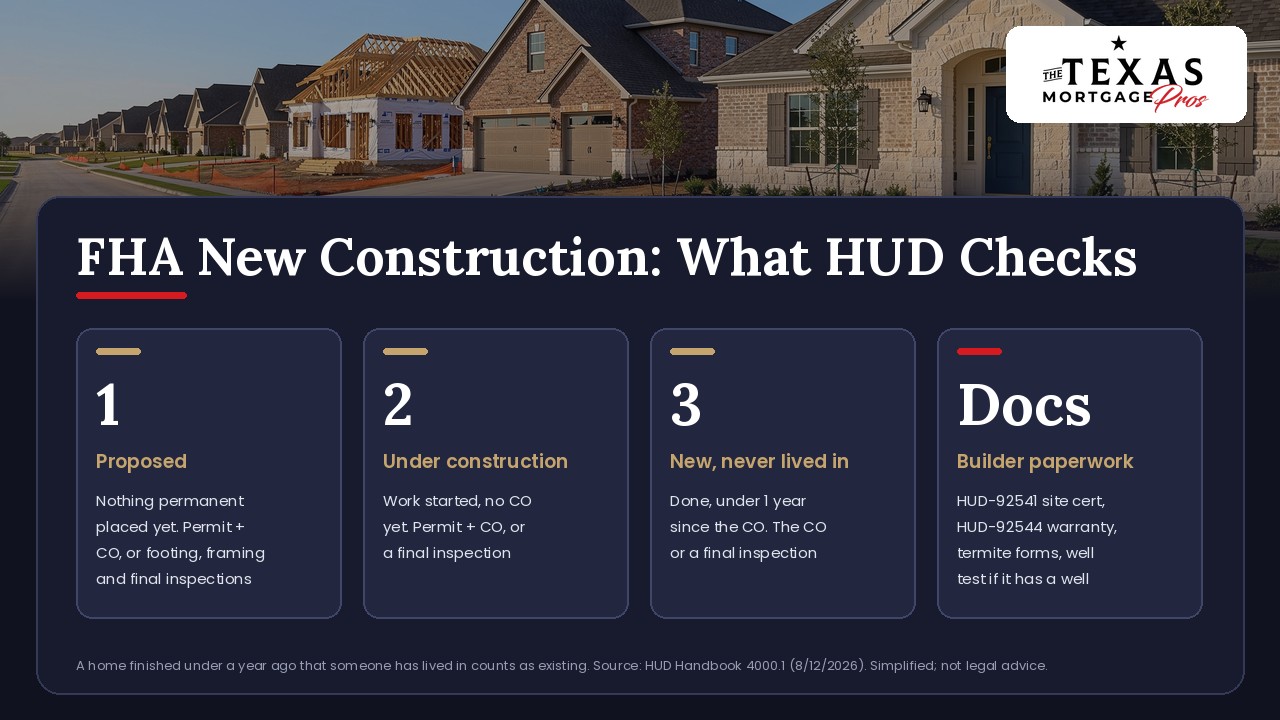
Proposed Construction: before permanent materials are in place
A home is “Proposed Construction” when no concrete or permanent materials have been placed at the site. Digging footings alone does not move the home into the next category.
For a site-built home at this stage, the Mortgagee must obtain one of these:
- Copies of the building permit and certificate of occupancy; or
- Three inspections—footing, framing, and final—performed by the local building authority or an International Code Council-certified inspector; or
- If no local building authority or ICC-certified inspector is available, the same three inspections must be performed by a disinterested licensed and bonded third party, such as a registered architect, structural engineer, or qualified contractor or tradesperson.
This distinction is especially important in unincorporated Texas areas where a local government may not perform building inspections.
Under Construction: permanent work has begun
“Under Construction” begins when the first permanent material is placed and continues until the home is completely finished. The home does not yet have a certificate of occupancy.
For this stage, HUD requires the permit and certificate of occupancy, or a final inspection. Your closing date may depend not only on the builder’s construction schedule but also on when the required inspection record and completion documents are available.
Existing Less Than One Year: complete but never occupied
A home can still be treated as new construction for FHA purposes when it is fully complete, less than one year old from the certificate of occupancy date, and has never been occupied.
For this category, HUD requires a certificate of occupancy or a final inspection. If someone has already occupied the home, FHA treats it as an existing property, even if the home is less than one year old.
This article addresses buying in a subdivision. If you plan to build a home on land you own or are buying separately, that is a different process. Read my guide to an FHA construction loan for building your own home.
Builder documents HUD requires for an FHA new construction file
The exact file requirements depend on the property, construction stage, and site conditions, but several builder documents are central to the process.
Builder’s Certification of Plans, Specifications, and Site
The builder completes HUD-92541, the Builder’s Certification of Plans, Specifications, and Site. This form addresses matters such as site conditions, flood-zone information, and noise considerations.
It must be signed within 30 days before the appraisal is ordered. That timing is one reason I recommend bringing your FHA financing plan into the conversation early rather than waiting until the home is nearly complete.
Warranty of Completion of Construction
HUD-92544 is the Warranty of Completion of Construction. Through this warranty, the builder represents that the home was built in substantial conformity with the plans and specifications.
The one-year notice period matters. The warranty covers cases where the buyer gives the builder written notice of a substantial nonconformity with the plans and specifications within one year after closing or move-in, whichever occurs first. If title transfers before construction is finished, the timing runs from completion or occupancy.
Keep copies of your contract, plans, specifications, finish-out selections, change orders, inspection reports, warranty materials, emails, and written repair requests.
Termite, well, and septic records, where applicable
HUD requires thebuilder’ss subterranean termite protection form, HUD-NPMA-99-A, for all new construction unless the county is on HUD’s Termite Treatment Exception Areas list. If the home was treated, HUD also requires the HUD-NPMA-99-B service record. HUD rejects a post-construction soil treatment applied only around the perimeter of the foundation.
If the home has a private well, HUD requires a water test for newly built homes, collected and tested by a disinterested party and no more than 180 days old at closing. A septic report is required where the local health authority calls for one.
You can review the source requirements in HUD Handbook 4000.1.
The appraisal has special rules in a new subdivision
An FHA appraisal is not a home inspection, but new construction requires the appraiser and FHA Mortgagee to work from specific construction information.
For homes that are 90% complete or less, the appraiser receives the plans and plot plan. For homes that are more than 90% complete but unfinished, the appraiser receives a list of remaining items.
In a new subdivision, HUD requires the appraiser to use:
- At least one comparable sale from inside the subdivision; and
- At least one comparable sale from outside the subdivision.
That requirement can matter when a community is new, has few completed sales, or includes several builders and product types.
Before closing, the FHA Mortgagee must certify that the home is 100% complete and meets HUD’s minimum property requirements and standards. Unfinished items or a missing final document can hold up closing even when most of the home looks finished.
For more on the property-review side of the process, see FHA appraisal requirements in Texas.
Ask about site conditions early
Some site conditions require extra attention under HUD rules:
- A newly constructed home within 75 feet of an operating oil or gas well is not acceptable unless required mitigation is completed.
- A nearby slush pit can require a survey for proposed construction.
- A new home in a Special Flood Hazard Area is rejected unless a FEMA Letter of Map Amendment or Revision removes it from the flood zone, or an elevation certificate shows the lowest floor is built above the 100-year flood elevation. Flood insurance is still required if the home stays in the flood zone.
Address flood questions before you get deep into the contract process. My article on FHA flood insurance in Texas explains why a flood-zone determination deserves close attention.
How builder incentives fit FHA rules
Builder incentives can be legitimate and valuable, particularly when they help cover eligible closing costs or prepaid items. But FHA has specific rules for how they must be documented and counted.
Builders, sellers, and real estate agents are “interested parties” under FHA rules. Their combined contributions may be up to 6% of the sales price for eligible items such as closing costs, prepaid expenses, discount points, buydowns, and the upfront mortgage insurance premium.
The contribution cannot be used for the buyer’s minimum required investment. It also must appear on the sales contract and Closing Disclosure.
Amounts above the permitted limit, or above the buyer’s actual eligible costs, can be treated as an inducement to purchase. HUD lists decorating allowances, repair allowances, moving costs, paying off consumer debt, and personal property as examples. When an inducement applies, it reduces the price used to calculate the FHA loan amount dollar for dollar.
There are important distinctions. Appliances, carpeting, and window treatments that are customary for the area and included before closing with no cash allowance are not treated as inducements.
If the builder offers an incentive, ask these questions before signing:
- What specifically does the incentive cover?
- Is every part of it listed in the contract?
- Is it available regardless of which mortgage company or title company I choose?
- Does the total exceed my actual eligible costs?
- Will a contract amendment be needed if the incentive changes?
For a fuller explanation of seller and interested-party contributions, read Texas seller concessions and FHA loans.
A builder selling a newly built home is also not subject to FHA’s 90-day resale restriction. That rule addresses certain quick resales, not the builder’s sale of its own newly constructed home. My guide to the FHA 90-day flip rule in Texas covers that separate issue.
You can consider the builder’s affiliated mortgage company, but it must be your choice
Many builders have an affiliated mortgage company, title company, or both. It is reasonable to ask that company for a Loan Estimate and to compare its service, timeline, and total quoted costs with other options.
Under the federal RESPA rules in Regulation X, a builder that refers you to an affiliated mortgage or title company should give you a written Affiliated Business Arrangement Disclosure explaining the relationship and estimated charges. The builder cannot require you to use that company. If an incentive is tied to using an affiliate, it must be optional and represent a real discount rather than being offset by higher charges elsewhere. Read the affiliated-business rule in Regulation X.
The Texas Mortgage Pros is a mortgage broker, so we can help you compare FHA loan options and documentation requirements while you evaluate the builder’s offer. The goal is not to criticize a builder’s affiliated company. It is to make sure you understand the choices, incentives, and contract deadlines in front of you.
Read the MUD and PID notices before your contract becomes binding
Many Texas new-home communities are located in a Municipal Utility District (MUD), a Public Improvement District (PID), or both. These districts can affect the property-tax and escrow picture, so they belong in your purchase review.
Under Texas law, a seller of property in a utility district such as a MUD must provide written notice before the contract becomes binding. If the contract is signed without the required notice, the buyer can terminate the contract. If the notice is provided at or before closing and the buyer closes anyway, that right is waived. Read Texas Water Code Chapter 49.
A PID also requires written notice. PID assessments may be paid in full or through annual installments, and the installments can vary.
Ask the builder or sales representative for the MUD and PID notices, current tax information, and any available district documents before you sign. You can also review my overview of Texas property taxes and your mortgage payment.
Your Texas builder contract deserves a careful review
Texas Real Estate Commission forms include separate New Home Contracts for incomplete construction and completed construction. Builders frequently use their own contract forms instead, so do not assume every builder agreement works the same way.
The TREC incomplete-construction form identifies “Construction Documents” as plans, specifications, finish-out schedules, change orders, and allowances. It permits the buyer to hire a TREC-licensed inspector, requires change orders to be in writing, and addresses allowances and comparable material substitutions. It also includes a completion date.
Read the TREC New Home Contract for Incomplete Construction before relying on anyone else’s summary.
Pay particular attention to:
- The planned completion date and any extension language;
- Your inspection rights and timing;
- What is included in the base price;
- Allowances and what happens if selections exceed them;
- Material substitutions;
- Change-order procedures;
- The warranty language;
- Earnest money and termination provisions; and
- Incentives and their conditions.
Texas construction-defect law also matters. The TREC new home contracts point buyers to Texas Property Code Chapter 27: before you file a lawsuit or start arbitration over a construction defect, you must send the contractor written notice by certified mail at least 60 days ahead, describing the defect, and give the contractor an opportunity to inspect and cure it if requested.
This is not legal advice. If you have questions about a builder contract, warranty, dispute provision, construction defect, or district notice, speak with a Texas real estate attorney before signing or taking action.
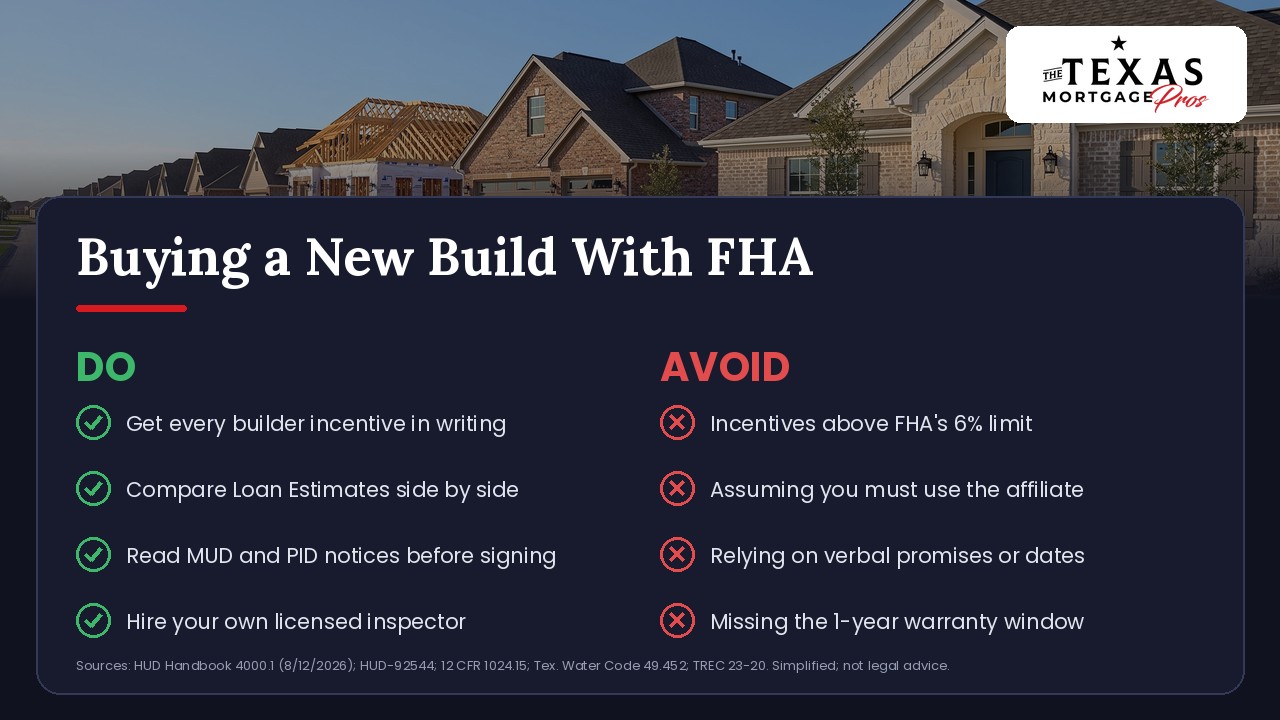
A short FHA new-construction document checklist
Before your builder-contract deadline, ask for or confirm:
- The lot number, plans, elevation, and plot plan;
- Your complete contract and every addendum;
- Finish-out schedule, allowances, and written change orders;
- A written list of builder incentives;
- MUD and PID notices, if applicable;
- Building permit, certificate of occupancy, or applicable inspection records;
- Builder’s Certification of Plans, Specifications, and Site;
- Warranty of Completion of Construction;
- Termite, well-water, and septic documents when applicable;
- The builder’s estimated completion schedule; and
- An Affiliated Business Arrangement Disclosure if the builder refers you to an affiliated mortgage or title company.
Frequently asked questions about FHA new construction in Texas
Q: Can I use an FHA loan for a builder’s quick move-in home?
A: Yes, if the home and your file meet FHA requirements. If it is complete, less than one year past its certificate of occupancy, and has never been occupied, HUD classifies it as Existing Less Than One Year. The certificate of occupancy or final inspection is an important part of the file.
Q: Does FHA require the builder to finish every item before closing?
A: The FHA Mortgagee must certify before closing that the home is 100% complete and meets HUD’s minimum property requirements and standards. Any unfinished work, required repair, or missing final documentation should be addressed before closing.
Q: Can a builder pay my FHA closing costs?
A: A builder may contribute toward eligible costs within FHA’s interested-party contribution rules. The contribution must be properly documented, cannot fund the buyer’s required investment, and may be limited by the actual eligible costs.
Q: Do I have to use the builder’s affiliated mortgage company?
A: No. You may consider the builder’s affiliated mortgage company and compare its Loan Estimate with other options, but the builder cannot require you to use it. Any incentive tied to an affiliated company must be optional.
Before you sign at the sales office, line up your FHA questions
A new construction purchase can be a great way to choose a home, community, and finish-out that fit your plans. The key is recognizing that the lot, builder documents, inspections, appraisal requirements, incentives, and contract terms all need to work together.
Before you sign, pre-qualify for an FHA loan, contact The Texas Mortgage Pros, or call me at (281) 801-6965. I can help you identify the FHA documentation questions to raise while there is still time to evaluate the builder’s contract and timeline.
— Gerry Nicodemus
Sources
- U.S. Department of Housing and Urban Development, Single Family Housing Policy Handbook 4000.1 (last revised August 12, 2026): New Construction (definitions, required inspections, required documentation, documents provided to the Appraiser, Mortgagee review of appraisal, completion of construction); Interested Party Contributions; Inducements to Purchase; Property Flipping exceptions
- U.S. Department of Housing and Urban Development, form HUD-92544, Warranty of Completion of Construction; form HUD-92541, Builder’s Certification of Plans, Specifications, and Site
- National Association of Home Builders, Builder Sentiment Continues to Fall on Affordability Concerns (November 17, 2026)
- HomesUSA.com, Texas New Home Sales Report: October 2026 Charts (November 13, 2026)
- U.S. Census Bureau and U.S. Department of Housing and Urban Development, Monthly New Residential Construction, October 2026 (November 18, 2026)
- Texas Water Code, Section 49.452 (Notice to Purchasers); Texas Property Code, Section 5.014 (Public Improvement District notice) and Chapter 27 (residential construction liability)
- Texas Real Estate Commission, New Home Contract (Incomplete Construction), TREC No. 23-20, and New Home Contract (Completed Construction), TREC No. 24-20
- Consumer Financial Protection Bureau, Regulation X (RESPA), 12 CFR 1024.15 (Affiliated business arrangements) and 1024.2 (definition of required use)
Recommended Reading
- Build Your Forever Home Using an FHA Construction Loan
- Texas Seller Concessions: How Buyers Can Negotiate as Competition Cools
- FHA Appraisal Requirements in Texas: What the Appraiser Checks
TexasFHA.org is not affiliated with or endorsed by the U.S. Department of Housing and Urban Development, the Federal Housing Administration, the Consumer Financial Protection Bureau, the U.S. Census Bureau, the Texas Real Estate Commission, the National Association of Home Builders, HomesUSA.com, any home builder or builder-affiliated company, the State of Texas or any other government agency, and this is not a government document.
The Texas Mortgage Pros, LLC | Company NMLS #2665861 | Gerry Nicodemus, NMLS #286371 | Equal Housing Opportunity | www.nmlsconsumeraccess.org | (281) 801-6965
Equal Housing Opportunity. We do business in accordance with federal fair lending laws.

Gerry Nicodemus (NMLS #286371) is a licensed Texas loan originator with more than 25 years of mortgage experience. He specializes in FHA loans and explains credit, down payment, gift fund, and appraisal rules in plain English so Texas buyers know exactly where they stand. Gerry is also a digital marketer who builds agentic AI systems that help mortgage and real estate professionals get found online and serve borrowers better.