

If you’re buying a Texas home this holiday season, protecting your FHA loan before closing matters more than any doorbuster deal. A new store card, furniture financing plan, car purchase, unexplained deposit, or job change can give the FHA underwriter new information to review. That does not automatically end a home purchase. It can, however, change the timeline, add documentation, or affect the numbers in your file.
TL;DR
- Between pre-approval and closing, the FHA underwriter can recheck your credit, debts, bank deposits, job and documents.
- HUD requires new debts from recent credit inquiries to be counted, and manually underwritten files need a written explanation of inquiries from the last 90 days.
- A single deposit of more than half of your monthly effective income needs a documented source; holiday gifts toward closing should be documented as gifts.
- Employment is reverified within 10 days before the Note, so tell your loan officer about a job change right away.
- Pause store cards, checkout financing, undisclosed buy now, pay later plans, car loans and cosigning until after closing.
- Confirm any change to wire instructions by calling a trusted number, never one from the email.
TexasFHA
Closing on a Home This Holiday Season?
Talk with The Texas Mortgage Pros, a Texas mortgage broker, before you open new credit, move money, or change jobs while your FHA file is in process.
Black Friday shopping meets a slower Texas homebuying season
Holiday promotions can make a purchase feel urgent. On November 23, Deloitte’s 2026 Black Friday and Cyber Monday survey reported that shopping intent for the week from Thanksgiving through Cyber Monday reached a 10-year high. Nearly nine in ten consumers surveyed plan to shop that week, and most said they were holding off on some purchases until then. About four in ten Gen Z shoppers said they plan to use buy now, pay later to finance their purchases.
At the same time, homebuyers may have more time to compare homes and financing choices. On November 18, Texas Public Radio reported that San Antonio home sales dipped in October compared with a year earlier, that the area’s inventory could take nearly six months to sell, and that sellers waited an average of 88 days to close a deal. Statewide, October home sales were also down from a year ago. “Buyers have time to compare options,” said Ed Zapata, the 2026 board chair of the San Antonio Board of Realtors.
That extra time can be useful, but it can also mean more time for financial changes between pre-approval and closing. A pre-approval is an important starting point, not permission to add new monthly obligations without checking first. If you are early in the process, read our guide to mortgage pre-approval in Texas to understand what the review is designed to establish.
What the FHA underwriter rechecks before closing
FHA underwriting is based on the borrower and property information available for the file. Some items must be checked again as closing approaches. The rules are intended to make sure the file reflects the debts, funds, employment, and documents that actually exist when you sign.
The controlling guidance is HUD Handbook 4000.1, FHA’s Single Family Housing Policy Handbook. Here are the rechecks that matter most during the holiday season.
Credit inquiries and new monthly debts
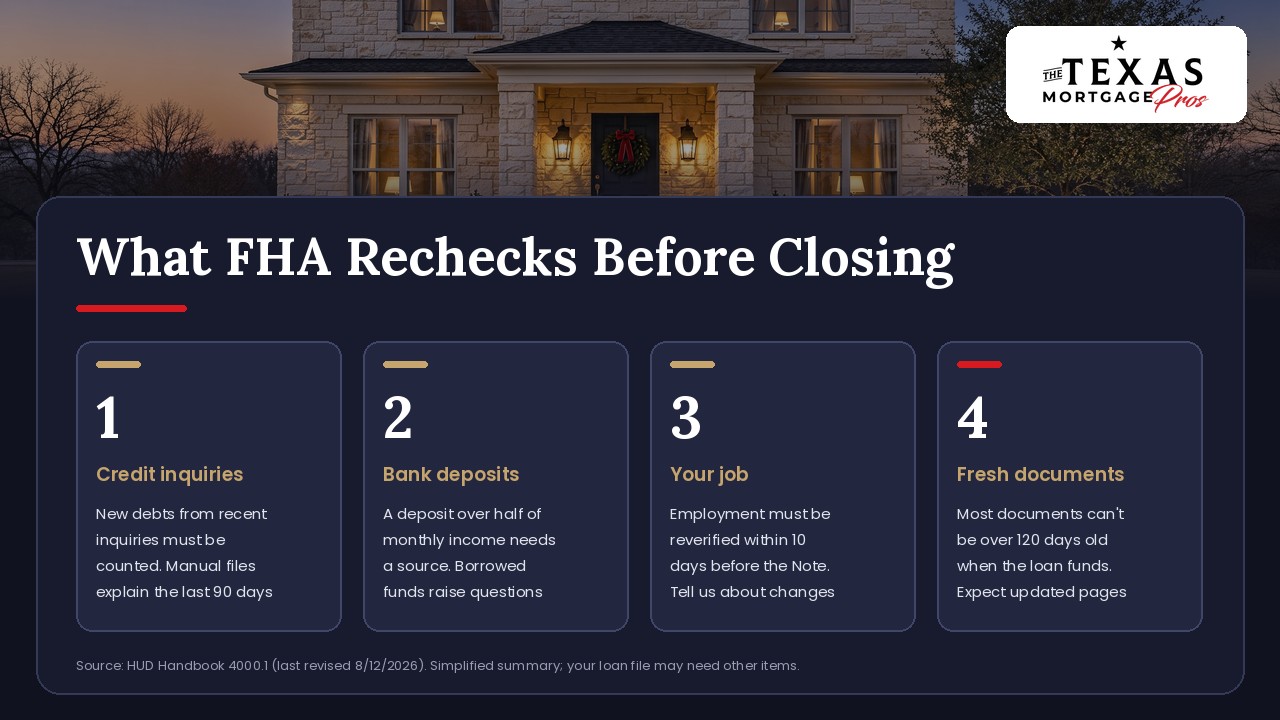
HUD requires the FHA underwriter to review all credit report inquiries and make sure every debt is counted in the debt ratios, including payments from material inquiries that result in new debt. Material inquiries are those that may lead to another mortgage, auto loan, lease, or other installment loan. Department store, credit bureau, and insurance-company inquiries are not treated as material inquiries under this rule.
The FHA underwriter also must determine that recent debts were not taken on to obtain money needed for closing. If an undisclosed debt appears during processing, the actual monthly obligation has to be verified and included. A large enough change can require the file to be evaluated again through FHA’s automated underwriting scorecard.
For a manually underwritten file, the borrower must provide a written explanation for all credit report inquiries made in the prior 90 days. Our overview of FHA manual underwriting in Texas explains why documentation and consistency matter so much in that type of review.
A credit report may be obtained when you apply, for pre-approval, and again just before closing, according to the CFPB’s explanation of mortgage credit checks. Separately, the CFPB says a credit inquiry typically has a small negative effect, and advises consumers to avoid applying for a credit card, car loan, or other loan right before or during the mortgage process. Checking your own credit does not affect your scores. Our guide to FHA credit score requirements explains how scores fit into the rest of the file.
Deposits and the source of closing funds
Your bank statements are not just a snapshot of the current balance. They help the FHA underwriter verify where funds came from. For any single deposit of more than half of your total monthly effective income, HUD requires the underwriter to document the deposit. The file must show that the deposit fits your income and savings history and was not borrowed.
This is why moving money among accounts, depositing holiday cash, or receiving help from family without a paper trail can create questions. It is usually easier to ask before making the deposit than to recreate the source later.
A large earnest money deposit can also need source documentation. If a family member gives you money toward closing, it needs to be handled and documented properly as a gift, not simply deposited as unexplained cash. See our guide to FHA gift funds in Texas before accepting or moving those funds.
Employment close to the Note date
HUD requires employment to be reverified within 10 days before the Note date. A holiday job change, reduced hours, a new commission structure, unpaid leave, or a switch from employee income to self-employment can require the file to be reviewed again.
This does not mean you should turn down a career opportunity. It means you should call your loan officer before making a move, whenever possible. The timing and documentation can matter as much as the change itself.
Document age and a longer timeline
Most documents used for FHA underwriting cannot be more than 120 days old when the loan funds. Appraisals have their own validity rules, and documents that don’t go stale, such as tax returns and divorce decrees, are exceptions. If a closing takes longer than expected, you may need updated pay stubs, account statements, or other documents.
That request is not necessarily a sign that something is wrong. It may simply keep the file current. Promptly providing readable, complete pages can help the review move forward.
Paying off a debt before closing
Paying off a debt may sound like an easy fix, but the source matters. HUD requires funds used to pay off debts before closing to come from an acceptable source, and there cannot be new uncounted debts behind that payoff.
For example, using a newly opened account to eliminate an existing card balance could replace one question with another. Do not shift balances, borrow from someone, or liquidate an asset to pay off debt without first discussing the documentation with your loan officer.
Holiday money moves to avoid with an FHA loan before closing
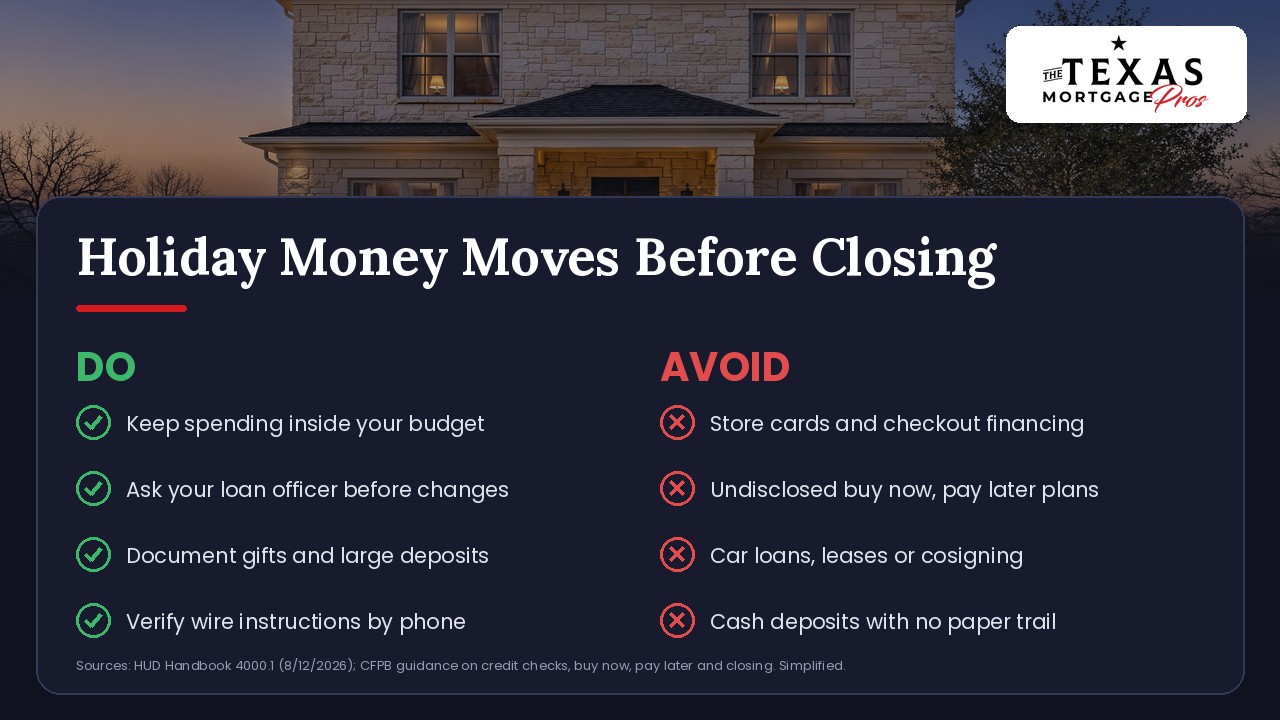
You do not have to stop living your life. The goal is to avoid preventable changes that make the file less clear. These are the holiday moves I would pause until after closing unless your loan officer has reviewed them.
Opening a store card or taking promotional financing
A checkout offer may be framed as a discount or a convenient way to spread out a purchase. It can still create a credit inquiry, a new account, or a monthly debt. A store card may be especially tempting during holiday sales, but it is better to wait.
The same applies to financing furniture, appliances, electronics, or home improvement items for the new house. Even when an offer advertises delayed payments, the application and account can still matter to your mortgage file.
Using buy now, pay later without disclosing it
Buy now, pay later arrangements are not all reported the same way. The CFPB explains that most pay-in-four products do not report payment history to the major credit reporting companies and generally do not involve a hard inquiry. But if a plan isn’t repaid and is turned over to a debt collector, it could be reported and hurt your credit scores. Larger or longer installment products may involve hard inquiries and reporting.
For a buyer with an FHA loan, the important point before closing is broader than a credit score: payments can appear on bank statements, and the obligation should be disclosed. Do not assume that an arrangement is invisible because it did not appear on a credit report. Be direct with your loan officer about any new payment plan.
For more detail, read the CFPB’s guidance on buy now, pay later and credit scores.
Buying or leasing a vehicle
A vehicle purchase or lease is one of the clearest examples of a material credit inquiry and potential new monthly obligation. It can require the debt ratios to be recalculated. If the vehicle is essential, call before you apply, sign, or take delivery.
The same caution applies to co-signing. Even if you are not the person using the car or credit account, a co-signed obligation can affect your financial profile and must be discussed.
Financing the house before you own it
It is understandable to want furniture, appliances, security equipment, and moving supplies ready for move-in day. But financing them before closing can create the same issue as any other new debt.
Make a list instead. Save product links. Ask the seller what conveys with the home. Then revisit the purchases after closing, when your home purchase is complete. If closing costs are part of your budget planning, our explanation of average closing costs in Texas can help you identify the categories to discuss early.
Moving cash or accepting undocumented holiday money
Avoid cash deposits, unexplained transfers, and moving money back and forth between accounts to organize it. Keep a clear trail. If family wants to help, ask first how the gift should be documented.
Do not borrow money for earnest money, closing expenses, or reserves without discussing it. HUD’s rules require the underwriter to determine whether recent debt was used to obtain money needed to close.
Changing jobs, pay structure, or work status
Do not wait until a verification call to mention a job change. Tell your loan officer promptly if you change employers, reduce hours, take leave, move to a different compensation structure, or plan to become self-employed. Employment is reverified close to signing, so this isn’t a detail you can save for later.
Following new wire instructions from an email
Wire fraud is a real risk at any time of year, and the holidays are busy, which makes rushed decisions more likely. Be highly cautious if an email says that wiring instructions, payment details, or account information changed at the last minute. The CFPB’s mortgage closing checklist warns that an email with last-minute changes to payment or wire instructions may be a scam, and suggests contacting the trusted parties you have already identified.
Use a number you already know is legitimate, not one in the unexpected email. Never rush because a message creates pressure.
A safe holiday money plan while your file is in process
A simple plan can let you enjoy the season without creating needless questions for your file.
- Use the budget already reflected in your application. Keep ordinary spending ordinary. If a purchase would require new credit or a new payment plan, pause and ask first.
- Keep accounts stable. Do not close accounts, transfer large sums without a reason and record, or deposit cash without talking with your loan officer.
- Save documents as you go. Keep pay stubs, bank statements, gift records, and receipts or explanations for unusual transactions. Send only what your loan officer requests, but be ready.
- Disclose changes early. New credit, a BNPL plan, a co-signing request, employment news, or a large deposit is easier to address before it appears in a later review.
- Protect your closing information. Compare the Closing Disclosure with your most recent Loan Estimate. By law, you must receive the Closing Disclosure three business days before closing. Confirm any purported wire change by phone through a trusted contact method.
- Keep the home purchase first. Black Friday deals return. A clear, stable file is harder to replace on short notice.
For a broader look at FHA documentation and eligibility, visit our FHA loan requirements page.
If something already changed, act early, not quietly
A holiday purchase, deposit, or employment change does not automatically mean your purchase cannot continue. Do not panic, and do not try to hide it. Contact your loan officer as soon as possible. Explain what changed, when it changed, whether there is a new monthly obligation, and what records you have.
The next step may be simple documentation. In other situations, the FHA underwriter may need to verify a payment, source a deposit, update documents, or reassess the file. The earlier that happens, the more clearly everyone can understand the available path.
If the file stalls, options can vary depending on the facts. You may need time to work on the file and apply for FHA financing later. Other possibilities include Texas down payment assistance, where you still must qualify for a mortgage; a non-QM option; or an Earned Equity rent-to-own program. An Earned Equity program is not a mortgage and is not an FHA loan in your name. Later FHA financing is a possible path, not a guarantee. Our guide for buyers who are not ready for an FHA loan yet compares those paths side by side.
The best outcome doesn’t come from guessing. It comes from giving the loan officer accurate information early enough to review it.
Frequently asked questions about an FHA loan before closing
Q: Can I use buy now, pay later while buying a house?
A: Ask your loan officer before starting any new plan. Some short BNPL arrangements may not appear on a credit report, but payments can show on your bank statements and should be disclosed. Longer installment arrangements can involve a hard inquiry and reporting. The question is not just whether it affects a score, but whether it creates a new obligation or documentation question.
Q: Can I buy furniture before my FHA closing?
A: It is safer to wait, especially if the purchase involves a credit application, promotional financing, or a new payment plan. A cash purchase can also create questions if it changes the funds needed for closing or leads to unusual account activity. Discuss the purchase before committing.
Q: What if my family gives me holiday money for the home purchase?
A: Tell your loan officer before depositing or transferring it. Money intended for closing may need to be documented as an acceptable gift, and the account history needs to make sense. Keep the transaction trail clear rather than depositing cash.
Q: Can I change jobs before closing on an FHA home purchase?
A: A job change can require an updated review because employment must be reverified within 10 days before the Note date. Contact your loan officer before the change when possible, or immediately afterward if it has already happened. The details of the new role, pay structure, and timing all matter.
Wrap up the holidays with the keys in hand
The holiday season can be a good time to shop, compare homes, and prepare for a move. While your FHA file is active, though, the smartest financial move is often the one you postpone. Keep spending and accounts steady, document anything unusual, and speak up quickly when life changes.
If you are preparing to buy in Texas and want to discuss your next steps, you can start an FHA pre-qualification or contact The Texas Mortgage Pros. You can also call me at (281) 801-6965. I’ll help you understand what information the FHA underwriter may need so you can make decisions with a clearer picture.
Gerry Nicodemus
Sources
- Deloitte, 2026 Black Friday-Cyber Monday Survey press release (November 23, 2026)
- Texas Public Radio, San Antonio home sales sluggish but not as bad as Texas, U.S. sales (November 18, 2026), citing the San Antonio Board of Realtors
- U.S. Department of Housing and Urban Development, Single Family Housing Policy Handbook 4000.1 (last revised August 12, 2026): Evaluating Liabilities and Debts; Undisclosed Debt and Inquiries; Checking and Savings Accounts; Earnest Money Deposit; Employment reverification; Maximum Age of Mortgage Documents
- Consumer Financial Protection Bureau, Ask CFPB: when a credit report is obtained; what happens when a mortgage credit check is made; Buy Now, Pay Later loans and credit scores
- Consumer Financial Protection Bureau, Mortgage Closing Checklist
- TexasFHA.org, Not Ready for an FHA Loan Yet? Your Texas Options (as published November 2026)
Recommended Reading
- Mortgage Pre-Approval in Texas: Your 2026 Buying Guide
- FHA Gift Funds in Texas: Rules for Using Family Money
- Texas Closing Costs: State Rules and County Tax Swings
TexasFHA.org is not affiliated with or endorsed by the U.S. Department of Housing and Urban Development, the Federal Housing Administration, the Consumer Financial Protection Bureau, Deloitte, Texas Public Radio, the San Antonio Board of Realtors, or any other government agency, and this is not a government document.
The Texas Mortgage Pros, LLC | Company NMLS #2665861 | Gerry Nicodemus, NMLS #286371 | Equal Housing Opportunity | www.nmlsconsumeraccess.org | (281) 801-6965
Equal Housing Opportunity. We do business in accordance with federal fair lending laws.

Gerry Nicodemus (NMLS #286371) is a licensed Texas loan originator with more than 25 years of mortgage experience. He specializes in FHA loans and explains credit, down payment, gift fund, and appraisal rules in plain English so Texas buyers know exactly where they stand. Gerry is also a digital marketer who builds agentic AI systems that help mortgage and real estate professionals get found online and serve borrowers better.