

FHA student loan guidelines determine how much of your student debt counts when you apply for an FHA loan, and for millions of borrowers, that number will change this fall. With the SAVE repayment plan gone, many people are picking new plans or being moved into one, and their monthly payment may go up or down. If you’re a Texas buyer with student loans, it helps to know which payment FHA will use, what paperwork your mortgage broker will need, and what to fix before you apply.
TL;DR:
- FHA counts every student loan in your monthly debts, whether it’s in repayment, deferred, in forbearance or on an income-driven plan.
- If your credit report shows a payment above zero, that payment (or your documented payment) is used. If it shows zero, FHA uses 0.5 percent of the balance.
- Former SAVE borrowers who don’t pick a new plan by their final deadline are placed in a fixed plan, so get your new payment in writing.
- A defaulted federal student loan makes you ineligible for FHA until it is resolved.
- Texas is a community property state, so a non-borrowing spouse’s debts, including student loans, generally count in FHA’s ratios.
Table of Contents
- Why Should Texas Buyers With Student Loans Pay Attention Now?
- How Do FHA Student Loan Guidelines Count Your Payment?
- What Documents Will Your Mortgage Broker Need?
- What If a Federal Student Loan Is in Default?
- Do Co-Signed Loans and a Spouse’s Debts Count in Texas?
- Questions to Ask Your Mortgage Broker
- Student Loan Do’s and Don’ts
- Talk Through Your Options
- Sources
Why Should Texas Buyers With Student Loans Pay Attention Now?
The SAVE plan is over. According to Federal Student Aid, a court order ended the Saving on a Valuable Education (SAVE) Plan in March 2026, and every SAVE borrower has to choose another repayment plan. Servicers began sending notices on July 1, 2026, giving borrowers 90 days to choose. Anyone who misses that window gets a final 30-day notice. Borrowers who still don’t choose are placed in the Standard Repayment Plan, or the Tiered Standard Plan, and Federal Student Aid warns that payments on those plans may be higher than on an income-driven plan. Servicers will notify every SAVE borrower before the end of 2026.
The first of those final deadlines is close. Borrowers could move into a fixed plan as early as November 1, and an Education Department spokesperson said nearly 2 million of the 7.5 million SAVE borrowers had chosen a new plan. The same report cited Federal Student Aid data showing 9.3 million borrowers in default, with another 1.3 million expected to default over the next six months.
For homebuyers, this matters because your student loan payment counts toward your debt-to-income ratio. A payment that changes mid-home search can change the numbers your mortgage broker uses, and a missed payment during the switch can affect your credit.
How Do FHA Student Loan Guidelines Count Your Payment?
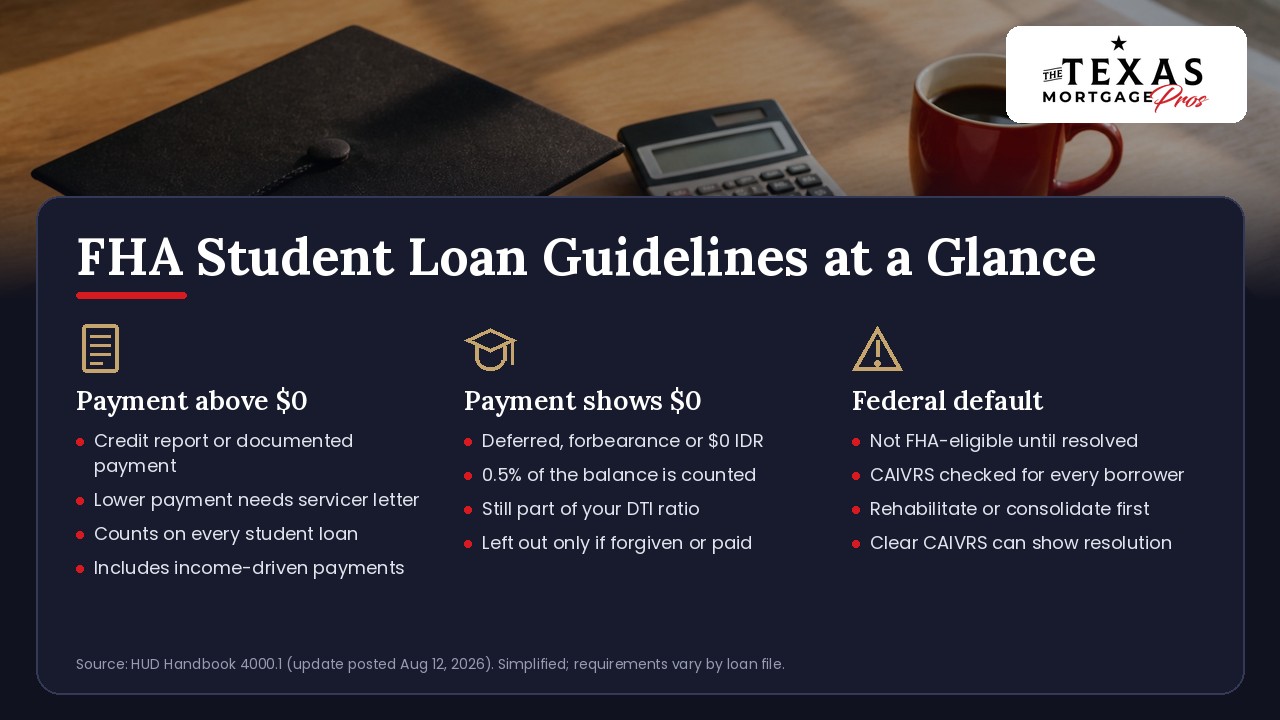
HUD’s Single Family Housing Policy Handbook 4000.1 sets the rules. The mortgage company must include all your student loans in your liabilities, regardless of your payment plan or whether payments are currently due. That covers federal and private student loans, loans in deferment or forbearance, and loans on income-driven plans.
For the monthly amount, HUD tells the mortgage company to use:
- The payment on your credit report, or your actual documented payment, when it’s above zero. If you’re on an income-driven plan with a real monthly payment, you can use that payment, with documentation, if it’s lower than what the credit report shows.
- 0.5 percent of the outstanding balance when your credit report shows a zero payment. A deferred loan, a loan in forbearance, or a zero-dollar income-driven payment does not count as zero for FHA. Instead, the 0.5 percent figure is added to your monthly debts.
You can exclude a student loan from your debts only if you have written documentation from the student loan program, creditor, or servicer showing the balance was forgiven, canceled, discharged, or paid in full. HUD’s August 12, 2026 handbook update also removed an older COVID-19 exception that let mortgage companies use a payment from before the pandemic payment pause, so current servicer paperwork matters more than old statements. Manually underwritten loans follow the same student loan rules.
Our page on debt-to-income ratios explains how your monthly debts are compared with your income, and our FHA income requirements guide covers the income side.
What Documents Will Your Mortgage Broker Need?

If the payment your mortgage broker uses is lower than the payment on your credit report, HUD requires written documentation from the creditor or student loan servicer showing your actual monthly payment, payment status, outstanding balance, and terms. Credit reports often lag behind plan changes, so this paperwork can make a real difference.
- Your servicer notices. Federal Student Aid says your servicer will tell you your new monthly payment at least 21 days before the first due date on a new plan. Save that notice.
- A current statement or payment letter. It should show the plan, the monthly payment, the balance, and whether the loan is in repayment, deferment, or forbearance.
- Proof of forgiveness or discharge, if any loan was forgiven, canceled, discharged, or paid in full.
- Your StudentAid.gov account. Log in to confirm which plan you’re on and which servicer holds your loans.
The U.S. Department of Education has also extended a temporary interest-rate reduction on federal student loans for borrowers who enroll in auto pay by December 31, 2026, according to the Department’s September 29 announcement and USA Today’s October 26 report. Auto pay can also help you avoid a missed payment while you’re getting ready to buy. Ask your servicer whether it applies to your loans. It doesn’t change how FHA counts the payment.
Late payments also show up on your credit report. Our post on mortgage credit score changes explains how credit is reviewed.
What If a Federal Student Loan Is in Default?
A defaulted federal student loan is a bigger problem than a high payment. Under HUD 4000.1, a borrower with delinquent federal non-tax debt isn’t eligible for an FHA-insured mortgage until the debt is resolved with the agency owed. Every borrower is checked against HUD’s Credit Alert Verification Reporting System (CAIVRS). If a federal debt shows up, the mortgage company must verify it with the agency, and it can’t deny an application based only on unverified CAIVRS information. Proof of resolution can come from the agency or from a clear CAIVRS report.
Federal Student Aid lists rehabilitation and consolidation as the two main ways out of default. Rehabilitation means agreeing in writing to nine voluntary, reasonable, and affordable monthly payments, made within 20 days of the due date during 9 or 10 consecutive months. Rehabilitation can remove the default record from your credit history. Consolidation can be quicker but does not remove that record. On September 30, the Department of Education and the Treasury launched a Defaulted Loans Support Center at StudentAid.gov/default-support, where borrowers can compare options and apply online.
If you think one of your loans is in default, start there and tell your mortgage broker early. Ask what documentation will show the debt is resolved before you sign a home purchase contract. The Consumer Financial Protection Bureau’s student loan resources can also help you understand your options.
Do Co-Signed Loans and a Spouse’s Debts Count in Texas?
Co-signed loans. If you co-signed a student loan for a child, sibling, or friend, FHA counts that payment as your debt unless your mortgage broker can document that the other person has made on-time payments for the last 12 months.
Your spouse’s debts. Texas is a community property state. In community property states, HUD requires the debts of a non-borrowing spouse to be included in your qualifying ratios unless state law specifically excludes them. That means your spouse’s student loan payment can count even if only you are applying. HUD also says a non-borrowing spouse’s credit history can’t be used to deny the application. If you’re married, bring your spouse’s student loan information to your first conversation with your mortgage broker.
Before you start shopping, our guide to mortgage pre-approval in Texas covers what to have ready.
Questions to Ask Your Mortgage Broker
Bring your latest servicer notice and statement:
- Which student loan payment should I use for each loan?
- My credit report shows a different payment than my servicer. What documentation do you need?
- I’m switching off SAVE. Should I wait to apply until I have my new payment?
- Does a co-signed student loan count against me?
- How will Texas community property rules handle my spouse’s student loans?
- If I defaulted, what proof of resolution do you need?
Student Loan Do’s and Don’ts
Do:
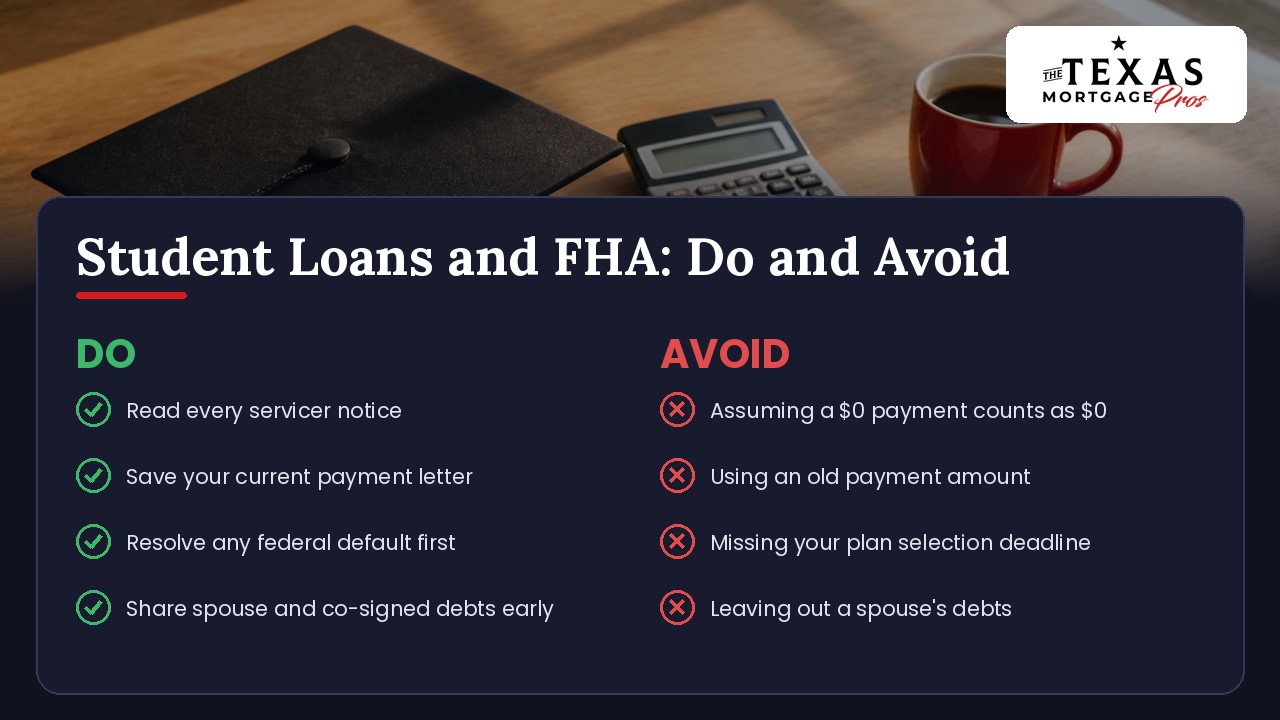
- Read every servicer notice, including the 90-day and final 30-day notices if you were on SAVE.
- Save your current payment letter so your broker can document the payment you actually owe.
- Resolve any federal default first, before you make an offer.
- Share spouse and co-signed debts early so there are no surprises in underwriting.
Avoid:
- Assuming a $0 payment counts as $0. FHA uses 0.5 percent of the balance instead.
- Using an old payment amount. Pre-pause or pre-SAVE figures may no longer apply.
- Missing your plan selection deadline. You could be moved into a fixed plan you didn’t choose.
- Leaving out a spouse’s debts. In Texas, they generally count, even if your spouse isn’t applying.
— Gerry Nicodemus
Talk Through Your Options
Student loans don’t rule out an FHA loan, but FHA student loan guidelines are specific, and this fall’s plan changes make good paperwork more important. If you have student loans and want to know how they may affect an FHA application, call (281) 801-6965 to talk with a mortgage professional at The Texas Mortgage Pros, a mortgage broker. You can also review our FHA loan requirements, start with FHA pre-qualification, or contact us online.
TexasFHA.org is not affiliated with, endorsed by, or sponsored by HUD, FHA, the U.S. Department of Education, Federal Student Aid, the U.S. Department of the Treasury, the IRS, the Consumer Financial Protection Bureau, Business Insider, USA Today, or any other organization or government agency named in this article. Third-party names are used only to cite their published information.
The Texas Mortgage Pros, LLC | Company NMLS #2665861 | Gerry Nicodemus, NMLS #286371 | Equal Housing Opportunity | www.nmlsconsumeraccess.org | (281) 801-6965
Sources
- U.S. Department of Housing and Urban Development, Single Family Housing Policy Handbook 4000.1 (Student Loans, II.A.4.b.iv(H) and II.A.5; Non-Borrowing Spouse Debt; Contingent Liabilities; Delinquent Federal Non-Tax Debt, II.A.1; update posted August 12, 2026)
- Business Insider, The first deadline for student-loan borrowers to pick a new repayment plan is approaching after a 30-day extension (October 27, 2026)
- Federal Student Aid, SAVE Plan Borrowers: FAQs About Choosing a Different Repayment Plan
- U.S. Department of Education, Extends Enrollment Period for Student Loan Interest Rate Reduction (September 29, 2026)
- USA Today, How long can I reduce my student loan interest rate? (October 26, 2026)
- U.S. Department of Education and U.S. Department of the Treasury, Launch New Defaulted Loans Support Center (September 30, 2026)
- Federal Student Aid, Defaulted Loans Support Center
- Federal Student Aid, Getting Out of Default
- Internal Revenue Service, Publication 555, Community Property
- Consumer Financial Protection Bureau, Student Loans
Recommended
- Mortgage Credit Score Changes: What Texas Buyers Should Know About VantageScore 4.0
- FHA Income Requirements: What Texas Buyers Need to Qualify
- FHA Charge-Off Guidelines: What Borrowers Need to Know

Gerry Nicodemus (NMLS #286371) is a licensed Texas loan originator with more than 25 years of mortgage experience. He specializes in FHA loans and explains credit, down payment, gift fund, and appraisal rules in plain English so Texas buyers know exactly where they stand. Gerry is also a digital marketer who builds agentic AI systems that help mortgage and real estate professionals get found online and serve borrowers better.