

An FHA 203(k) renovation loan lets a Texas buyer roll a home’s price and the cost of eligible repairs into one FHA-insured mortgage at closing. The repair money goes into an escrow account and is paid out as the work gets done. A Limited 203(k) covers nonstructural work up to $75,000 in total repair costs. A Standard 203(k) covers bigger or structural projects and requires a HUD-approved 203(k) Consultant. This fall, Texas buyers have more homes to choose from, and FHA leaders are openly talking about making the program easier to use, so it is worth knowing how it works before you write an offer on a house that needs work.
TL;DR:
- A 203(k) combines the purchase and eligible repairs in one FHA-insured mortgage. Repair funds sit in an escrow account and are released in draws as work is completed.
- Limited 203(k): nonstructural work, total repair costs up to $75,000, consultant optional, up to nine months to finish.
- Standard 203(k): major or structural work, at least $5,000 in repairs, HUD-approved consultant required, up to 12 months to finish.
- Since June 23, 2026, a Limited 203(k) can use up to four draws per contractor instead of two.
- On October 13, an FHA official said a shortage of HUD-approved consultants is holding back the Standard 203(k). No rule change has been announced.
Table of Contents
- Why Are FHA 203(k) Loans in the News?
- How Does an FHA 203(k) Renovation Loan Work?
- Limited 203(k) vs. Standard 203(k)
- What Can You Fix With a 203(k)?
- Choosing a Consultant and Contractors in Texas
- How Draws and the Repair Escrow Work
- What Happens After Closing?
- Questions to Ask Your Mortgage Broker
- FHA 203(k) Do’s and Don’ts
- Talk Through Your Options
- Sources
Why Are FHA 203(k) Loans in the News?
At a national mortgage industry convention in Chicago on October 13, FHA Deputy Assistant Secretary Matt Jones said a shortage of HUD-approved consultants is limiting the Standard 203(k). He called the lack of consultants “a headwind” and said FHA would like to look at the issue while keeping the safeguards consultants provide. According to the report, the program reaches only 3,000 to 4,000 units a year, and Ginnie Mae President Joe Gormley said renovation products remain underdeveloped relative to their potential. These were comments, not a policy change. Today’s rules still apply.
One change is already in effect. FHA raised the maximum number of draws on a Limited 203(k) from two to four per contractor. FHA said the old two-draw limit no longer fits the higher repair costs allowed since 2024 and could disrupt contractor cash flow, increasing the risk of delays.
The Texas market adds a reason to pay attention. The Texas REALTORS® 2026 Q3 Texas Quarterly Housing Report found active listings up 2.8% statewide from a year earlier, more homes available in 18 of 26 metro areas, and 5.5 months of inventory. With more choices and more time, a dated house that other buyers skip may be worth a closer look, as long as the repair plan and the numbers work.
How Does an FHA 203(k) Renovation Loan Work?
Under HUD’s Single Family Housing Policy Handbook 4000.1, you can use a 203(k) to buy and repair a one- to four-unit home, refinance and repair a home you own, or fix up the interior of an eligible condominium unit. For a buyer, the main steps look like this:
- The home must already exist. HUD requires the property to have been completed for at least one year before it assigns an FHA case number. A home may not qualify for a regular FHA loan because of health, safety, or security problems, but it may still qualify if the 203(k) work will fix those problems.
- The repair plan comes first. For a Standard 203(k), the consultant inspects the home and writes a Work Write-Up and Cost Estimate. For a Limited 203(k), you submit a work plan and written bids from your contractors.
- The appraisal looks ahead. An FHA Roster appraiser receives the repair plan and bids and appraises the home “subject to” the work, which sets the After Improved Value. That value, not the cost of your wish list, determines how much you can finance.
- Your contract has to say so. HUD requires the sales contract to state that you applied for 203(k) financing and that the contract depends on mortgage approval and your acceptance of any additional required repairs. Ask your real estate agent how to write that into your Texas contract.
- There is one closing. The repair funds go into an interest-bearing rehabilitation escrow account. You sign the Rehabilitation Loan Agreement and form HUD-92700-A (the 203(k) Borrower’s Acknowledgment), and work starts after closing.
Our guide to mortgage pre-approval in Texas covers what to have ready before you make an offer.
Limited 203(k) vs. Standard 203(k)
HUD’s 203(k) program page and the handbook describe two versions:
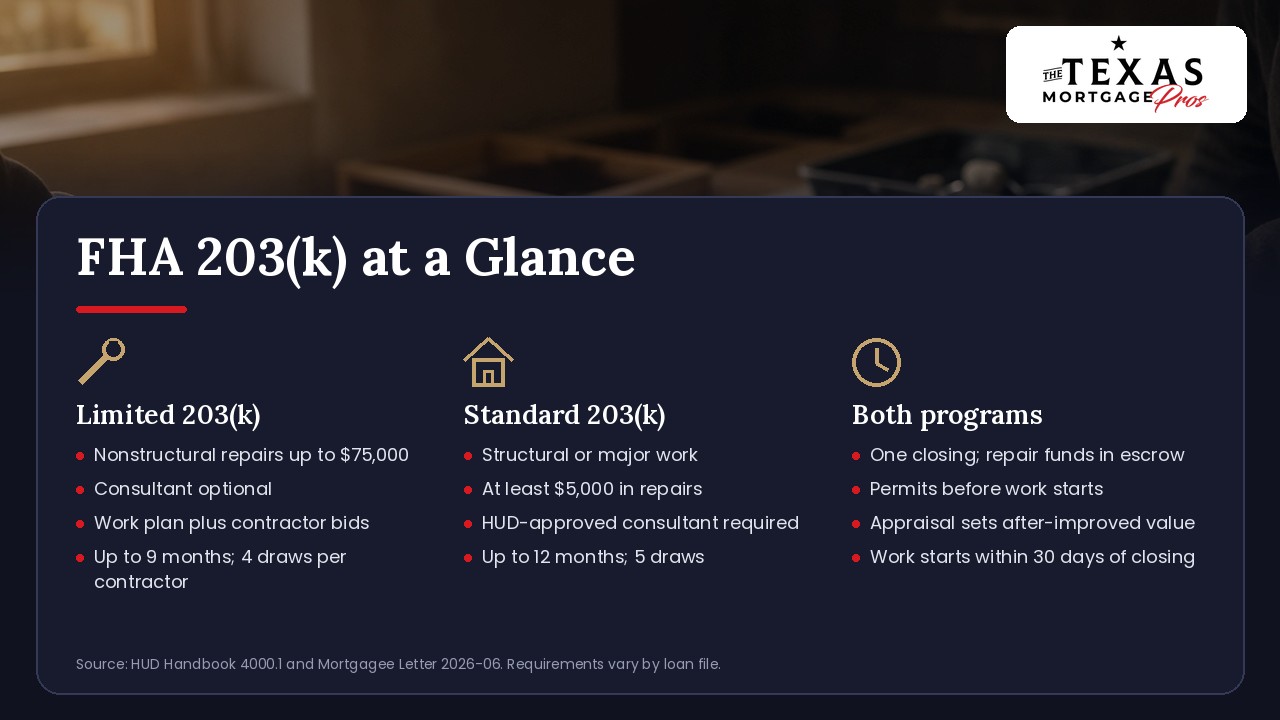
- Limited 203(k). For minor remodeling and nonstructural repairs. Total repair costs cannot exceed $75,000. A consultant is optional. Work must be finished within nine months.
- Standard 203(k). For major remodeling and structural work, such as foundation repair, room additions, or finishing an attic. It requires at least $5,000 in eligible improvements and a HUD-approved 203(k) Consultant. Work must be finished within 12 months.
HUD treats a project as “major,” and therefore not a fit for the Limited 203(k), if any of these apply: the work is expected to take more than nine months, it needs more than four draws per contractor, the repairs the appraiser calls for need a consultant’s work write-up or architectural plans, or the work would keep you out of the home for more than a total of 30 days.
What Can You Fix With a 203(k)?
HUD’s lists are long. For a Limited 203(k), eligible work includes:
- fixing health and safety hazards that would fail HUD’s Minimum Property Requirements;
- repairing or replacing plumbing, heating, air conditioning, and electrical systems;
- new roofing, siding, gutters and downspouts, as long as the structure is not affected;
- energy improvements, accessibility changes, smoke detectors, new kitchen appliances and a washer and dryer;
- fences, walkways, driveways, decks, patios and porches, and repairing or removing an existing in-ground pool; and
- lead-based paint stabilization on homes built before 1978.
A Standard 203(k) also covers structural work, such as foundation repair, additions, garages, and converting a one-family home into two to four units. Neither version pays for luxury or recreational items like a new swimming pool, hot tub, outdoor fireplace, barbecue pit, tennis court or gazebo, or for space used for a business. All work must meet HUD’s Minimum Property Requirements and local building codes.
If the home was built before 1978, ask about lead. The EPA’s Renovation, Repair and Painting Rule requires anyone paid to disturb painted surfaces in a pre-1978 home to be certified and trained in lead-safe work practices. HUD will not release 203(k) funds for lead-based paint stabilization until an independent certified inspector or risk assessor confirms clearance.
Not sure what the house needs? Our post on FHA appraisal requirements in Texas explains the repairs an FHA appraiser is likely to flag. A 203(k) is one way to pay for them.
Choosing a Consultant and Contractors in Texas

The consultant and your contractors play a major role in whether a 203(k) goes smoothly.
- The consultant. On a Standard 203(k), the mortgage company must choose a consultant who is active on HUD’s 203(k) Consultant Roster for Texas. If you want a feasibility study before you commit, a consultant can prepare one, and you may then use the same consultant for the project. Given the shortage FHA described in October, ask about consultant availability before your contract deadlines start running.
- The contractors. HUD requires contractors to be licensed and bonded where the local jurisdiction requires it, and the mortgage company must review their credentials, experience, and references. Each contractor must agree in writing to do the work for the bid amount and within the time allowed. In Texas, the Texas Department of Licensing and Regulation licenses electricians and air conditioning and refrigeration contractors, and the Texas State Board of Plumbing Examiners licenses plumbers. Both offer online license searches.
- Permits. HUD requires you to obtain building permits before work starts. Your city or county decides which permits you need.
- Doing your own work. HUD allows it only if you can show the right license or experience, and you are reimbursed for materials only, not your labor.
Still get a home inspection. HUD requires the consultant to agree in writing that the consultant’s inspection is not a home inspection. HUD’s notice For Your Protection: Get a Home Inspection says FHA does not inspect the home for you. In Texas, hire an inspector licensed by the Texas Real Estate Commission (TREC), ideally during the option period. A good inspection report can also help you build your repair list.
How Draws and the Repair Escrow Work
A 203(k) doesn’t give you a lump sum. The repair money is held in the rehabilitation escrow account and paid out in draws:
- Limited 203(k): up to four draws per contractor (an initial draw at closing, no more than two draws during the work, and a final draw). Each draw can be split into two separate payments. At closing, up to half of the estimated materials and labor can be paid in advance, but only if the contractor will not or cannot wait for payment, or the money covers materials bought before work starts.
- Standard 203(k): up to five draws (four during the work and one final), and a draw can include several payments.
- Proof before payment. Funds are released only for completed work that meets codes and permit requirements. The mortgage company collects lien waivers with each payment and holds back part of each draw until the work is complete and accepted. On a Limited 203(k) with total repairs over $15,000, someone must inspect the finished work. At or below that amount, receipts or your signed letter of completion can be enough.
- Timely release. HUD requires the mortgage company to release funds within five business days of a properly completed draw request.
On a Standard 203(k), a contingency reserve, money set aside for surprises, is required for homes 30 years or older and for newer homes with evidence of termite damage. The mortgage company must approve a written change order for any health and safety problems found during the work before the work is done.
What Happens After Closing?
The clock starts when the mortgage is funded. HUD’s handbook says the mortgage company may treat the loan as in default if work:
- has not started within 30 days of closing;
- stops for more than 30 days in a row; or
- is not finished within the time in your Rehabilitation Loan Agreement (no more than nine months for a Limited 203(k) or 12 months for a Standard 203(k)), unless an extension is approved.
You can ask for an extension with an explanation and a new completion date, but the mortgage company decides, and it can only say yes if your mortgage is current or you are following an approved forbearance plan. If the work never gets finished, you can apply unused repair money to your loan balance instead. In a state where weather and contractor schedules can shift, build slack into your plan and keep receipts, permits, and lien waivers in one place.
Questions to Ask Your Mortgage Broker
Bring your repair list and any inspection report:
- Does my project fit a Limited 203(k), or does it need a Standard 203(k)?
- What bids, contractor documents, and permits should I gather before I make an offer?
- If I need a Standard 203(k), how quickly can a HUD-approved consultant get to the property?
- How will draws, inspections, lien waivers, and holdbacks work for my contractors?
- How should the 203(k) provision be written into my TREC contract? Ask your real estate agent, too.
- What happens if the appraisal’s after-improved value comes in lower than expected, or the scope changes?
FHA 203(k) Do’s and Don’ts
Do:
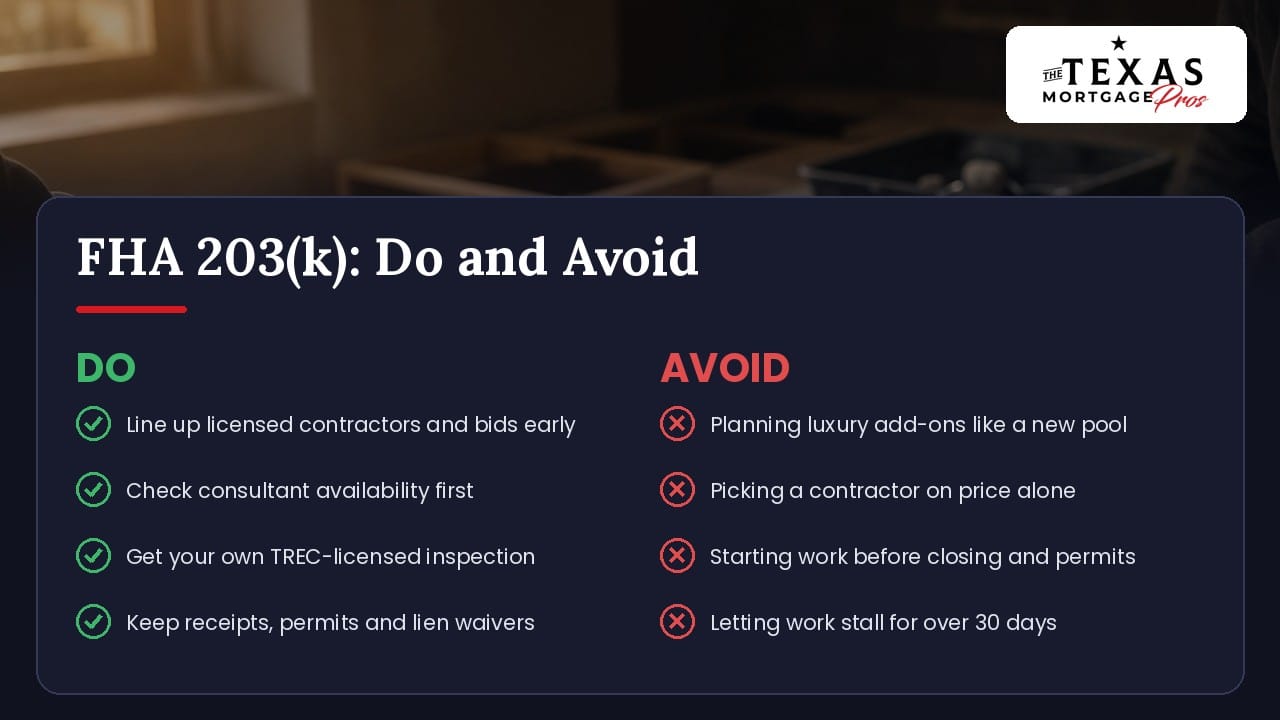
- Line up licensed contractors and written bids early, before your option period ends.
- Check consultant availability first, before you make an offer, if the project may need a Standard 203(k).
- Get your own TREC-licensed inspection. The consultant’s visit and the appraisal are not home inspections.
- Keep receipts, permits, and lien waivers together so you can release each draw on time.
Avoid:
- Planning luxury add-ons like a new pool. HUD does not allow them in either version.
- Picking a contractor on price alone. Credentials, references, and a realistic schedule matter.
- Starting work before closing and permits. Funds are released only for permitted work done under the loan.
- Letting work stall for over 30 days. The mortgage company can treat that as a default.
— Gerry Nicodemus
Talk Through Your Options
An FHA 203(k) renovation loan takes more planning than a regular purchase, but it can finance a house that needs work in one step. If you have found a Texas home with an old roof, dated systems, or a kitchen that needs help, call (281) 801-6965 to talk with a mortgage professional at The Texas Mortgage Pros, a mortgage broker, about whether a Limited or Standard 203(k) fits your project. You can also read more about FHA 203(k) loans, review our FHA loan requirements, or contact us online.
The Texas Mortgage Pros, LLC | Company NMLS #2665861 | Gerry Nicodemus, NMLS #286371 | Equal Housing Opportunity | www.nmlsconsumeraccess.org | (281) 801-6965
Sources
- U.S. Department of Housing and Urban Development, Single Family Housing Policy Handbook 4000.1 (203(k) Rehabilitation Mortgage Insurance Program, II.A.8.a; update posted August 12, 2026)
- HUD, Mortgagee Letter 2026-06, Increase in the Maximum Number of Draw Requests for Limited 203(k) Rehabilitation Mortgage Insurance Program (June 23, 2026)
- HUD, 203(k) Rehabilitation Mortgage Insurance Program Types
- HUD, 203(k) Consultant Search
- HUD/FHA, For Your Protection: Get a Home Inspection (form HUD-92564-CN)
- HousingWire, HUD Eyes 203(k) Renovation Changes to Boost Housing Supply (October 13, 2026)
- Texas REALTORS®, Texas Homebuyers Had More Options in Q3 of 2026 (October 20, 2026)
- U.S. Environmental Protection Agency, Lead Renovation, Repair and Painting Program
- Texas Department of Licensing and Regulation, Electricians
- Texas Department of Licensing and Regulation, Air Conditioning and Refrigeration Contractors
- Texas State Board of Plumbing Examiners
- Texas Real Estate Commission, What Consumers Should Know About Texas Property Inspections
- Texas Real Estate Commission, One to Four Family Residential Contract (Resale), TREC No. 20-18
Recommended
- FHA Appraisal Requirements in Texas: What the Appraiser Checks
- Texas Seller Concessions: How Buyers Can Negotiate as Competition Cools
- Mortgage Pre-Approval in Texas: Your 2026 Buying Guide

Gerry Nicodemus (NMLS #286371) is a licensed Texas loan originator with more than 25 years of mortgage experience. He specializes in FHA loans and explains credit, down payment, gift fund, and appraisal rules in plain English so Texas buyers know exactly where they stand. Gerry is also a digital marketer who builds agentic AI systems that help mortgage and real estate professionals get found online and serve borrowers better.