

HUD 4000.1 does not require borrowers to pay off charge-off accounts before qualifying for an FHA-insured loan. That is the bottom line, and it comes directly from the FHA’s governing handbook, not from a lender’s marketing page. If a lender tells you otherwise, you have options.
Here is what to do right now:
- Please confirm that the lender’s requirement is a written policy, not a verbal assumption.
- Ask for documentation explaining why payoff is required under their underwriting guidelines.
- If the lender cannot produce a written policy grounded in FHA rules, consider shopping other FHA-approved lenders. TexasFHA works with borrowers who have charge-offs and applies FHA guidelines as written.
Table of Contents
- What HUD 4000.1 actually says about charge-offs
- Charge-off vs. collection vs. judgment: why the difference matters
- How charge-offs affect your debt-to-income ratio under FHA rules
- Automated vs. manual underwriting when charge-offs appear on your file
- Why some lenders still require payoff (lender overlays explained)
- When underwriters ask for a Letter of Explanation (and a template you can use)
- Should you pay a charge-off before applying for an FHA loan?
- Special treatment for medical charge-offs and collections
- How charge-offs can affect your credit score and mortgage pricing
- Key Takeaways
- A lender’s perspective on files with charge-offs
- TexasFHA helps borrowers with charge-offs get to closing
- Primary references and further reading
What HUD 4000.1 actually says about charge-offs
The HUD Single Family Housing Policy Handbook 4000.1 is the definitive source for FHA underwriting rules, and its treatment of charge-offs is more borrower-friendly than many people expect. As of 2026, the handbook does not list charge-off payoff as a condition of FHA loan approval.
HUD 4000.1 (as of 2026): Charge-off accounts are not required to be paid off as a condition of FHA mortgage approval. Lenders must document whether the charge-off resulted from extenuating circumstances or from borrower disregard for financial obligations, and borrowers may be asked to provide a Letter of Explanation with supporting documentation.
Two specific obligations fall on the lender, not the borrower. First, the lender must analyze the charge-off to determine its cause. Second, if the cause is unclear, the lender must request a Letter of Explanation (LOE) and any supporting documents that clarify the circumstances. Neither obligation translates into a mandatory payoff.
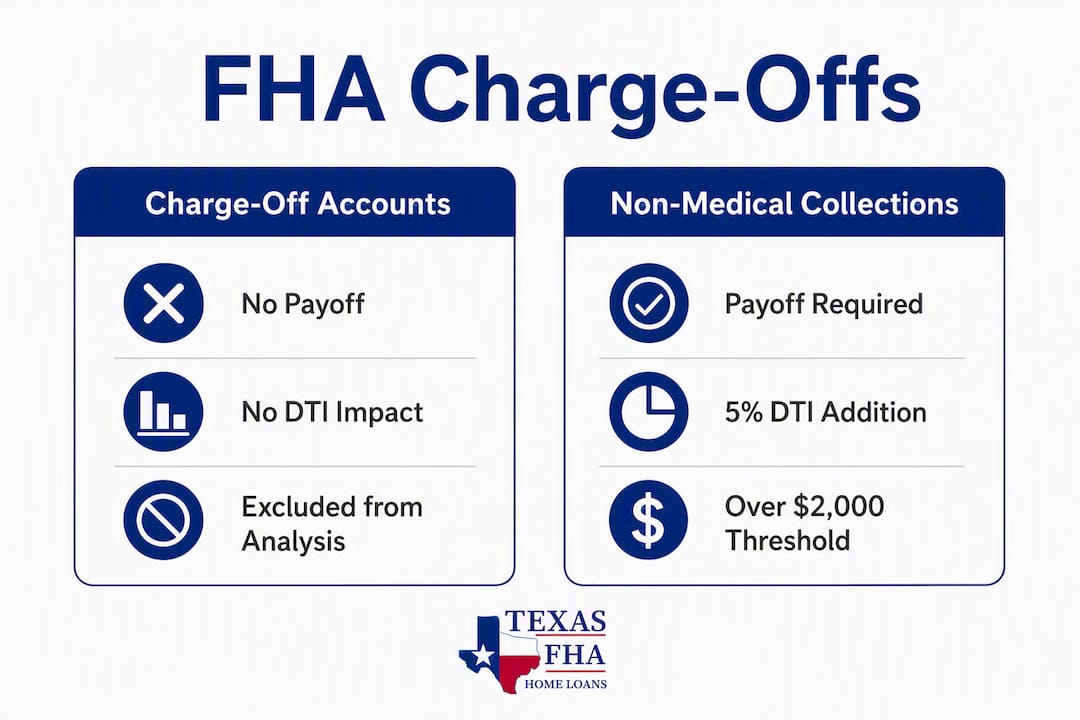
Charge-offs are also excluded from the FHA capacity analysis that adds 5% of aggregate non-medical collection balances to a borrower’s monthly debt obligations. That exclusion is significant because it means a $10,000 charge-off has no direct mathematical impact on your debt-to-income ratio under FHA rules. At the same time, a $10,000 non-medical collection account would add $500 per month to your calculated obligations.
Pro Tip: Always request a copy of the lender’s written overlay policy if they require payoff. Lenders are permitted to add stricter requirements than FHA minimums, but those requirements must be documented and consistently applied.
Charge-off vs. collection vs. judgment: why the difference matters
These three terms appear on credit reports and in underwriting conversations, but FHA treats them differently. Knowing which category applies to your account can change your loan outcome.

A charge-off occurs when a creditor writes a debt off its books, typically after 180 days of non-payment. The debt still legally exists and can still be collected, but the creditor has classified it as a loss. On a credit report, it appears as “charged off” or “charged-off as bad debt.” Per the FHA Single Family Housing Policy Handbook glossary, a Charge Off Account refers specifically to a borrower’s loan or debt that the creditor has written off.
A collection account is a debt that has been transferred to a collection agency, either by the original creditor or through sale. It may have been charged off first. Collections are the accounts that trigger the FHA’s $2,000 aggregate threshold rule.
A judgment is a court order requiring repayment. FHA treats judgments differently from both charge-offs and collections: outstanding judgments generally must be resolved before loan approval, either through payment or through a documented repayment agreement with a track record of on-time payments.
| Account Type | Must be paid? | DTI impact under FHA | FHA threshold |
|---|---|---|---|
| Charge-off | No | None (excluded from capacity analysis) | No minimum threshold |
| Non-medical collection | No, but may trigger rule | 5% of balance added to monthly obligations | Aggregate over $2,000 |
| Medical collection | No | Excluded from 5% calculation | No threshold |
| Judgment | Generally yes | Included in monthly obligations | Any amount |
The practical takeaway: a charge-off is the most borrower-favorable of the three derogatory account types under FHA rules. Collections above $2,000 carry a real DTI cost; judgments carry a payoff requirement. Charge-offs carry neither.
How charge-offs affect your debt-to-income ratio under FHA rules
The FHA’s capacity analysis is where the distinction between charge-offs and collections has the most direct financial impact. Understanding the mechanics helps you see exactly what is and is not counted against you.
Under HUD 4000.1, when a borrower has non-medical collection accounts with an aggregate balance exceeding $2,000, the underwriter must add 5% of that total balance to the borrower’s monthly obligations for DTI purposes. Charge-offs are explicitly excluded from this calculation.
Consider two borrowers with the same gross monthly income of $6,000 and the same base monthly obligations of $1,500 (housing payment plus other debts). Their DTI starts at 25%.
Borrower A has a $5,000 non-medical collection account. The underwriter adds 5% of $5,000, or $250 per month, to monthly obligations. Total obligations become $1,750, and DTI rises to approximately 29.2%.

Borrower B has a $5,000 charge-off. No additional monthly obligations are added. DTI stays at 25%.
That gap can determine whether a borrower qualifies at a given loan amount or needs to reduce the purchase price. You can model your own numbers using an FHA DTI calculator to see how the 5% rule affects your specific situation.
Medical collections are also excluded from the 5% calculation entirely, regardless of balance. If your derogatory accounts are medical in nature, they carry no DTI penalty under FHA guidelines. Document medical debts with hospital billing statements, insurance explanation-of-benefits letters, or correspondence showing the account’s medical origin. Underwriters will want that paper trail.
Automated vs. manual underwriting when charge-offs appear on your file
How your loan is underwritten matters almost as much as what the guidelines say. Charge-offs can be handled very differently depending on whether your file goes through an automated underwriting system or a manual review.
Automated underwriting (DU/LP) refers to Desktop Underwriter (Fannie Mae’s system) and Loan Product Advisor (Freddie Mac’s system), both of which FHA lenders use to generate an initial risk assessment. Automated systems often treat charge-offs differently from manual underwriting, and a file that receives an “Approve/Eligible” finding from DU or LP may not require any LOE for charge-offs at all. The system evaluates the overall credit profile, and charge-offs alone rarely trigger a denial finding.
Manual underwriting applies when a file does not receive an automated approval, or when the lender chooses to underwrite for other reasons manually. In manual review, the underwriter reads the file as a whole and applies judgment. Charge-offs will receive direct scrutiny, and the underwriter will want to understand the pattern of behavior behind them.
Key differences between the two paths:
- Automated systems evaluate charge-offs as part of a broader risk score; they rarely add DTI for charge-offs and may not require an LOE if the overall profile is strong.
- Manual underwriters will request an LOE and supporting documents to assess whether the charge-off reflects a one-time hardship or a recurring pattern.
- Manual underwriting allows compensating factors to carry more weight, including stable employment history, cash reserves, a low overall DTI, and recent responsible credit use (on-time payments for 12+ months).
- A file downgraded from an automated approval to a manual review because of other risk factors will face more scrutiny on all derogatory items, including charge-offs.
If your file goes manual, compensating factors become your strongest tool. Steady employment with the same employer for two or more years, three to six months of reserves, and a DTI well below the FHA maximum all give underwriters concrete reasons to approve despite derogatory history.
Why some lenders still require payoff (lender overlays explained)
A lender overlay is a requirement that goes beyond FHA’s minimum guidelines. Lenders are permitted to add overlays, and many do, for reasons that have nothing to do with HUD policy. Understanding overlays helps you respond strategically rather than simply complying with a demand that may not be necessary.
Lenders add overlays for several reasons: secondary market investors who purchase loans may require cleaner credit profiles, internal risk management policies may be more conservative than FHA minimums, or state-level regulatory considerations may influence underwriting standards. A detailed explanation of how HUD rules and lender overlays interact is available in this mortgage overlays guide.
When a lender demands payoff of a charge-off, here is how to respond:
- Request the written policy. Ask the lender to provide their written overlay policy that requires charge-off payoff. A legitimate overlay will be documented.
- Ask for an underwriting exception. Some lenders will consider exceptions for well-documented extenuating circumstances. Request this in writing.
- Get the AUS finding in writing. Ask for the Desktop Underwriter or Loan Product Advisor result so you can compare what the automated system found with what the lender is requiring. If DU returned an “Approve/Eligible” and the lender is still demanding payoff, that gap is worth questioning.
- Escalate to the underwriting manager. If the loan officer cannot explain the overlay, ask to speak with the underwriting manager directly.
- Shop other FHA-approved lenders. FHA guidelines are federal minimums; lender overlays vary widely. A different lender may approve the same file without requiring payoff.
- Document your LOE regardless. Even if you decide to shop lenders, prepare your Letter of Explanation now. Every FHA lender will want it.
Pro Tip: Ask the lender to confirm in writing whether their payoff requirement is an FHA rule or a lender overlay. That single question often clarifies the situation immediately and gives you leverage to negotiate or shop.
When underwriters ask for a Letter of Explanation (and a template you can use)
An LOE is not a formality. Underwriters use it as a decision tool to evaluate whether a charge-off reflects a temporary hardship or a pattern of disregarding financial obligations. A well-written LOE can be the difference between an approval and a denial on a manually underwritten file.
Per HUD 4000.1, lenders must document whether charge-offs resulted from extenuating circumstances or borrower disregard. Your LOE is the primary vehicle for making that case.
LOE structure (one page maximum):
- Opening paragraph: Identify the account by creditor name, approximate balance, and date of charge-off. State clearly that you are providing this explanation in connection with your FHA mortgage application.
- Cause paragraph: Explain the specific circumstances that led to the charge-off. Be factual and specific. “I lost my job in March 2021 and was unemployed for seven months” is far stronger than “I had financial difficulties.”
- Resolution paragraph: Describe what steps you took to address the situation. Include dates. “I secured new employment in October 2021 and have maintained continuous employment since.”
- Stability paragraph: Describe your current financial position. Reference your current income, employment tenure, and any reserves or savings.
- Closing sentence: A single sentence confirming that the circumstances have been resolved and that you are committed to your mortgage obligations.
Documents to attach:
- Pay stubs or employment verification covering the period of hardship and current employment
- Bank statements showing current reserves
- Medical bills, insurance statements, or explanation-of-benefits letters (for medical charge-offs)
- Discharge letters (for bankruptcy-related accounts)
- Police reports or identity theft affidavits (for fraudulent accounts)
- Any correspondence with the creditor showing dispute or resolution attempts
Common scenario phrasing:
- Medical emergency: “In [month/year], I was hospitalized for [condition] and unable to work for [X] months. The resulting loss of income led to the charge-off of [account]. I have since returned to full-time employment and maintained on-time payments on all active accounts.”
- Temporary unemployment: “Following a company-wide layoff in [month/year], I was unemployed for [X] months. I prioritized housing and essential expenses during this period. I secured new employment in [month/year] and have been continuously employed since.”
- Identity theft: “This account was opened fraudulently without my knowledge. I filed a police report on [date] and disputed the account with [creditor] and the credit bureaus. Supporting documentation is attached.”
Should you pay a charge-off before applying for an FHA loan?
The short answer is: probably not, unless a specific strategic reason applies. Paying a charge-off is rarely required for FHA approval, and it can sometimes create short-term credit complications.
Reasons paying might help:
- Paying a non-medical collection account can reduce the aggregate balance below the $2,000 threshold, eliminating the 5% DTI addition.
- Resolving a charge-off may improve your relationship with the creditor and stop collection activity.
- Some lenders with overlays will approve a file more readily if derogatory accounts show a “paid” status.
Reasons to think carefully before paying:
- Paying an old charge-off can temporarily lower your credit score because the payment updates the account’s activity date, which can refresh the derogatory impact on your score.
- A “paid charged-off” status on your credit report is still a derogatory mark. It does not become a positive account simply because it is paid.
- FHA does not require payoff, so paying may be an unnecessary expense that depletes reserves you could use for a down payment or closing costs.
- Paying a charge-off does not guarantee removal from your credit report. The account typically remains for seven years from the original delinquency date, regardless of payment status.
Timing guidance: If your non-medical collection accounts aggregate above $2,000 and the 5% DTI addition is pushing you over the FHA limit, paying enough to bring the aggregate below $2,000 is a targeted, strategic move. Paying charge-offs specifically, however, is rarely necessary for FHA qualification and should be evaluated carefully with your loan officer before acting.
Special treatment for medical charge-offs and collections
Medical debt receives distinct treatment under FHA guidelines, and that distinction can meaningfully affect how your file is underwritten. Mortgagee Letter 2013-24 established that medical collections and charge-offs are excluded from the capacity analysis that applies to non-medical collection accounts.
In practical terms: medical collection and charge-off balances do not count toward the $2,000 aggregate threshold, and they do not trigger the 5% monthly DTI addition. A borrower with $15,000 in medical collections and $1,800 in non-medical collections faces no DTI addition under FHA rules, because the medical balances are excluded and the non-medical balance falls below $2,000.
Compare that to a borrower with $1,800 in medical collections and $2,500 in non-medical collections. The non-medical balance exceeds $2,000, so the underwriter adds 5% of $2,500, or $125 per month, to monthly obligations.
To document medical accounts for underwriting, retain the following:
- Hospital billing statements showing the service date and amount
- Insurance explanation-of-benefits letters showing what was covered and what remained
- Any correspondence with the provider or collection agency
- A brief LOE noting the medical nature of the account if the credit report does not make it obvious
Providing this documentation upfront speeds the underwriting decision and prevents back-and-forth requests that delay closing.
How charge-offs can affect your credit score and mortgage pricing
Even when FHA guidelines allow approval with charge-offs, the credit score impact of those accounts can affect what you pay for the loan. Charge-offs are among the most damaging derogatory marks on a credit report, and a lower FICO score can move a borrower into a different pricing tier or affect mortgage insurance costs.
Consider two scenarios. A borrower with a 680 FICO score and a recent charge-off may qualify for an FHA loan but face higher lender-level pricing adjustments than a borrower at 720 with no derogatory history. FHA’s mortgage insurance premium (MIP) structure is tied to loan-to-value ratio and loan term, not directly to credit score, but lenders may apply risk-based pricing adjustments on top of FHA’s base structure. Those adjustments can affect the interest rate offered.
A borrower whose charge-off drops their score from 640 to 599 faces a more significant shift. Some FHA lenders apply overlays that require a minimum 620 or 640 score, meaning a sub-600 score could result in denial at certain lenders even when FHA’s technical minimum is 500 (with 10% down) or 580 (with 3.5% down). Reviewing your FHA credit score requirements before applying helps you understand which pricing tier you are likely to fall into.
Getting a pre-approval before you commit to a purchase price is the most direct way to see the real pricing impact of your credit profile. TexasFHA provides personalized rate quotes that reflect your actual credit history, including charge-offs, so you know exactly where you stand before making an offer.
Key Takeaways
HUD 4000.1 does not require charge-off payoff for FHA loan approval, but non-medical collections over $2,000 trigger a 5% monthly DTI addition that charge-offs do not.
| Point | Details |
|---|---|
| No mandatory payoff | HUD 4000.1 (as of 2026) does not require borrowers to pay charge-offs before FHA approval. |
| Collection threshold | Non-medical collections above a certain aggregate balance add 5% of the balance to monthly DTI; charge-offs are excluded. |
| Medical debt exclusion | Medical collections and charge-offs are excluded from both the $2,000 threshold and the 5% DTI calculation. |
| Lender overlays vary | Some lenders require payoff beyond FHA minimums; shopping lenders can change your outcome significantly. |
| TexasFHA applies FHA rules. | TexasFHA evaluates charge-offs under HUD 4000.1 guidelines and guides borrowers through LOE preparation and preapproval. |
A lender’s perspective on files with charge-offs
At TexasFHA, charge-offs on a borrower’s file are not an automatic red flag. What matters more is the pattern behind them: when did the charge-off occur, what caused it, and what has the borrower’s credit behavior looked like since?
A charge-off from five years ago, paired with 24 months of on-time payments on active accounts, steady employment, and documented reserves, tells a very different story than a charge-off from eight months ago with no subsequent positive credit activity. Underwriters are trained to read that distinction, and so are the loan specialists at TexasFHA.
The documents that consistently make approvals easier are straightforward: a clear, one-page LOE that explains the cause and resolution of the charge-off, proof of current income stability (two years of W-2s or tax returns, recent pay stubs), bank statements showing reserves, and any correspondence that supports the explanation in the LOE. Medical accounts benefit from billing statements and insurance records. Disputed accounts benefit from credit bureau dispute confirmations or creditor correspondence.
Borrowers sometimes expect that a charge-off means an automatic denial. Under FHA rules, that is rarely the case. Underwriting may ask follow-up questions, and the process may take a few extra days to document the file properly, but the charge-off itself is seldom the deciding factor. What decides the outcome is how well the file is prepared and how clearly the borrower’s current financial stability is documented.
TexasFHA helps borrowers with charge-offs get to closing
Knowing the FHA rules is one thing. Getting a lender who applies them correctly is another. TexasFHA is a Full Eagle FHA-approved lender that works with borrowers who have charge-offs, collections, and imperfect credit histories, applying HUD 4000.1 guidelines as written rather than layering on unnecessary overlays.
Services relevant to borrowers with charge-offs include FHA purchase loans, personalized underwriting guidance, LOE coaching, and preapproval assistance that reflects your actual credit profile. The team walks you through what to prepare, what to expect from underwriting, and how to present your file in the strongest possible light.
Bring these to your first appointment:
- Your most recent credit report (all three bureaus)
- A draft Letter of Explanation for each charge-off or collection
- Two years of W-2s or tax returns and recent pay stubs
- Two to three months of bank statements
- Medical billing statements or insurance correspondence (for medical accounts)
- Any dispute documentation or creditor correspondence
Ready to see where you stand? Get a rate quote from TexasFHA and find out exactly what your FHA options look like with your current credit profile. You can also review the full FHA loan requirements to understand what documentation you will need before you apply.
This article provides general information about FHA guidelines and is not a substitute for professional mortgage or legal advice. FHA policies can change; confirm current requirements with your FHA-approved lender or directly through HUD resources.
Primary references and further reading
Policy checked as of 2026. Readers should verify any updates directly with HUD or their FHA-approved lender, as guidelines are subject to change through Mortgagee Letters and handbook revisions.
| Source | Description | Date / Version |
|---|---|---|
| HUD 4000.1 Single Family Housing Policy Handbook | Primary FHA underwriting authority; governs charge-off, collection, and judgment treatment | Current as of 2026 |
| Mortgagee Letter 2013-24 | Clarifies medical collection and charge-off exclusions from capacity analysis | Issued August 2013 |
| HUD 4000.1 Glossary | Official definitions for Charge Off Account and Disputed Derogatory Credit Account | — |
| NMLS Consumer Access | Verify lender NMLS licensing and credentials | Current |
| TexasFHA FHA Loan Requirements | Texas-specific FHA eligibility and documentation guidance | Current |
| TexasFHA Common Questions | Broad FAQ resource covering FHA underwriting topics | Current |
For state-specific questions or to confirm how a particular charge-off will be treated in your file, consult an FHA-approved lender directly or contact HUD’s National Servicing Center. FHA guidelines are federal minimums; your lender’s overlay policies may differ.
Recommended
- FHA Loans Frequently Asked Questions – Learn About FHA Loan
- FHA Loan Requirements | FHA Loan Qualifications in Texas
- Why FHA Loan Delinquencies Are Rising in 2026: What Texas Borrowers Need to Know – Texas FHA Home Loans | First Time Buyer Loans

Over 25 years of experience in the Mortgage business. A Digital Marketer specializing in Conversion Rate Optimization, Search Engine Optimization, and Artificial Intelligence Overview Optimization for the Mortgage and Real Estate industry.