

Yes, you can buy a duplex with an FHA loan, provided you meet the owner-occupancy requirement and standard FHA underwriting rules. Lenders can count 75% of the projected rental income from the unit you don’t occupy toward your qualifying income, which meaningfully lowers the effective cost of ownership.
Three rules every duplex buyer needs to know upfront:
- Owner-occupancy is mandatory. You must certify intent to occupy and actually move in within 60 days. Violating this is treated as occupancy fraud.
- Down payment and credit thresholds mirror single-family FHA loans. 3.5% down at 580+; 10% down if your score is 500–579; below 500 is ineligible.
- Duplexes are exempt from the FHA self-sufficiency test that applies to 3- and 4-unit properties, making qualification simpler.
The sections below cover loan limits, underwriting mechanics, appraisal requirements, costs, and a step-by-step checklist to get you from preapproval to closing.
Key Takeaways
| Point | Details |
|---|---|
| Owner-occupancy rule | Move in within 60 days and stay at least 12 months; violations are treated as fraud. |
| Down payment and credit | 3.5% down with 580+ credit score; 10% down for scores between 500 and 579. |
| Rental income treatment | Lenders count 75% of projected market rent from the non-occupied unit toward qualifying income. |
| Loan limits are county-specific | Travis County’s 2-unit FHA limit is $731,700; check HUD tables before making an offer. |
| TexasFHA support | TexasFHA is a Full Eagle FHA-approved lender offering duplex preapprovals and specialist guidance across Texas. |
Table of Contents
- Can you use an FHA loan to buy a duplex?
- How lenders underwrite an FHA duplex purchase
- FHA loan limits, down payment, and mortgage insurance costs
- What FHA appraisers look for on a duplex
- What does the FHA duplex closing process look like?
- Step-by-step: how to apply for an FHA duplex loan
- FHA duplex financing: honest pros and cons
- An FHA lender’s perspective on duplex pitfalls
- TexasFHA is ready to help you finance your duplex
- Sources
Can you use an FHA loan to buy a duplex?
FHA insures 2-, 3-, and 4-unit residential properties under the standard FHA 203(b) loan program, the same product used for single-family purchases. The occupancy rule is firm: you must move into one unit as your primary residence within 60 days of closing and remain there for at least 12 months. Borrowers sign an intent-to-occupy certification at closing, and FHA lenders can audit compliance.
Down payment and credit requirements for a duplex match single-family FHA standards exactly. The duplex exemption from the self-sufficiency test is a meaningful advantage. For 3- and 4-unit properties, FHA requires that projected rents cover the entire mortgage payment. Duplexes carry no such requirement, so the rental income from the second unit supplements your qualifying income rather than being held to a stricter standard.
Pro Tip: If you’re weighing a triplex versus a duplex, run the self-sufficiency math before making an offer on the larger property. Duplexes sidestep that calculation entirely, which is why many first-time investors start there.
How lenders underwrite an FHA duplex purchase
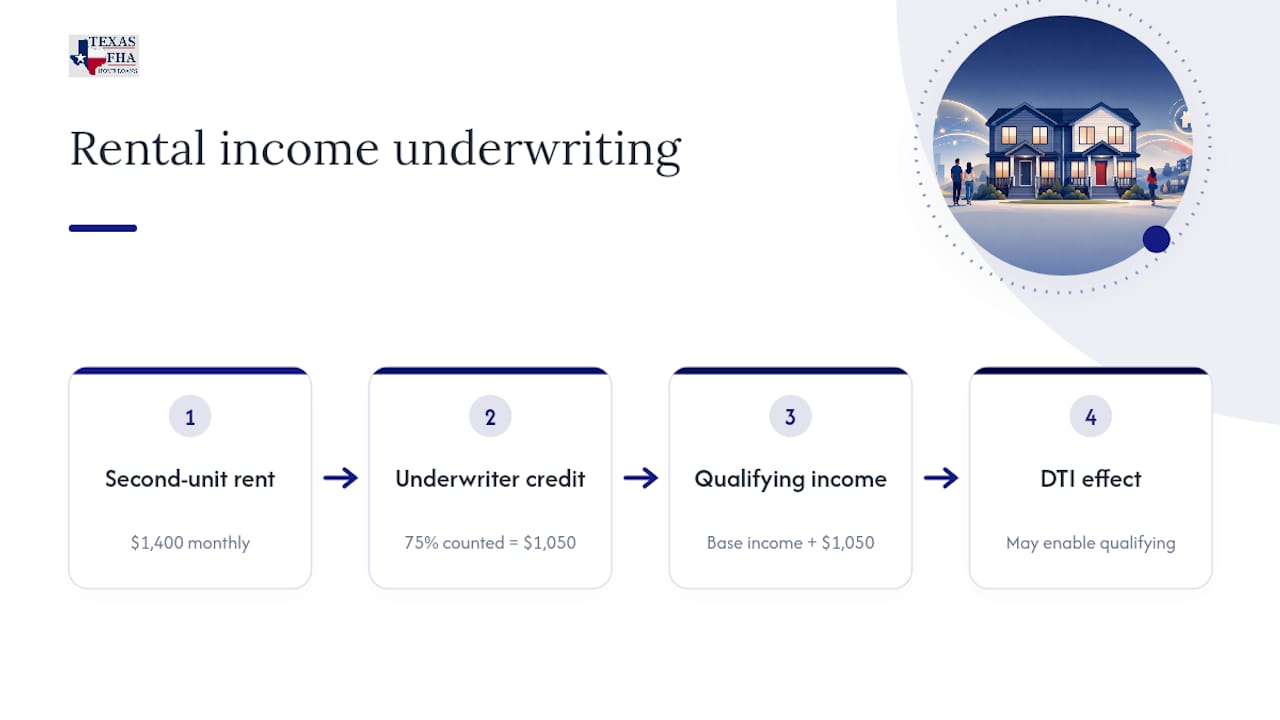
Rental income treatment is where FHA duplex underwriting gets practical. Lenders can apply 75% of the projected market rent from the non-occupied unit toward your qualifying income. For example, if the second unit rents for $1,400 per month, $1,050 of that counts as income in your debt-to-income (DTI) calculation. That offset can make the difference between qualifying and not qualifying, particularly for buyers whose base income alone would push DTI too high.
Reserve requirements vary by lender, but having two to three months of mortgage payments in savings after closing strengthens your file.
One underwriting constraint worth knowing: FHA will not insure a purchase loan made solely in the name of a business entity. If an LLC or trust appears on the mortgage note, at least one individual must be analyzed and listed as a borrower. Expect additional documentation and a full credit review for any entity-involved transaction. Review the FHA loan requirements and income qualification guidelines before structuring your purchase.
Pro Tip: Large rental income claims without a signed lease or comparable market data will draw underwriter scrutiny. If the property is currently vacant, pull rent comparables from a licensed appraiser early.
FHA loan limits, down payment, and mortgage insurance costs
FHA loan limits for 2-unit properties are set by county and updated annually by HUD. In high-cost markets, those limits can be substantially higher than the national floor. Travis County, Texas, for example, carries a two-unit FHA loan limit of $731,700, while lower-cost counties may fall well below that figure. Always check HUD’s county loan limit tables before making an offer, since a property priced above your county’s limit is ineligible for FHA financing regardless of your credit or income.
Mortgage insurance is the cost most buyers underestimate. FHA requires two layers:
- Upfront MIP (UFMIP): Typically 1.75% of the base loan amount, usually financed into the loan rather than paid at closing.
- Annual MIP: Added to your monthly payment; the rate depends on loan term, LTV, and loan amount.
By the numbers: On a $400,000 FHA loan, the UFMIP alone adds $7,000 to the financed balance. Annual MIP at a common rate of 0.55% adds roughly $183 per month to the payment. Both figures should be modeled when comparing FHA to conventional options.
The FHA vs. conventional comparison page at TexasFHA walks through this calculation.
What FHA appraisers look for on a duplex
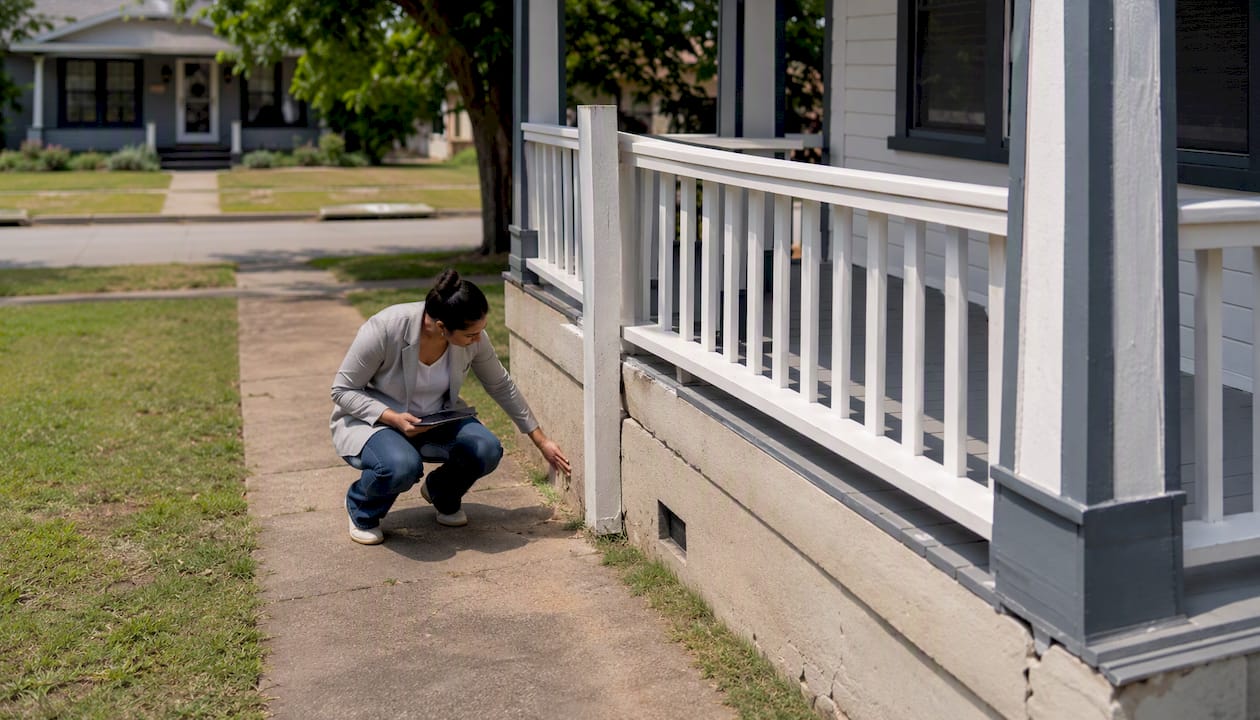
FHA appraisals go beyond market value. The appraiser must confirm that the property meets HUD’s Minimum Property Standards, covering safety, structural soundness, access to utilities, and habitability for both units. Issues commonly flagged on duplex appraisals include exposed wiring, missing handrails, roof damage, peeling paint on pre-1978 properties (lead-based paint concern), and non-functional heating systems. Any flagged item must be repaired before FHA will endorse the loan.
For duplexes that are part of a condominium project, additional approval requirements apply under HUD 4150.2 and HUD 4265.1. The project itself must be on FHA’s approved condo list, and the individual unit must meet project-level eligibility criteria. A standalone duplex on its own lot avoids this layer of review entirely.
The appraiser also completes a rent analysis using Form 1025 (the Small Residential Income Property Appraisal Report) for multi-unit properties. This documents market rents for each unit and supports the lender’s rental income calculation.
Pro Tip: Walk the property before the appraisal and address visible deficiencies yourself. Sellers who fix flagged items before the appraiser visits avoid costly re-inspection delays.
What does the FHA duplex closing process look like?
A typical FHA duplex purchase runs 30–45 days from ratified contract to closing, assuming clean documentation. Preapproval takes one to three business days with a complete file. The appraisal and inspection phase adds seven to fourteen days. Underwriting review typically runs five to ten business days, with a conditional approval followed by a clear-to-close once conditions are satisfied.
Closing costs on an FHA duplex purchase generally include:
Pro Tip: Submit your complete documentation package at preapproval, not piecemeal during underwriting. A full file upfront cuts conditional approval cycles and keeps your closing date on track.
Step-by-step: how to apply for an FHA duplex loan
- Get preapproved. Gather pay stubs, W-2s or 1099s, two years of tax returns, two months of bank statements, and a government-issued ID. If the property has an existing tenant, include the current lease.
- Confirm the county loan limit. Check HUD’s published limits for your county before making an offer. A purchase price above the 2-unit limit disqualifies the property.
- Make an offer and open escrow. Include an FHA financing contingency. Confirm the property is a standalone duplex or, if in a condo project, that the project is FHA-approved.
- Order the appraisal and inspection. Your lender orders the FHA appraisal; you arrange a separate home inspection. Address any flagged repair items promptly.
- Submit the full loan application. Provide the intent-to-occupy certification and any rental income documentation. If an LLC is involved, expect individual credit analysis per HUD underwriting guidelines.
- Complete underwriting. Respond to conditions quickly. Common conditions include updated bank statements, a letter of explanation for credit inquiries, or proof of repairs.
- Close and move in. You must occupy one unit within 60 days. After 12 months, FHA refinance options become available if you want to adjust your rate or term.
Questions to ask your lender: How do you document projected rental income for a vacant unit? What reserves do you require after closing? What is your current timeline from application to clear-to-close?
Pro Tip: House-hacking a duplex is one of the most accessible ways for a first-time buyer to enter real estate. The rental income from the second unit often covers a significant portion of the mortgage, reducing your effective housing cost from day one.
FHA duplex financing: honest pros and cons
Advantages
- Low down payment (3.5% with 580+ credit) makes entry accessible for buyers without large cash reserves.
- The 75% rental income offset can meaningfully improve your qualifying DTI.
- Duplexes are exempt from the self-sufficiency test, unlike 3- and 4-unit properties.
- FHA credit standards are more flexible than most conventional loan programs.
Disadvantages
- Mortgage insurance (UFMIP plus annual MIP) adds to both the loan balance and monthly payment, and typically persists for the life of the loan.
- The 12-month owner-occupancy requirement limits short-term flexibility.
- FHA property condition standards are stricter than conventional, which can complicate purchases of older or distressed duplexes.
- Purchases through an LLC or trust require individual borrowers on the note and additional documentation.
FHA is usually the strongest fit for buyers with limited down payment funds or credit scores in the 580–680 range. VA loans, for eligible veterans, can also finance multi-unit properties with no down payment and no mortgage insurance.
An FHA lender’s perspective on duplex pitfalls
The duplex is genuinely one of the most practical FHA purchase structures available, and yet it’s also where borrowers make avoidable mistakes. The most common: overstating projected rental income without market support. If the appraisal’s rent analysis comes in lower than the borrower’s estimate, the qualifying income shrinks, and the DTI can fail. Get a realistic rent estimate from a local property manager or appraiser before you’re deep in the contract.
Occupancy fraud is the other serious risk. Signing an intent-to-occupy certification and then renting both units from day one is not a gray area. FHA and lenders can audit occupancy, and violations carry significant legal and financial consequences. The program is designed for owner-occupants who want to offset their housing costs with rental income, not for investors who want to bypass the stricter rules that apply to non-owner-occupied financing.
TexasFHA is ready to help you finance your duplex.
Buying a duplex with an FHA loan is one of the most effective ways to reduce your housing costs while building equity, and TexasFHA’s Full Eagle FHA-approved status means your loan is handled by specialists who know this program from the inside out.

TexasFHA works with duplex buyers across Texas, from preapproval through closing, covering FHA purchase loans, streamline refinances after the occupancy period, and guidance on how projected rental income is documented and applied. You get a dedicated FHA Loan Specialist who walks you through county loan limits, MIP modeling, and the documentation checklist before you make an offer, not after.
Ready to move forward? Start your FHA application or review the full FHA loan requirements to confirm you qualify. A specialist is available to answer your duplex-specific questions and get your preapproval started.
Sources
The rules governing FHA duplex loans come from HUD policy documents and FHA consumer guidance. These are the primary sources:
- Section B. Property Ownership Requirements and Restrictions
- FHA Loan Rules, Multi-Family Homes, and Rental Properties
- FHA Loans for Multifamily: Buy a Duplex With 3.5% Down (2026) | Neuhaus Realty Group
- FHA Loan for Investment Property: Rules and Strategies
This article is general information, not a substitute for advice from a qualified financial advisor. Consult a qualified financial professional about your own circumstances before acting on anything here.
Recommended
- How to Buy a Home with 3.5% Down: FHA Loan Myths & Facts for Texas Buyers – Texas FHA Home Loans | First Time Buyer Loans
- Using an FHA Loan to Purchase a Home – Texas FHA Home Loans | First Time Buyer Loans

Over 25 years of experience in the Mortgage business. A Digital Marketer specializing in Conversion Rate Optimization, Search Engine Optimization, and Artificial Intelligence Overview Optimization for the Mortgage and Real Estate industry.