

A rapid rescore is an expedited credit-report update that your lender requests so recent payments or corrections appear on your file within days rather than waiting the normal 30–60 day reporting cycle. Experian describes it as a service lenders purchase directly from the credit bureaus, Experian, Equifax, and TransUnion, to reflect documented changes fast enough to influence underwriting and pricing decisions.
Is a rapid rescore mortgage strategy right for you? Check these three conditions:
- You made a verifiable change recently, paid down a balance, paid off a loan, or corrected an error, and you have documentation to prove it.
- Your credit score sits close to a pricing or eligibility threshold, where even a modest point gain could change your rate or program.
- Your loan timeline is tight, and waiting 30–60 days for normal reporting would push you past your rate lock or closing date.
If all three apply, talk to your loan officer today. The Fair Credit Reporting Act (FCRA) and TexasFHA’s loan specialists can guide you through the process without unnecessary cost or delay.
Key Takeaways
A rapid rescore is a lender-initiated timing tool that reflects documented credit changes within days; its value depends entirely on whether the resulting score crosses a pricing or eligibility threshold.
| Point | Details |
|---|---|
| Speed advantage | Rapid rescores typically complete in 2–5 business days versus the standard 30–60 day reporting cycle. |
| Simulate before spending | Ask your lender to run a credit simulation before paying down balances to confirm the score change will cross a pricing threshold. |
| Lender pays the fee | Bureau vendor fees are charged to the lender; FCRA guidance prohibits passing that cost directly to borrowers. |
| Documentation is everything | Only documented, already-completed changes can be reflected; a rescore cannot create history or remove accurate negatives. |
| TexasFHA can help | TexasFHA loan specialists run simulations, manage vendor coordination, and time rescores around rate locks for FHA applicants in Texas. |
Table of Contents
- How does a rapid rescore actually work?
- How long does a rapid rescore take?
- What documents do you need to submit?
- Who pays for a rapid rescore, and what does the law say?
- When is a rapid rescore likely to change your mortgage terms?
- How do you ask your loan officer to start a rapid rescore?
- What a rapid rescore will not do, and red flags to watch for
- Are there alternatives if a rapid rescore isn’t the right fit?
- Regulatory and industry context that changes how you should approach rescoring
- An honest perspective on when rescoring actually moves the needle
- TexasFHA loan specialists can evaluate your rescore options at no pressure
- Sources
How does a rapid rescore actually work?
The process moves through a defined chain of steps, and understanding each one helps you prepare the right documents and set realistic expectations.
- The lender identifies a potential score improvement. Your loan officer reviews your credit report and spots a recent payoff, balance reduction, or error that hasn’t yet been reflected. They may run a credit simulation to estimate the score impact before proceeding.
- You provide documentation. You gather proof of the change, a payoff letter, updated statement, paid-in-full confirmation, or dispute resolution notice, and submit it to your loan officer.
- The lender or its credit vendor submits to the bureau(s). Equifax confirms that only lenders or their authorized vendors can request a rapid rescore. Consumers cannot contact Experian, Equifax, or TransUnion directly to initiate one.
- The bureau updates the credit file and recalculates the score. The bureau processes the submitted documentation, updates the relevant tradeline, and generates a new score.
- The lender pulls the updated report. The new score replaces the prior one for that underwriting or pricing decision.
A few mechanics worth understanding:
- If only one bureau is updated, the score change appears only on that bureau’s report. Most mortgage lenders use a tri-merge report (all three bureaus) and take the middle score of the three. Updating a single bureau may or may not move the qualifying score, depending on which bureau holds the lowest or middle score.
- Updating all three bureaus costs more and takes slightly longer, but it gives you the best chance of moving the score that actually matters for underwriting.
- The FHA loan process includes specific checkpoints where the credit score is locked in for pricing; knowing where your loan sits in that sequence determines whether a rescore can still influence the outcome.
How long does a rapid rescore take?
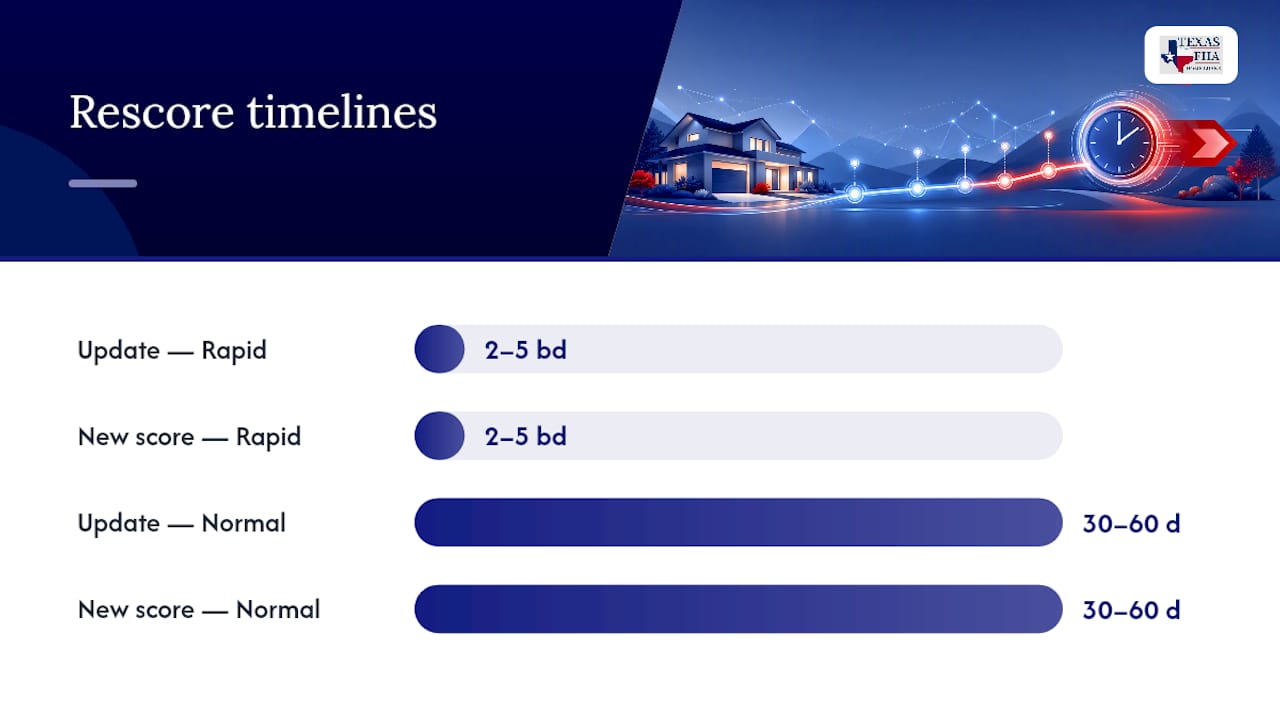
Speed is the entire point of this tool. Industry practitioner guidance reports typical turnaround of 48 hours to 3–5 business days after documentation is submitted, compared to the standard 30–60 day creditor reporting cycle.
Several factors affect where your rescore lands in that range:
- Creditor confirmation speed. The bureau needs the creditor to confirm the update. If the creditor is slow to verify, processing stalls.
- Number of bureaus involved. Updating all three takes longer than updating one, though the difference is usually measured in hours, not days.
- Credit vendor processing queue. High-volume periods can add a day or two.
- Documentation completeness. Incomplete or unclear documents are the single most common cause of delays.
Scheduling around your rate lock is critical. Many lenders will not reprice after a lock even if your score improves. The rescore must complete before the rate lock or pricing decision to have any effect on your interest rate or program eligibility. Tell your loan officer your lock expiration date at the start of the conversation so they can confirm whether the timeline is workable.
| Stage | Rapid Rescore | Normal Reporting Cycle |
|---|---|---|
| Documentation submitted | Day 1 | Day 1 |
| Bureau updates file | 2–5 business days | 30–60 days |
| New score available | 2–5 business days | 30–60 days |
| Lender reprices/re-underwrites | Same day as new score | After next reporting cycle |
What documents do you need to submit?
The bureau will only update what you can prove. Gather documents that are specific, dated, and tied to a named account.
By situation:
- Credit card paydown: A current statement showing the reduced balance, or a screenshot from the card issuer’s online portal showing a zero or lower balance. The statement must show the account number and the date of the balance.
- Installment loan payoff: A formal payoff letter from the lender on company letterhead, showing the account number, payoff amount, and the date the loan was satisfied.
- Collection account settlement: A paid-in-full letter from the collection agency, signed and dated, confirming the account is resolved. A receipt alone is usually not sufficient.
- Error correction or dispute resolution: A written confirmation from the bureau or the furnisher (the original creditor) that the disputed item has been corrected or removed.
Formatting tips that reduce back-and-forth:
- Every document should clearly show the account number, the transaction or effective date, and a confirmation number or reference number where one exists.
- Lender signatures or official letterhead add credibility and reduce the chance of a rejection.
- Scan documents as PDFs rather than photos; image quality issues are a common reason vendors request resubmission.
Pro Tip: Name your files clearly before sending: “Smith_CapitalOne_ZeroBalance_2026-03-15.pdf” moves faster through vendor intake than “scan001.pdf.” Use the same convention in your email subject line so your loan officer can find it instantly.
Who pays for a rapid rescore, and what does the law say?
Fees for expedited bureau processing are charged to the lender or its credit vendor, not to you. Industry reporting notes that per-account, per-bureau fees are commonly passed to lenders, and legal commentary is clear that lenders should not pass that cost directly to the consumer.
Key points on costs and protections:
- The lender may absorb the fee entirely, or it may appear indirectly within lender fees or closing costs; ask your loan officer for clarification if you see an unexplained line item.
- FCRA mortgage disclosure rules under 15 U.S.C. § 1681g(g) require lenders to disclose the credit score used, its range, the date it was pulled, the provider, and the key adverse factors. You are entitled to this information.
- If a fee is requested directly from you for the rescore vendor, ask for the charge in writing and consult a HUD-approved housing counselor or attorney before paying.
When is a rapid rescore likely to change your mortgage terms?
A mortgage credit rescore is most valuable when a small score improvement crosses a meaningful threshold. A 10-point gain that moves you from 679 to 689 may do nothing for your rate. The same 10 points moving you from 619 to 629 could change your FHA program eligibility entirely.
Use-case checklist: a rescore is worth pursuing when:
- You recently paid down a high revolving balance, and your utilization was above 30% before the payment.
- You paid off an installment loan and the payoff hasn’t been reported yet.
- You corrected an erroneous late payment with written confirmation from the furnisher.
- You settled a collection account and have a paid-in-full letter in hand.
Decision questions to ask yourself:
- Am I within 20–30 points of a program threshold or a better pricing tier?
- Can I document the change today, with a dated letter or statement?
- Is my rate lock still open, or do I have enough time before it closes?
FHA credit score thresholds illustrate how a few points can shift both eligibility and mortgage insurance costs. Loan-level pricing adjustments (LLPAs) on conventional loans work similarly; score bands determine the pricing grid, and crossing a band boundary can reduce your rate meaningfully.
How do you ask your loan officer to start a rapid rescore?
The process starts with a conversation, not paperwork. Here is the sequence:
- Ask for a credit simulation first. Before spending money paying down balances, ask your loan officer to run a simulation showing the projected score impact. This step prevents wasted paydowns that don’t move the needle enough to change pricing.
- Gather your documentation. Use the checklist in the documentation section above. Have every document ready before the conversation so there is no delay once the lender confirms the rescore is worth initiating.
- Confirm vendor availability and timeline. Ask your loan officer which credit vendor they use, how long the process typically takes, and whether that timeline fits within your rate lock window.
- Submit documents and confirm receipt. Send everything in one organized email. Ask for written confirmation that the vendor received the submission.
- Confirm how the updated score will be used. Ask whether the new score will be reflected in the rate lock or whether a new lock will be needed.
A simple script to open the conversation:
“I recently [paid off / paid down / corrected] my [account type]. I have documentation ready. Can you run a score simulation to see if a rapid rescore would move me into a better pricing tier before my rate lock?”
What to confirm with your lender before proceeding:
- Which bureau(s) will be updated
- Estimated turnaround time
- Whether the rescore result will be used for repricing or requires a new lock
- Who initiates the request and whether any fee will appear in your closing costs
Understanding how mortgage underwriting works helps you identify exactly where in the timeline a rescore can still influence the outcome.
What a rapid rescore will not do, and red flags to watch for
Nolo’s consumer guidance makes this point clearly: a rapid rescore does not raise your credit score by itself. It only reflects changes that are already documented and already made. That distinction matters for setting realistic expectations.
What a rescore cannot do:
- Create new credit history or add positive accounts that don’t exist
- Remove accurately reported negative items such as bankruptcies, foreclosures, or legitimate late payments
- Guarantee a score increase; the updated data still runs through the bureau’s scoring model, and the outcome depends on your full credit profile
- Change an underwriting decision on its own; the lender still evaluates the full file
Risks and drawbacks:
- A score improvement that doesn’t cross a pricing threshold produces no benefit to your rate or program, even if the score technically went up.
- Paying down balances without running a simulation first can deplete savings without producing a meaningful score change.
- Timing a rescore after the rate lock has closed means the new score does not affect your current loan terms.
Red flags: stop and ask questions if:
- A company that is not your lender or its authorized vendor offers to run a rapid rescore for a fee you pay directly.
- Anyone asks you to change account ownership, add an authorized user, or alter account details as part of the rescore process.
- You receive an unsolicited offer promising a specific score increase in exchange for payment.
These patterns are associated with credit repair scams, not legitimate rescoring. Legitimate rapid rescoring is always initiated by your lender, never by a third party soliciting you directly.
Are there alternatives if a rapid rescore isn’t the right fit?
Not every situation calls for a rescore. Sometimes a different approach produces the same result with less complexity.

Standard bureau dispute (30–45 days): If an item on your report is inaccurate and you have time, filing a dispute directly with Experian, Equifax, or TransUnion is free and follows FCRA-mandated timelines. It’s slower than a rescore but costs nothing and doesn’t require lender involvement. Rebuilding your credit score covers dispute strategies in more detail.
Wait for normal creditor reporting: If your closing date is flexible and the creditor reports monthly, waiting for the next reporting cycle may be simpler than coordinating a rescore. Ask your loan officer when the creditor typically reports and whether the timing works.
Targeted payment timing: Paying down a balance a few days before the creditor’s statement closing date means the lower balance appears on the next statement, which then gets reported in the normal cycle. No rescore needed if the timing aligns.
Ask about lender re-price policies: Some lenders allow a rate re-price (without a full new lock) if your score improves before closing. Ask whether this option exists before committing to a rescore.
When to choose an alternative:
- Your lender doesn’t offer rapid rescoring through a vendor.
- A simulation shows the score improvement won’t cross a pricing threshold.
- You don’t have verifiable documentation ready right now.
- Your closing timeline is flexible enough to wait for normal reporting.
Regulatory and industry context that changes how you should approach rescoring
The FCRA gives mortgage applicants specific protections that go beyond general consumer credit rights. Under 15 U.S.C. § 1681g(g), any lender that uses a credit score for a one-to-four-family residential loan must disclose the score used, its range, the date it was pulled, the provider, and the key adverse factors. This disclosure applies whether or not a rescore was involved.
Furnishers, the creditors who report your account data to the bureaus, have obligations under FCRA Section 623 to investigate and correct inaccurate information. When a lender submits documentation through a rapid rescore vendor, it is essentially triggering a fast-tracked version of that correction process. LegalClarity’s analysis of FCRA mortgage rules covers these obligations in detail.
Industry shifts worth knowing:
- FHFA and Fannie Mae/Freddie Mac have been transitioning scoring models and merge-method requirements. These changes affect which bureau scores and which score models lenders rely on for conventional loan underwriting.
- The shift from tri-merge (all three bureaus) to bi-merge (two bureaus) reporting for some loan programs means updating the “wrong” bureau in a rescore could not affect the qualifying score.
One question every borrower should ask their lender before initiating a rescore: “Which credit score model and merge type will you use for underwriting and pricing on my loan?” The answer determines which bureau(s) to update and whether a rescore is even worth pursuing.
An honest perspective on when rescoring actually moves the needle
There is a version of rapid rescoring advice that oversells the tool. Borrowers read that a rescore can “boost” their score and assume it’s a shortcut to better rates. The reality is more precise.

A rapid rescore is a timing mechanism. It compresses weeks of waiting into days so that a change you already made gets recognized before your loan closes. The score improvement, if any, comes entirely from the underlying change, not from the rescore itself. Paying off a maxed-out card and then rescoring is powerful. Rescoring without making any change produces nothing.
The simulation step is where most borrowers leave value on the table. Simulating spending cash tells you whether a specific paydown will cross a pricing threshold. Without it, you might pay $3,000 toward a balance, gain 12 points, and still land in the same pricing tier, with less cash for closing costs.
The other underappreciated risk is timing. A rescore that completes one day after your rate lock closes has zero effect on your loan terms. Coordinate the rescore timeline with your lock expiration date before submitting a single document.
Borrowers who use this tool well treat it as a precision instrument, not a general credit fix. They simulate first, document thoroughly, and time the rescore to land before the lock. That sequence consistently produces better outcomes than acting on urgency alone.
TexasFHA loan specialists can evaluate your rescore options at no pressure
If you’re applying for an FHA loan in Texas and your score is close to a qualifying threshold, TexasFHA’s loan specialists can run a credit simulation, review your documentation, and coordinate with the credit vendor on your behalf. As a Full Eagle FHA-approved lender, TexasFHA manages the rescore process within the lender workflow, meaning the vendor fee is handled on the lender side, consistent with FCRA guidance that prohibits passing that cost directly to borrowers.

TexasFHA specialists understand FHA loan requirements and the specific score thresholds that affect program eligibility and mortgage insurance costs. They can tell you whether a rescore is likely to change your terms before you commit to any paydowns, and they’ll time the process around your rate lock so the updated score is used for pricing. TexasFHA is a lender, and standard lender fees apply to loan origination, but the rapid rescore vendor fee is not passed directly to you as a separate borrower charge. To find out whether a rescore could improve your loan terms, start with a pre-qualification and ask a specialist to run the simulation.
This article provides general information about rapid rescoring and is not a substitute for advice from a licensed mortgage professional. Confirm current program rules and eligibility requirements with your lender.
Sources
The following sources cover rapid rescoring, FCRA borrower rights, and bureau processes from different angles:
- What Is a Rapid Rescore?
- What Is a Rapid Rescore & How Do They Work? (Equifax)
- How can rapid rescore help me get a mortgage? (Nolo)
- Rapid rescore explained (The Lenders Network)
Recommended
- 5 Reasons To Refinance Your Mortgage in The Nearest Time – Texas FHA Home Loans | First Time Buyer Loans
- FHA Streamline Refinance: The Best Way To Lower Your Mortgage Payment And Gain Equity – Texas FHA Home Loans | First Time Buyer Loans
- Mortgage Refinance with Low Credit Score: 2026 Guide
- FHA Streamline Refinance: A Simpler Way to Lower Your Payment Without the Usual Hassle – Texas FHA Home Loans | First Time Buyer Loans

Over 25 years of experience in the Mortgage business. A Digital Marketer specializing in Conversion Rate Optimization, Search Engine Optimization, and Artificial Intelligence Overview Optimization for the Mortgage and Real Estate industry.