

A reverse mortgage calculator estimates how much money homeowners aged 62 and older can access by converting home equity into loan proceeds without making monthly repayments. The formal industry term for this product is a Home Equity Conversion Mortgage (HECM), insured by the Federal Housing Administration (FHA). Using a reverse mortgage estimator before speaking with a lender gives you a realistic picture of your options and helps you plan retirement funding with confidence. Three inputs drive every calculation: your age, your home’s appraised value, and current interest rates.
What key factors determine your reverse mortgage estimate?
The principal limit is the maximum amount a borrower can receive from an HECM, and HUD calculates it based on three core variables.
Age of the youngest borrower. HUD’s Principal Limit Factor (PLF) tables assign a higher factor to older borrowers, meaning more equity becomes accessible as age increases. The youngest borrower on the title controls this calculation. If the youngest spouse is 62, the PLF uses that age even if the other spouse is 75, which can significantly reduce the couple’s available proceeds.

Home value versus the HUD lending limit. The calculator uses whichever is lower: your home’s appraised value or the 2026 HUD HECM lending limit of $1,249,125. That cap means a Texas home appraised at $1,500,000 is treated as $1,249,125 for calculation purposes. Homes valued below the cap use the full appraised value.
Expected interest rate. The expected interest rate is a 10-year average used specifically for PLF calculations. A 0.25% change in interest rates can shift available funds by several percentage points of home value. Lower rates produce higher principal limits, which is why the rate environment matters so much when you run your estimate.
How the PLF ties it together. HUD publishes PLF tables that assign a percentage factor based on age and expected rate. Multiply that factor by the maximum claim amount (the lower of appraised value or lending limit), and you get the initial principal limit. That gross figure is what the calculator displays before deductions.
Pro Tip: Run your estimate at two different interest rate scenarios, one at the current rate and one 0.5% higher, to see how sensitive your proceeds are to rate changes before you commit to a timeline.
How to use a reverse mortgage calculator step by step
Getting accurate results from a home equity release calculator requires the right inputs from the start.
- Gather your information first. You need the age of the youngest borrower on the title, your home’s estimated market value, and your current mortgage balance. If you have a home equity line of credit or any other lien, include those balances too.
- Enter your home value and location. Texas has no state income tax, which affects retirement cash flow planning but not the HECM calculation itself. Enter your home’s realistic market value, not the tax-assessed value, since lenders will order an FHA appraisal to confirm it.
- Input the youngest borrower’s age. Most calculators accept age in whole years. Use the youngest person who will be on the loan title, not just the primary applicant.
- Review the initial principal limit. The calculator returns a gross principal limit. This is the maximum available before deductions, not the cash you will receive at closing.
- Understand net proceeds. Subtract mandatory costs from the principal limit to estimate net proceeds. These costs include the upfront mortgage insurance premium, origination fees, closing costs, and any existing mortgage payoff. The calculator may show these deductions separately or as a combined figure.
- Select a payout option. Most calculators let you toggle between a lump sum, monthly payments, and a line of credit. Each choice changes how you access funds and how the loan balance grows over time.
- Compare multiple scenarios. Run the calculation at different ages, for example, at 62 versus 68, to see how waiting affects your proceeds. A few years of additional age can meaningfully increase the PLF.
Pro Tip: Write down your inputs before you start so you can replicate the exact scenario when you speak with a lender. Consistent inputs make it easier to compare the lender’s official quote against your estimate.
What costs and deductions affect your actual available funds?
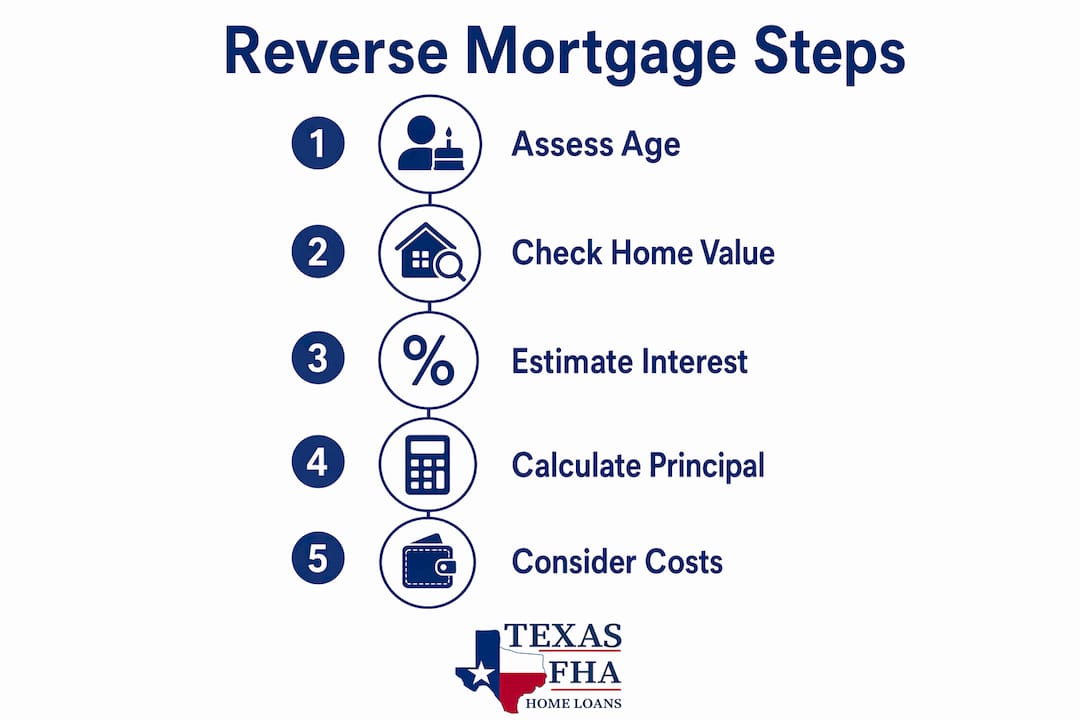
The gross principal limit from a reverse mortgage estimator is not the amount you take home. Several mandatory charges reduce it to the net proceeds.
| Cost Item | Typical Amount |
|---|---|
| Upfront mortgage insurance premium (MIP) | 2% of the maximum claim amount |
| Origination fee | Up to $6,000, based on home value |
| Third-party closing costs | Varies by Texas county; typically $1,500–$3,500 |
| Existing mortgage payoff | Full balance of any current mortgage or lien |
| Life Expectancy Set Aside (LESA) | Varies; can be a significant share of proceeds |
The upfront MIP is fixed at 2% of the maximum claim amount. On a $400,000 home, that equals $8,000 financed into the loan balance at closing. The ongoing annual MIP is 0.5% of the outstanding loan balance, which accrues over time.
The Life Expectancy Set Aside is the deduction that surprises most borrowers. If a lender’s financial assessment finds that you may struggle to cover property taxes and homeowner’s insurance, HUD requires a LESA. This reserve can consume a large portion of your proceeds, especially when property taxes represent more than 10% of your gross income. The financial assessment screens your ability to pay ongoing homeownership costs. No minimum credit score applies to HECMs, but the assessment still matters.
HUD also limits how much you can draw in the first 12 months. Borrowers can access only 60% of the principal limit during that period, with exceptions for mandatory obligations like paying off an existing mortgage. This first-year draw limit exists to prevent borrowers from exhausting equity too quickly.
What are the payout options and typical limitations shown by the calculator?
A reverse mortgage calculator for seniors typically lets you model several payout structures, and each one affects your cash flow and loan growth differently.
- Lump sum. Available only with a fixed-rate HECM. You receive all eligible proceeds at closing. The trade-off is that the loan balance begins accruing interest immediately on the full amount.
- Tenure payments. Equal monthly payments for as long as you live in the home as your primary residence. This option suits borrowers who want predictable monthly income to supplement Social Security or a pension.
- Term payments. Fixed monthly payments for a set number of months. Useful if you need income for a specific period, such as until a pension or deferred Social Security benefit begins.
- Line of credit. Funds available to draw as needed. The unused portion of the line grows over time at the same rate the loan balance accrues interest, which means waiting to draw can increase your available credit.
- Combination options. Adjustable-rate HECMs allow you to combine a partial lump sum with a line of credit or monthly payments.
The line of credit growth feature is one of the least understood benefits of a HECM. A borrower who opens a $100,000 line of credit and draws nothing for five years may find that line has grown to a meaningfully larger amount, providing a larger financial cushion than the original estimate suggested.
The 60% first-year draw limit applies regardless of payout type on adjustable-rate HECMs. If your mandatory obligations, such as an existing mortgage payoff, exceed 60% of the principal limit, you may draw up to that obligation amount plus an additional 10% cushion. Understanding this rule before closing prevents surprises about how much cash you actually receive on day one.
Key Takeaways
A reverse mortgage calculator gives you a realistic estimate of available proceeds, but net funds depend on age, home value, interest rates, and mandatory cost deductions.
| Point | Details |
|---|---|
| The youngest borrower controls the limit | Use the youngest person on the title to determine the Principal Limit Factor. |
| HUD caps the home value used | The 2026 lending limit is $1,249,125; values above this cap are treated as equal to the limit. |
| Gross proceeds differ from net proceeds | Subtract MIP, closing costs, mortgage payoff, and any LESA to find actual available funds. |
| First-year draws are restricted | HUD limits access to 60% of the principal limit in the first 12 months, with narrow exceptions. |
| A line of credit grows over time | Unused credit increases at the loan’s accrual rate, making early setup potentially valuable. |
What I’ve learned from watching seniors misread their calculator results
Most homeowners who run a reverse mortgage estimate for the first time focus on the top-line number. They see the gross principal limit, feel encouraged, and stop reading. That is the most expensive mistake in the process.
The non-recourse protection that FHA provides is genuinely powerful. Borrowers and their heirs never owe more than the home’s fair market value at loan payoff. That protection removes a real fear for Texas families who worry about leaving debt to their children. But that protection does not eliminate the upfront costs or the LESA risk.
What I tell every homeowner is this: treat the calculator as an educational tool, not a loan offer. The reverse mortgage calculator produces a realistic range, not a guarantee. Actual proceeds depend on a formal appraisal, a financial assessment, and the specific loan terms offered by the lender.
HUD’s mandatory counseling session is not a bureaucratic hurdle. It is a 60–90-minute conversation with an independent advisor who must discuss all your options before you proceed. The session costs approximately $125, and the certificate is valid for 180 days. Use that time to ask hard questions about LESA, about what happens if you need to move, and about how the loan balance grows. A calculator cannot answer those questions. A qualified counselor can.
My honest recommendation: run the calculator first to get a ballpark estimate, then schedule counseling before you speak with any lender. That sequence protects you.
— Gerry Nicodemus
TexasFHA is ready to help you plan your next step
Reverse mortgage planning works best when you have a knowledgeable resource guiding you through the numbers. TexasFHA is a Full Eagle FHA-approved lender with specialists who understand both the mechanics of calculation and the Texas housing market.

Whether you want to review FHA loan qualifications before your counseling session or you are ready to discuss how an HECM fits your retirement plan, TexasFHA’s team is available to walk you through every step. You can also review current rate information to refine your calculator inputs before your first conversation with a lender. Reach out to TexasFHA at texasfha.org to connect with a specialist who can turn your estimate into a clear, personalized plan.
FAQ
What is a reverse mortgage calculator?
A reverse mortgage calculator is an online tool that estimates how much a homeowner aged 62 or older can borrow against home equity through a HECM, based on age, home value, and current interest rates. The result is an estimate, not a guaranteed loan offer.
How accurate is a reverse mortgage estimator?
A reverse mortgage estimator provides a close approximation, but the actual loan amount depends on a formal FHA appraisal, a financial assessment, and the lender’s specific terms. Use the estimate to set expectations, then confirm figures with a licensed lender.
Does age really affect how much I can borrow?
Yes. The youngest borrower’s age on the title determines the Principal Limit Factor, and older borrowers receive a higher factor, meaning more available proceeds. Waiting even a few years to apply can meaningfully increase your loan amount.
What is the HUD lending limit for 2026?
The 2026 HUD HECM lending limit is $1,249,125. Home values above this amount are capped at the limit for calculation purposes, so a higher-value Texas home does not produce proportionally higher proceeds above that threshold.
Do I need a minimum credit score for a reverse mortgage?
No minimum credit score applies to HECMs. Lenders conduct a financial assessment to confirm you can cover ongoing costs like property taxes and homeowner’s insurance, and a LESA may be required if that assessment raises concerns.
Recommended
- HECM 101: What You Need To Know About Reverse Mortgage
- Mortgage Calculators – Texas FHA Home Loans | First Time Buyer Loans
- Mortgage Glossary – Texas FHA Home Loans | First Time Buyer Loans
- How To Prepare Your Finances For Retirement Now – Texas FHA Home Loans | First Time Buyer Loans

Over 25 years of experience in the Mortgage business. A Digital Marketer specializing in Conversion Rate Optimization, Search Engine Optimization, and Artificial Intelligence Overview Optimization for the Mortgage and Real Estate industry.