

Divorce can change nearly every part of a household budget at once: income, support obligations, ownership of the former marital home, and the debts that show up on a credit report. If you’re considering an FHA loan after divorce in Texas, the divorce itself usually isn’t the issue. Documenting your current financial picture clearly is.
As a mortgage broker, I encourage buyers to start the conversation early, before they make an offer and, when possible, before a divorce decree is signed. The terms of a decree can affect your debt-to-income ratios, your closing funds, what happens to the former marital home, and the documents an FHA-approved Mortgagee will need to review.
TL;DR
- For FHA, the divorce itself usually isn’t the issue; documenting your income, debts and the former home is.
- Support you receive can count as income with the decree or order, proof of receipt and at least three more years of continuance.
- Child support and maintenance you pay count as debts; alimony is either deducted from income or counted as a debt.
- A debt your decree assigns to your ex can be left out without 12 months of their payment history.
- Texas has no legal separation, so a spouse’s debts generally count until the divorce is final.
- Divorce isn’t an FHA extenuating circumstance, but HUD has a narrow exception if your ex kept the home and it was later foreclosed or short sold.
TexasFHA
Buying on Your Own After a Divorce?
Talk with a mortgage broker about your decree, support, and debts before you make an offer.
More Texans are buying on one income after a life change
Buying alone isn’t unusual. In the National Association of REALTORS® 2026 Profile of Home Buyers and Sellers, released November 5, 2026, first-time buyers made up 22% of buyers, and their median age held at a record 40. Only 47% of first-time buyers were married; 25% were single women, 12% were single men, and 11% were unmarried couples. NAR’s “single” groups include divorced and widowed buyers, though the report doesn’t break out a separate divorced-buyer share.
For Texans buying after a divorce, the practical question is simple: what income, debts, housing history, and assets can you document today? FHA guidelines give a framework for answering it, and the paperwork does most of the talking.
Start with the divorce decree, or know what’s still missing
A final divorce decree is often one of the most important documents in an FHA purchase file. It can establish who keeps the former marital home, who is responsible for which debts, whether support is paid or received, and whether either spouse receives sale proceeds.
Texas doesn’t have legal separation. A couple can live apart, sign agreements, and get temporary orders while a case is pending, but they remain married until the court grants the divorce. TexasLawHelp.org explains the alternatives to legal separation in Texas. That distinction matters for FHA underwriting.
If your divorce is final
Provide the fully executed final divorce decree early. It helps the FHA-approved Mortgagee evaluate:
- alimony, maintenance, or child support you receive
- alimony, maintenance or child support you pay
- debts assigned to your former spouse
- whether you’re still tied to the mortgage on the former marital home
- whether you’re entitled to proceeds from the home’s sale
- a foreclosure, deed-in-lieu or short sale on a property your former spouse kept
HUD treats a divorce decree as a document that doesn’t change over time, so it may be more than 120 days old when the Note is signed. The Mortgagee will still need current documents alongside it, such as pay stubs, bank statements, a credit report, and payment histories.
If your divorce is still pending
A pending divorce doesn’t automatically stop you from exploring an FHA purchase, but it complicates the file because your debts, support obligations, property ownership, and household status may still change.
Under the Texas Family Code, a court generally can’t grant a divorce before the 60th day after the case is filed, with limited family-violence exceptions. Temporary orders may cover who stays in the home, who pays which bills, child support, or spousal support while the case is pending. Those arrangements can be relevant, but they aren’t the same as a final decree.
Before you sign an agreement or decree, coordinate with your family law attorney. This isn’t legal or tax advice, and a mortgage broker shouldn’t tell you how to divide property or structure support. What I can do is help you spot the mortgage-related questions to raise before the terms are final.
How FHA treats child support, maintenance and alimony you receive
Support you receive may be usable as qualifying income when it’s properly documented and expected to continue. The key word is documented. HUD Handbook 4000.1 asks the Mortgagee to look at both the legal basis for the payments and your history of receiving them. For the bigger picture on what counts as income, see our guide to FHA income requirements.
Court-ordered support
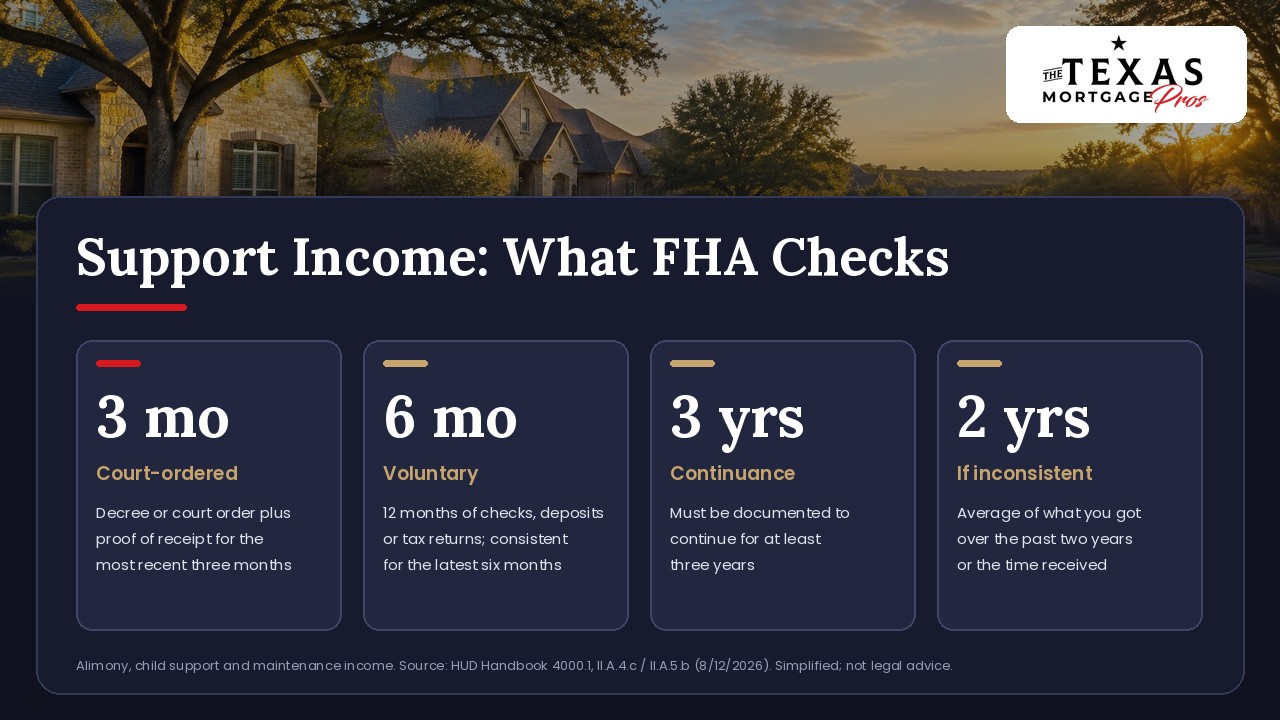
When support is set by a final divorce decree, court order or legal separation agreement, the Mortgagee needs:
- a fully executed copy of the decree, order or agreement, and
- evidence of receipt for the most recent three months, such as bank deposits, canceled checks or records from the child support agency.
If the payments have come in consistently for those three months, the current payment can be used. If they haven’t, the Mortgagee averages what you received over the previous two years, or over the time you’ve received it if that’s less than two years.
Voluntary payment agreements
Some former spouses use a voluntary payment agreement instead of a court order. FHA’s documentation is heavier here: 12 months of canceled checks, deposit slips, or tax returns. The current payment can be used only if it has been received consistently for the most recent six months; otherwise, the averaging rule above applies.
The three-year continuance test, Texas-style
Whatever the source, the Mortgagee must document that the support will continue for at least three years. In Texas, child support generally continues until the child turns 18 or graduates from high school, whichever is later (Texas Family Code §154.001). If your youngest child is a high school sophomore, that support may not clear the three-year test, so check the child’s age, expected graduation date, and the exact terms of the order.
Texas court-ordered spousal maintenance has limits too. Under Texas Family Code Chapter 8, a court can’t order maintenance above the lesser of $5,000 a month or 20% of the paying spouse’s average monthly gross income, and court-ordered maintenance is generally limited to 5, 7, or 10 years depending on the length of the marriage, with exceptions for disability. It ends if either party dies or the recipient remarries, and a court can end it for qualifying cohabitation. Contractual alimony agreed to in a decree can follow different terms. That’s why the decree, the order, and the dates matter more than a verbal estimate of future support.
How FHA treats support you pay
Support you pay can affect your qualifying ratios because it’s a recurring obligation.
Child support and maintenance you pay
FHA treats child support and maintenance as recurring liabilities included in your debts. The Mortgagee obtains the signed divorce decree, separation agreement, maintenance agreement or other legal order, plus pay stubs covering at least 28 consecutive days to see whether any payment is being garnished. The monthly obligation is the greater of the amount in the most recent decree or agreement or the monthly garnishment amount.
Alimony you pay
Alimony gets slightly different treatment. If the Mortgagee doesn’t reduce your gross income by the alimony amount, you must count the alimony as a monthly debt. Either way, it’s part of the analysis. If your file ends up manually underwritten, those ratios carry extra weight; our post on FHA manual underwriting in Texas explains how.
What happens to debts assigned to your ex-spouse?
A decree may say your former spouse is responsible for a mortgage, car loan, credit card, or other account. That matters, but the account can still show up on your credit report and remain legally connected to you.
FHA calls these contingent liabilities. Normally, you must count the payment in your ratios unless the Mortgagee documents that the creditor can’t pursue you if the other party defaults, or that the other party has made 12 months of timely payments. Divorce gets an important carve-out: when the contingent liability is created by a divorce decree or other court order, the 12-month payment history isn’t required. The Mortgagee needs a copy of the decree ordering your former spouse to make the payments.

The former marital home’s mortgage
The old house is often the biggest question. If your former spouse keeps it and the decree assigns them the mortgage, have ready:
- the fully executed divorce decree
- recent statements for that mortgage
- anything showing whether your name is still on the loan or the deed
- who lives in the home now
Every file still gets a full review of the remaining obligation, credit reporting, and what happened to the property.
Buying while your ex stays in a home with an FHA loan
FHA generally insures only one principal residence per borrower at a time, but HUD lists specific exceptions. One is vacating a jointly owned property: you may be eligible for another FHA-insured mortgage if you’re moving out of the principal residence with no intent to return and an existing co-borrower will stay in it. That fits many divorce situations where one spouse moves out, and the other keeps living in the home.
It isn’t automatic. Ownership, occupancy, who is on the existing FHA loan, and the documents behind the move all get reviewed. For more on FHA’s owner-occupancy rules, see our guide to FHA occupancy requirements.
If the former home was sold, foreclosed, or short sold
Sale proceeds from the marital home
If the marital home is sold and you receive part of the proceeds, your net proceeds can be an acceptable source of funds for an FHA purchase. The Mortgagee documents them with a fully executed Closing Disclosure or similar legal document, and must confirm the sale was arm’s length and that you’re entitled to the proceeds. Keep the final closing documents, the bank records showing the deposit, and the decree if it spells out how the proceeds were divided. If family is helping with your down payment, read our guide to FHA gift funds in Texas.
Foreclosure, deed-in-lieu or short sale after a divorce
FHA generally requires three years between a foreclosure, deed-in-lieu, or short sale and the assignment of a case number on a new FHA loan. HUD allows exceptions for documented extenuating circumstances beyond your control, such as a serious illness or the death of a wage earner, when you’ve re-established good credit. Divorce isn’t considered an extenuating circumstance.
There is a divorce-specific exception, though: it may be granted when your mortgage was current at the time of the divorce, your ex-spouse received the property, and the mortgage was later foreclosed, or the home was short sold. Keep the decree, proof that the loan was current when the divorce was granted, and the transfer records. If a bankruptcy was part of the picture, see our guide to FHA bankruptcy waiting periods.
Community property rules apply until the divorce is final
Texas is a community property state. For FHA, a non-borrowing spouse’s debts are included in the borrower’s ratios unless state law excludes them, and the Mortgagee pulls a credit report for that spouse. The non-borrowing spouse’s credit history alone isn’t a reason to deny the application, but their debts can still count.
Because Texas has no legal separation, you’re still married until the decree is signed, even if you’ve lived apart for months. Don’t assume a temporary arrangement takes your spouse’s debts out of the picture. It’s one more reason to review your situation early.
One more definition worth knowing: under its TOTAL scorecard rules for positive rental history, HUD defines a first-time homebuyer as someone who is divorced or legally separated and who had no ownership interest in a principal residence during the past three years, other than joint ownership with a spouse. Texas assistance programs set their own definitions, so check our overview of Texas first-time homebuyer programs for each program’s rules.
Your FHA-after-divorce document checklist
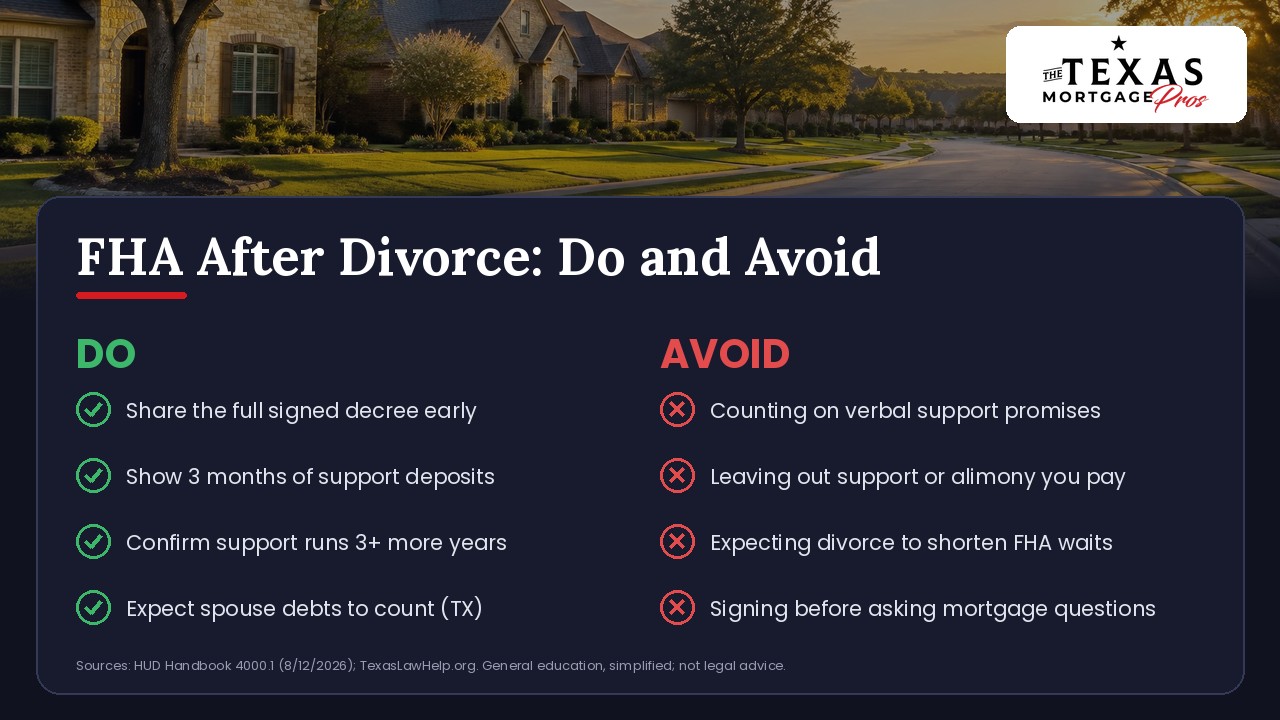
- Fully executed final divorce decree, if final
- Temporary orders or signed agreements, if your divorce is pending
- Every child support, maintenance, or alimony order and agreement
- Proof of support received: recent bank statements, canceled checks, or agency records
- Proof of support paid: pay stubs covering at least 28 consecutive days, including any garnishment
- The decree pages that assign debts to your former spouse
- Current statements for the former marital home’s mortgage and any joint debts
- The Closing Disclosure and bank records if you received proceeds from selling the former home
- Records for any foreclosure, deed-in-lieu, or short sale
- Current income, asset, and employment documents
A mortgage review is also a good time to catch credit report errors, such as a joint account the decree assigned to your ex that still shows late payments in your name. Starting with case numbers assigned on or after January 1, 2027, FHA will accept more credit score models; our post on mortgage credit score changes explains what that means for Texas buyers. You can also review the basics on our FHA loan requirements page.
FAQ: FHA loans after divorce in Texas
Q: Can child support count as income for an FHA loan after divorce?
A: It can, if it’s properly documented, has been received consistently under HUD’s rules, and will continue for at least three years. A court order and recent proof of receipt are central to the review.
Q: Does my divorce decree take my ex-spouse’s mortgage off my FHA application?
A: It can make a big difference. When the decree orders your former spouse to pay a debt, FHA doesn’t require 12 months of their payment history to exclude that contingent liability. The Mortgagee still reviews the whole picture, including your legal responsibility and your credit report.
Q: Can I get an FHA loan before my Texas divorce is final?
A: You can start the conversation and document review, but because Texas has no legal separation, you’re still married until the divorce is final. Community property debt rules, temporary orders, property ownership, and support arrangements can all affect the analysis.
Q: Is divorce an extenuating circumstance for FHA’s foreclosure waiting period?
A: No. HUD says divorce isn’t an extenuating circumstance. But an exception may be granted when your mortgage was current at the time of the divorce, your ex-spouse received the property, and it was later foreclosed or short sold.
Turn your decree into a clean FHA file
A divorce decree settles family-law questions, but it doesn’t automatically answer every FHA underwriting question. The most useful next step is to gather the decree, support records, debt information, and former-home documents before you start shopping seriously.
As a mortgage broker, I can help you understand which documents an FHA-approved Mortgagee is likely to ask for and how HUD’s guidelines may apply to your situation, without judgment and without assumptions. To talk through your plan, contact us, start a conversation on our FHA pre-qualification page, or call (281) 801-6965.
— Gerry Nicodemus
Sources
- U.S. Department of Housing and Urban Development, Single Family Housing Policy Handbook 4000.1 (last revised August 12, 2026): Principal Residence and Exceptions to the FHA Policy Limiting the Number of Mortgages per Borrower; Alimony, Child Support, and Maintenance (liabilities and income, TOTAL and Manual); Contingent Liabilities; Non-Borrowing Spouse Debt in Community Property States; Foreclosure, Deed-in-Lieu and Short Sale; Sale of Real Property; First-Time Homebuyer definition
- National Association of REALTORS®, Top 10 Takeaways from NAR’s 2026 Profile of Home Buyers and Sellers (November 2026; profile released November 5, 2026)
- TexasLawHelp.org, Alternatives to Legal Separation in Texas
- Texas Family Code Chapter 8 (Maintenance), Sections 8.054, 8.055 and 8.056
- Texas Family Code Section 154.001 (Support of Child) and Section 6.702 (Waiting Period)
Recommended Reading
- FHA Mortgage Insurance in Texas: How Long You Pay MIP
- FHA Non-Occupant Co-Borrower Rules: Buying With a Parent in Texas
- Texas Closing Costs: State Rules and County Tax Swings
TexasFHA.org is not affiliated with or endorsed by the U.S. Department of Housing and Urban Development, the Federal Housing Administration, the National Association of REALTORS®, TexasLawHelp.org, the State of Texas or any other government agency, and this is not a government document.
The Texas Mortgage Pros, LLC | Company NMLS #2665861 | Gerry Nicodemus, NMLS #286371 | Equal Housing Opportunity | www.nmlsconsumeraccess.org | (281) 801-6965
Equal Housing Opportunity. We do business in accordance with federal fair lending laws.

Gerry Nicodemus (NMLS #286371) is a licensed Texas loan originator with more than 25 years of mortgage experience. He specializes in FHA loans and explains credit, down payment, gift fund, and appraisal rules in plain English so Texas buyers know exactly where they stand. Gerry is also a digital marketer who builds agentic AI systems that help mortgage and real estate professionals get found online and serve borrowers better.