

FHA flood insurance requirements can determine whether a Texas home purchase closes on time. If any part of the home sits in a FEMA Special Flood Hazard Area, FHA requires flood insurance for the life of the loan, and the policy has to be in place before closing. With FEMA’s new online NFIP purchase tool and a December 11 deadline for the program’s authority, now is a good time to understand the rules before you make an offer.
TL;DR:
- FHA requires flood insurance when any part of the home, or structures and equipment essential to its value, is in a Special Flood Hazard Area (zones starting with A or V).
- The mortgage company orders its own flood zone determination. A map search or the appraisal doesn’t replace it.
- An NFIP policy or a private flood policy that meets FHA’s standards can work, and the coverage must stay in place for the life of the loan.
- Texas sellers must answer flood questions on the Seller’s Disclosure Notice, but brand-new homes are exempt, and new construction in a flood zone has extra FHA elevation rules.
- The NFIP’s authority runs through December 11, 2026. If it lapses, FEMA stops selling and renewing policies, which can hold up flood-zone closings.
Table of Contents
- Why Is Flood Insurance in the News Right Now?
- What Are FHA Flood Insurance Requirements?
- What Counts as Acceptable Flood Coverage?
- What Must a Texas Seller Disclose About Flooding?
- How Do New Construction, Condos, and Manufactured Homes Differ?
- What Happens If the NFIP Lapses on December 11?
- Questions to Ask Your Mortgage Broker
- Flood Insurance Do’s and Don’ts
- Talk Through Your Options
- Sources
Why Is Flood Insurance in the News Right Now?
Buying flood insurance just got simpler. FEMA said on October 20 that people in almost 22,700 NFIP communities can now get a quote and buy a National Flood Insurance Program policy online through its FloodSmart site, Insurance Journal reported on October 23. The quote asks for details such as the address, foundation type, construction type, elevation, and where the heating and cooling equipment sits. You can buy online or take the quote to an insurance agent.
The same report pointed to a Government Accountability Office finding that 86% of at-risk properties had no NFIP coverage as of April 2026, partly because FEMA’s flood zones don’t capture every risk, such as heavy rainfall. NFIP policies have dropped from 5.5 million in 2010 to 4.5 million in 2026, with private insurers picking up some of the difference.
There is also a deadline. FEMA’s NFIP reauthorization page says Congress extended the program’s authority on September 2, 2026, and it now runs through 11:59 p.m. on December 11, 2026. If you plan to close on a Texas home in December, that date matters.
One thing hasn’t changed: most homeowners and renters policies don’t cover flood damage, according to FEMA. Our post on Texas homeowners insurance costs covers the rest of your insurance budget.
What Are FHA Flood Insurance Requirements?

FHA’s rules are in HUD Handbook 4000.1. Here is how they work for a typical purchase:
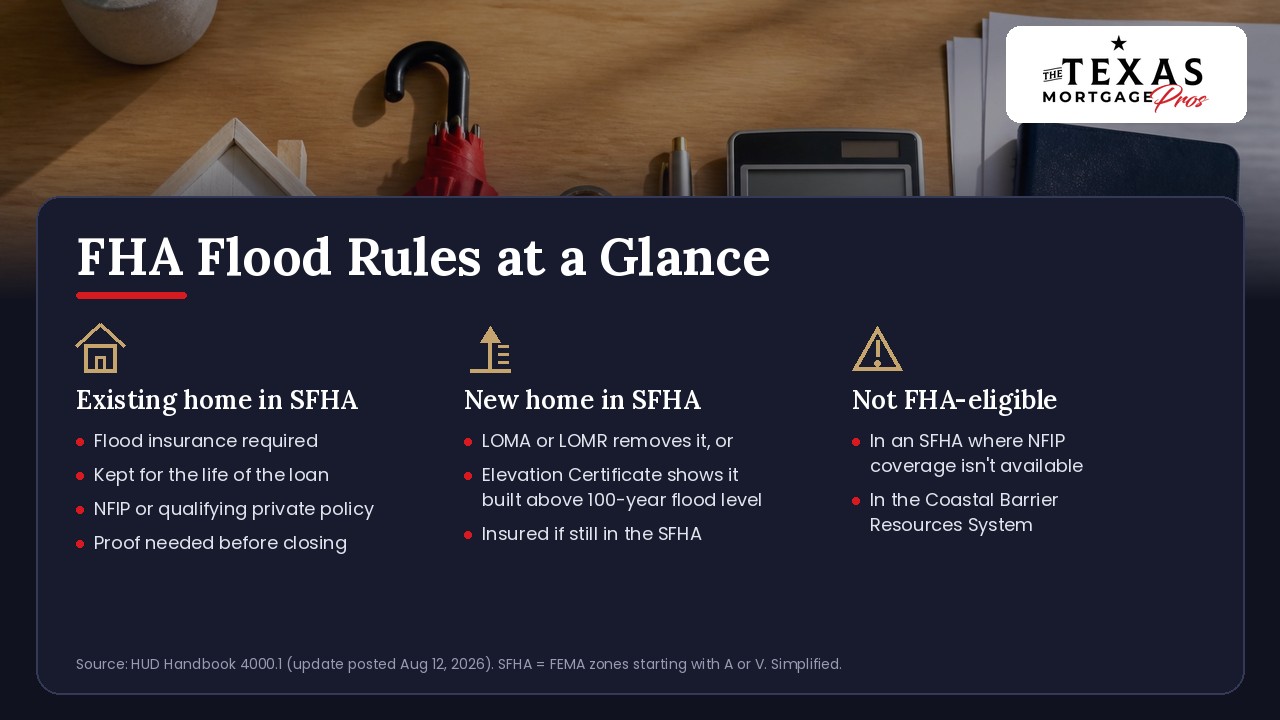
- The mortgage company checks the flood zone. It must determine whether the property is in a Special Flood Hazard Area (SFHA) using a flood zone determination service separate from the appraiser. That determination covers the life of the loan.
- Coverage is required in an SFHA. If any part of the dwelling, or related structures or equipment essential to the property’s value, is in an SFHA and NFIP coverage is available in the community, you must get and keep flood insurance.
- It lasts for the life of the loan. The coverage must be at least the lowest of three amounts: the full replacement cost of the insurable value of the improvements, the most NFIP coverage available for that type of property, or the outstanding loan balance.
- Some homes aren’t eligible. A home in an SFHA can’t get FHA insurance if NFIP coverage isn’t available in that community. Homes in the federal Coastal Barrier Resources System aren’t eligible. On the Texas coast, ask about this before you fall in love with a house.
For an SFHA property, the loan file includes the flood certification, any FEMA Letter of Map Amendment (LOMA), Letter of Map Revision (LOMR), or Elevation Certificate that applies, and a copy of the flood insurance certificate or policy.
You can do your own early check on FEMA’s Flood Map Service Center, but treat it as a first look. The mortgage company’s determination counts for the FHA file. FHA also includes a flood premium in your total monthly mortgage payment, so it can affect your debt-to-income ratios.
What Counts as Acceptable Flood Coverage?
FHA accepts two kinds of flood insurance:
- An NFIP policy, run by FEMA. FEMA says NFIP building coverage for homeowners goes up to $250,000 and contents coverage up to $100,000. They are bought separately and carry separate deductibles.
- A private flood policy that meets FHA’s standards. Among other things, the insurer must be licensed or otherwise approved in Texas, the coverage must be at least as broad as a standard NFIP policy, deductibles can’t be higher than NFIP’s maximum, and the insurer must give 45 days’ written notice before canceling or not renewing.
Some private policies include a short statement saying the policy “meets the definition of private flood insurance contained in 24 CFR 203.16a(e) for FHA-insured mortgages.” HUD lets the mortgage company rely on that statement. If it’s missing, the mortgage company can review the policy itself or ask the agent or carrier for the statement, so ask your agent about it up front.
Timing matters, too. New NFIP coverage usually starts after a 30-day waiting period, but federal law (42 U.S.C. 4013(c)) waives that wait when you first buy the policy in connection with a loan, such as a home purchase. Even so, the policy and proof of coverage must still be ready before closing.
What Must a Texas Seller Disclose About Flooding?
Texas gives buyers of most existing single-family homes a head start. Under Texas Property Code Section 5.008, the Seller’s Disclosure Notice asks whether the seller knows of:
- current flood insurance on the property;
- past flooding from a reservoir release, or water getting into a structure from a natural flood;
- whether the property is wholly or partly in a 100-year floodplain (an SFHA), a 500-year floodplain, a floodway, a flood pool or a reservoir;
- any flood claim the seller has filed with any insurer, including the NFIP; and
- any FEMA or U.S. Small Business Administration assistance for flood damage.
The seller must give you the notice on or before the effective date of the contract. If they don’t, you can end the contract for any reason within seven days after you receive it. The notice reflects what the seller knows and isn’t a warranty, so it doesn’t replace the flood zone determination.
Some sales are exempt, including foreclosure sales and new homes that have never been lived in. That’s another reason new construction needs its own check.
How Are New Construction, Condos and Manufactured Homes Different?
New construction. A newly built home in an SFHA isn’t eligible for FHA unless the mortgage company gets either a final FEMA LOMA or LOMR that removes the property from the SFHA, or a FEMA Elevation Certificate showing the lowest floor (including any basement) and essential equipment are built above the 100-year flood elevation. If the property is still in the SFHA, you also need flood insurance. If you’re building, our page on the FHA construction one-time close loan explains how that program works.
Existing homes. If any part of the home is in an SFHA, flood insurance is required.
Condos. The condo association must carry flood insurance on buildings in the SFHA, covering both unit owners and common areas. Our guide to FHA condo approval in Texas covers the rest of the condo checklist.
Manufactured homes. The finished grade beneath the home must be at or above the 100-year flood elevation, documented with a LOMA, LOMR, or Elevation Certificate when the home is in an SFHA, and flood insurance is still required.
What Happens If the NFIP Lapses on December 11?
If Congress doesn’t act by 11:59 p.m. on December 11, FEMA says it would keep paying valid claims but would stop selling and renewing policies. FEMA cites a National Association of Realtors estimate that a lapse might affect about 1,300 property sales a day, or roughly 40,000 closings a month.
For a December FHA closing on a home in an SFHA, that can be a problem if you’re counting on a new NFIP policy. A few practical steps:
- Ask for the flood zone determination as soon as you’re under contract.
- Get an NFIP quote early, and compare it with a private flood quote that meets FHA’s standards.
- Talk with your agent, title company, and mortgage broker about what happens to your closing date if the program lapses.
No one can say whether Congress will extend the deadline again or when. Planning early is safer than waiting to find out.
Questions to Ask Your Mortgage Broker
Bring the property address and the seller’s disclosure to the conversation:
- Has the flood zone determination been ordered, and what did it show?
- If the home is in an SFHA, how much coverage will FHA require?
- Will a private flood policy work, and what should my agent send you?
- How will the flood premium affect my monthly payment and ratios?
- For a new home, do we need a LOMA, LOMR, or Elevation Certificate?
- For a condo, does the association’s flood policy meet FHA’s rules?
- Could the December 11 NFIP deadline affect our closing?
Before you shop, our guide to mortgage pre-approval in Texas covers what to have ready.
Flood Insurance Do’s and Don’ts
Do:
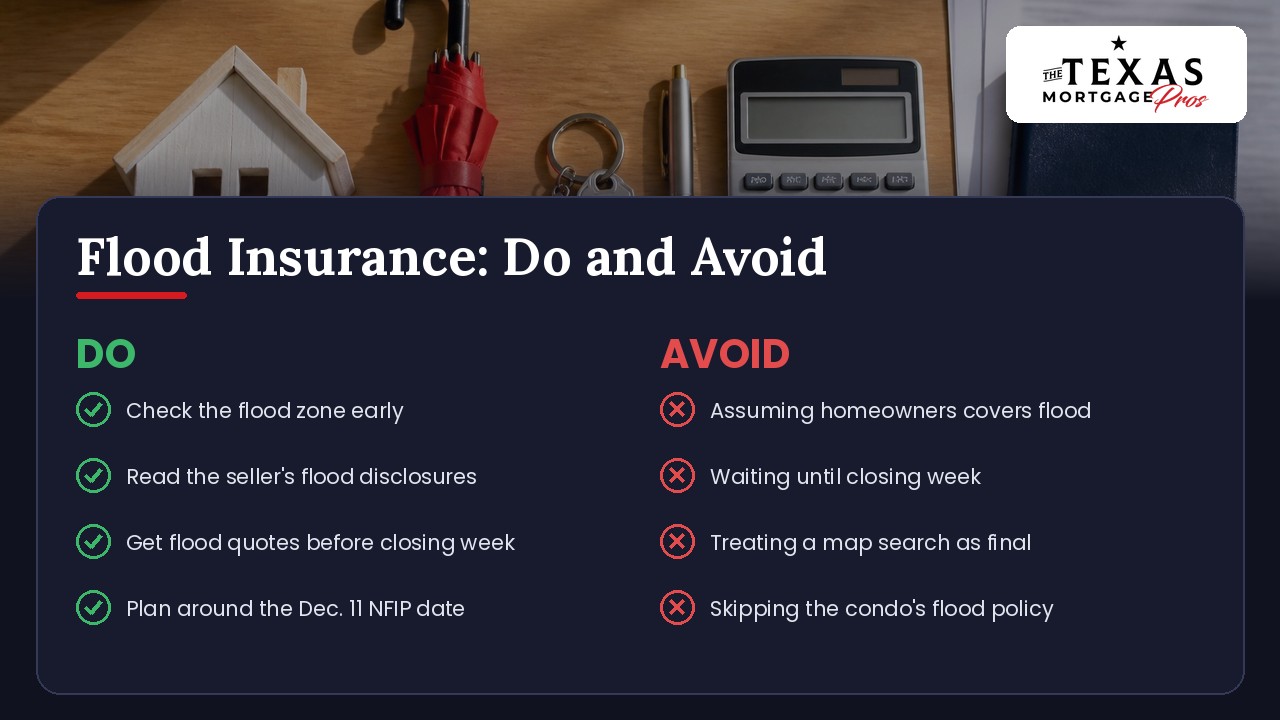
- Check the flood zone early, before or right after you make an offer.
- Read the seller’s flood disclosures on the Seller’s Disclosure Notice.
- Get flood quotes before closing week, from the NFIP and a private insurer.
- Plan around the December 11 NFIP date if you’re closing in December.
Avoid:
- Assuming homeowners insurance covers flood. Most policies don’t.
- Waiting until closing week. The policy and proof have to be ready before you close.
- Treating a map search as final. The mortgage company’s determination is the one FHA uses.
- Skipping the condo’s flood policy. The association’s coverage must meet FHA’s rules, too.
— Gerry Nicodemus
Talk Through Your Options
FHA flood insurance requirements are easy to handle when you know about them early and stressful when they show up the week of closing. If you’re looking at a Texas home near a creek, bayou, or the coast, or you want to know where you stand, call (281) 801-6965 to talk with a mortgage professional at The Texas Mortgage Pros, a mortgage broker. You can also review our FHA loan requirements, start with FHA pre-qualification, or contact us online.
Last verified: October 30, 2026. FHA guidelines, NFIP deadlines, and Texas law can change. Check HUD Handbook 4000.1, FEMA, and each source for the latest details.
This article is general information, not legal, insurance, or financial advice. It is not a commitment to lend or an offer of credit. Loan approval and terms are subject to underwriting, program guidelines, credit review, property eligibility, and appraisal. Flood insurance requirements, coverage and costs vary by property and insurer, and buying flood insurance does not guarantee loan approval or a closing date. For questions about coverage, talk with a licensed insurance agent. For questions about a contract or disclosure, talk with your real estate agent or an attorney.
The Texas Mortgage Pros is not affiliated with, endorsed by, or sponsored by HUD, FHA, FEMA, the National Flood Insurance Program, the Government Accountability Office, the National Association of Realtors, the State of Texas, Insurance Journal, or any other organization or government agency named in this article. Third-party names are used only to cite their published information.
The Texas Mortgage Pros, LLC | Company NMLS #2665861 | Gerry Nicodemus, NMLS #286371 | Equal Housing Opportunity | www.nmlsconsumeraccess.org | (281) 801-6965
Sources
Each source below is linked once in the article above, except 42 U.S.C. 4013, which is cited by name only.
- Insurance Journal, FEMA Launches Online Purchasing for Flood Insurance Policies (October 23, 2026)
- FEMA, Congressional Reauthorization for the National Flood Insurance Program (last updated September 28, 2026)
- U.S. Department of Housing and Urban Development, Single Family Housing Policy Handbook 4000.1 (Special Flood Hazard Areas, II.A.1.b.iv(A)(1); Borrower’s Total Mortgage Payment, II.A.4.a and II.A.5; New Construction Site Considerations, II.A.8.i.vii(A)(5); update posted August 12, 2026)
- FEMA, Flood Map Service Center, and FEMA FloodSmart, Buy a Flood Insurance Policy
- Texas Legislature, Texas Property Code Section 5.008, Seller’s Disclosure of Property Condition
- United States Code, 42 U.S.C. 4013(c), Effective Date of Policies (waiting period)
Recommended
- Texas Homeowners Insurance Costs: What Buyers Should Know This Fall
- FHA Appraisal Requirements in Texas: What the Appraiser Checks
- Texas Property Taxes and Your Mortgage Payment: What Buyers Should Budget

Gerry Nicodemus (NMLS #286371) is a licensed Texas loan originator with more than 25 years of mortgage experience. He specializes in FHA loans and explains credit, down payment, gift fund, and appraisal rules in plain English so Texas buyers know exactly where they stand. Gerry is also a digital marketer who builds agentic AI systems that help mortgage and real estate professionals get found online and serve borrowers better.