

Many Texas condo and townhome buyers don’t think about FHA condo approval until they’re under contract. With an FHA loan, the unit must qualify, and so must the building. In most cases, the condo project must be on HUD’s approved list, the single unit must get FHA’s Single-Unit Approval, or the property must meet FHA’s definition of a site condominium. Texas buyers have more condos and townhomes to choose from this fall, so it helps to know how to check before you write an offer.
TL;DR:
- FHA can insure a condo unit in a HUD-approved project, a unit with Single-Unit Approval or an eligible site condominium.
- Check HUD’s condo search yourself. An “FHA approved” line in a listing is not proof, and approvals expire.
- If the building isn’t on HUD’s list, Single-Unit Approval may still work, but the building has to pass owner-occupancy, FHA-concentration, reserve, insurance and litigation tests.
- In Texas, read the HOA’s resale certificate and know your termination rights under the TREC condominium contract.
- Houston’s condo and townhome market had 9.3 months of inventory in September, and statewide listings were up 2.8% in the third quarter.
Table of Contents
- Why Should Texas Condo Buyers Pay Attention Now?
- How Does FHA Condo Approval Work?
- What if the building isn’t on HUD’s List?
- Is It a Site Condo?
- Checking the HOA’s Finances and Insurance
- The Texas Condo Resale Certificate
- Questions to Ask Your Mortgage Broker
- FHA Condo Do’s and Don’ts
- Talk Through Your Options
- Sources
Why Should Texas Condo Buyers Pay Attention Now?
Condo and townhome buyers in Texas have more room to shop. In Houston, townhome and condominium closings fell 21% in September from a year earlier; active listings rose 6.9% to 3,609; and inventory reached 9.3 months, up from eight months a year before, according to Houston Association of REALTORS® data reported by Houston Agent Magazine on October 15. Statewide, active listings are up 2.8% from a year earlier, with more homes available in 18 of 26 metro areas and 5.5 months of inventory.
More choices can mean more time to compare buildings. For an FHA buyer, that time is well spent on one question: will this condo project work with FHA financing? A unit you love in a building that doesn’t qualify can cost you inspection fees, appraisal fees, and weeks of your option period.
The rules are also being updated. HUD’s latest revision of its Single Family Housing Policy Handbook 4000.1, posted August 12, 2026, revises the condominium section and takes effect November 10, 2026. Ask your mortgage broker which version applies to your loan.
How Does FHA Condo Approval Work?
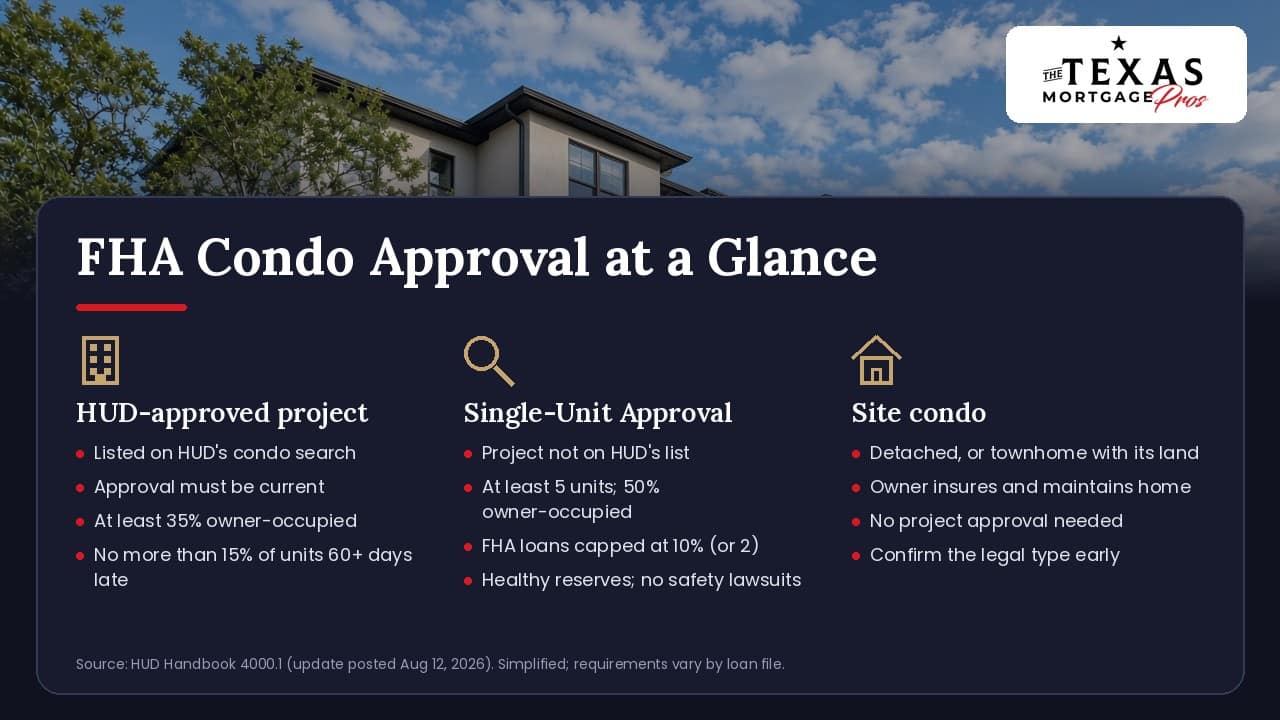
Under HUD Handbook 4000.1, FHA will insure a mortgage on a condominium unit in one of three situations:
- The project is HUD-approved. The whole condominium project has been approved by FHA staff or by an FHA-approved mortgage company with HUD’s delegated authority.
- The unit gets Single-Unit Approval. Sometimes called a spot approval, this allows one unit in a project not on HUD’s list to qualify if the unit and project meet HUD’s tests.
- The home is a site condominium. Some detached homes and townhome-style homes are legally condos but do not need project approval.
Start with HUD’s list. You can search approved projects by state, city, name, or ZIP code with HUD’s FHA condominium search. Look at the status. Approved projects have an expiration date and must be recertified, so a building that was approved a few years ago may now show as expired. The mortgage company must confirm the project is on the approved list when it assigns the FHA case number.
Approved projects still have unit-level checks. For a unit in an approved project, HUD requires the mortgage company to confirm that at least 35% of the units are owner-occupied and that no more than 15% of the units are more than 60 days behind on association dues or special assessments. FHA may stop issuing new case numbers in a project where FHA-insured mortgages exceed 50% of the units. The HOA’s master insurance must also meet FHA standards.
What if the Building is Not on HUD’s List?
A building not on HUD’s list may still qualify through Single-Unit Approval. The mortgage company reviews the unit and the project itself, using HUD’s loan-level questionnaire (form HUD-9991) and the HOA’s documents. An FHA case number for a single-unit file does not approve the unit or the project. The review still has to be completed. Under the handbook, the main tests include:
- The loan file. The application must receive an Accept from FHA’s automated scorecard, or meet stricter limits if it is manually underwritten.
- The building. At least five units, a certificate of occupancy for all units, and at least one unit with a certificate of occupancy at least a year old or that has been occupied. Manufactured homes are not eligible for Single-Unit Approval.
- Owner occupancy and FHA concentration. At least 50% of the units must be owner-occupied. In projects with 20 or more units, FHA-insured mortgages generally can’t exceed 10% of the units. In smaller projects, no more than two units can have FHA-insured mortgages.
- Control and ownership. The developer must have turned control of the association over to the unit owners. In projects with 20 or more units, one owner or related party can own no more than 10% of the units.
- Money in the bank. Separate operating and reserve accounts, reserves funded with at least 10% of a year’s assessments unless an acceptable reserve study supports less, no more than 15% of units more than 60 days late on dues, and no bankruptcy, receivership, or foreclosure involving the project in the last three years.
- Use of the building. Commercial space can’t exceed 35% of the total floor area, and the project can’t be in litigation about safety, structural soundness, habitability, or functional use.
Some projects are not eligible for FHA approval at all, including condo hotels, timeshares, cooperatives, houseboat projects, continuing care facilities, and projects with mandatory rental pooling. Your broker will need the HOA or its management company to answer questions and provide documents, so expect this route to take longer than buying in an approved building.
Is It a Site Condo?
Many Texas townhome and patio-home communities are structured as condominiums on paper, even though each owner has a house. HUD treats a property as a site condominium if the project is made up entirely of detached single-family homes with no shared garages or other attached buildings, or if the units are detached or townhome-style homes where the unit includes the dwelling and the land, the project has no manufactured homes, and it is under a condominium declaration. The owner must cover all required insurance and maintenance on the home, except landscaping. Site condos do not need project approval or Single-Unit Approval.
Don’t judge by how the community looks. Ask your broker and real estate agent to confirm the legal setup from the recorded declaration early. It also affects your contract: the TREC Residential Condominium Contract (Resale) isn’t for use when the seller owns fee simple title to the land beneath the unit, so your agent will choose the right form.
Checking the HOA’s Finances and Insurance

The HOA’s paperwork tells you a lot about whether the building works for FHA and fits your budget. Ask for the current budget, the latest balance sheet, reserve information, the delinquency picture, insurance certificates, and any approved or proposed special assessments.
- Master policy. HUD requires the association to carry a master hazard policy that covers the full insurable replacement cost of the units and common elements, plus liability coverage of at least $1 million per occurrence. Projects with more than 20 units also need fidelity (crime) coverage.
- Your own policy. If the master policy does not cover the inside of your unit, FHA requires you to carry a walls-in (HO-6) policy that covers the interior and any improvements you make. The Texas Department of Insurance home insurance guide explains how condo and townhouse policies differ depending on what the HOA’s master policy covers. Our post on Texas homeowners insurance costs also covers shopping for coverage.
- Flood and the coast. If buildings sit in a FEMA Special Flood Hazard Area, the project must meet FHA’s flood insurance requirements. You can check flood maps at the FEMA Flood Map Service Center. Along the Texas coast, a project is not eligible for FHA project approval or Single-Unit Approval if any part falls within the Coastal Barrier Resources System.
- Dues and assessments. HUD counts HOA or condo association fees and special assessments as part of your total mortgage payment, so a dues increase or a new assessment can change what fits your budget. Our page on debt-to-income ratios explains how monthly costs are weighed.
The Texas Condo Resale Certificate
Texas gives condo buyers a useful tool. Under Texas Property Code Section 82.157, the association must give the selling owner a resale certificate within 10 days of a written request. The certificate covers items such as the regular assessment, unpaid amounts the seller owes, capital expenditures approved for the next 12 months, reserves, unsatisfied judgments, pending lawsuits, insurance coverage, known code violations, and the current operating budget and balance sheet. TREC publishes a Condominium Resale Certificate form.
The TREC condominium contract requires the certificate to have been prepared no more than three months before it is delivered to you. If you did not receive the certificate or the condo documents (declaration, bylaws, and rules) before signing, the contract lets you terminate within seven days after you receive them and get your earnest money refunded. Read them as soon as they arrive and share them with your broker, because they often answer FHA’s questions. Your real estate agent can walk you through the deadlines in your specific contract.
Before you make an offer, our guide to mortgage pre-approval in Texas covers what to have ready.
Questions to Ask Your Mortgage Broker
Bring the listing and any HOA documents you already have:
- Is this project on HUD’s approved list, and when does the approval expire?
- If it isn’t, is Single-Unit Approval realistic, or could this be a site condo?
- Which HOA documents and insurance certificates will you need, and who should request them?
- Do owner occupancy, FHA concentration, reserves, delinquencies, or commercial space look like problems?
- Does the master policy cover the interior, or will I need an HO-6 policy?
- Can I finish the condo review within my option period and contract deadlines? Ask your real estate agent, too.
FHA Condo Do’s and Don’ts
Do:
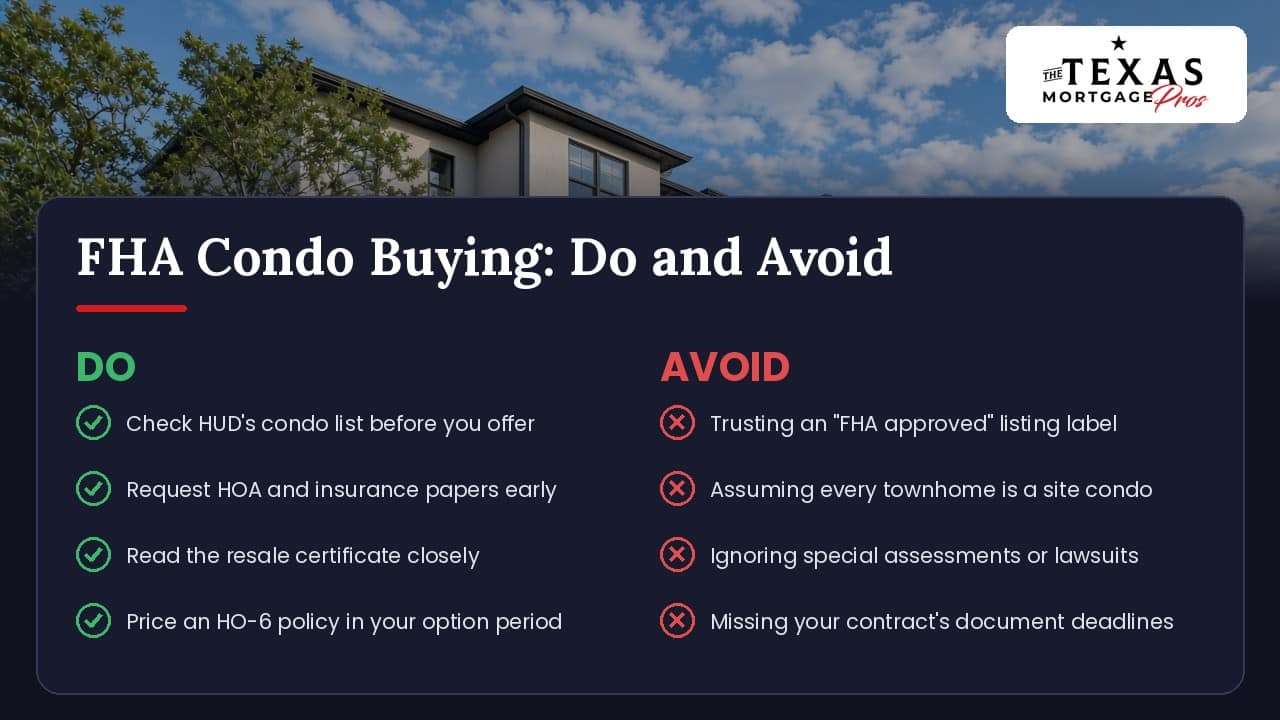
- Check HUD’s condo list before you make an offer, and review the status and expiration date.
- Request HOA and insurance papers early so your broker can review the project while your option period is still open.
- Read the resale certificate closely, especially reserves, approved capital expenditures, and pending lawsuits.
- Price an HO-6 policy in your option period if the master policy does not cover the interior.
Avoid:
- Trusting an “FHA approved” listing label. Approvals expire, and HUD’s list is the record.
- Assuming every townhome is a site condo. The recorded documents decide.
- Ignoring special assessments or lawsuits. They can affect both FHA eligibility and your monthly budget.
- Missing your contract’s document deadlines. Termination rights tied to the certificate and documents are time-limited.
— Gerry Nicodemus
Talk Through Your Options
FHA condo approval adds a few steps to buying a condo or townhome, but checking early can save you time and money. If you have found a Texas condo or townhome and want to know whether the building works for FHA, call (281) 801-6965 to talk with a mortgage professional at The Texas Mortgage Pros, a mortgage broker. You can also review our FHA loan requirements, read about closing costs, or contact us online.
The Texas Mortgage Pros, LLC | Company NMLS #2665861 | Gerry Nicodemus, NMLS #286371 | Equal Housing Opportunity | www.nmlsconsumeraccess.org | (281) 801-6965
Sources
- U.S. Department of Housing and Urban Development, Single Family Housing Policy Handbook 4000.1 (Condominiums, II.A.8.p, and Condominium Project Approval, II.C; update posted August 12, 2026)
- HUD, FHA Condominiums Search
- Houston Agent Magazine, HAR: Housing Market Activity Cools in Houston (October 15, 2026)
- Texas REALTORS®, Texas Homebuyers Had More Options in Q3 of 2026 (October 20, 2026)
- Texas Property Code, Chapter 82 (Uniform Condominium Act), Section 82.157, Resale of Unit
- Texas Real Estate Commission, Residential Condominium Contract (Resale), TREC No. 30-18
- Texas Real Estate Commission, Condominium Resale Certificate, TREC No. 32-5
- Texas Department of Insurance, Home Insurance Guide
- FEMA, Flood Map Service Center
- U.S. Fish and Wildlife Service, Coastal Barrier Resources Act Maps and Data
Recommended
- Texas Homeowners Insurance Costs: What Buyers Should Know This Fall
- FHA Appraisal Requirements in Texas: What the Appraiser Checks
- Mortgage Pre-Approval in Texas: Your 2026 Buying Guide

Gerry Nicodemus (NMLS #286371) is a licensed Texas loan originator with more than 25 years of mortgage experience. He specializes in FHA loans and explains credit, down payment, gift fund, and appraisal rules in plain English so Texas buyers know exactly where they stand. Gerry is also a digital marketer who builds agentic AI systems that help mortgage and real estate professionals get found online and serve borrowers better.