

FHA appraisal requirements cover two things: the appraiser estimates the home’s market value, and the appraiser checks whether the home meets HUD’s Minimum Property Requirements, which state that every FHA-insured home must be safe, sound, and secure. The appraiser will run the heat and water, inspect the roof, check older homes for peeling paint, and, when safe, look into the attic and crawl space. That is not a home inspection. HUD says FHA does not inspect the home or guarantee its value or condition, so Texas buyers should still hire their own licensed inspector.
TL;DR:
- An FHA appraiser must observe, analyze and report whether the home meets HUD’s Minimum Property Requirements (MPR): safe, sound and secure.
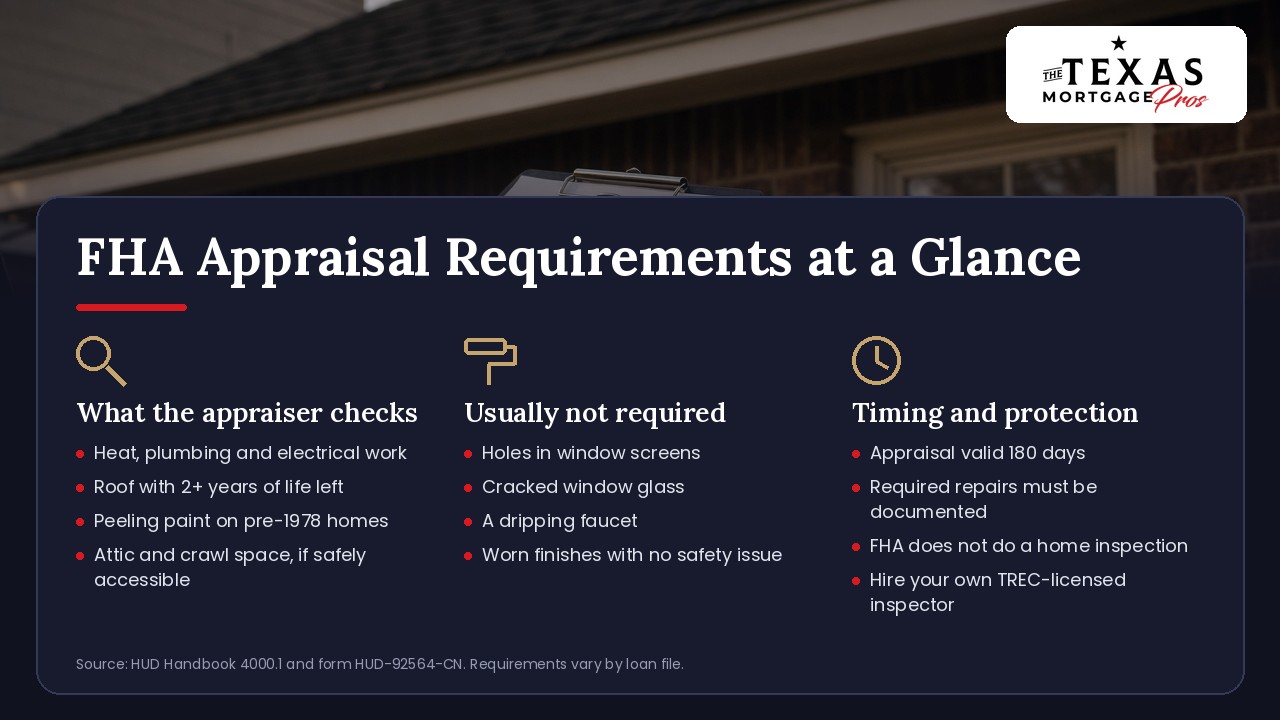
- The appraiser operates the heating, plumbing and electrical systems, checks that the roof has at least two years of life left and looks for defective paint, moisture, pests and structural problems.
- Cosmetic items, such as holes in window screens, cracked window glass or a dripping faucet, are not required repairs.
- An appraisal is not a home inspection. In Texas, hire a TREC-licensed inspector and use your option period.
- FHA has proposed updating its MPR, with feedback open through November 6, 2026. It is a draft only. Today’s rules still apply.
Table of Contents
- Why Are FHA Appraisal Requirements in the News?
- What Does an FHA Appraisal Do?
- What Does the FHA Appraiser Check?
- What Is Not a Required Repair?
- FHA Appraisal vs. Home Inspection
- What Happens If the Appraisal Calls for Repairs?
- What If the Appraisal Comes In Low?
- Texas Tips Before the Appraiser Arrives
- Questions to Ask Your Mortgage Broker
- FHA Appraisal Do’s and Don’ts
- Talk Through Your Options
- Sources
Why Are FHA Appraisal Requirements in the News?
On September 22, the Federal Housing Administration posted proposed updates to its Minimum Property Requirements on its Single Family Drafting Table. FHA said the standards “have not been updated in over two decades” and that the proposal aims to align them with industry standards and simplify them. Feedback is open through November 6, 2026. FHA made it clear that the draft is not official policy, and its existing policies remain in effect until amended.
HousingWire reported that industry stakeholders have argued FHA’s repair and reinspection requirements exceed those of Fannie Mae and Freddie Mac, contributing to some sellers’ reluctance to accept FHA offers. Separately, on October 1, FHA began optionally accepting appraisals in the new UAD 3.6 format, ahead of Fannie Mae and Freddie Mac’s November 2, 2026 switch. That changes how appraisals are reported, not the property rules.
Texas buyers also have more room to work. Texas Public Radio reported that San Antonio home sales in September were 2% lower than a year earlier, with about six months of inventory and homes taking close to three months to sell. The San Antonio Board of Realtors’ chair said sellers should review comparable sales and price realistically, and that buyers have more selection and more time. That time lets you inspect a home, learn what an FHA appraiser may flag, and negotiate repairs without feeling pressured.
What Does an FHA Appraisal Do?
Under HUD’s Single Family Housing Policy Handbook 4000.1, the appraiser must follow FHA guidance and the Uniform Standards of Professional Appraisal Practice. Beyond estimating market value, the appraiser must observe, analyze, and report whether the property meets HUD’s Property Acceptability Criteria, including the MPR. HUD defines the MPR as general requirements that all FHA-insured homes be safe, sound, and secure. The appraiser must note every place the home falls short, or clearly state that no deficiencies were observed or known.
- The appraiser must be on the FHA Appraiser Roster and know the local market. The mortgage company that underwrites your loan orders the appraisal.
- The appraiser is independent. HUD does not allow a mortgage broker or commissioned sales staff to select, manage, or pay the appraiser, and no one may push the appraiser toward a value. As your mortgage broker, we help you prepare, but we don’t choose the appraiser.
- The value has a specific job. HUD’s required contract language says the appraised value sets the maximum mortgage HUD will insure, and HUD does not warrant the value or condition of the property.
What Does the FHA Appraiser Check?
Based on HUD Handbook 4000.1, these are the main items the appraiser looks at:
- Basic living needs. Safe drinking water; at least one bathroom with a toilet, sink, and tub or shower; safe sewage disposal; adequate heat, hot water, electricity, and a kitchen area with a sink and a stove hookup. FHA has no minimum home size.
- Heating and cooling. The permanent heating system must be safe and able to heat living areas to at least 50 degrees Fahrenheit without someone tending it. Central air conditioning is not required, but if the home has it, it must work, or the appraiser reports the deferred maintenance and cost to cure.
- Electrical. The appraiser looks for frayed or exposed wiring, notes an undersized panel, and tests a sample of switches, lights, and outlets.
- Plumbing. The appraiser flushes toilets, runs hot and cold faucets to check pressure, looks for leaks under fixtures, and checks the water heater’s temperature and pressure relief valve. The appraiser visually checks the septic system for signs of failure.
- Roof. The roof must keep moisture out and have at least two years of remaining physical life. If it has less, HUD requires the appraisal to be made subject to an inspection by a professional roofer.
- Paint. If the home was built before 1978, the appraiser must note all defective paint (cracking, scaling, chipping, peeling, or loose) inside and out, including outbuildings and fences, and require repair under federal lead-based paint rules. For newer homes, repair exterior paint that exposes the surface underneath to the weather.
- Attic, crawl space, and foundation. The appraiser inspects the attic and crawl space when safely accessible and checks the foundation for readily observable safety or structural problems. Signs like a water-stained ceiling or a mold smell can trigger an inspection or repairs.
- Drainage and access. Water should drain away from the foundation, and the property needs safe, all-weather access.
- Pests, hazards and extras. Evidence of wood-destroying insects, including a prior treatment, makes the appraisal subject to a pest inspection. Report known safety hazards, and ensure appliances that stay with the home and add value work.
When the appraiser cannot tell whether something meets the rules, such as a worn-out roof or a heating system that doesn’t seem to work, the appraisal may require an inspection by a qualified individual or entity. The appraiser must state the reason and may not require inspections to limit liability.
What Is Not a Required Repair?
FHA appraisal requirements focus on safety and soundness, not appearance. HUD limits required repairs to those needed to keep the property safe, secure, and sound, preserve its marketability, and protect occupants’ health and safety. Minor wear and tear that doesn’t affect health, safety, or soundness can be appraised “as is.”
HUD lists these as cosmetic or minor repairs that are not required:
- missing handrails that do not pose a threat to safety;
- holes in window screens;
- cracked window glass;
- defective interior paint in homes built after 1978;
- minor plumbing leaks that do not cause damage, such as a dripping faucet; and
- other inoperable or damaged parts that, in the appraiser’s judgment, do not pose a health or safety issue.
The appraiser still reports these items and considers them in the condition rating and value. A component that works and has not reached the end of its useful life should not be flagged for replacement just because of its age. The mortgage company makes the final call on which repairs are required.
FHA Appraisal vs. Home Inspection
HUD’s consumer notice, For Your Protection: Get a Home Inspection (form HUD-92564-CN), spells out the difference. An appraisal estimates the property’s value and is required to make sure the property is marketable. A home inspection evaluates the home’s condition for the buyer. FHA does not perform home inspections, and you arrange one yourself. HUD also warns that if you find problems after closing, FHA cannot give or lend you money for repairs or buy the home back. You should receive this notice at first contact, whether that is prequalification, pre-approval, or application.
The Consumer Financial Protection Bureau (CFPB) agrees: an inspection is different from an appraisal, and you generally need both.
In Texas, use a TREC-licensed inspector. The Texas Real Estate Commission (TREC) requires licensed inspectors to follow its Standards of Practice and provide clients with its Property Inspection Report form (REI 7-6). You can look up an inspector’s license and disciplinary history on TREC’s website. Termite reports require a separate license from the Texas Department of Agriculture’s Structural Pest Control Service. On the standard TREC One to Four Family Residential Contract, the buyer can pay an option fee for an unrestricted right to terminate during the option period, which is when most Texas buyers schedule their inspection. Our guide to mortgage pre-approval in Texas covers the steps you should take before making an offer.
What Happens If the Appraisal Calls for Repairs?
When a home does not meet the MPR, HUD requires the appraiser to list the repairs needed, give an estimated cost to cure, include photos, and make the appraisal “subject to” those repairs. From there:
- The work gets done and documented. The mortgage company must get evidence that required repairs, inspections, or certifications were completed. If the appraiser goes back to confirm, HUD requires the Certification of Completion section of the appraisal update and completion report.
- Some work can be escrowed. HUD allows a repair escrow for repairs that cannot be completed before closing, but only if the home is habitable and safe for occupancy at closing.
- The contract decides who pays. Under paragraph 7 of the TREC resale contract, unless the parties agree otherwise in writing, neither the buyer nor the seller must pay for repairs or treatments required by the loan, including wood-destroying insect treatment. If no one agrees to pay, the contract terminates, the buyer’s earnest money is refunded, and if those repairs cost more than a contract-set limit, the buyer may terminate. Unless otherwise agreed, the seller completes agreed repairs before closing.
Our guide to Texas seller concessions explains how buyers negotiate in a cooling market. If a home needs more work than a seller will do, an FHA 203(k) renovation loan can finance repairs as part of the purchase.
What If the Appraisal Comes In Low?
FHA buyers in Texas have a built-in protection. The TREC Third Party Financing Addendum includes the FHA/VA required provision: you are not obligated to complete the purchase or forfeit your earnest money unless you receive a written statement, under HUD/FHA requirements, showing an appraised value of at least the amount written into that paragraph. You also have the option to proceed regardless of the appraised value.
If the number disappoints:
- Get and read your copy. Under the CFPB’s Regulation B appraisal rule, you must receive a copy of the appraisal promptly upon completion or three business days before closing, whichever is earlier, unless you waive the timing.
- Look for factual errors. HUD allows the underwriter to request a reconsideration of value when the appraiser did not consider information that was relevant on the appraisal’s effective date. If you spot a wrong square footage or a missed nearby sale, tell your mortgage broker. HUD does not allow a new appraisal to increase the value.
- Negotiate. The CFPB says it’s risky to buy a home for more than its appraised value and that a lower appraisal often helps you ask the seller to reduce the price. It suggests talking with an attorney about your contract options.
- Watch the clock. HUD says an initial FHA appraisal is valid for 180 days from its effective date, and an update can extend it to one year from that date.
Texas Tips Before the Appraiser Arrives
A little preparation can save a second visit:
- Ask the seller to keep the utilities on. If the systems cannot be operated, HUD makes the appraisal subject to a return visit, which can uncover more repairs. This matters most on vacant homes.
- Clear the way. The appraiser does not have to move stored items, so keep the attic hatch, crawl space, electrical panel, and water heater easy to reach.
- Look up before you make an offer. After hail and wind season, an older roof is a common surprise. If the roof looks near the end of its life, ask early, since HUD requires at least two years of remaining life. Our post on Texas homeowners insurance costs explains how your roof can affect coverage and discounts.
- Check the build year. On a pre-1978 home, chipping or peeling paint anywhere on the property may require repair.
- Walk the yard after a rain. The appraiser should look for standing water against the foundation or grading that slopes toward the house.
Questions to Ask Your Mortgage Broker
Use this list before or right after you sign a contract:
- Does anything about this home’s age, roof, paint, or systems raise FHA property questions?
- When will the appraisal be ordered, and when should I expect my copy?
- If the appraisal calls for repairs, how are they documented, and can any be escrowed?
- How should I write repair terms into my TREC contract? Ask your real estate agent, too.
- What happens if the appraised value is below the price? How does the FHA/VA provision in my financing addendum work?
- How long is the appraisal good for, and what if closing slips?
FHA Appraisal Do’s and Don’ts
Do:
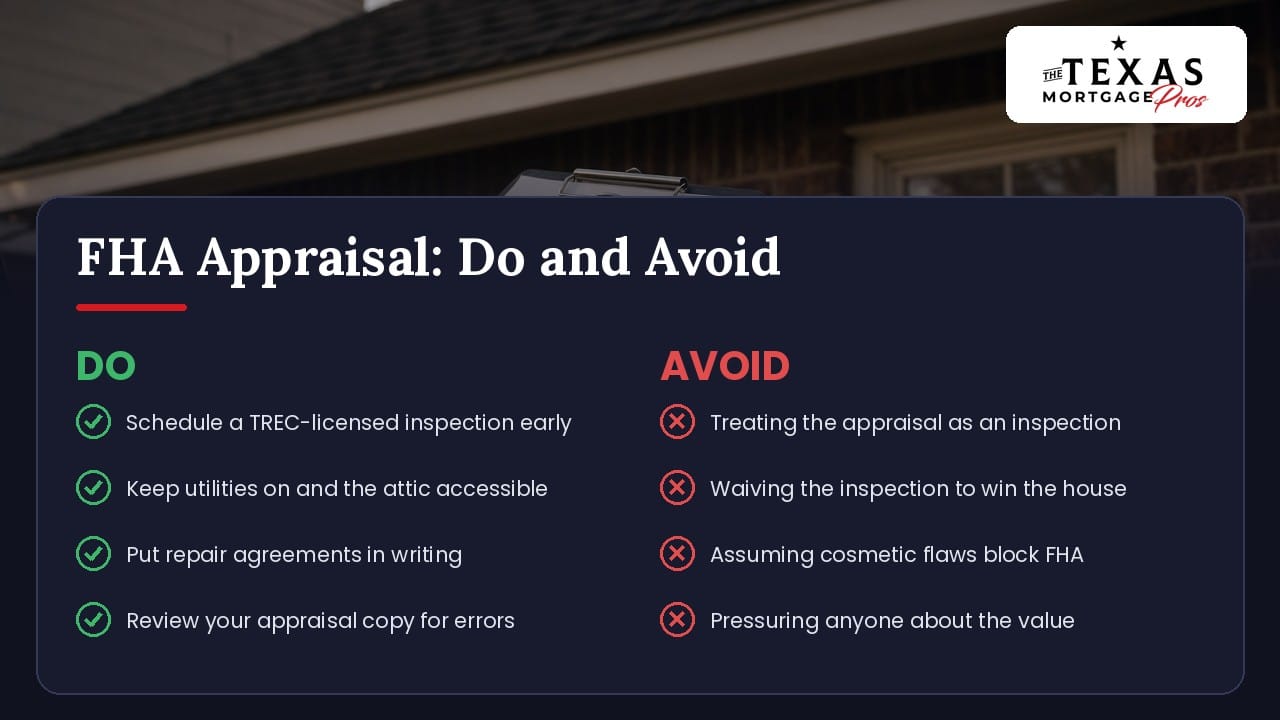
- Schedule a TREC-licensed inspection early, ideally within your option period.
- Keep the utilities on and the attic accessible so the appraiser can finish in one visit.
- Put repair agreements in writing in your contract or an amendment.
- Review your appraisal copy for errors and share any factual mistakes with your mortgage broker.
Avoid:
- Treating the appraisal as an inspection. HUD says FHA does not inspect the home for you.
- Waiving the inspection to win the house. HUD says FHA cannot pay for repairs you find after closing.
- Assuming cosmetic flaws block FHA. A torn window screen or a dripping faucet is not a required repair.
- Pressuring anyone about the value. Appraiser independence rules protect the process for everyone.
— Gerry Nicodemus
Talk Through Your Options
FHA appraisal requirements are easier to handle when you know them before you write an offer. If you are looking at an older home, a home with a worn roof, or a property that has been sitting on the market, call (281) 801-6965 to talk with a mortgage professional at The Texas Mortgage Pros, a mortgage broker, about what the appraiser is likely to look at and how repairs could affect your timeline. You can also review our FHA loan requirements to see where you stand today.
TexasFHA is not affiliated with, endorsed by, or sponsored by HUD, FHA, the CFPB, the Texas Real Estate Commission, Fannie Mae, Freddie Mac, the San Antonio Board of Realtors, Texas Public Radio, HousingWire, or any other organization named in this article. Third-party names are used only to cite their published information.
The Texas Mortgage Pros, LLC | Company NMLS #2665861 | Gerry Nicodemus, NMLS #286371 | Equal Housing Opportunity | www.nmlsconsumeraccess.org | (281) 801-6965
Sources
- U.S. Department of Housing and Urban Development, Single Family Housing Policy Handbook 4000.1 (Appraiser and Property Requirements, II.D.2-3; Ordering Appraisals and Appraisal Validity, II.A.1; Underwriting the Property, II.A.3; Repair Completion Escrow, II.A.6; update posted August 12, 2026)
- HUD, FHA INFO 2026-22, FHA Seeks Feedback on Proposed Changes to Single Family Housing Minimum Property Requirements (September 22, 2026) and FHA INFO 2026-23, Optional Broad Production Period for UAD 3.6 (October 1, 2026)
- HUD, FHA Single Family Drafting Table: Modernizing and Strengthening Minimum Property Requirements (feedback through November 6, 2026)
- HUD/FHA, For Your Protection: Get a Home Inspection (form HUD-92564-CN)
- Consumer Financial Protection Bureau, Schedule a Home Inspection
- Consumer Financial Protection Bureau, My Appraisal Is Less Than the Sale Price. What Does That Mean for Me? (last reviewed September 11, 2024)
- Consumer Financial Protection Bureau, Regulation B, 12 CFR 1002.14, Rules on Providing Appraisals and Other Valuations
- Texas Real Estate Commission, What Consumers Should Know About Texas Property Inspections
- Texas Real Estate Commission, One to Four Family Residential Contract (Resale), TREC No. 20-18
- Texas Real Estate Commission, Third Party Financing Addendum, TREC No. 40-11
- HousingWire, Feedback Still Open for Updates to FHA Minimum Property Requirements (September 22, 2026)
- Texas Public Radio, September Home Sales and Prices Dip in San Antonio (October 16, 2026)
Recommended
- Texas Seller Concessions: How Buyers Can Negotiate as Competition Cools
- What You Need to Know About FHA 203(k) Loans in Texas
- Mortgage Pre-Approval in Texas: Your 2026 Buying Guide

Gerry is a licensed mortgage loan originator and digital marketer with 25+ years in the mortgage business, specializing in conversion rate optimization, SEO, AI Overviews, and generative engine optimization (GEO) for the mortgage and real estate industry. Today he builds agentic intelligent systems, meaning AI agents that research, create content, nurture leads, and handle follow-up, to help mortgage and real estate business owners get found online, convert more leads, and scale. Gerry pairs decades of hands-on industry knowledge with the latest AI tools, so his clients stay a step ahead of the market.