

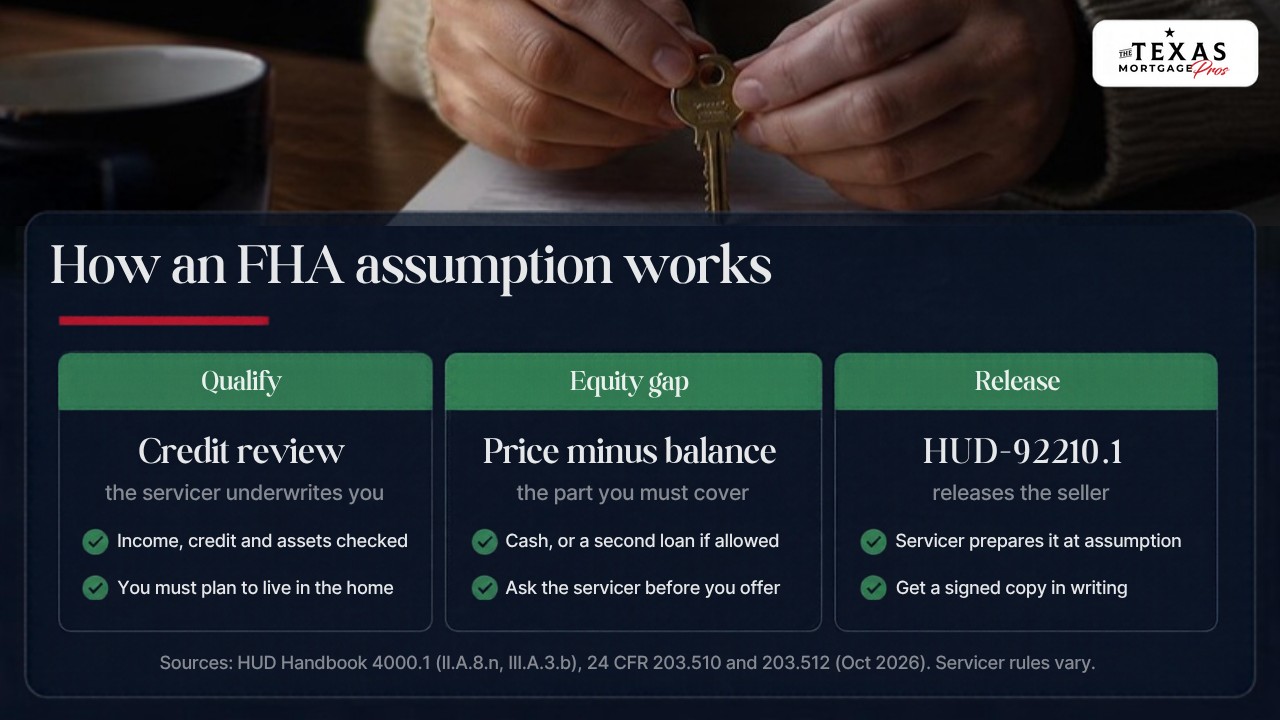
An assumable FHA loan allows a qualified buyer to take over the seller’s existing FHA mortgage, keeping its remaining balance and original terms rather than starting a new first mortgage. HUD says all FHA-insured mortgages are assumable, but for loans closed on or after December 15, 1989, the buyer must pass a creditworthiness review by the loan servicer and must plan to live in the home. You also have to cover the gap between the price and the loan balance, and the seller should get a written release of liability. A “subject-to” handshake deal is not the same thing.
TL;DR:
- All FHA-insured mortgages are assumable, HUD says. On loans closed on or after December 15, 1989, which covers nearly every FHA loan today, the buyer must be approved as creditworthy.
- The servicer, not the buyer’s own mortgage company, runs the review. A Direct Endorsement underwriter must manually underwrite the assumption, and HUD caps the processing fee.
- You must intend to live in the home as your principal residence (or a HUD-approved secondary residence). Investors generally cannot assume newer FHA loans.
- The equity gap, which is the price minus the loan balance, is yours to cover with cash or, where the servicer and FHA rules allow it, a separate second loan.
- The seller is released through form HUD-92210.1. “Subject-to” deals skip the approval, leave the seller on the hook and can trigger the due-on-sale clause.
Table of Contents
- Why Are Texas Buyers Asking About Assumable FHA Loans Now?
- What Is an Assumable FHA Loan?
- Who Can Assume an FHA Loan?
- How Does an FHA Assumption Work?
- What Happens to the Seller’s Liability?
- How Do Buyers Cover the Equity Gap?
- Why a “Subject-To” Deal Is Not an FHA Assumption
- Questions to Ask the Listing Agent and Servicer
- Assumable FHA Loan Do’s and Don’ts
- Talk Through Your Options
- Sources
Why Are Texas Buyers Asking About Assumable FHA Loans Now?
Mortgage rates recently climbed to their highest level in nearly three years, KTRH reported on October 15. In the same story, the Houston Association of Realtors’ September 2026 Housing Market Update showed 7,030 single-family home sales in the Houston area, down 5.7% from a year earlier, with 5.5 months of inventory. A local agent quoted in the piece said buyers have more options and sellers have less pricing power.
Statewide, the competition picture has eased, too. About 69% of agents in the Texas REALTORS® 2026 Texas Homebuying Experience Report said their buyers did not have to compete against other offers, up from 57% in 2025. The Texas Real Estate Research Center also pointed to rising interest rates as a source of uncertainty.
Put those together, and you get a question we are hearing more often: if the seller has an FHA loan from a few years ago, can I take it over? The Consumer Financial Protection Bureau (CFPB) has listed loan assumptions as an option buyers may want to ask about when rates are elevated, because the buyer assumes the remaining balance under the original loan terms. The CFPB also cautions that assumptions are not always feasible, in part because the buyer must make up the difference between the price and the loan balance. With less competition, buyers have more room to ask.
What Is an Assumable FHA Loan?
HUD’s Single Family Housing Policy Handbook 4000.1 defines an assumption as the transfer of an existing mortgage obligation from the current borrower to the assuming borrower. In plain terms, the buyer steps into the seller’s loan:
- The existing loan stays in place. The remaining balance, the remaining term, and the original note terms carry over. You do not get a new first mortgage with new terms.
- Every FHA-insured mortgage is assumable. The handbook says the mortgage company may not impose or enforce restrictions on assumptions after closing except where HUD regulations allow it, and federal rules at 24 CFR 203.512 describe the same “free assumability” policy.
- “Assumable” does not mean “automatic.” On FHA loans closed on or after December 15, 1989, the sale must be approved through a credit review. The buyer signs an agreement to assume and pay the debt.
If you are not sure what kind of loan the seller has, the listing agent can ask the seller, who can then confirm with the servicer.
Who Can Assume an FHA Loan?
The buyer has to qualify much like a new FHA borrower. According to HUD Handbook 4000.1:
- You must be found creditworthy. The assuming buyer is underwritten under FHA’s standard origination rules for credit, income, assets, and debts, with a few exceptions, such as ordering a new appraisal, that HUD lists because the existing loan stays in place. If you want a refresher on what FHA considers, our guide to FHA income requirements walks you through it.
- A person reviews your file. The holding or servicing mortgage company is responsible for the review, which must be completed by a Direct Endorsement underwriter. HUD says FHA’s TOTAL Mortgage Scorecard must not be used for assumptions, so the file is manually underwritten.
- You must plan to live there. If the original loan closed on or after December 15, 1989, the buyer must intend to occupy the home as a principal residence or a HUD-approved secondary residence. Investment purchases are allowed only on older loans closed before that date, with limits. Our FHA occupancy requirements guide explains what “principal residence” means.
- You need a valid Social Security number or EIN. HUD’s servicing rules, updated in late 2025, say anyone assuming an FHA-insured mortgage must have a valid SSN or EIN, or meet HUD’s limited exception for Social Security numbers.
Transfers by inheritance and certain divorces are subject to different HUD rules and fall outside the scope of a typical purchase.
How Does an FHA Assumption Work?
Servicers have their own packages, but an FHA assumption usually follows this path:
- Confirm the loan. The seller confirms the loan is FHA-insured and identifies the current servicer.
- Request the assumption package. The seller or buyer contacts the servicer for its application, document list, and fee schedule. HUD requires servicers to send a notice explaining release of personal liability to sellers or buyers who ask about HUD’s creditworthiness review criteria or procedures.
- Apply and submit documents. The buyer applies with the servicer and provides credit, income, and asset documents, the same kind of file you would gather for a mortgage pre-approval.
- Underwriting. A Direct Endorsement underwriter manually reviews the file.
- Closing. The buyer signs an agreement to assume and pay the debt; the equity gap and closing costs are paid; title transfers; and the servicer prepares the seller’s release.
- HUD is notified. The servicer must report the change of borrower to HUD within 15 days.
Fees are capped. HUD allows the mortgage company to charge the assuming buyer a reasonable and customary processing fee of up to $1,800, plus the actual costs of third-party items such as credit reports and employment verifications. If your credit is approved but the assumption does not happen for reasons beyond your control, HUD says the mortgage company must refund half of its processing fee. The seller or other interested parties may help with the buyer’s actual closing costs within FHA’s interested party contribution rules. Our Texas seller concessions guide covers how buyers are negotiating that help this fall.
Timing is set by the servicer. HUD’s handbook does not promise buyers a specific processing time. Ask the servicer for its current timeline in writing and build that time, plus a cushion, into your contract and option period.
Watch for a partial claim. If the seller received an FHA partial claim, a separate HUD lien sometimes used to help homeowners catch up on missed payments, HUD says it becomes due and payable when the seller no longer owns the home. The servicer must get an official payoff letter at the time of the assumption, so the seller should plan to pay it off at closing.
What Happens to the Seller’s Liability?
This is the part sellers care about most. When a creditworthy buyer assumes the loan, HUD Handbook 4000.1 says the mortgage company must prepare form HUD-92210.1, Approval of Purchaser and Release of Seller, releasing the original owner once the buyer signs an agreement to assume the mortgage and pay the debt. Federal rules at 24 CFR 203.510 set out the same steps: a creditworthiness determination, the buyer’s agreement to pay the debt, and a written release on a HUD-approved form.
Two practical points:
- Notifying HUD is not a release. HUD says the servicer’s notice to HUD of a change in borrower does not, by itself, release the original borrower from personal liability on the note. The signed release form is what matters.
- Get it in writing at closing. Sellers should request a signed copy of the release as part of their closing documents. A seller who allows someone to take over payments without an approved assumption has no release at all.
Selling a VA loan instead? VA loans have their own assumption rules. If a VA loan is assumed rather than paid off, the seller’s entitlement can be restored when a qualified Veteran buyer assumes the loan and substitutes their own entitlement, according to the VA home loan eligibility page. Veterans selling to a non-Veteran should ask the servicer how an assumption would affect their entitlement before agreeing to one.
How Do Buyers Cover the Equity Gap?
The seller has usually paid down the loan, and the home has often gained value, so the remaining loan balance is often well below the agreed price. That difference is the seller’s equity, and the buyer pays it at closing. HUD does not require the assuming buyer to make the usual FHA minimum cash investment into the existing loan, but that does not eliminate the equity gap. The seller still expects to be paid for it.
Buyers generally cover the gap in one of these ways:
- Cash. Savings and other documented funds are the simplest route, and the underwriter will verify the source of the funds.
- A separate second loan, where allowed. Because the assumed buyer is underwritten under FHA’s standard rules, any secondary financing must meet FHA’s requirements and be included in the underwriting. Some servicers offer or allow a second loan alongside an assumption, and others do not. The CFPB has noted that finding a company willing to make a second mortgage for the difference may be challenging. Confirm availability with the servicer before you count on it.
- Help with closing costs. The seller may contribute toward your actual closing costs within FHA’s interested party contribution rules, but a seller credit does not replace the equity payment itself.
Before you fall in love with the assumption, ask for the current unpaid balance, run the full payment including taxes and insurance (our Texas property taxes guide covers the escrow side), and compare the total cost of the assumption, any second loan, and your cash against a new loan on the same home. Your mortgage broker can help you line those options up side by side.
Why a “Subject-To” Deal Is Not an FHA Assumption
You may see ads or social media posts about buying a home “subject-to” the existing mortgage. In that kind of deal, the buyer takes title and makes the payments, but the loan stays in the seller’s name, and no one asks the servicer for approval. It can sound like a shortcut. It is not an FHA assumption, and it carries real risks for both sides:
- The due-on-sale clause still applies. Under 24 CFR 203.512, each FHA mortgage must contain a due-on-sale clause. When a sale or transfer occurs without the required approval, the servicer must request HUD approval to accelerate the loan, meaning calling the full balance due, where the law permits it. HUD’s handbook lists “assumptions made without credit approval” as a reason the servicer may request acceleration.
- The seller stays liable. With no approved assumption, there is no HUD-92210.1 release. The seller’s name stays on the note, and the seller remains responsible for the debt if payments stop.
- The buyer has no standing with the servicer, and questions about title, insurance, and legal matters multiply.
If anyone suggests a subject-to arrangement, slow down and talk with a Texas real estate attorney and a title company before you sign or send money.
Questions to Ask the Listing Agent and Servicer
Use this list before you write an offer that depends on an assumption:
- Is the seller’s loan FHA-insured, and when did it close? The December 15, 1989 date decides the occupancy and credit review rules.
- Who is the servicer, and will the seller authorize it to talk with me? You will need the servicer’s assumption package and contact information early.
- What is the current unpaid balance, and how big is the equity gap at our price?
- Does the seller have an FHA partial claim or any other lien on the home? A partial claim becomes due when the seller no longer owns the home.
- What are the servicer’s fees and document requirements? Ask how its processing fee compares with HUD’s cap and which third-party costs you will pay.
- What is the servicer’s current processing timeline? Ask for it in writing and match your contract dates to it.
- Does the servicer offer or allow a second loan for the equity gap? If so, ask what it requires.
- Will the servicer provide a signed HUD-92210.1 release for the seller at closing?
- What happens if the assumption is not approved? Ask your agent about financing contingency language, and have a backup financing plan ready.
Assumable FHA Loan Do’s and Don’ts
Do:
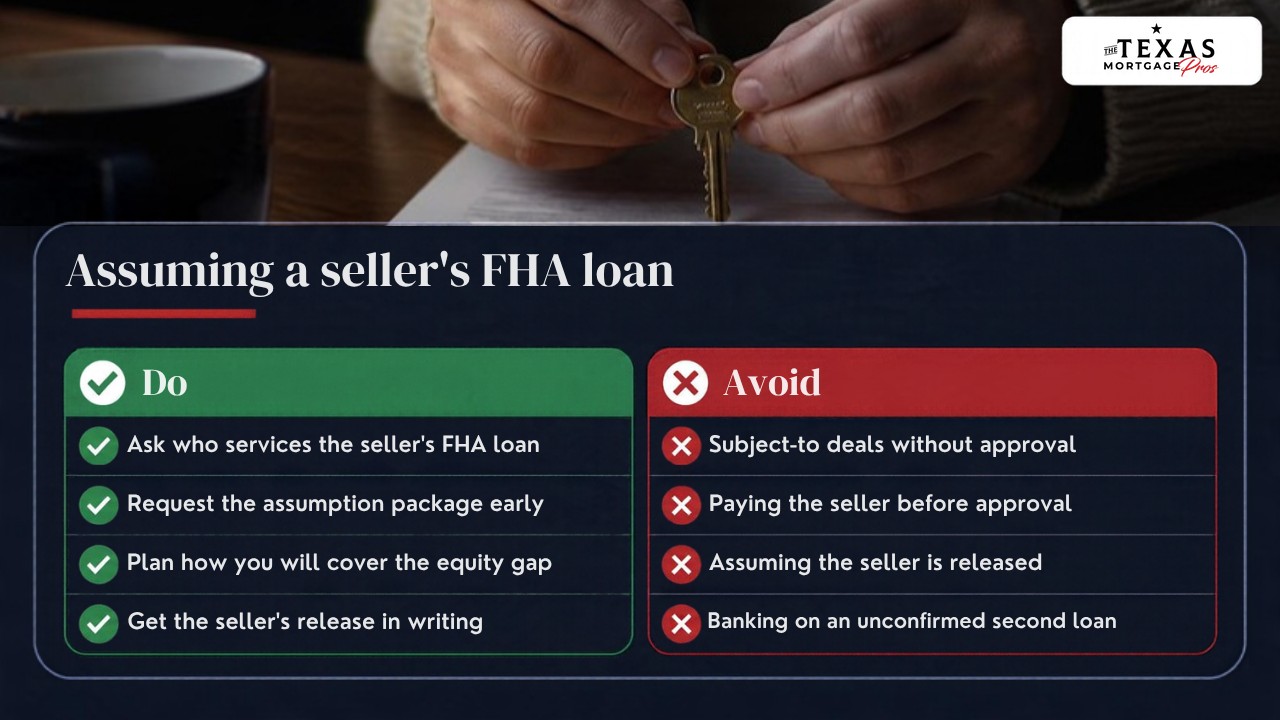
- Ask who services the seller’s FHA loan.
- Request the assumption package early to learn the documents, fees, and timeline.
- Plan how you will cover the equity gap with documented funds or confirmed financing.
- Get the seller’s release in writing on form HUD-92210.1 at closing.
Avoid:
- Subject-to deals without approval. They can trigger the due-on-sale clause, leaving the seller liable.
- Paying the seller before approval. Keep funds with the title company until closing.
- Assuming the seller is released. Only the signed release form does that.
- Banking on an unconfirmed second loan. Confirm it with the servicer before you count on it in your offer.
— Gerry Nicodemus
Talk Through Your Options
An assumable FHA loan can be worth a look on the right Texas home, but the details decide whether it works for you: the servicer’s process, the equity gap, and how the total cost compares with a new loan. If you are considering an assumption or another FHA purchase in Texas and want help comparing your options before you make an offer, call (281) 801-6965 to talk with a mortgage professional at The Texas Mortgage Pros, a mortgage broker. You can also review our FHA loan requirements to see where you stand today.
Last verified: October 15, 2026. FHA assumption rules, servicer procedures, fees, and timelines change. Check HUD Handbook 4000.1, the loan’s servicer, and each source for the latest details.
This article is general information, not legal, tax, or financial advice. It is not a commitment to lend or an offer of credit. Loan approval and terms are subject to underwriting, program guidelines, and eligibility. Assumptions are approved by the servicer of the existing loan, not by The Texas Mortgage Pros, and no assumption, second loan, release of liability, or timeline is guaranteed. Consult a qualified real estate attorney or financial professional about your own circumstances before acting on anything here.
The Texas Mortgage Pros is not affiliated with, endorsed by, or sponsored by HUD, FHA, the U.S. Department of Veterans Affairs, the CFPB, the Houston Association of Realtors, Texas REALTORS, Realtor.com, KTRH, the Texas Real Estate Research Center, or any other organization named in this article. Third-party names are used only to cite their published information.
The Texas Mortgage Pros, LLC | Company NMLS #2665861 | Gerry Nicodemus, NMLS #286371 | Equal Housing Opportunity | www.nmlsconsumeraccess.org | (281) 801-6965
Sources
- U.S. Department of Housing and Urban Development, Single Family Housing Policy Handbook 4000.1 (Assumptions, II.A.8.n and III.A.3.b; Update 18 redline posted August 12, 2026)
- 24 CFR 203.512, Free Assumability; Exceptions (via Cornell LII)
- 24 CFR 203.510, Release of Personal Liability (via Cornell LII)
- Consumer Financial Protection Bureau, Mortgage Financing Options in a Higher Interest Rate Environment (December 21, 2022, archived blog)
- U.S. Department of Veterans Affairs, Eligibility for VA Home Loan Programs (restoration of entitlement)
- KTRH NewsRadio 740, Houston Home Sales Have Slowed Compared to One Year Ago Amid Higher Mortgage Rates (October 15, 2026; citing HAR’s September 2026 Housing Market Update)
- Realtor.com, Bidding Wars Fade Across Texas as Most Buyers Face Zero Opponents (October 13, 2026)
- Texas Real Estate Research Center at Texas A&M University, Texas Economic Outlook, October 2026 (October 9, 2026)
Recommended
- FHA Occupancy Requirements: Rules Every Buyer Must Know
- FHA Income Requirements: What Texas Buyers Need to Qualify
- Texas Seller Concessions: How Buyers Can Negotiate as Competition Cools
- Mortgage Pre-Approval in Texas: Your 2026 Buying Guide

Gerry is a licensed mortgage loan originator and digital marketer with 25+ years in the mortgage business, specializing in conversion rate optimization, SEO, AI Overviews, and generative engine optimization (GEO) for the mortgage and real estate industry. Today he builds agentic intelligent systems, meaning AI agents that research, create content, nurture leads, and handle follow-up, to help mortgage and real estate business owners get found online, convert more leads, and scale. Gerry pairs decades of hands-on industry knowledge with the latest AI tools, so his clients stay a step ahead of the market.