

The 2026 FHA one-unit loan limit floor is $541,287, and the ceiling is $1,249,125, effective for case numbers assigned on or after January 1, 2026. HUD Mortgagee Letter 2025-23] Most Texas counties sit at that floor, but 25, including the Austin, Dallas-Fort Worth, and San Antonio metro groups plus Glasscock County, allow more. Check your exact number on HUD’s FHA Mortgage Limits lookup before you write an offer.
TL;DR:
- Most Texas counties have an FHA loan limit of $541,287, with some metro counties, such as Travis and Collin, exceeding this amount.
- Glasscock County has the highest limit in the state at $813,050, driven by Midland metro area pricing, while counties outside major metros mostly sit at the floor.
- FHA limits are based on 65% to 150% of the conforming loan limit, which is adjusted annually, with new figures released in early December.
- Buyers should verify their county’s exact limit through HUD’s lookup before making offers, as assumptions based on nearby areas can cause delays.
- If a loan exceeds the county limit, options include increasing down payments, switching to a conventional loan, or negotiating a lower purchase price.
Table of Contents
- What Are the 2026 FHA Loan Limits by Texas County?
- How Does HUD Set FHA Loan Limits Each Year?
- How Do You Check Your Exact County Limit Before Making an Offer?
- What If Your Loan Amount Exceeds the FHA County Limit?
- Why Multi-Unit Properties Get Higher FHA Limits
- When Does HUD Update FHA Loan Limits Each Year?
- How TexasFHA Verifies County Limits and Helps You Get Approved
- Do First-Time Buyers Get Different FHA Limits Than Repeat Buyers?
- A Straight-Talk Take on Planning Around These Limits
- Get Your County Limit Confirmed and Start Your FHA Preapproval
- Where to Verify FHA Loan Limits Yourself
- Sources
What Are the 2026 FHA Loan Limits by Texas County?
Texas one-unit FHA limits for 2026 range from $541,287 to $813,050, depending on the property’s location. [HUD Summary of Areas] That’s widespread for a single state, and it catches a lot of buyers off guard when they assume the number they saw for Dallas also applies to their cousin’s place in Lubbock.
Of the state’s 254 counties, many use the national floor of $541,287. A smaller number sits above it, driven up by local median home prices in fast-growing metro areas. [HUD Summary of Areas] Glasscock County, a small West Texas county swept into the Midland metro’s pricing, actually carries the highest one-unit limit in the state at $813,050, according to HUD’s summary of areas above the floor and below the ceiling.
Metro patterns matter more than most buyers realize. Counties in the Austin metro (Travis, Williamson, Hays) and the Dallas-Fort Worth group (Collin, Denton, Dallas, Tarrant) run well above the floor, and the Bexar County limit for San Antonio also lands above baseline, though modestly compared to Austin or DFW. Here’s a snapshot of how the ranges break down:
| Metro Area | Representative County | 1-Unit FHA Limit (2026) |
| Most of Texas | 254 counties statewide | $541,287 |
| Midland (Glasscock) | Glasscock County | $813,050 |
| Austin metro | Travis County | Above floor, varies by MSA |
| Dallas-Fort Worth metro | Collin/Denton/Dallas/Tarrant | Above floor, varies by MSA |
| San Antonio metro | Bexar County | Modestly above floor |
For the full 254-county breakdown, including 2- through 4-unit figures, a complete Texas county-by-county listing built from HUD’s own CHUMS data gives you every row without needing to parse a government CSV file yourself. If you want the raw source, HUD’s CHUMS file layouts contain the underlying fields lenders pull from directly.
How Does HUD Set FHA Loan Limits Each Year?
FHA county limits track the Federal Housing Finance Agency’s conforming loan limit, which sets the national ceiling. The floor is 65% of that conforming limit, and the ceiling is 150% of it.
This is why a county like Glasscock, with no major population of its own, ends up with a high limit. It gets pulled into the Midland Metropolitan Statistical Area for pricing purposes, and Midland’s median home values are high enough to push the formula above the statewide floor. Alaska, Hawaii, Guam, and the U.S. Virgin Islands get separate, higher ceiling treatment under federal law, but that exception doesn’t touch Texas. Every number cited here traces back to Mortgagee Letter 2025-23, HUD’s official 2026 authority.
How Do You Check Your Exact County Limit Before Making an Offer?
Confirming your county’s number takes about two minutes, and skipping this step is one of the more avoidable mistakes we see buyers make.
- Go to HUD’s FHA Mortgage Limits lookup and select Texas from the state menu.
- Choose your county or metropolitan statistical area from the dropdown, not the nearest big city name.
- Select your unit count (one through four) since the limit changes significantly by unit count.
- Note the exact dollar figure returned. That row governs your loan, regardless of what a real estate listing or a lender estimate assumes.
- For bulk research, such as comparing several counties at once, download the CHUMS text or CSV file instead of running individual lookups.
Double-check that the county listed matches where the property actually sits. City names often span multiple counties in Texas, and that mismatch causes real underwriting delays.
What If Your Loan Amount Exceeds the FHA County Limit?
If your target purchase price pushes the loan amount above your county’s FHA cap, you still have workable paths forward. FHA insures the base loan up to that county figure. Anything above it needs a different approach.
- Increase your down payment so that the loan amount falls below the limit.
- Shift to a conventional loan, either conforming or jumbo, which carries different limits and different mortgage insurance rules than FHA’s MIP structure.
- Negotiate the purchase price down if the market allows it.
- Explore split-financing options with your lender if the gap is small.
Conventional mortgage insurance (PMI) can often be canceled once you build enough equity, while FHA’s MIP typically stays for the life of the loan under the current program structure. That distinction affects total cost over time, not just eligibility.
Pro Tip: Before you fall in love with a listing, run the numbers: subtract your planned down payment from the purchase price, then compare the result to your county’s FHA limit. A five-minute check now saves a renegotiated contract later.
Why Multi-Unit Properties Get Higher FHA Limits
FHA sets separate, higher limits for two-, three-, and four-unit properties, since a duplex or fourplex costs more to build and appraise than a single-family home. The 2026 floor jumps to $693,050 for two units, $837,700 for three units, and $1,041,125 for four units, according to HUD’s lender guidance.
That gap matters for buyers considering house-hacking, where you live in one unit and rent the others. FHA still requires owner-occupancy in one unit, and the appraisal process weighs rental income differently than in a standard single-family valuation. Always confirm both your county’s number and your exact unit count before making an offer. The two figures move independently.
When Does HUD Update FHA Loan Limits Each Year?
HUD publishes new limits annually through a Mortgagee Letter, typically announced in early December for the following calendar year. The 2026 figures came from Mortgagee Letter 2025-23, effective January 1, 2026, for new case numbers.
Re-check the current limit before you submit an offer and again before you lock a rate, especially near a year-end transition. Mid-year changes are rare but not impossible if FHFA revises its conforming limit. If you’re shopping in November or December, ask your lender which year’s case number your file will use.
How TexasFHA Verifies County Limits and Helps You Get Approved
TexasFHA operates as a “Full Eagle” FHA-approved lender, meaning we’re authorized to underwrite and close FHA loans without a third-party review layer slowing things down. That status matters when a deal has a tight timeline and a county limit question needs a same-day answer.
Our team has tracked these numbers through past cycles, including Austin’s 2023 limit changes and the 2025 statewide adjustments, so we know how these figures shift year over year across Texas markets from Austin to smaller communities like New Caney. An FHA Loan Specialist confirms your exact county row, coordinates with the appraiser on unit count and value, and builds your preapproval around the correct ceiling from day one, not after a contract falls through.
Do First-Time Buyers Get Different FHA Limits Than Repeat Buyers?
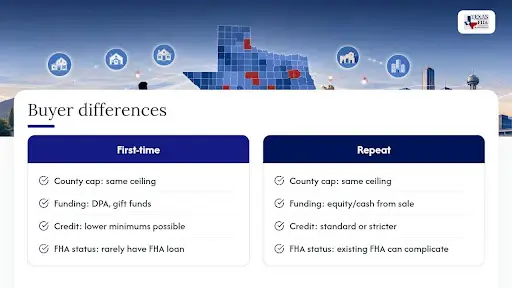
The county limit itself doesn’t change based on buyer history. HUD sets one number per county per unit count, and it applies whether this is your first house or your fifth.
The real difference shows up in how each group approaches that limit. First-time buyers in Texas often qualify for down payment assistance programs, gift funds, or lower minimum credit thresholds that stretch their buying power closer to the county cap. A repeat buyer bringing equity from a prior sale may have more cash to work with, but could also face a lower FHA limit relative to what they’re used to if they’re moving between counties, say from a floor county into an Austin-area county with a different cap.
Repeat buyers also need to confirm that they qualify for FHA financing. FHA generally requires the property to be your primary residence, and having an existing FHA loan on another property can complicate a second FHA application unless specific exceptions apply, such as relocation for work or a change in family size. First-time buyers rarely run into that wrinkle since they’re starting from zero.
Either way, the county limit is the ceiling both groups measure against. What varies is the strategy for working within it, not the number itself.
A Straight-Talk Take on Planning Around These Limits
Buyers waste time guessing at limits instead of confirming them. My advice: check your exact county on HUD’s lookup before you fall for a listing, not after. If the number feels tight, seriously consider a duplex or triplex; more units can open doors that a single-family search closes. And keep a down payment backup plan ready in case your target county sits right at the edge of what FHA will insure.
— Gerry Nicodemus
Get Your County Limit Confirmed and Start Your FHA Preapproval
TexasFHA turns a county limit number into an actual preapproval, without you having to decode HUD’s lookup tool or a CHUMS spreadsheet on your own. As a “Full Eagle” FHA-approved lender serving all of Texas, we verify your exact county and unit-count limits, then build your preapproval around them before you ever submit an offer.

Whether you’re buying your first home or adding a rental unit to your household income, our FHA Loan Specialists walk through eligibility, documentation, and timing with you directly, so there’s no guessing about whether your target property fits within your county’s cap. If you’re ready to see what you qualify for, review our FHA loan requirements and reach out to start your preapproval today.
Where to Verify FHA Loan Limits Yourself
For readers who want to check the primary sources directly: Mortgagee Letter 2025-23 is HUD’s official 2026 policy document establishing the floor and ceiling. The FHA Mortgage Limits lookup tool returns your exact county figure in real time. HUD’s CHUMS county file layouts provide the raw data lenders use, and a compiled Texas county listing makes the full 254-county table easy to scan without downloading anything.
This article is general information, not a substitute for advice from a qualified financial advisor. Consult a qualified financial professional about your own circumstances before acting on anything here.
Sources
- FHA 2026 areas above floor and below ceiling (HUD CHUMS summary)
- Texas FHA Loan Limits 2026: $541,287–$813,050 by County | FHA Limit Calc
Recommended
- Understanding FHA Loan Limits in Texas for 2025: What Buyers Should Expect
- FHA Loan Limits and Market Shifts to Watch in Texas This October
- Exploring Texas FHA Loans for Aspiring Homeowners in the Lone Star State
- FHA Loans in Texas: A Lifeline That Bends With the Market

Gerry is a licensed mortgage loan originator and digital marketer with 25+ years in the mortgage business, specializing in conversion rate optimization, SEO, AI Overviews, and generative engine optimization (GEO) for the mortgage and real estate industry. Today he builds agentic intelligent systems, meaning AI agents that research, create content, nurture leads, and handle follow-up, to help mortgage and real estate business owners get found online, convert more leads, and scale. Gerry pairs decades of hands-on industry knowledge with the latest AI tools, so his clients stay a step ahead of the market.