

Buying a home from a relative, landlord, or employer triggers what HUD calls an FHA identity-of-interest transaction, and the default outcome is a maximum loan-to-value of 85%, meaning you’ll need a 15% down payment instead of the standard 3.5%. HUD carves out specific exceptions that restore the lower down payment:
- A family member buying a relative’s principal residence
- A tenant who has rented the property for at least six months before signing the contract
- A builder’s employee purchasing a new or model home
- A borrower relocating through a corporate transfer
Tell your lender about the relationship as soon as you apply. Hiding it risks a denied loan or a fraud flag later in underwriting.
Key Takeaways
| Point | Details |
|---|---|
| Default down payment jumps | Identity-of-interest deals require 15% down (85% LTV) instead of the standard 3.5%. |
| Four exceptions exist | Family principal residence, six-month tenant rule, builder-employee, and corporate transfer can restore standard financing. |
| Documentation is non-negotiable | Lenders require leases, canceled checks, employer letters, or occupancy certifications, not verbal claims. |
| Disclose immediately | Tell your lender about the relationship at the time of application to avoid delays or fraud flags later. |
| Some lenders decline these files | Working with an FHA-specialist lender reduces the risk of a mid-process denial. |
Table of Contents
- What FHA Identity of Interest Means Under HUD Rules
- How the 85% LTV Rule Changes Your Down Payment
- Exceptions That Bring Back the 3.5% Down Payment
- Why Underwriters Scrutinize Identity-of-Interest Deals
- Your Preparation Checklist Before You Apply
- How TexasFHA Helps With Identity-of-Interest Transactions
- Primary Sources for FHA Identity-of-Interest Rules
- Why the Standard Advice on This Topic Falls Short
- Sources
What FHA Identity of Interest Means Under HUD Rules
HUD defines an identity of interest as any sale in which the buyer and seller share a family or business connection, based on the framework laid out in HUD Handbook 4000.1 and the older but still frequently referenced HUD 4155.1. The rule exists because a related buyer and seller have less incentive to negotiate an honest price, which can lead to inflated valuations or disguised cashback schemes.
Family relationships covered by the rule include:
- Parents, children, and siblings
- In-laws and step-relatives
- Domestic partners
- Foster and adopted children
Business relationships count too. A landlord selling to a current tenant, an employer selling to an employee, or a company facilitating a sale among transferred staff all fall under the same scrutiny. Picture a father selling his house to his daughter, a property manager selling a rental unit to the person already living there, or a corporation unloading a relocated employee’s old house to a coworker. Each one gets flagged the same way in underwriting, regardless of how the relationship formed.
How the 85% LTV Rule Changes Your Down Payment
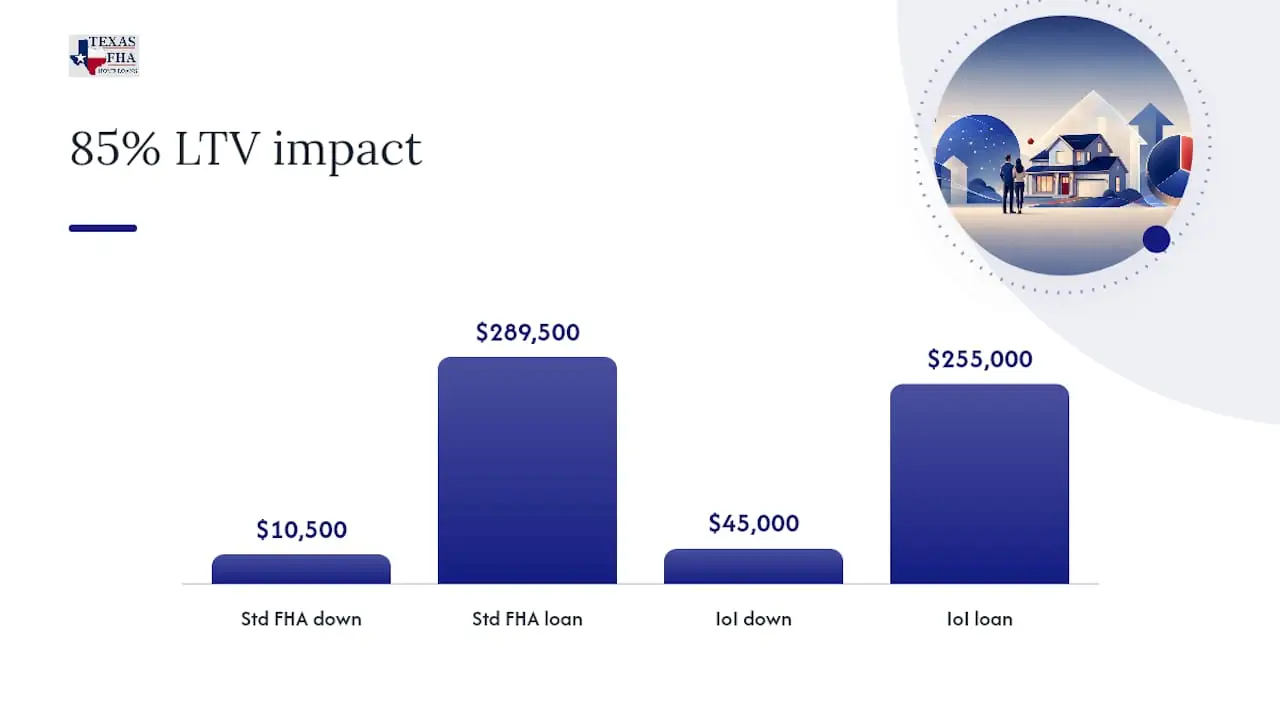
Loan-to-value, or LTV, measures how much of the home’s value your mortgage covers. Identity-of-interest transactions cap financing at 85% LTV, which pushes your required cash to 15%.
The math plays out like this on a $300,000 home:
- Standard FHA purchase: 3.5% down equals $10,500, financing $289,500.
- Identity-of-interest purchase: 15% down equals $45,000, financing $255,000.
- Difference: $34,500 more cash due at closing, with no exception applied.
That gap is the entire reason exceptions matter so much to buyers in this situation. If a second mortgage, gift, or seller contribution is added to the primary loan, HUD also expects lenders to check the combined loan-to-value (CLTV), since 4155.1 treats any layered financing as part of the same maximum-mortgage calculation.
Exceptions That Bring Back the 3.5% Down Payment
Four HUD-recognized exceptions can restore standard financing, but each demands specific paperwork. Vague assurances don’t satisfy underwriters. Documented proof does.
- Family-member principal residence purchase: The relative buying the home must occupy it as their primary residence. If the property will operate as a rental instead, the 85% LTV limit still applies even between close relatives.
- Six-month tenant exception: You must show at least six months of tenancy at that specific property immediately before signing the sales contract. Acceptable proof includes a signed lease, canceled checks, or bank transfer records. A verbal rental agreement, according to HUD Handbook 4000.1, does not qualify on its own.
- Builder-employee exception: Employees of a builder who are buying a new or model home from their employer can typically use standard financing, supported by an employer letter confirming the employment relationship and the property’s builder-owned status.
- Corporate transfer exception: When an employer relocates a worker and facilitates the sale of company-owned property, the transaction may bypass the 85% cap if documentation shows the employer’s role in the relocation.
Pro Tip: Start collecting your six months of bank statements or canceled checks now, even before you’ve picked a lender. Underwriters want records tied specifically to the property address and the rent amount, not just a general payment history.
Why Underwriters Scrutinize Identity-of-Interest Deals
Underwriters treat these transactions differently because their incentive structures differ. A stranger negotiating an arm’s-length sale wants top dollar. A parent selling to a child might not, and that gap creates room for property-flipping schemes, inducement-to-purchase red flags (like setting rent suspiciously below market to fabricate a tenant history), or outright straw-buyer fraud.
That scrutiny shows up in a few predictable ways:
- Some lenders decline identity-of-interest loans outright as a policy overlay, regardless of how well documented the file is.
- Others approve them but demand higher credit scores or larger cash reserves than a standard FHA file requires.
- Expect a second appraisal request or additional verification steps beyond what a typical purchase requires, per underwriting guidance from lenders handling FHA transactions.
- Required disclosures and certifications add processing time compared to a standard purchase file.
Pro Tip: Disclose the relationship in writing at the pre-approval stage, not after the appraisal comes back. Lenders who learn about an identity-of-interest situation midstream often restart parts of underwriting, which costs you weeks you didn’t need to lose.
Your Preparation Checklist Before You Apply
Getting organized before you submit paperwork shortens the underwriting timeline and reduces back-and-forth requests.
- Gather your executed lease and six months of rent payment proof if you’re claiming the tenant exception.
- Secure a purchase agreement that clearly states your intent to occupy the home as a primary residence.
- Collect employer or HR letters if a builder-employee or corporate transfer exception applies.
- Sign the identity-of-interest certification your lender requires to confirm the nature of the relationship.
- Disclose the relationship at your initial loan application, not later in the process.
Expect the added appraisal and verification steps to add time and potentially a few hundred dollars in extra costs. If one lender declines the file, look for an FHA-specialist lender rather than assuming the deal is dead; conventional, VA, or USDA financing may also be worth comparing depending on your eligibility.
Pro Tip: Ask any lender directly, before you apply, whether they originate identity-of-interest FHA loans at all. Some simply don’t, and finding that out on day one saves you a rejected file later.
How TexasFHA Helps With Identity-of-Interest Transactions
TexasFHA operates as a Full Eagle FHA-approved lender, which means our FHA loan specialists handle identity-of-interest scenarios directly, rather than routing them to overlays or resulting in automatic denials. We walk you through documentation requirements, occupancy certifications, and exception qualifications specific to your situation.

Before applying, review our FHA loan requirements page to understand documentation standards, or check our first-time buyer guide if this is your first purchase. Reach out the moment you know a family or business relationship exists in your transaction, or if another lender has already applied an overlay against your file. Early conversations prevent the costliest delays.
Primary Sources for FHA Identity-of-Interest Rules
- HUD 4155.1, Section B details maximum mortgage calculations for these transactions.
- FHA explains the rules in plain language for family purchases.
- Compliance practices for lenders handling these files are outlined in this mortgage compliance checklist.
Why the Standard Advice on This Topic Falls Short
That’s backward. The exceptions aren’t obscure loopholes; they’re the normal path for a huge share of these transactions, since renting from a future seller or buying a parent’s house is a common situation, not an edge case.
What gets underrated is documentation timing. Borrowers assume they can gather proof of tenancy or occupancy intent after finding a lender, but underwriters want records that already exist and clearly predate the sales contract. A signed lease alone won’t cut it. You need canceled checks or bank transfers showing six months of actual payments, not just an agreement.
The other gap is disclosure anxiety. Some buyers worry that flagging the family or business relationship will tank their approval odds, so they delay mentioning it. That backfires. Lenders who discover it midstream restart verification steps that early disclosure would have avoided entirely. If you know the relationship exists, say so on day one and let the documentation, not the deal structure, do the convincing.
— Gerry Nicodemus
This article is general information, not a substitute for advice from a qualified financial advisor. Consult a qualified financial professional about your own circumstances before acting on anything here.
Sources
Recommended
- Is an FHA Mortgage Good For You? – Texas FHA Home Loans | First-Time Buyer Loans
- Is an FHA Mortgage Good for You? – Texas FHA Home Loans | First-Time Buyer Loans

Over 25 years of experience in the Mortgage business. A Digital Marketer specializing in Conversion Rate Optimization, Search Engine Optimization, and Artificial Intelligence Overview Optimization for the Mortgage and Real Estate industry.