

Yes, you can qualify for a mortgage with 1099 income. The right path depends on one factor above all else: whether your tax returns actually reflect your real cash flow, or whether deductions have shrunk your paper income below what you actually earn. Three paths cover almost every self-employed borrower. A conventional or FHA loan works when your tax returns show solid, stable earnings. A 1099 non-QM loan uses your gross 1099 income, verified through IRS transcripts, so deductions don’t work against you. A bank-statement loan looks at deposits rather than tax returns.
Before you call a lender, do three things:
- Pull 1 to 2 years of 1099 forms
- Request your IRS wage-and-income transcripts
- Gather 12 to 24 months of bank statements
Pro Tip: Call a CPA and a loan officer in the same week. One tells you how your returns will read to an underwriter; the other tells you which program actually fits those numbers.
Key Takeaways
Qualifying for a mortgage with 1099 income depends on matching your documentation strategy, whether tax returns, IRS transcripts, or bank deposits, to the loan program that reads your income most favorably.
| Point | Details |
|---|---|
| A two-year history is standard | Most programs want two years of self-employment income; some accept one strong year plus YTD deposits. |
| Transcripts verify everything | IRS wage and income transcripts, obtained via Form 4506-C, confirm that your 1099 totals match IRS records. |
| Program choice depends on your returns | Conventional/FHA loans work when tax returns reflect actual income; non-QM and bank-statement loans cost more but ignore net income. |
| Clean records prevent delays | Mismatched names, unexplained deposits, and inconsistent documentation are the top causes of underwriting delays. |
| TexasFHA specializes in self-employed files | As a Full Eagle FHA-approved lender, TexasFHA guides 1099 borrowers through document prep and prequalification. |
Table of Contents
- What Is a 1099 Mortgage and How Does It Differ From W-2 Underwriting?
- How Do Lenders Verify and Calculate 1099 Qualifying Income?
- Which Loan Programs Accept 1099 Income?
- What Documents Do 1099 Borrowers Need to Provide?
- How Can You Improve Your Odds Before You Apply?
- How Do You Apply, and What Should You Expect?
- How Texas FHA Loan Supports 1099 Borrowers
- What Should You Do First if You’re Self-Employed and Want a Mortgage?
- Start Your 1099 Mortgage Application With Texas FHA Loan
- Frequently Asked Questions
- Sources
What Is a 1099 Mortgage and How Does It Differ From W-2 Underwriting?
A 1099 mortgage is a home loan underwritten based on self-employment or contract income reported on a Form 1099 rather than a W-2. Most of these products fall under non-QM (non-qualified mortgage) rules, meaning they don’t meet the standardized income and documentation criteria that Fannie Mae and Freddie Mac require for conventional loans. That’s not a red flag. It’s simply a different rulebook designed for income that doesn’t arrive in even, predictable paychecks.
The core problem non-QM lending solves is a documentation gap, not an income gap. A W-2 employee’s pay stub shows gross income directly. A freelancer’s Schedule C often shows net income after write-offs for a home office, mileage, software subscriptions, and equipment. Those deductions lower your tax bill, but they also lower the number a conventional underwriter uses to qualify you.
This path tends to fit:
- Freelancers and consultants with multiple 1099 clients
- Real estate agents and independent contractors
- Rideshare drivers, gig workers, and small business owners with heavy legitimate deductions
How Do Lenders Verify and Calculate 1099 Qualifying Income?
Lenders don’t take your word for what you earned. They verify it, and the process follows a fairly consistent sequence.
- You sign Form 4506-C, authorizing the lender to pull your IRS wage-and-income transcripts directly from the IRS, which confirms your reported 1099 totals match what you told the lender.
- The lender applies the two-year history rule. Most programs want at least two years of consistent self-employment income in the same line of work. Some lenders will accept one strong year plus year-to-date deposits when the most recent year clearly outperforms the prior one.
- Income is averaged, usually over both a 12-month and a 24-month window. When your most recent year is notably higher, many lenders calculate both figures and use whichever yields the higher qualifying income, provided you can show the increase is durable rather than a one-time spike.
- The file gets cross-checked for mismatches: 1099 totals against Schedule C, Schedule C against bank deposits, and business name variations that don’t match across documents.
Pro Tip: If your income jumped meaningfully in the last 12 months, build a short reconciliation packet showing why. New recurring contracts, a rate increase, or an added client all count as evidence that the increase will stick.
Which Loan Programs Accept 1099 Income?
The right program depends on how well your tax returns already reflect your real earnings.
- Conventional and FHA loans remain the cheapest route when your returns show solid net income after deductions. If the numbers already work, there’s no reason to pay a premium for a non-QM product.
- 1099 non-QM loans qualify borrowers using 100% of gross 1099 income, verified against IRS transcripts rather than net Schedule C income. Published program examples cite credit score floors near 620 and debt-to-income caps at typical program limits, though specific requirements vary by lender.
- Bank-statement loans calculate income from 12 to 24 months of deposits using an expense factor rather than tax returns at all. They help borrowers whose returns understate real cash flow, but they typically carry higher rates and larger down payment requirements.
- CPA-prepared profit-and-loss loans and DSCR products fill narrower niches, particularly for borrowers with complex business structures or rental income layered on top of 1099 work.
FHA loans, in particular, offer lower down payments and more flexible credit thresholds that can offset some of the documentation friction self-employed borrowers face, provided the underlying income can still be documented clearly.
What Documents Do 1099 Borrowers Need to Provide?
Underwriters see the same handful of errors over and over, and nearly all of them are preventable with a little prep work before you ever submit a file.
- 1099 forms for the past 1 to 2 years from every paying client, not just your largest one.
- IRS wage-and-income transcripts confirming the totals on those 1099s match what the IRS has on record.
- Personal and business bank statements, typically 12 to 24 months, showing deposits that align with your reported income.
- A CPA-prepared profit-and-loss statement if you’re using a P&L-based program.
- K-1 forms if you hold ownership in a partnership or S-corp.
- Business licenses or client contracts proving the business is active and ongoing.
Before submitting, check that your name and business name appear identically across every document, that deposits don’t include unexplained transfers that look like undisclosed debt, and that every form is signed and dated. Documentation mismatches between 1099s, Schedule C filings, and bank deposits are the single most common reason files stall, sometimes adding weeks to underwriting. A short written explanation for any irregular deposit, attached proactively, resolves most of these issues before an underwriter even asks the question.
How Can You Improve Your Odds Before You Apply?
The strongest move most freelancers can make happens 12 to 24 months before they apply, not the week they start shopping for houses.

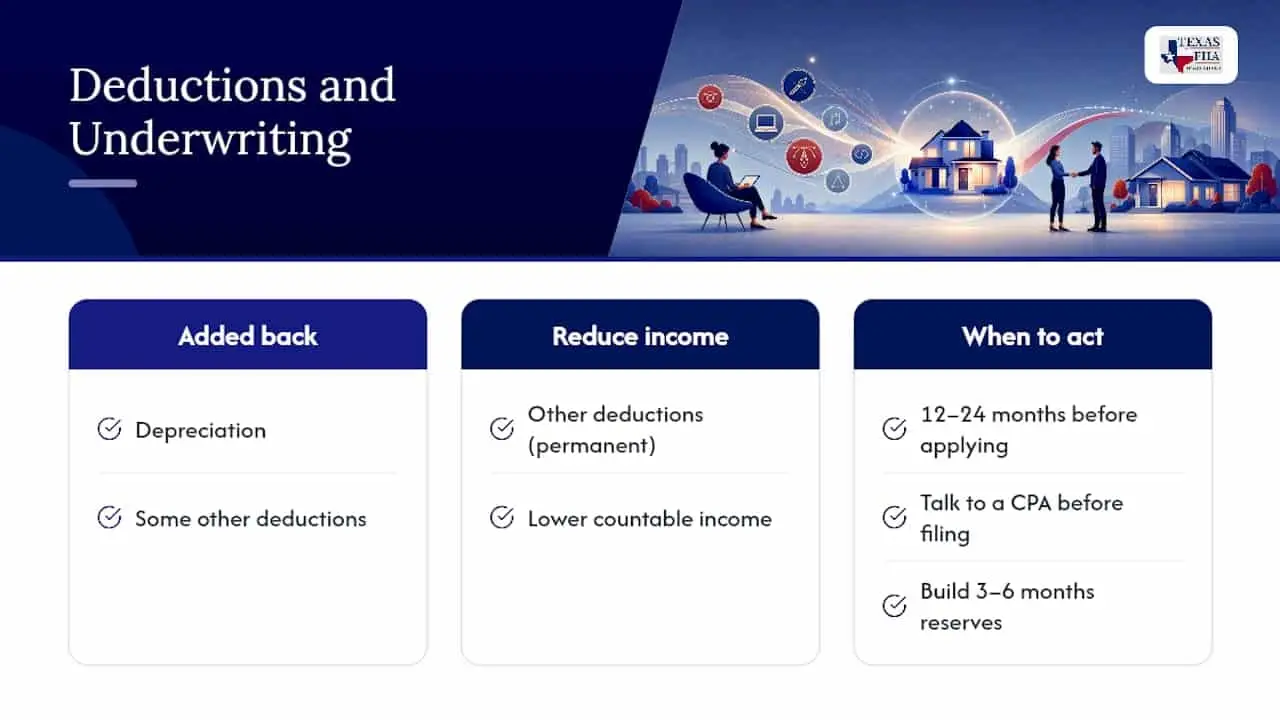
Talk to a CPA about which deductions matter for tax season versus which ones matter for loan qualification. Some deductions are added back by underwriters, such as depreciation, while others permanently reduce the income a lender will count. If you’re planning to buy within two years, that conversation should happen before you file, not after.
Clean up your bookkeeping. Separate business and personal accounts, keep deposit descriptions consistent, and maintain an up-to-date P&L rather than reconstructing one at tax time.
On the credit side, pay down revolving balances, dispute any reporting errors, and aim for the score floor your target program requires well ahead of applying.
Pro Tip: Build 3 to 6 months of reserves before you apply. Reserves don’t just satisfy underwriting; they signal to a lender that a slow month won’t put your mortgage payment at risk.
How Do You Apply, and What Should You Expect?
Once your documents are in order, the process moves faster than most self-employed borrowers expect.
- Get pre-screened by a loan officer. Expect questions about how long you’ve been self-employed, your industry, and whether your tax returns or bank deposits better represent your income.
- Submit your documentation package for preapproval, including the 1099s, transcripts, and bank statements gathered earlier.
- Expect the biggest delays to come from transcript turnaround and appraisal scheduling, not from the loan officer’s review of your file.
- Compare costs across programs. Non-QM and bank-statement loans generally carry higher rates and larger down payment requirements than conventional or FHA loans, so weigh the effective monthly payment, not just the headline rate.
How Texas FHA Loan Supports 1099 Borrowers
As a Full Eagle FHA-approved lender, TexasFHA works directly with self-employed and freelance borrowers across the state, not just W-2 employees with straightforward pay stubs. That distinction matters when your file needs someone who actually understands how to read a 1099 income history.
- FHA Loan Specialists who walk through loan requirements specific to self-employed applicants
- Resources covering income qualifications for 1099, W-2, and K-1 earners side by side
- A prequalification process that starts with a document checklist tailored to your income type
What Should You Do First if You’re Self-Employed and Want a Mortgage?
Start with your paper trail, not your house search. Pull two years of 1099s, request your IRS transcripts, and get both a CPA and a lender looking at the same numbers before you fall in love with a listing.
Of the three priorities, documentation comes first. A strong 1099 history with messy records will move more slowly than a modest history with clean records. The CPA conversation comes second because tax strategy decisions made today affect what a lender sees next year. The lender call comes third, but don’t wait long to make it. Most freelancers overestimate how disqualifying their tax deductions are and underestimate how much a well-organized file speeds everything up.
Start Your 1099 Mortgage Application With Texas FHA Loan
TexasFHA gives self-employed borrowers something most lenders don’t: specialists who read 1099 income histories every day instead of treating them as an exception to work around. If your tax returns reflect real cash flow, an FHA loan through TexasFHA often costs less than the non-QM or bank-statement programs described above, with lower down payments and more flexible credit thresholds built into the program itself.
TexasFHA works especially well for first-time buyers, borrowers who don’t have a large down payment saved, and freelancers whose credit isn’t flawless but whose income tells a solid story once transcripts back it up. Getting started means a short prequalification conversation, a review of your 1099s and bank statements, and a clear answer on which program fits your numbers. Recent FHA policy updates, including the elimination of the 90-day flip rule, have also made certain purchases easier to finance than in past years.
Visit the FHA loan requirements page to see what documentation to prepare, or start your pre-qualification today to find out where you stand.
Frequently Asked Questions
Can you get a mortgage with only 1099 income?
Yes. Lenders offer 1099-specific non-QM programs that qualify borrowers using gross 1099 income verified through IRS transcripts, along with bank-statement and conventional options depending on how your tax returns look.
How many years of 1099s do you need for a mortgage?
Most lenders want two years of consistent 1099 income in the same field. Some programs accept one strong year plus year-to-date deposits if the recent year clearly outperforms the prior one.
Does a 1099 mortgage require a higher credit score than a W-2 mortgage?
Not necessarily. FHA loans often have more flexible credit floors, while 1099 non-QM programs commonly set minimums near 620, though exact requirements vary by lender and program.
What’s the difference between a 1099 mortgage and a bank-statement mortgage?
A 1099 mortgage verifies gross 1099 income through IRS transcripts. A bank-statement mortgage instead calculates income from 12 to 24 months of deposits, which helps borrowers whose tax returns understate their actual cash flow.
Is a 1099 mortgage more expensive than a conventional loan?
Often, yes. Non-QM and bank-statement loans typically carry higher rates and larger down payment requirements than conventional or FHA loans, so it’s worth checking whether your tax returns already qualify you for the cheaper path first.
This article is general information, not a substitute for advice from a qualified financial advisor. Consult a qualified financial professional about your own circumstances before acting on anything here.
Sources
- 1099 Income for Mortgage: Documentation and Verification – LegalClarity
- Jd
- Non-QM loans guide — HousingWire
- How to get a mortgage when you’re self-employed — Bankrate
Recommended
- 1099 Home Loans: Best Loan Program for the Self-Employed – Texas FHA Home Loans | First-Time Buyer Loans
- How To Qualify For A Mortgage – Texas FHA Home Loans | First Time Buyer Loans
- Bank Statement Mortgage for Texas First-Time Buyers

Over 25 years of experience in the Mortgage business. A Digital Marketer specializing in Conversion Rate Optimization, Search Engine Optimization, and Artificial Intelligence Overview Optimization for the Mortgage and Real Estate industry.