

There is no fixed minimum dollar income for an FHA loan. Approval hinges on your qualifying ratios and whether your income is stable enough to count under HUD Handbook 4000.1. Three things matter most:
- Ratios: FHA benchmarks run about 31% front-end (housing payment) and 43% back-end (total debt), rising to 33%/45% for Energy Efficient Homes. Documented compensating factors can push these higher.
- Stability: Lenders care less about your current paycheck and more about whether overtime, bonus, part-time, or self-employment income is likely to continue, typically judged over a two-year history.
- Documentation: Expect to provide two years of tax returns, recent pay stubs or W-2s, a year-to-date profit-and-loss statement if you’re self-employed, IRS transcripts, and translations for any non-English income records.
Key Takeaways
FHA loan eligibility depends on documented, stable, effective income and qualifying ratios under Handbook 4000.1, not a fixed minimum salary.
| Point | Details |
|---|---|
| No minimum income figure | Approval rests on your front-end and back-end ratios, not a specific dollar amount. |
| Standard ratio benchmarks | FHA targets 31% front-end and 43% back-end, or 33%/45% for Energy Efficient Homes. |
| Compensating factors help | Larger down payments or strong reserves can justify exceeding standard ratios. |
| Two-year income history | Overtime, bonus, part-time, and self-employment income need a track record of continuity. |
| Texas FHA Loan support | A Full Eagle FHA-approved lender that reviews documentation and identifies compensating factors for you. |
Table of Contents
- How Do FHA Income Requirements Actually Work?
- What Counts as Effective Income for FHA Loans?
- How Does FHA Handle Self-Employment Income?
- FHA vs. Conventional: How Do Income Rules Differ?
- Automated Underwriting vs. Manual Review: What’s the Difference?
- How Texas FHA Loan Reads FHA Income Rules for You
- Get Help Qualifying for Your FHA Loan
- Primary Sources and Further Reading
- Frequently Asked Questions
- Sources
How Do FHA Income Requirements Actually Work?
FHA loan eligibility criteria don’t include a minimum income line item anywhere in HUD’s rulebook. What matters is the relationship between what you earn and what you owe. Handbook 4000.1 calls this “effective income,” and it’s the number your lender actually uses, not your gross salary.
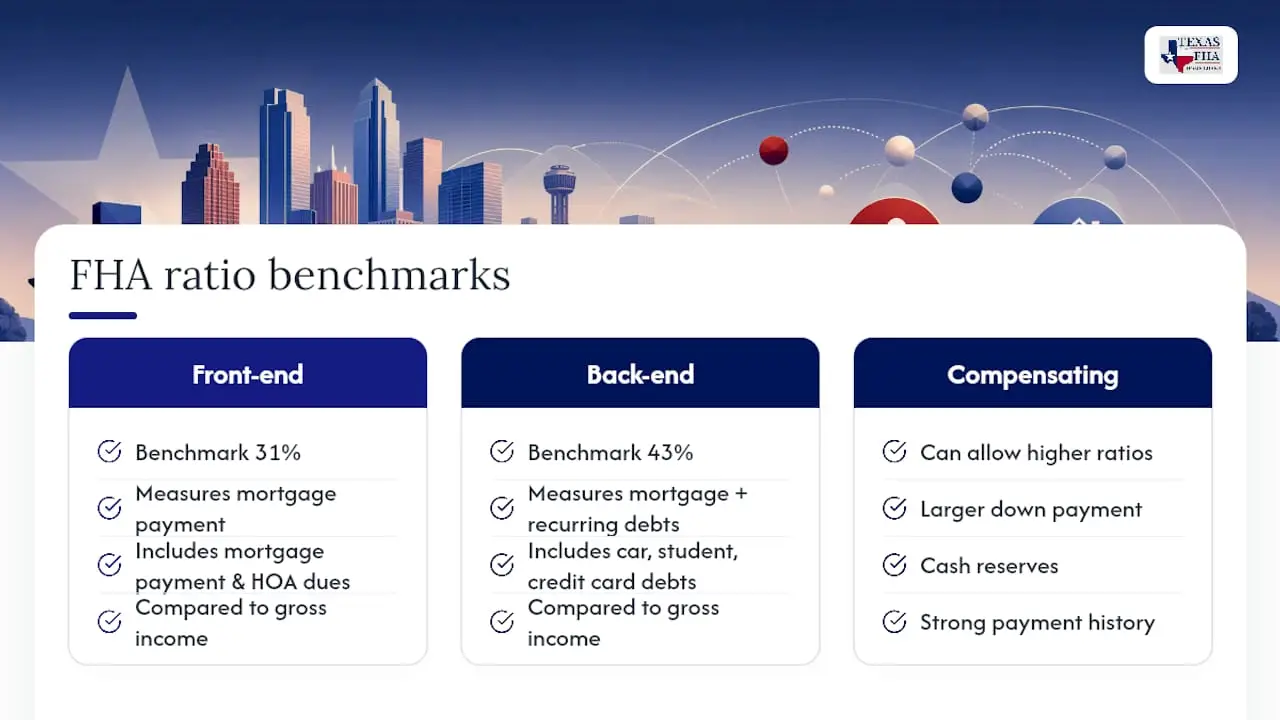
The math starts with two ratios. Your front-end ratio is calculated by dividing your proposed mortgage payment, including principal, interest, taxes, insurance, and any HOA dues, by your gross monthly income. Your back-end ratio adds in car payments, student loans, credit cards, and other recurring debt. HUD 4155.1 sets the benchmarks at 31% and 43%, with a slightly higher allowance for Energy Efficient Homes. These aren’t hard walls. A larger down payment, healthy cash reserves, or a strong payment history can serve as compensating factors that let an underwriter approve a file above those thresholds.
Where things get interesting is how FHA treats income that isn’t a flat salary. Overtime, bonuses, commissions, part-time work, and self-employment earnings all get extra scrutiny because they can dry up. The Handbook’s most recent update reinforces this focus on continuity, and it applies whether your file is handled by the automated system or a human underwriter.
What Counts as Effective Income for FHA Loans?
FHA mortgage qualifications accept a broader mix of income sources than many first-time buyers expect. Wages and salary are the baseline, but the list also includes:
- Alimony and child support, when documented, are likely to continue.
- FHA rental income from an investment property or a portion of the subject property.
- FHA boarder income, which allows a portion of rent paid by a roommate or family member to count, with proper documentation.
- Commission and bonus pay are averaged over a look-back period rather than taken at face value.
Gig economy earnings and irregular bonuses fall into a gray zone. Underwriters generally want at least two years of history and will average the income rather than count a single strong month. A sudden spike in 1099 income without a track record usually won’t move the needle much on your effective income calculation.
How Does FHA Handle Self-Employment Income?
Self-employed applicants face the most detailed FHA income verification requirements. If you own 25% or more of a business, HUD treats you as self-employed for underwriting purposes, and that triggers a deeper paper trail: two years of personal and business tax returns, a year-to-date profit-and-loss statement, and often bank statements to confirm cash flow.

Lenders typically average two years of net income, or one year in more limited circumstances, and they apply “lesser-of” rules when income trends are inconsistent. Business write-offs that lower your tax bill also lower your qualifying income, which surprises a lot of first-time applicants. A practical guide for self-employed FHA borrowers walks through how this averaging plays out in real applications, and it’s worth reading before you submit anything.
FHA vs. Conventional: How Do Income Rules Differ?
The minimum income for an FHA loan isn’t really a minimum at all; it’s a ratio test, and that’s true for conventional loans too. But FHA tends to be more forgiving on the back-end ratio and more willing to count nontraditional income sources like boarder income. Conventional guidelines can be stricter about self-employment history and often cap how much rental or gig income counts toward qualifying. If your income picture is unconventional, FHA’s flexibility, paired with documented compensating factors, often opens doors that conventional financing keeps shut.
Automated Underwriting vs. Manual Review: What’s the Difference?
Most FHA applications run through TOTAL, the Technology-Open-to-Approved Lenders scorecard. When TOTAL returns an “Accept,” the loan can move forward without a written explanation of compensating factors. When a file gets flagged for manual underwriting, usually because of ratio overages, credit history questions, or income complexity, the underwriter must document any compensating factors directly on Form HUD-92900-LT. That form is the paper trail proving why an exception was justified, and it’s a routine part of the process for buyers with irregular income.
How Texas FHA Loan Reads FHA Income Rules for You
Our specialists work through Handbook 4000.1 and TOTAL/AUS guidance daily, translating dense HUD language into a checklist you can actually follow. As a Full Eagle FHA-approved lender, Texas FHA Loan helps applicants assemble documentation and identify the compensating factors that make marginal ratios work, especially for self-employed and first-time buyers.
Get Help Qualifying for Your FHA Loan
Texas FHA Loan gives you something a generic online calculator can’t: a specialist who reviews your actual documents before you apply, not after a lender flags a problem.
Because we hold Full Eagle FHA-approved status, our team handles document checklist reviews, manual underwriting support, and the compensating factor paperwork on Form HUD-92900-LT in-house, rather than routing you through layers of review. That matters most for self-employed borrowers and first-time buyers whose income doesn’t fit neatly into a standard W-2 box.
Before you reach out, gather two years of tax returns, recent pay stubs, and any documentation on rental or boarder income. Then visit our FHA loan requirements page to see what fits your situation, or connect with a specialist to walk through your numbers and find out exactly where you stand.
Primary Sources and Further Reading
- HUD 4155.1 Section F: qualifying ratios and compensating factors.
- Handbook 4000.1 Update 15: current income and documentation clarifications.
- Texas FHA Loan income qualifications: a Texas-focused breakdown of effective income rules.
- Texas FHA debt-to-income ratios: how housing and total debt ratios apply to your file.
Frequently Asked Questions
What is the minimum income for an FHA loan?
There isn’t one. Lenders look at your qualifying ratios and whether your income is stable and likely to continue, not a set dollar threshold.
What is the FHA debt-to-income ratio limit?
Standard benchmarks are 31% front-end and 43% back-end, per HUD 4155.1, though documented compensating factors can allow higher ratios.
Does FHA count rental or boarder income?
Yes. FHA rental income and boarder income can count toward qualifying, provided you document the arrangement and show a history of receipt.
How does FHA verify self-employment income?
Lenders typically average two years of tax returns and a year-to-date profit-and-loss statement, applying lesser-of rules when income is inconsistent.
What’s the difference between TOTAL and manual underwriting?
TOTAL is FHA’s automated scorecard; an “Accept” can close without extra explanation. Manual underwriting requires documented compensating factors on Form HUD-92900-LT.
This article is general information, not a substitute for advice from a qualified financial advisor. Consult a qualified financial professional about your own circumstances before acting on anything here.
Sources
Recommended

Over 25 years of experience in the Mortgage business. A Digital Marketer specializing in Conversion Rate Optimization, Search Engine Optimization, and Artificial Intelligence Overview Optimization for the Mortgage and Real Estate industry.