

FHA occupancy requirements are straightforward at their core: at least one borrower must move into the property within a short time after signing the security instrument and intend to live there as a primary residence for a minimum adequate duration. That standard comes directly from HUD 4000.1, the Federal Housing Administration’s governing handbook, and it applies to nearly every FHA-insured purchase in Texas and nationwide.
There are documented exceptions, and they matter if your life doesn’t fit neatly into a 60-day move-in window. The most common ones include:
- Military deployment: active-duty orders can delay physical occupancy without violating the rule.
- Job relocation over 100 miles: a new job location far enough away can justify a second FHA loan.
- Increased family size: a growing household is a recognized reason to seek a larger home while retaining FHA financing.
- Divorce or legal separation: one spouse keeping the home under new financing is an accepted scenario.
- 203(k) rehab projects: renovation timelines can push back the occupancy start date if the home isn’t livable at closing.
If you need to verify the fine print, request UD 4000.1 and your lender’s occupancy checklist. Violating the occupancy rule isn’t a minor paperwork issue. It can trigger loan acceleration, denial of an FHA insurance claim, or a federal fraud investigation under 18 U.S.C. § 1014.
Key Takeaways
FHA occupancy compliance comes down to one core standard: move in within a reasonable timeframe, intend to stay anfor appropriate minimum period, and document any exception before a lender has to ask.
| Point | Details |
|---|---|
| Meet the 60-day rule | At least one borrower must occupy the home within 60 days of closing per HUD 4000.1. |
| Confirm one-year intent | Plan to live in the property as your principal residence for at least twelve months. |
| Document exceptions early | Gather relocation letters, military orders, or divorce decrees before your lender requests them. |
| Prepare occupancy proof | Keep your driver’s license, utility bills, and mail consistently updated to the property address. |
| Talk to a specialist | TexasFHA Loan Specialists can review your occupancy timeline and exception paperwork before you apply. |
Table of Contents
- What the FHA Occupancy Requirement Actually Says
- Who Has to Live There: Occupant vs. Non-Occupying Co-Borrower Rules
- The Exceptions: What Qualifies and What Lenders Want to See
- What Happens if You Violate FHA Occupancy Rules
- How Lenders Verify You’re Actually Living There
- Renting Out an FHA Home and the Rules on Second Properties
- Real Scenarios: How the Rules Play Out
- How FHA Catches Occupancy Misuse
- Why Occupancy Rules Trip Up Good-Faith Buyers
- How TexasFHA Helps You Navigate Occupancy Rules
- Where to Verify the Official Rules
- Sources
What the FHA Occupancy Requirement Actually Says
The controlling language is more specific than most borrowers realize. HUD 4000.1 states that the borrower must occupy the property “as their principal residence within 60 days of signing the security instrument” and must “continue to occupy the property for at least one year.” Both halves of that sentence carry separate weight, and lenders check them separately, too.
The FHA does not require the borrower to occupy the home on day one, but it does require move-in within 60 days of closing and a documented intent to stay for a full year afterward. Intent, not just physical presence, is what underwriters are evaluating.
The 60-day clock and the one-year intent are two different tests. The 60-day requirement is about timing. It answers “When do you have to move in?” The one-year requirement is about intent. It answers “How long do you have to plan on staying?” A borrower who moves in on day 45 but lists the home for rent on day 90 has satisfied the first test and failed the second, and underwriters treat that gap as a red flag during any post-closing review referenced in HUD’s servicing guidance.
“Principal residence” itself has a technical meaning under FHA rules. It means the property where you live for the majority of the calendar year, maintain your permanent mailing address, and generally conduct your day-to-day life. FHA also enforces what’s often called the one-principal-residence rule: you generally cannot have more than one FHA-insured home financed as a principal residence at the same time, absent one of the exceptions covered below.
Who Has to Live There: Occupant vs. Non-Occupying Co-Borrower Rules
Not every name on the loan has to live in the house. FHA permits non-occupying co-borrowers, typically parents or other family members who help a buyer qualify with income or credit support, but the rules around who qualifies for that role are specific:
- At least one borrower on the loan must occupy the property as a principal residence and meet the 60-day and one-year standards.
- A non-occupying co-borrower does not need to live in the home, but must either be a U.S. citizen or maintain a principal residence in the United States. A family relationship is not always required, but most lenders scrutinize non-occupying co-borrowers who have no familial relationship to the occupying borrower, as these arrangements attract greater underwriting scrutiny.
- The occupying borrower’s income and credit still factor into loan approval; a co-borrower supplements, but does not replace, that underwriting picture.
A common allowed setup: a mother co-signs for her adult son, who lives in the home full-time and handles the mortgage payments himself. A common disallowed setup: an investor with no U.S. residence status co-signs for a buyer purely to help the deal close, with no intention of ever living stateside. Lenders flag the second scenario quickly because it strips away the residence and citizenship protections FHA guidance requires.
The Exceptions: What Qualifies and What Lenders Want to See
FHA’s occupancy rule isn’t absolute. HUD 4000.1 and related guidance carve out several documented exceptions for borrowers whose circumstances genuinely prevent standard occupancy. Each one comes with its own evidentiary bar.
The 100-mile relocation exception is the one lenders see most often, and it’s more nuanced than a straight-line distance check. Underwriters typically measure the practical driving route between your old address and new job location, not a radius on a map. You’ll also need an employment relocation letter that names the new reporting location and start date, since a vague “I’m moving for work” claim won’t satisfy an underwriter.

| Exception | Qualifying Condition | Typical Documentation |
|---|---|---|
| Job relocation | New employment more than 100 miles from current residence | Employer relocation letter, new job offer, driving-distance verification |
| Military active duty | Deployment or reassignment preventing physical occupancy | Military orders, spouse or dependent occupancy plan |
| Increased family size | Household growth requiring a larger home | Birth certificate, adoption papers, or similar family documentation |
| Divorce or separation | One spouse retains the home under new financing | Divorce decree or separation agreement, refinance or assumption paperwork |
| 203(k) rehab project | Property uninhabitable during renovation | Renovation contract, timeline, occupancy start date estimate |
Before applying under any exception, gather a short document packet: proof of the qualifying life event, a letter explaining your occupancy timeline, and any lender-specific affidavit your loan officer requires. Missing one piece of that packet is the single most common reason exception requests stall in underwriting.
What Happens if You Violate FHA Occupancy Rules
Lenders and FHA don’t treat occupancy violations casually, and the consequences can escalate quickly once a discrepancy surfaces. The typical path looks like this:
- An underwriter or servicer notices a red flag (a rental listing, a mismatched address, a neighbor complaint) during a post-closing review.
- The lender requests documentation to confirm occupancy status, often within a short response window.
- If the borrower cannot prove compliance or a valid exception, the lender can pursue loan acceleration and demand immediate repayment of the full balance
- In cases involving intentional misrepresentation, the file can be referred for fraud investigation under federal loan-fraud statutes, which carry both criminal and civil penalties.
- An FHA insurance claim tied to a property that was never occupied as promised can also be denied outright, leaving the lender to absorb the loss and pursue the borrower directly.
None of this requires a missed mortgage payment to trigger. A borrower who’s paid on time every month can still face acceleration if occupancy fraud is discovered, because the violation is about the terms of the loan agreement, not payment history.
If you realize partway through year one that you can’t meet the occupancy requirement, contact your lender immediately rather than waiting for a review to catch it. Document the circumstances that changed, gather any exception paperwork that might apply, and ask directly what your options are. A lender who works with you proactively is a very different conversation than one that discovers a problem on its own.
How Lenders Verify You’re Actually Living There
FHA lenders don’t take occupancy claims at face value, before or after closing. They build a documentation trail and often revisit it during servicing.
Standard proof of occupancy typically includes:
- A driver’s license or state ID showing the property address.
- Voter registration at the new address.
- Recent utility bills in the borrower’s name at the property.
- An employment verification letter listing the address as the current residence.
- Mail, bank statements, or tax documents showing the property as the mailing address.
- A signed occupancy affidavit at closing, and military orders where a service member exception applies.
Lenders request additional proof most often when something appears inconsistent, such as a rapid post-closing address change or a mismatch between the mortgage application and public records. Post-closing verification can include database cross-checks against other active FHA loans, confirmation of delivery, and, in some cases, a physical property inspection.
Pro Tip: The fastest way to satisfy an underwriter is document triangulation: a driver’s license, a utility bill, and a pay stub or direct deposit records that all show the same address within the same short window. Lenders trust convergence, not a single document standing alone.
Renting Out an FHA Home and the Rules on Second Properties
Once you’ve satisfied the one-year occupancy intent, FHA generally allows you to move out and rent the property, provided you continue meeting your mortgage obligations. The rule isn’t designed to trap you in the home forever. It’s designed to prevent buyers from using FHA’s low-down-payment terms to acquire investment property under the guise of a primary residence.
That’s also why FHA maintains its one-principal-residence policy so firmly. You typically can’t hold two FHA-insured mortgages as principal residences at the same time, and lenders check for this using shared FHA case number databases. A second FHA loan is allowed only under the same documented exceptions covered earlier: relocation over 100 miles, an increase in family size, or a few other narrow circumstances, and even then, loan-to-value requirements on the departing residence often apply.
Dos: Rent the property after your one-year obligation is satisfied. Keep records showing you occupied the home for the required period. Refinance into a conventional loan first if you plan to convert to a rental sooner than expected.
Don’ts: List the property for rent within weeks of closing. Use an FHA loan with the intent of buying a vacation home. Assume a family member living in the home on your behalf satisfies your personal occupancy requirement, since it generally does not, outside of documented military exceptions.
Real Scenarios: How the Rules Play Out
- Active-duty service member buying while deployed. A soldier stationed overseas closes on a home his spouse will occupy immediately. This satisfies FHA’s military exception as long as the lender has copies of the deployment orders and a statement confirming the spouse’s occupancy. Action items: submit orders at application, get the occupancy affidavit signed by the occupying spouse, and keep a copy of the orders in your own records for future reference.
- Buyer transferred 120 miles for a new job three months after closing. This qualifies for the relocation exception since the distance clears the 100-mile threshold. The borrower needs an employer relocation letter, a clear timeline, and lender approval before pursuing a second FHA loan at the new location. Action items: request the letter from HR immediately, contact the lender before house-hunting again, and confirm the equity position on the departing home meets the lender’s requirements.
- Divorced couple where one spouse keeps the house. The remaining spouse refinances or formally assumes the loan and continues occupying the property. This is a well-recognized exception, but it requires the divorce decree and updated loan paperwork to avoid confusion during a later servicing review. Action items: finalize the decree language regarding the property, contact the lender about assumption or refinance options, and update all address-linked documents to reflect sole ownership.
- 203(k) rehab buyer who can’t move in during renovation. A borrower purchasing a fixer-upper under an FHA 203(k) rehab loan can’t occupy the home immediately if it’s uninhabitable. FHA accounts for this with an adjusted occupancy timeline tied to the renovation schedule. Action items: get the projected completion date in writing from the contractor, confirm the lender’s accepted occupancy start date, and keep renovation permits and contracts on file.
How FHA Catches Occupancy Misuse
FHA and its lending partners electronically cross-reference loan records to identify patterns that suggest misuse of the one-loan rule. Every FHA loan carries a case number, and those numbers get checked against a national database before a second FHA loan is approved for the same borrower.
Certain patterns draw scrutiny almost automatically, and understanding them helps legitimate borrowers avoid unnecessary friction:
- Multiple active FHA loans tied to one Social Security number, especially opened within a short time span.
- A rental listing or lease agreement appearing within weeks of closing.
- A mailing address on file with the lender that doesn’t match the financed property.
- Utility accounts that show minimal or no usage at the property.
- A home was reported vacant during a servicer’s routine property inspection.
The relocation exception, in particular, draws extra scrutiny, since lenders and FHA systems treat it as a common vector for attempted abuse of the one-loan policy. That doesn’t mean legitimate relocations get denied. It means the documentation needs to be airtight from the start: a dated relocation letter, a clear new work address, and a consistent paper trail showing your address changed accordingly. Borrowers using a genuine exception should keep all supporting documents organized before applying, not scramble them together after a lender asks a follow-up question.
Why Occupancy Rules Trip Up Good-Faith Buyers
Most borrowers who run into occupancy trouble aren’t trying to game the system. They’re reacting to a life change: a job offer, a growing family, or a divorce, and they don’t realize that the timing of their decision matters as much as the decision itself. The rule isn’t punitive by design. It exists because FHA financing carries below-market terms specifically for people buying a home to live in, and the insurance fund that backs those loans depends on that promise holding up.
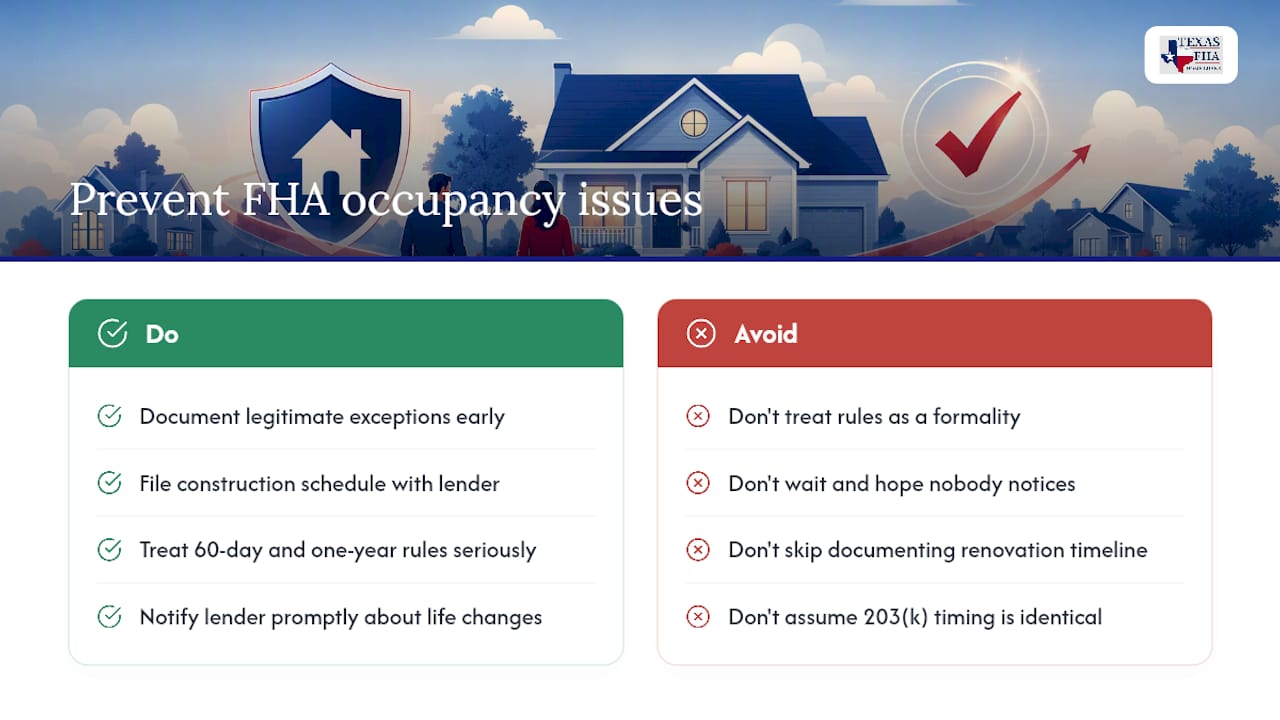
Where I’d push back on the common framing: too many borrowers treat the 60-day and one-year requirements as a formality to get through rather than a genuine commitment they’re making. The paperwork isn’t the point. The intent behind it is. A borrower who documents a legitimate exception early, before a lender has to come asking, almost always fares better than one who waits and hopes nobody notices a rental listing or a change-of-address form. Lenders aren’t looking to trap people who relocate for a good job or care for a growing family. They’re looking for the pattern of someone who never intended to live in the home at all, and that pattern is usually obvious once you compare timing, documentation, and behavior side by side.
The 203(k) exception is the one I think deserves more attention than it gets. Buyers taking on a rehab project often assume the occupancy clock is as rigid for them as it is for a move-in-ready purchase, and they either panic unnecessarily or skip documenting their renovation timeline because they don’t realize it matters. It does. A construction schedule filed early with your lender is worth far more than an explanation offered after the fact.
How TexasFHA Helps You Navigate Occupancy Rules
TexasFHA gives you something a lot of borrowers don’t get elsewhere: direct access to a loan specialist who reviews your occupancy situation before it becomes a problem, not after an underwriter flags it. If your circumstances involve a relocation, a military assignment, a divorce, or a rehab timeline, that early review is often the difference between a smooth approval and a stalled file.

As a Full Eagle FHA-approved lender, TexasFHA handles loan origination in-house and offers direct guidance on documentation packets for occupancy exceptions, including the letters and timelines underwriters expect for job relocations and military orders. First-time buyers get the same specialist support, with clear answers about what FHA loan qualifications in Texas actually require before you sign anything.
If you’re ready to see where you stand, reach out to a TexasFHA Loan Specialist and walk through your specific occupancy timeline together. It costs you nothing to ask the question before you’re locked into a closing date, and getting it right from the start avoids the entire chain of problems a documentation gap can create later.
Where to Verify the Official Rules
For borrowers who want to read the governing language directly rather than take any summary at face value, these are the primary sources behind FHA occupancy policy:
- HUD 4000.1 occupancy language: the core handbook provision requiring a 60-day move-in and a one-year occupancy intent.
- HUD’s official Q&A on multiple FHA loans, covering the one-principal-residence rule and its exceptions.
- HUD handbooks and program guidance are available through HUDCLIPS for program-specific occupancy standards.
- 18 U.S.C. § 1014 is the federal statute governing loan and credit application fraud, including occupancy misrepresentation.
This article provides general information about FHA occupancy requirements and is not a substitute for personalized guidance from a licensed mortgage professional. Confirm your specific situation with your lender or a HUD-approved housing counselor before making decisions based on an occupancy exception.
Sources
- FHA Loan Rules: HUD 4000.1 on Occupancy by the Borrower
- Answers
- HUD update — occupancy reporting and certification references
- 18 U.S.C. § 1014 — Loan and credit application fraud
- FHA loan rules: occupancy and second homes
Recommended
- FHA Loan Requirements | FHA Loan Qualifications in Texas
- FHA Loans Frequently Asked Questions – Learn About FHA Loans
- House Hunting in Flip-Flops? Your Summer FHA Loan Survival Guide – Texas FHA Home Loans | First-Time Buyer Loans

Over 25 years of experience in the Mortgage business. A Digital Marketer specializing in Conversion Rate Optimization, Search Engine Optimization, and Artificial Intelligence Overview Optimization for the Mortgage and Real Estate industry.