

Refinancing a conventional loan with an FHA loan means replacing your existing mortgage with a government-backed loan insured by the Federal Housing Administration, which carries more flexible credit and income standards than conventional financing. Texas homeowners with credit scores under 660, high debt-to-income ratios, or limited equity often find FHA refinance options more accessible than staying in the conventional market. The process follows HUD guidelines and requires meeting FHA loan eligibility requirements covering credit, occupancy, and payment history. Understanding each requirement before you apply puts you in a much stronger position to close successfully.
What are the eligibility requirements to refinance a conventional loan to an FHA loan?
You can refinance a conventional mortgage into an FHA loan if you meet credit and income standards, have occupied the property as your primary residence, and have made at least six consecutive on-time mortgage payments. These three conditions form the baseline. Meeting all three does not guarantee approval, but missing any one of them will stop the process immediately.
Credit score minimums and lender overlays

FHA guidelines technically allow credit scores as low as 500, but most lenders require 580 or higher at the retail level. Scores below 580 rarely succeed at standard banks, even if HUD rules technically permit them. Many Texas lenders apply overlays that push the practical minimum to 620, so checking with your specific lender early matters.
Debt-to-income ratio limits
FHA refinancing allows DTI ratios up to 56.99% with compensating factors, as outlined in FHA’s TOTAL Mortgage Scorecard. Conventional refinancing typically caps DTI at 43%–45%. That gap is significant for homeowners carrying car loans, student debt, or other obligations alongside their mortgage.
Other key eligibility criteria
- The property must be your primary residence, not a rental or vacation home.
- You must have owned and occupied the home long enough to satisfy seasoning requirements.
- Income must be verifiable through W-2s, tax returns, or pay stubs covering at least two years.
- Loan-to-value ratio limits apply; FHA cash-out refinances generally cap at 80% LTV.
- A new appraisal is required to establish current market value.
| Requirement | FHA Refinance | Conventional Refinance |
|---|---|---|
| Minimum credit score | 580 (lender overlays may require 620) | 620 minimum |
| Maximum DTI | Up to 56.99% with compensating factors | 43%–45% |
| Mortgage insurance | Upfront + lifetime annual MIP | PMI cancels at 78% LTV |
| Occupancy | Primary residence required | Primary, second home, investment |
| Payment history | 6+ months of on-time payments | Varies by lender |
Pro Tip: Pull your credit report from all three bureaus before applying. Errors on even one report can drop your score below a lender’s overlay minimum and delay your refinance by weeks.
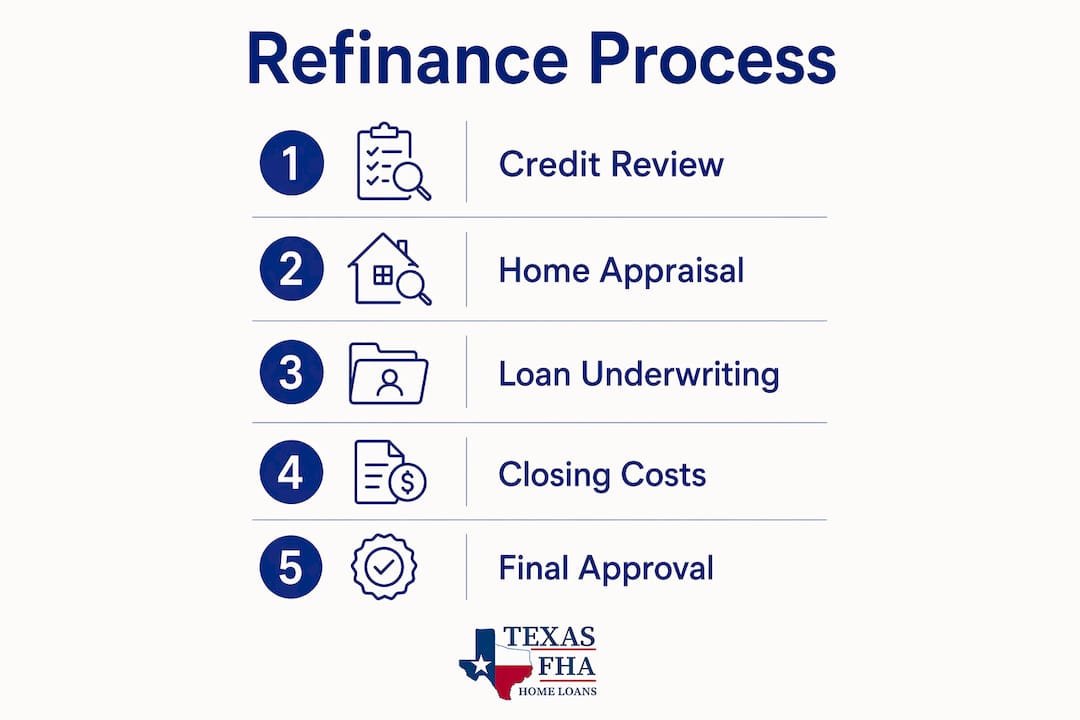
How does the conventional-to-FHA refinance process work?
The conventional-to-FHA switch follows a defined sequence. Skipping or rushing any stage delays underwriting and can increase your closing costs.
- Prequalify with an FHA-approved lender. Contact a lender like TexasFHA to review your credit score, income, and current loan balance. Prequalification gives you a realistic picture of what loan amount and rate you qualify for before you invest time in a full application.
- Submit your formal application. Complete the Uniform Residential Loan Application (Form 1003). Your lender will pull a hard credit inquiry and request two years of tax returns, recent pay stubs, bank statements, and your current mortgage statement.
- Order the FHA appraisal. FHA requires an appraisal by an FHA-approved appraiser. The appraisal establishes current market value and checks the property against HUD’s minimum property standards. A low appraisal can raise your LTV above allowable limits, which may require you to bring cash to closing or restructure the loan.
- Move through underwriting. The underwriter reviews your full file against FHA guidelines and any lender overlays. The FHA loan process typically takes longer than conventional underwriting because of the additional HUD compliance checks. Budget for 30–45 days from application to closing on a standard FHA refinance.
- Review the Closing Disclosure. Three business days before closing, you receive a Closing Disclosure that lists all fees. Compare it line by line against your Loan Estimate. Any differences above the tolerance thresholds must be corrected before you sign.
- Close and fund. At closing, you sign the new FHA loan documents, pay closing costs, and the new loan pays off your existing conventional mortgage. Your first FHA payment is typically due 30–60 days after closing.
Pro Tip: Lock your interest rate as soon as you are satisfied with the terms. FHA refinance timelines average 30–45 days, and rate movements during that window can meaningfully affect your monthly payment.
What are the pros and cons of switching from conventional to FHA?
The decision to switch from conventional to FHA carries real financial trade-offs. The benefits are clear for the right borrower, but the costs can outweigh the advantages if your situation does not fit the profile.
Advantages of FHA refinancing
- Lower credit score thresholds open the door for borrowers whom conventional lenders decline.
- Higher DTI allowances let you qualify even with significant existing debt.
- FHA refinancing benefits borrowers with scores below 660 or DTI above 45% who face denial or higher rates from conventional lenders.
- Upfront closing costs are generally lower for FHA loans than for conventional loans, providing short-term savings at closing.
- A switch from conventional to FHA can reduce your monthly payment if your current conventional rate is high relative to available FHA rates.
Disadvantages of FHA refinancing
The biggest drawback is mortgage insurance. FHA loans charge an upfront mortgage insurance premium of 1.75% of the loan amount, plus an annual premium of approximately 0.55%. On a $300,000 loan, the upfront MIP alone adds $5,250 to your loan balance. Conventional PMI cancels automatically once your LTV reaches 78%. FHA annual MIP on loans originated with LTV above 90% lasts the life of the loan. That permanent cost is the central trade-off every homeowner must calculate before committing.
“Upfront closing costs are lower for FHA loans compared to conventional, but the ongoing annual MIP can outweigh initial savings if you hold the home long term.” This means the FHA refinance makes the most financial sense as a short-term solution or a credit-rebuilding step, not necessarily a permanent mortgage structure.
Many FHA borrowers treat the conventional-to-FHA refinance as a two-step strategy. They refinance into an FHA loan now to access better terms, then refinance back to a conventional loan once their credit scores and equity improve enough to eliminate permanent MIP. That approach can optimize total mortgage insurance costs over time.
Conventional refinancing is the better choice for borrowers with credit scores above 740 and more than 20% equity, as it avoids permanent mortgage insurance entirely. If you are in that position, the FHA route adds cost without benefit.
What mistakes should you avoid when refinancing to an FHA loan?
Several common errors derail FHA refinances in Texas. Knowing them in advance lets you prepare rather than react.
Appraisal shortfalls
A low appraisal is one of the leading causes of refinance denials. If the appraised value comes in below expectations, your LTV rises above the allowable limit, and you may need to bring cash to closing or accept a smaller loan amount. Order a pre-appraisal consultation if your home’s value is uncertain. Comparable sales in your neighborhood directly affect the outcome, so document any improvements you have made.
Misunderstanding lender overlays
FHA sets minimum standards, but individual lenders add their own overlays. A lender requiring a 640 credit score is not violating FHA rules; they are applying their own risk threshold. Applying to a lender whose overlay exceeds your score wastes time and generates a hard credit inquiry. Ask about overlay requirements before submitting a full application.
Underestimating closing costs
Typical FHA refinance closing costs range from 2% to 6% of the loan amount. On a $300,000 loan, that is $6,000 to $18,000. Many homeowners budget for the low end and are caught off guard. Factor in appraisal fees, title insurance, lender fees, recording fees, and prepaids from the start.
Overlooking title insurance
Lenders require a new lender’s title insurance policy on every refinance, even if you purchased an owner’s title policy when you bought the home. This cost is frequently missed in early budgeting. Your existing owner’s policy does not cover the new lender’s interest.
Pro Tip: Calculate your break-even point before signing anything. Divide your total closing costs by your monthly payment savings. If you plan to sell or refinance again before that break-even date, the refinance may cost you more than it saves.
Key Takeaways
Refinancing a conventional loan to an FHA loan is the right move for Texas homeowners with credit scores below 660 or DTI above 45%, but it requires careful cost analysis before committing.
| Point | Details |
|---|---|
| Credit score threshold | FHA requires a minimum of 580; most Texas lenders apply overlays requiring 620 or higher. |
| DTI flexibility | FHA allows DTI up to 56.99% with compensating factors, well above conventional limits. |
| Mortgage insurance cost | FHA MIP includes 1.75% upfront and ~0.55% annual, and it lasts for the life of the loan at LTVs above 90%. |
| Closing cost range | FHA refinance closing costs run 2%–6% of the loan amount; calculate break-even before committing. |
| Two-step strategy | Many borrowers now refinance into FHA, then back to conventional once credit and equity improve. |
Why I think the FHA refinance question is more strategic than most homeowners realize
Most articles treat the conventional-to-FHA switch as a last resort for borrowers with credit problems. My experience tells a different story. The FHA refinance is genuinely useful as a deliberate, time-limited tool, not just a fallback.
Borrowers with scores in the 600–659 range often qualify for FHA loans at rates meaningfully better than those conventional lenders offer, if conventional lenders approve them at all. The permanent MIP can sound alarming, but if you plan to refinance again in three to five years, once your credit score crosses 700 and your equity reaches 20%, the math often works in your favor. The short-term savings on rate and monthly payment can exceed the MIP cost over that window.
What I tell homeowners is this: run the numbers for your specific holding period, not the generic 30-year scenario. The FHA vs. conventional comparison looks very different at year three than at year fifteen. Most people who reject FHA on principle because of MIP are comparing it to a conventional loan they cannot actually qualify for at a competitive rate.
The appraisal is the variable most homeowners underestimate. In Texas markets where values have shifted, a property that appraised well at purchase may come in lower today. Build a buffer into your expectations and talk to your appraiser about recent comparable sales before the formal appraisal is ordered.
— Gerry Nicodemus
TexasFHA can guide your FHA refinance from start to finish
Switching from a conventional mortgage to an FHA loan involves credit reviews, appraisals, underwriting, and closing costs that add up fast if you are not prepared. TexasFHA specializes in FHA refinance options for Texas homeowners and works with borrowers at every credit and equity level.

As a Full Eagle FHA-approved lender, TexasFHA gives you direct access to FHA programs without the delays of a broker chain. Whether you need help understanding FHA loan qualifications or want to compare your options side by side, the team at TexasFHA provides clear answers and personalized guidance. Explore the full range of FHA refinance programs available to Texas homeowners and get a rate quote tailored to your situation.
FAQ
What credit score do I need to refinance from conventional to FHA?
FHA guidelines allow scores as low as 500, but most lenders require 580 or higher, and many Texas lenders apply overlays requiring 620. Check your lender’s specific overlay before applying.
How long do I need to own my home before refinancing with the FHA?
You must have made at least six consecutive on-time mortgage payments on your current conventional loan before qualifying for an FHA refinance. Seasoning requirements protect both the lender and the borrower.
Does FHA mortgage insurance ever go away after refinancing?
FHA annual MIP lasts the life of the loan if your original LTV was above 90%. The only way to remove it is to refinance back to conventional once your credit score and equity meet conventional standards.
What are typical closing costs for an FHA refinance in Texas?
FHA refinance closing costs typically range from 2% to 6% of the loan amount and include appraisal fees, title insurance, lender fees, and prepaids. On a $300,000 loan, expect $6,000 to $18,000 at closing.
Can I do a cash-out refinance from a conventional loan to an FHA loan?
Yes. FHA cash-out refinances are available for homeowners switching from conventional loans, subject to an 80% LTV cap, credit minimums, and the standard six-month payment history requirement.
Recommended
- Refinance to an FHA Loan: Your 2026 Texas Guide
- FHA vs. Conventional Loans: Which Is Right for Texas Home Buyers? – Texas FHA Home Loans | First-Time Buyer Loans
- How To Get An FHA Loan In Texas – Texas FHA Home Loans | First Time Buyer Loans

Over 25 years of experience in the Mortgage business. A Digital Marketer specializing in Conversion Rate Optimization, Search Engine Optimization, and Artificial Intelligence Overview Optimization for the Mortgage and Real Estate industry.