

A mortgage refinance with a low credit score replaces your existing home loan with a new one on better terms, even when your credit falls below conventional lending thresholds. Government-backed programs from the FHA, VA, and USDA make this possible for Texas homeowners who would otherwise be turned away. Conventional loans require a minimum credit score of 620 for refinancing, but FHA and VA programs set the bar significantly lower. If your credit score sits below 620, you still have real options, and this guide walks you through each one.
What refinance loan programs are available to homeowners with marginal credit?
The right program depends on your loan type, military status, and how low your credit score actually is. Each government-backed option carries different rules, and knowing which one fits your situation saves you time and rejection letters.
FHA refinance options
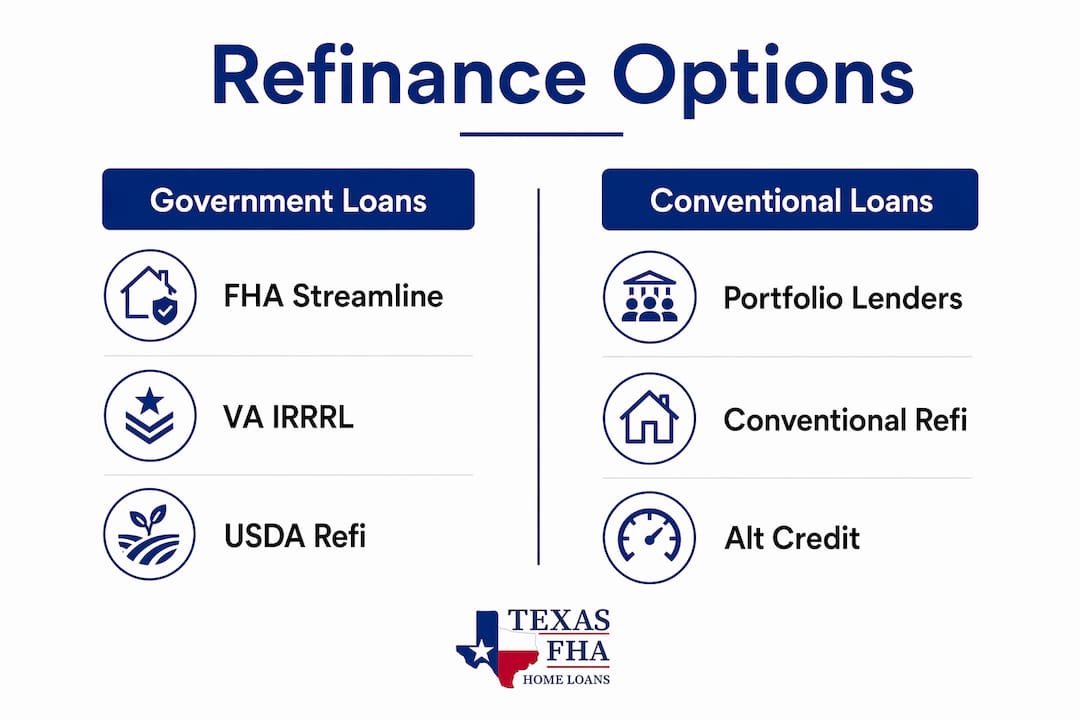
FHA loans permit credit scores as low as 580 for refinancing, with some lenders accepting scores between 500 and 579 when the borrower holds sufficient equity. That lower threshold makes FHA the most accessible path for most Texas homeowners with damaged credit. The FHA Streamline Refinance is the standout option here. HUD sets no statutory minimum credit score for the Streamline program, though most lenders impose their own overlays around 580 or 600. The program often waives the appraisal requirement and reduces paperwork, making it faster and cheaper than a full refinance. You can learn more about how this works through TexasFHA’s guide on the FHA Streamline process.

VA and USDA refinance options.
VA loans carry no official minimum credit score set by the Department of Veterans Affairs. The VA Interest Rate Reduction Refinance Loan (IRRRL) requires no credit check or appraisal in most cases, though individual lenders often prefer scores above 580. For eligible Texas veterans, this is the most flexible refinancing path available. USDA Streamline refinances follow a similar model, skipping appraisals and credit reviews for borrowers in eligible rural areas who already hold a USDA loan. Both programs prioritize payment history over raw credit scores.
Conventional and portfolio loan alternatives
Borrowers below the 620 threshold for conventional loans can turn to portfolio lenders, who may accept scores as low as 500 by evaluating the full financial picture rather than the credit score alone. Portfolio loans typically carry higher interest rates and require more equity or cash reserves. They serve as a last resort for homeowners who do not qualify for FHA, VA, or USDA programs. Reviewing the differences between FHA and conventional loans helps clarify which path fits your credit profile.
| Program | Minimum Credit Score | Appraisal Required | Best For |
|---|---|---|---|
| FHA Streamline | No HUD minimum (lenders ~580) | Often waived | Existing FHA borrowers |
| FHA Rate-and-Term | 580 (500–579 with equity) | Yes | Most low-credit homeowners |
| VA IRRRL | No VA minimum (lenders ~580) | Often waived | Eligible veterans |
| USDA Streamline | No formal minimum | Waived | Rural USDA borrowers |
| Portfolio Loan | As low as 500 | Yes | Borrowers with no other options |
What prerequisites improve your chances of refinancing with marginal credit?
Preparation separates approved applications from rejected ones. Your credit score is one factor, but lenders weigh several others just as heavily.
- Build a perfect payment record. Mortgage professionals recommend 6–12 months of on-time payments before applying to refinance. Sustained payment history often carries more weight with underwriters than a snapshot of a credit score.
- Run a credit audit. A credit audit can uncover reporting errors that suppress your score without cause. Dispute outdated accounts, incorrect balances, and duplicate entries through Equifax, Experian, and TransUnion before you apply.
- Reduce your debt-to-income ratio. Lenders evaluate how much of your gross monthly income goes toward debt payments. Paying down credit card balances or auto loans before applying lowers this ratio and strengthens your file.
- Stabilize your income. Two years of consistent employment or self-employment income is the standard benchmark. Gaps in income history raise red flags during underwriting, even when credit scores meet the minimum.
- Shop multiple lenders. Lender overlays impose stricter requirements beyond federal guidelines, and they vary widely from one lender to the next. One lender may decline you at 580 while another approves the same file. TexasFHA’s advice on finding the right lender covers this process in detail.
Pro Tip: Pull your free credit reports from AnnualCreditReport.com at least 60 days before applying. That gives you time to dispute errors and see the score improvement reflected before a lender pulls your file.
How to apply for a refinance with marginal credit: step-by-step
The application process for a marginal credit refinance follows the same general path as any refinance, but a few steps require extra attention.
Step 1: Assess your current loan and credit status. Identify your existing loan type (FHA, VA, USDA, or conventional) and pull your current credit scores. Your loan type determines which refinance programs you qualify for. Check your FHA credit score requirements to understand where you stand.
Step 2: Select the right program. Match your loan type and credit score to the programs listed above. FHA Streamline works only if you already have an FHA loan. VA IRRRL applies only to existing VA loans. If you have a conventional loan with a score below 620, an FHA rate-and-term loan or a portfolio loan is your primary option.
Step 3: Gather your documentation. Collect recent pay stubs, two years of tax returns, bank statements, your current mortgage statement, and proof of homeowner’s insurance. Streamlined programs require less paperwork, but having everything ready speeds up the application process.
Step 4: Contact lenders and submit applications. Apply to at least three lenders simultaneously. Streamline refinance programs reduce documentation requirements significantly, but full refinances still require complete financial disclosure. Use a mortgage calculator to estimate your new payment before committing to any offer.
Step 5: Understand the impact of the credit inquiry. Multiple mortgage applications within a 45-day window count as a single inquiry under FICO scoring models. Apply to all lenders within that window to protect your score.
Step 6: Respond to underwriting requests promptly. Underwriters frequently request additional documents, letters of explanation, or updated bank statements. Delays at this stage extend your closing timeline and can cause rate locks to expire.
Step 7: Review and close. Before signing, verify the new interest rate, monthly payment, loan term, and total closing costs. Confirm the numbers match what you were quoted. FHA Streamline refinances may not allow rolling closing costs into the new loan when the home value falls below program limits, so budget for upfront costs.
Pro Tip: Lock your interest rate in writing as soon as you receive an acceptable offer. Rates can shift between application and closing, and a written lock protects you from last-minute increases.
What challenges do borrowers with marginal credit face, and how do you overcome them?
Marginal credit refinancing comes with real obstacles. Understanding them in advance prevents surprises.
- Higher interest rates. Lenders price risk into the rate. A borrower with a score of 580 pays a higher rate than one with a score of 720. Run the numbers using a loan cost calculator to confirm the refinance still saves money over the life of the loan before proceeding.
- Lender overlays. Federal guidelines and lender overlays are two different things. Meeting HUD’s minimum does not guarantee approval at every lender. Shopping around at least three lenders is not optional for borrowers with marginal credit. It is the only reliable way to find one whose overlays match your profile.
- Cash-out refinance restrictions. Cash-out refinances require scores of 580–620 and 20–25% equity at a minimum. Most borrowers with marginal credit do not meet both conditions simultaneously. A rate-and-term refinance is a more realistic first step, with cash-out as a future goal after credit improves.
- Appraisal and property value issues. If your home’s value has dropped, you may owe more than it is worth. Streamlined programs sidestep this problem by waiving the appraisal. Full refinances require sufficient equity, so a low appraisal can kill an otherwise approvable application.
- Mortgage modification as an alternative. If refinancing is not yet feasible, a loan modification through your current servicer adjusts your rate or term without a new loan application. This option does not require a credit check and can reduce your payment while you work to improve your credit profile.
Mortgage experts confirm that federal programs prioritize payment history over standard credit scores, creating real pathways for marginal credit refinances. The borrowers who succeed are the ones who prepare their file, shop multiple lenders, and apply to the program that matches their existing loan type.
What I’ve learned about refinancing with marginal credit after years in Texas mortgages
The most common mistake I see Texas homeowners make is giving up after one rejection. One lender’s “no” is not the industry’s verdict. Lender overlays vary so much that the same borrower can be declined at one institution and approved at another within the same week. The federal guidelines are the floor, not the ceiling, and most lenders sit somewhere above that floor.
Payment history is the single most underrated factor in this process. I have seen borrowers with scores in the low 600s sail through FHA Streamline approvals because they had 18 months of perfect payments. I have also seen borrowers with higher scores struggle because their payment record had gaps. Lenders are not just reading your score. They are reading your behavior.
The timing question matters more than most people realize. Applying right after a financial setback, before you have rebuilt any payment history, almost always produces worse outcomes than waiting 6–12 months and applying with a clean recent record. That patience is not passive. Use that time to run a credit audit, pay down balances, and research which program fits your loan type. Arrive at the application with a prepared file, not just a hope.
One more thing: understand what you are refinancing into, not just what you are refinancing out of. A lower monthly payment that extends your loan term by 10 years may cost you more in total interest than staying put. Run the full numbers. TexasFHA’s resources on the reasons to refinance lay out the financial case clearly and are worth reading before you commit to any path.
— Gerry Nicodemus
How TexasFHA helps Texas homeowners refinance with marginal credit
Texas homeowners with damaged credit have more options than most realize, and TexasFHA specializes in exactly this situation.

TexasFHA is a Full Eagle FHA-approved lender with deep experience in government-backed refinancing programs across Texas. The team works directly with homeowners to identify which program fits their credit profile, whether that is an FHA Streamline, a rate-and-term refinance, or a path that starts with credit rebuilding. You can review the FHA loan requirements to see where you stand today. TexasFHA’s FHA Loan Specialists walk you through every step, from the initial credit review to closing, so you never have to guess what comes next. If you are ready to evaluate your options, TexasFHA is the place to start.
FAQ
What is the minimum credit score to refinance a mortgage?
FHA refinancing accepts scores as low as 580, and some lenders work with scores between 500 and 579 when sufficient equity exists. VA and USDA streamline programs have no official minimum score, though individual lenders typically prefer 580 or higher.
Can I refinance with marginal credit without a new appraisal?
Yes. FHA Streamline and VA IRRRL programs frequently waive the appraisal requirement, making them accessible even when home values have declined. These programs require verified current payments but minimal additional documentation.
How does marginal credit affect my refinance interest rate?
A lower credit score results in a higher interest rate because lenders price their risk into the loan. Running the total cost through a mortgage calculator before accepting any offer confirms whether the refinance saves money over the full loan term.
What is a lender overlay?
A lender overlay is a stricter requirement that a lender adds on top of federal program guidelines. Shopping multiple lenders is the most effective way to find one whose overlays align with your credit profile.
How long should I wait before refinancing if I have marginal credit?
Mortgage professionals recommend 6–12 months of perfect on-time payments before applying. That window also gives you time to correct errors on your credit report and reduce your debt-to-income ratio.
Key takeaways
A mortgage refinance with a marginal credit score is achievable through FHA, VA, and USDA programs that prioritize payment history over credit score thresholds, provided borrowers prepare their financial file and shop multiple lenders.
| Point | Details |
|---|---|
| FHA is the primary path | FHA accepts scores starting at 580, and the Streamline option often waives the appraisal requirement and reduces paperwork. |
| Payment history outweighs score | Six to twelve months of on-time payments strengthen your application more than a score bump alone. |
| Lender overlays vary widely | Federal minimums do not guarantee approval; apply to at least three lenders to find favorable terms. |
| Cash-out refinancing is harder | Marginal credit borrowers need 20–25% equity and a minimum score of 580–620 for cash-out options. |
| Credit audits recover lost points | Correcting reporting errors before applying can raise your score enough to qualify for better terms. |
Recommended
- News and Blog Articles Archives – Texas FHA Home Loans | First Time Buyer Loans
- Five Reasons To Consider Refinancing Your Mortgage – Texas FHA Home Loans | First Time Buyer Loans
- Tips For Rebuilding Your Credit Score – Texas FHA Home Loans | First Time Buyer Loans
- Refinance to an FHA Loan: Your 2026 Texas Guide

Over 25 years of experience in the Mortgage business. A Digital Marketer specializing in Conversion Rate Optimization, Search Engine Optimization, and Artificial Intelligence Overview Optimization for the Mortgage and Real Estate industry.