

Reverse mortgage interest accrues on whatever you borrow and is typically added to your loan balance, so the longer you keep the loan, the more interest compounds. Your rate depends on whether you choose a fixed lump sum or an adjustable line of credit, and each option changes when compounding begins. FHA insurance and mandatory HUD counseling add real, specific protections that limit your downside.
TL;DR:
- Interest on reverse mortgages accrues on drawn funds only, leading to compound growth that can significantly increase the total owed over time.
- Fixed-rate loans require the entire amount upfront with interest on the full sum from day one, while adjustable-rate loans grow based on actual withdrawals and market-linked rates.
- Upfront costs typically include origination, appraisal, FHA insurance premium, and counseling fees, most of which are financed into the loan and accrue interest.
- The loan becomes due when the home is sold, the owner moves out permanently, or the last borrower dies; unpaid property taxes and insurance can still trigger foreclosure risks.
- Borrowers generally cannot deduct interest annually until the loan is paid off, and making voluntary interest payments can help limit long-term interest growth.
Table of Contents
- How Does Reverse Mortgage Interest Actually Accrue?
- Fixed vs. Adjustable Rates: How Are They Set?
- What Fees Come With a Reverse Mortgage?
- When Does a Reverse Mortgage Come Due?
- Can You Deduct Reverse Mortgage Interest on Your Taxes?
- How Can You Limit Interest Growth Over Time?
- What Protections Does HUD Provide Borrowers?
- Is a Reverse Mortgage the Right Move for You?
- Get Help Evaluating Your Reverse Mortgage Options in Texas
- Where to Find Official Reverse Mortgage Guidance
- Sources
How Does Reverse Mortgage Interest Actually Accrue?
Interest on a Home Equity Conversion Mortgage (HECM) works backward from what you might expect. Instead of paying interest monthly out of pocket, the interest is calculated on your outstanding balance and added directly to that balance. Your loan grows every month, even though you never write a check for it. Housing economists call this negative amortization, and it is the single most important concept for understanding reverse mortgage interest.
Here is the practical difference this makes: your balance grows in the opposite direction of a traditional mortgage. With a regular home loan, you pay down principal every month and your balance shrinks. With a reverse mortgage, you draw funds, interest accrues on those funds, and unless you choose to pay it, that interest gets folded into next month’s balance. Then next month’s interest gets calculated on the new, larger balance. That is compounding, and it is why a reverse mortgage taken at age 65 can carry a meaningfully larger balance by the time it comes due 15 or 20 years later.
One detail catches a lot of borrowers off guard: interest only accrues on money you have actually drawn, not on your full approved loan amount. If your lender approves you for $200,000 but you draw $50,000 through a line of credit, interest accrues only on that $50,000. This makes the line-of-credit option fundamentally different from a lump-sum payout, in which the full approved amount begins accruing interest from day one.
FHA’s mortgage insurance backs a critical guarantee here. Because HECM loans are non-recourse loans insured through HUD’s HECM program, you or your heirs will never owe more than the home’s value at payoff, even if accumulated interest pushes the loan balance past what the house is worth. FHA insurance absorbs that gap.
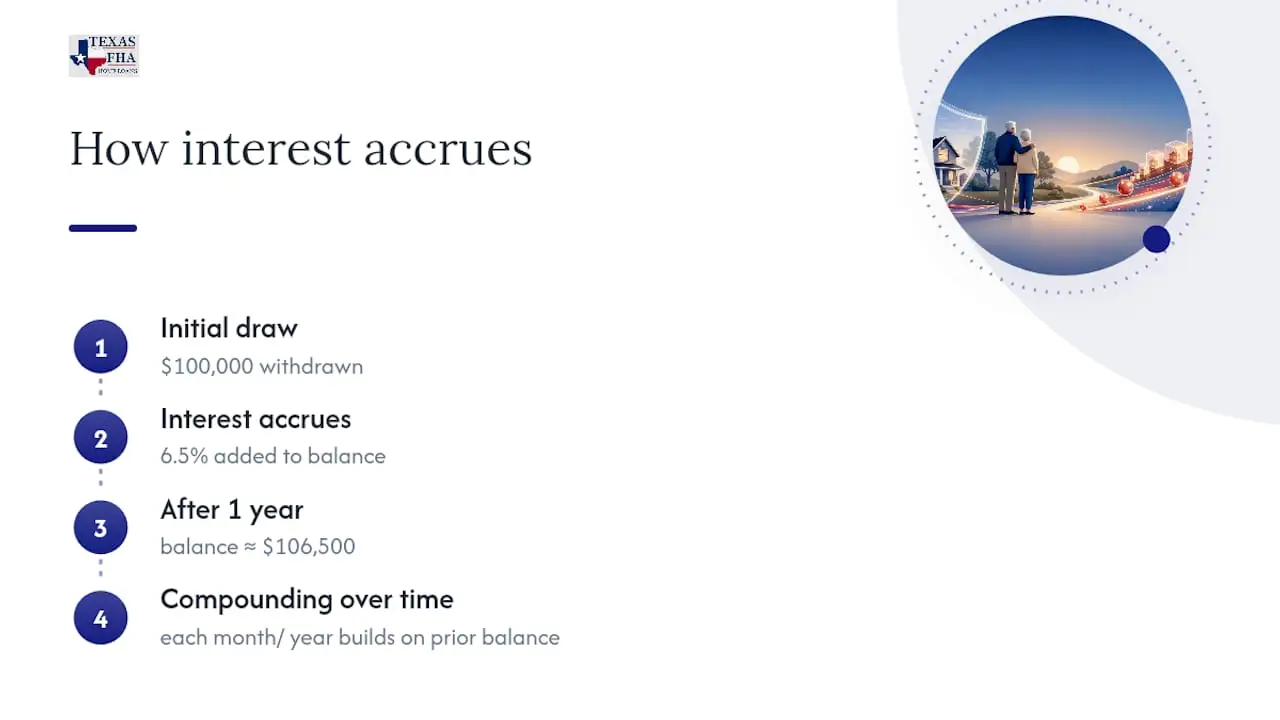
Consider a simplified example. A borrower draws $100,000 at an average accruing rate of 6.5%. In year one, roughly $6,500 in interest gets added to the balance, bringing it to $106,500. Year two’s interest is calculated against that higher figure, not the original $100,000. Extend that pattern over a decade without payments, and the balance climbs well beyond the amount actually borrowed. This is exactly why lenders and counselors push borrowers to think in terms of total cost over time, not just the amount received today.
Pro Tip: Ask your lender for an amortization schedule showing projected balance growth at 5, 10, and 15 years under your chosen payout option. Seeing the actual numbers on paper makes negative amortization far less abstract.
Fixed vs. Adjustable Rates: How Are They Set?
Your rate structure determines both your interest cost and your flexibility, and the two HECM options work differently enough that they suit different situations.
Fixed-rate HECMs require you to take your entire loan as a single lump sum at closing. The rate is locked for the life of the loan, and because you receive everything upfront, interest starts accruing on the full amount immediately. This option works for borrowers with one large need, such as paying off an existing mortgage in full.
Adjustable-rate HECMs let you choose a line of credit, monthly payments, or a combination, and interest accrues only as you draw funds. The rate on these loans is not arbitrary. It is built from two components:
- The index, usually tied to published Treasury yields that shift with broader market conditions
- The lender’s margin, a fixed percentage the lender adds on top of the index and keeps constant for the loan’s life
Add those two together, and you get your effective interest rate at any given time. Because the index component can move, Treasury’s published yield curve rates give you a way to track roughly where adjustable HECM rates are heading, though your specific rate depends on your lender’s margin and the loan’s adjustment terms. Most adjustable HECMs cap how much the rate can change in each adjustment period and over the life of the loan, which limits how dramatically your accrual can accelerate, even in a rising-rate environment.
Your age and home value also shape your cost per dollar borrowed, not just your total borrowing limit. Lenders use HUD’s principal limit factor tables to calculate how much you qualify for, and those tables weigh age heavily. An older borrower typically qualifies for a higher percentage of the home’s value, partly because HUD’s actuarial assumptions assume a shorter loan term and less total interest accrual. Comparing daily rate quotes, such as those published on consumer rate pages, can help you see how fixed and adjustable offers differ before you commit to either.
What Fees Come With a Reverse Mortgage?
Reverse mortgage costs fall into two buckets: what you pay at closing and what accrues over the life of the loan. Understanding both matters more than focusing solely on the headline interest rate.
Upfront costs typically include:
- Origination fees, which the Consumer Financial Protection Bureau notes can run up to $6,000 depending on home value
- Appraisal and title fees are standard for any mortgage transaction
- Initial FHA mortgage insurance premium, calculated as a percentage of your home’s appraised value or the FHA lending limit, whichever is lower
- Standard closing costs, including recording fees and credit reports
Separately, HUD requires a counseling session before you can close, and that session usually carries a modest fee, often in the $125-$200 range, depending on the counseling agency.
Most of these upfront costs get rolled directly into the loan rather than paid out of pocket. That convenience carries a real cost: every dollar of financed fees starts accruing interest immediately alongside your drawn funds, growing your balance faster than the draw amount alone would suggest.
Ongoing costs continue for the duration of the loan. The CFPB identifies an annual mortgage insurance premium equal to 0.5% of your outstanding balance as a recurring cost, along with loan servicing fees and, in some cases, advances the lender makes to cover property taxes or insurance if you fall behind.
The gap between gross and net proceeds catches many first-time borrowers by surprise. Gross proceeds are what you technically qualify for before fees are deducted. Net proceeds are what actually land in your account after origination costs, initial MIP, and other closing charges are subtracted. Always ask your lender for a net-proceeds worksheet rather than relying on the headline number, and review our FHA closing costs guide for a broader sense of what typically gets financed into a loan versus paid separately.
When Does a Reverse Mortgage Come Due?
A HECM does not have a fixed maturity date the way a 30-year mortgage does. Instead, it becomes due and payable upon the occurrence of a specific triggering event. The three most common triggers are:
- Sale of the home: the loan is repaid from the sale proceeds at closing.
- Permanent move: if you live elsewhere for more than 12 consecutive months, including moving into long-term care, the loan typically becomes due.
- Death of the last surviving borrower: heirs then have options for handling the balance.
When one of these events happens, heirs generally have a defined window, often six months with possible extensions, to decide how to proceed. They can sell the home and use the proceeds to pay off the loan, refinance the balance into a traditional mortgage to keep the property, or walk away and let the lender pursue the FHA insurance if the balance exceeds the home’s value. Because HECMs are non-recourse, heirs never owe more than the home is worth at the time of sale, no matter how much interest has accrued.
The absence of a monthly mortgage payment does not mean the absence of financial obligation. The Federal Trade Commission warns that unpaid property taxes, homeowners insurance, or HOA dues can trigger foreclosure on a reverse mortgage just as surely as a missed payment would on a traditional loan. This is the risk factor borrowers underestimate most.
Lenders address this risk with a Life Expectancy Set-Aside (LESA), a reserved portion of loan proceeds earmarked specifically for future property tax and insurance payments. If your financial profile suggests a pattern of late payments or thin cash reserves, your lender may require a LESA as a condition of approval. It reduces the funds available to you elsewhere, but it also substantially lowers your foreclosure risk.

Pro Tip: If your loan officer mentions a LESA, ask exactly how much it reduces your available proceeds and how it is funded over time. Some borrowers view it as a downside, but it functions as forced protection against the most common cause of reverse mortgage foreclosure.
Can You Deduct Reverse Mortgage Interest on Your Taxes?
The IRS treats reverse mortgage interest differently from a standard mortgage in one crucial way: it accrues on your balance every month, but it is not deductible until you actually pay it.
For most borrowers, that means no annual mortgage interest deduction while the loan is outstanding, since no interest payment actually changes hands during that time. The deduction typically becomes available in the year the loan is repaid, whether through sale, refinance, or payoff by heirs, and only for the amount of interest actually paid at that point.
This timing detail matters for planning purposes:
- Borrowers who itemize deductions should not expect an annual tax benefit from reverse mortgage interest the way they might with a traditional mortgage.
- The tax benefit, when it arrives, lands in a single year, potentially a large one if the loan ran for a long period.
- Because most seniors take the standard deduction rather than itemizing, the practical tax impact of reverse mortgage interest is often smaller than borrowers assume.
Talk to a tax professional about your specific situation before assuming any deduction will apply, and check the IRS’s own guidance for the most current rules on senior taxpayer deductions.
How Can You Limit Interest Growth Over Time?
You have more control over your total interest cost than most people realize, and the choices you make at the outset carry the most weight.
Your payout structure is the biggest lever. A lump-sum draw puts your full approved amount into accrual immediately. A line of credit accrues interest only on the funds you actually withdraw, leaving unused funds uncharged. For many borrowers who do not need all their proceeds immediately, the line-of-credit structure alone can meaningfully slow the growth of the balance over a 10- or 15-year horizon.
Voluntary interest payments offer a second lever. Nothing prevents you from paying some or all of your accruing interest each month, even though you are not required to. Doing so keeps your balance closer to your original draw amount and preserves more home equity for heirs.
Shopping lenders matters more than many borrowers expect, since margins vary between lenders even when they use the same underlying index. A margin that is even half a percentage point lower compounds into real savings over a decade-long loan.
- Compare margin offers from multiple lenders before committing
- Consider voluntary interest payments if your monthly cash flow allows
- Choose a line of credit over a lump sum when you don’t need full proceeds immediately
- Run projections through a reverse mortgage calculator before finalizing your payout structure
Pro Tip: Ask two or three lenders for their current margin and request a written net-proceeds comparison. A half-point difference in margin sounds small but adds up significantly over 15 to 20 years of accrual.
What Protections Does HUD Provide Borrowers?
Every HECM borrower must complete a counseling session with a HUD-approved counseling agency before closing. This session walks through loan mechanics, alternatives, and the specific financial commitment you are making, and it typically costs between $125 and $200.
FHA mortgage insurance runs alongside your loan for its entire life. The initial premium, usually financed into the loan, is paid once at closing.
- Counseling is mandatory, not optional, before any HECM closes
- Initial FHA MIP is typically rolled into the loan balance
- Ongoing MIP runs at 0.5% of your outstanding balance each year
- FHA insurance guarantees the non-recourse protection that caps what you or your heirs owe
Bring your property tax statements, insurance documentation, and a household budget to your counseling session. Counselors use this information to walk through realistic scenarios, including how a LESA might apply to your situation.
Is a Reverse Mortgage the Right Move for You?
A reverse mortgage tends to work best for homeowners who want to stay in their homes long-term, have limited liquid savings, and need supplemental income without taking on a monthly payment. It works less well as a patch for an ongoing budget shortfall because the underlying problem, insufficient monthly income, does not disappear. It just gets funded by a shrinking equity cushion instead.
Watch for three red flags before moving forward. First, using a reverse mortgage to cover a permanent gap between income and expenses rather than a specific, bounded need. Second, treating property tax and insurance payments as optional once the loan closes. Third, drawing the maximum available amount immediately with no cash reserve left for emergencies.
Bring specific questions to your HUD counseling session: What are my actual net proceeds after all fees? Does my profile suggest I’ll need a LESA? What would my balance look like in 10 years if I make voluntary interest payments versus letting everything compound? A counselor who cannot answer these clearly is not doing the job properly, and you deserve a straight answer before signing anything.
— Gerry Nicodemus
Get Help Evaluating Your Reverse Mortgage Options in Texas
The company offers Texas homeowners direct access to FHA loan specialists who can work through actual numbers, not just provide rough estimates. The company specializes in FHA-backed loans, including reverse mortgages for seniors, and walks you through net proceeds, fee structures, and payout options before you commit to anything.

If you are weighing whether a reverse mortgage fits your retirement plan, the next step is a conversation, not a guess. Consider reviewing your FHA loan requirements and qualifications with a specialist who can walk you through your home’s value, age, and financial goals, and clarify what your net proceeds may look like before you decide anything.
Where to Find Official Reverse Mortgage Guidance
For readers who want to go straight to primary sources rather than secondhand summaries, these federal resources cover the rules, costs, and protections discussed throughout this article:
- HUD publishes official HECM program rules, counseling requirements, and lender guidelines at Hud
- CFPB breaks down reverse mortgage costs and consumer protections at Consumer Finance
- IRS explains interest deductibility timing for senior taxpayers at IRS
- FTC covers consumer warnings and foreclosure risk at Consumer
- U.S. Treasury publishes the yield data underlying many adjustable HECM rates at Treasury
This article is general information, not a substitute for advice from a qualified financial advisor. Consult a qualified financial professional about your own circumstances before acting on anything here.
Sources
- How much does a reverse mortgage loan cost? | CFPB
- HUD: HECM reverse mortgages
- For senior taxpayers | Internal Revenue Service
- Reverse mortgages | FTC
- Daily Treasury yield curve rates | U.S. Department of the Treasury
Recommended
- Unlocking Home Equity In Retirement: An In-Depth Look At FHA Reverse Mortgages
- Reverse Mortgage Calculator for Seniors: 2026 Guide
- HECM 101: What You Need To Know About Reverse Mortgage
- Reverse Mortgage vs Cash-Out Refinance for Retirees

Over 25 years of experience in the Mortgage business. A Digital Marketer specializing in Conversion Rate Optimization, Search Engine Optimization, and Artificial Intelligence Overview Optimization for the Mortgage and Real Estate industry.