
When one married spouse applies for an FHA purchase loan in Texas and the other stays off the note, the FHA non-borrowing spouse is still an important part of the file. Because Texas is a community property state, “off the loan” doesn’t mean “out of the process.” Your spouse’s debts, credit report, identifying information, and signature at closing can all come into play.
There are plenty of neutral reasons a couple may set up a purchase this way. One spouse may carry debts that would affect the application, may not need to contribute income, may be on a different timeline, or may prefer not to sign the note. Whatever the reason, talk through the structure early, before you’re under contract, so the FHA-approved Mortgagee can document the file correctly and closing day doesn’t bring a surprise.
TL;DR
- In Texas, your spouse doesn’t have to be on your FHA loan, but they’re still part of the file.
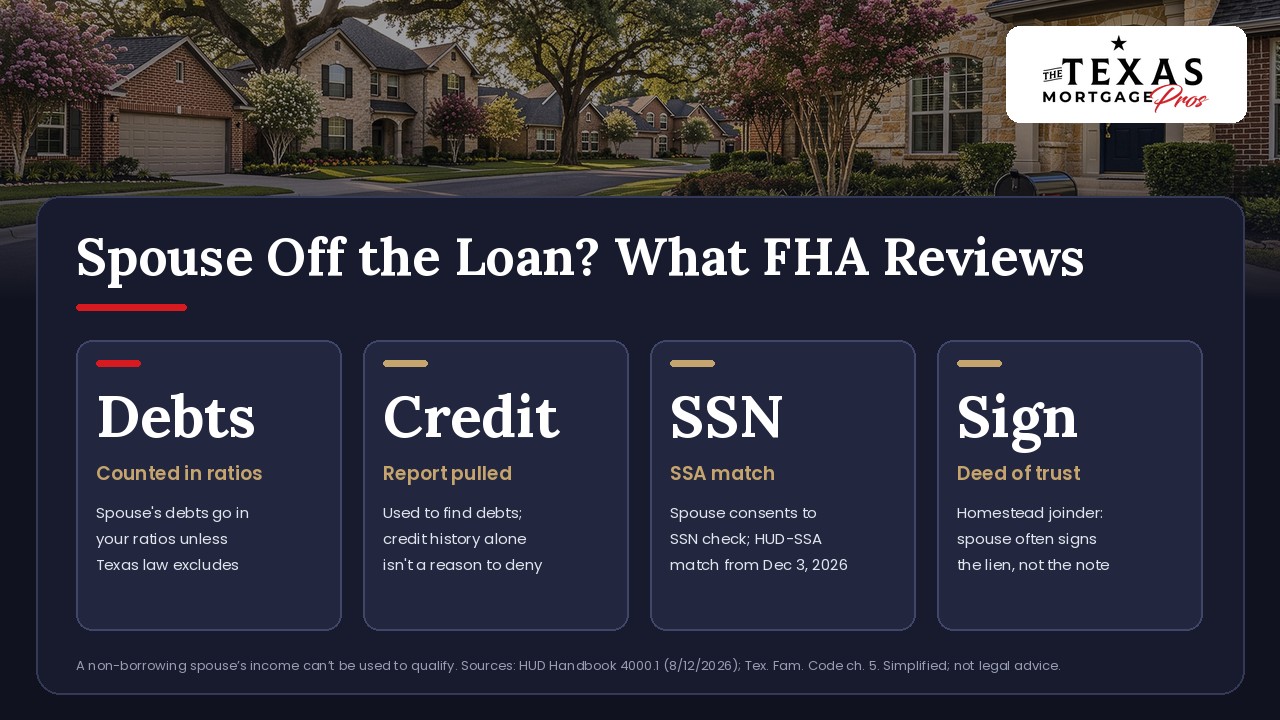
- Because Texas is a community property state, your spouse’s debts generally count in your qualifying ratios unless state law excludes them.
- The Mortgagee pulls your spouse’s credit report and verifies their Social Security number with SSA; HUD-SSA matching that covers non-borrowing spouses applies from December 3, 2026.
- Your spouse’s credit history alone isn’t a reason to deny the application, and their income can’t be used to qualify.
- Texas homestead rules mean your spouse often signs the deed of trust at closing, which is different from signing the note.
- Texas down payment assistance programs treat a non-purchasing spouse’s income differently, so check program rules early.
TexasFHA
Buying While Your Spouse Stays Off the Loan?
Talk with The Texas Mortgage Pros, a Texas mortgage broker, about who should sign the note before you make an offer.
New HUD-SSA verification rules put spouse information in the spotlight
On November 3, 2026, HUD published a Privacy Act matching-program notice in the Federal Register. The new HUD-SSA computer matching program becomes applicable December 3, 2026, and is scheduled to run for 18 months.
The notice specifically covers borrowers, non-borrowing spouses, and other people listed on the mortgage application whose information must be verified. For each person who consented on form HUD-92900-A, HUD sends a first name, last name, Social Security number, and date of birth. SSA returns a match or no-match response, with an explanatory code when the information doesn’t match.
As National Mortgage Professional reported on November 12, SSA validation of borrowers and non-borrowing spouses is already part of FHA case-number processing. Processing can continue while a mismatch is fixed, but a case that fails validation can’t be endorsed for FHA insurance without the required HUD acknowledgment. Correcting a name, Social Security number, or birth date triggers another check.
The notice doesn’t create a new FHA eligibility standard. It’s a practical reminder that a spouse who isn’t applying may still need to provide accurate identifying information and authorize verification.
It also fits who is buying right now. In its top takeaways from the 2026 Profile of Home Buyers and Sellers, the National Association of REALTORS® reported that just 47% of first-time buyers were married, while 25% were single women, 12% single men, and 11% unmarried couples. When married Texans do buy, deciding who goes on the loan is one of the first choices to make.
Why Texas community property rules change the FHA file
Texas is a community property state. Under FHA policy, your spouse doesn’t have to become a borrower or co-signer just because you’re married and buying in Texas. HUD does require the Mortgage to be signed by everyone needed to make the lien valid and enforceable under state law, and that’s where Texas homestead rules come in (more on that below).
FHA also treats a non-borrowing spouse’s debts differently in a community property state. The governing requirements are in HUD Handbook 4000.1. Here’s what they mean in everyday terms.
Your spouse’s debts generally go on the application
If you live in a community property state, or the home is located in one, HUD requires the non-borrowing spouse’s debts to be listed on the loan application and included in your qualifying ratios, except obligations specifically excluded by state law.
That means the underwriter needs to identify and document those obligations. It isn’t enough to say a debt belongs only to the spouse who is staying off the note. If a debt is excluded under state law, the Mortgagee must note the specific state law that justifies the exclusion in the file.
Examples can include car loans, credit cards, student loans, and other installment or revolving accounts. If student debt is part of the picture, our guide to FHA student loan guidelines explains how those payments are counted, and our FHA manual underwriting guide covers how ratios are reviewed when a file needs a closer look.
This is one reason I encourage couples to bring up marital status and the planned ownership structure at the very start of the conversation, not after a credit report is already in review.
Your spouse’s credit report is part of the review
For an FHA non-borrowing spouse in Texas, the Mortgagee must obtain a credit report for that spouse to determine your debt-to-income ratio. The report can be traditional or non-traditional.
The report must show that the spouse’s Social Security number was matched with SSA, or the Mortgagee must provide separate documentation of the match. If the spouse doesn’t have a Social Security number, the file needs a statement saying so, and the credit report must include at least the spouse’s full name, date of birth, and addresses for the last two years. The Mortgagee must also obtain the non-borrowing spouse’s consent to verify the Social Security number with SSA.
A credit report request can feel like your spouse is being added to the loan. It isn’t. It’s a required part of evaluating your application in a community property state.
Credit history alone isn’t a reason to deny the application
HUD says a non-borrowing spouse’s credit history isn’t a reason to deny an FHA mortgage application. In manual underwriting, HUD goes further: the Mortgagee must not consider the non-borrowing spouse’s credit history.
That distinction matters. The review isn’t about treating your spouse as a second applicant. It’s about finding the debts FHA requires in your ratios. A few items still need attention:
- The spouse’s collection accounts must be included in FHA’s cumulative collection-balance analysis, unless state law excludes the obligation.
- The spouse’s judgments must be resolved or paid in full, except obligations excluded by state law.
- The spouse’s disputed derogatory accounts are not counted toward the cumulative balance that can move a file to manual underwriting.
If collections, judgments, or disputed accounts show up, don’t assume the conversation is over. Share the documentation early so the file can be reviewed under the right rules. Our guide to FHA charge-off guidelines adds context on how derogatory credit items are evaluated.
Your spouse’s income can’t fill a qualifying-income gap
Here’s the part that surprises many couples: an FHA non-borrowing spouse’s debts can count against your ratios, but that spouse’s income can’t be used as qualifying income. HUD even bars it from the “additional income” compensating factor in a manual underwriting review.
A household may have two incomes for everyday bills, but FHA qualification is based on the people obligated on the note.
When you need your spouse’s income
If the purchase requires your spouse’s income to qualify, your spouse generally must apply as a co-borrower. Under HUD’s rules, a co-borrower takes title, is obligated on the note, and signs the security instruments.
That’s different from a non-occupant co-borrower, which is a separate FHA structure with its own occupancy and relationship rules.
Before deciding whether one or both spouses should apply, look at the whole picture:
- Your income and debts
- Your spouse’s debts that must be counted
- Whether your spouse’s income is needed to qualify
- Any collections, judgments, or disputed accounts
- Ownership and homestead-signing requirements
- Whether down payment assistance income limits apply
A conversation before you start touring homes is far easier than restructuring a file after an offer is accepted. You can start with our overview of FHA loan requirements, then talk through your specific situation.
The note, the title, and the deed of trust are different documents
One of the most common sources of confusion is the difference between being on the note, being on title, and signing the deed of trust.
The note creates the repayment obligation
The person who signs the promissory note takes on the obligation to repay the loan. A non-borrowing spouse doesn’t sign the note just because the couple is married. That’s what most people mean when they say, “My spouse isn’t on the loan.”
Title reflects ownership
Title shows who owns the property. A spouse can have an ownership interest even without being a borrower. Under the Texas Family Code, community property generally includes property, other than separate property, acquired by either spouse during marriage, and property held during marriage is presumed to be community property. Separate property generally includes property owned before marriage, plus gifts and inheritances.
Those are property-rights questions, and this isn’t legal advice. If you have questions about separate property, a premarital or marital property agreement, a prior ownership interest, or how title should be held, talk with a Texas attorney before closing.
The deed of trust secures the lien
Texas homestead law is a separate reason a non-borrowing spouse often signs closing documents. Under Texas Family Code Chapter 5, whether the homestead is separate or community property, neither spouse may sell, convey, or encumber the homestead without the other spouse’s joinder, except as the law provides.
HUD’s rule lines up with that: if it’s necessary to perfect a valid first lien under state law, the Mortgagee must require the non-borrowing spouse to sign the security instrument or documentation relinquishing rights to the property. In Texas, that commonly means your spouse signs the deed of trust at closing.
Signing the deed of trust isn’t the same as signing the note. It’s part of creating the lien on the home. If you have questions about what your spouse’s signature means for them personally, ask the title company or a Texas attorney.
Texas down payment assistance can count spouse income differently
FHA qualifying income and a down payment assistance program’s income limit are two different tests, and Texas programs don’t all treat a non-purchasing spouse the same way.
The Texas Department of Housing and Community Affairs (TDHCA) program guide effective November 1, 2026, and its My First Texas Home program matrix (published November 2, 2026) spell out the details:
- My First Texas Home and the Texas Mortgage Credit Certificate: income for the income-limit test includes a non-purchasing spouse’s income. The non-purchasing spouse must also meet the first-time homebuyer test (no ownership and occupancy of a primary residence in the last three years, unless an exemption applies).
- My Choice Texas Home: only the borrowers’ income shown on the loan application counts toward the income limit. A non-purchasing spouse’s income isn’t included.
- Title and the deed of trust: for TDHCA’s FHA, VA, and USDA options, borrowers and non-purchasing spouses must be vested on title and listed on the deed of trust.
- Homebuyer education: each borrower needs a completion certificate; non-purchasing spouses are exempt.
So your spouse’s income may not help you qualify for the FHA loan, yet it may count when a state program checks your household against its income limit. Identify that early. If you’re exploring assistance, start with our overview of Texas first-time homebuyer programs and ask which program rules fit your household.
Documents to gather before you apply
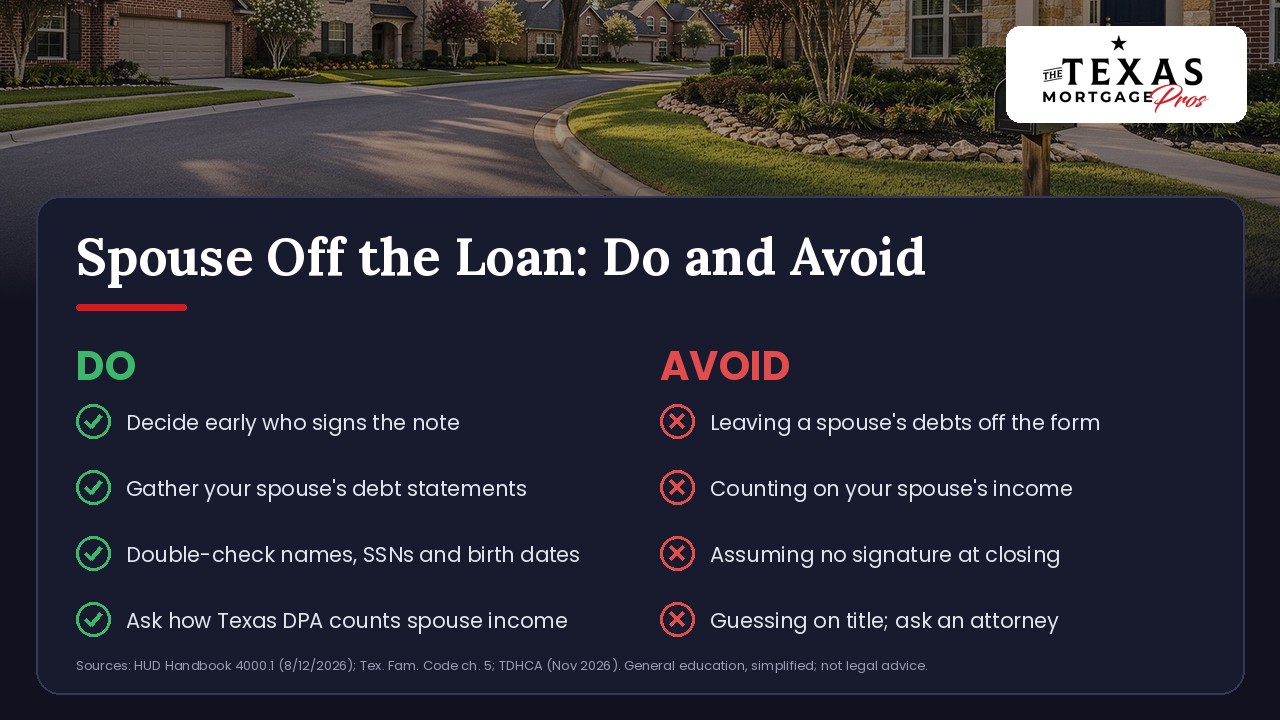
A short checklist can prevent last-minute requests:
- Your government-issued photo ID
- Your spouse’s full legal name, date of birth, Social Security number (or a statement that they don’t have one), and two years of address history
- Your spouse’s signed consent for the required verification
- Statements for your spouse’s debts, such as car loans, credit cards, and student loans
- Records for any collection accounts, judgments, or disputed accounts
- Your own income and asset documents, plus gift documentation if family is helping; see our FHA gift funds guide
- Notes on how you plan to hold title and any separate-property questions
- Details on any Texas down payment assistance program you want to use
Don’t leave information out because you assume your spouse is “not part of the application.” In Texas, complete information helps the Mortgagee evaluate the right structure from the start. If you’re buying after a separation or divorce, our guide to buying a home after divorce in Texas with an FHA loan covers what changes.
Frequently asked questions about an FHA non-borrowing spouse in Texas
Q: Can my spouse stay off an FHA loan in Texas?
A: Yes. FHA doesn’t require your spouse to be a borrower or co-signer because the purchase is in a community property state. However, your spouse’s debts, credit report, identifying information, and closing signatures may still be part of the file.
Q: Does my spouse’s credit score affect my FHA application?
A: HUD says a non-borrowing spouse’s credit history is not a reason to deny the application. Your spouse’s debts, though, generally must be documented and included in your qualifying ratios in Texas, along with any collections or judgments that HUD requires the Mortgagee to review.
Q: Does my spouse have to sign at closing if they aren’t on the loan?
A: Often, yes. Texas homestead joinder rules usually require a non-borrowing spouse to sign the deed of trust or related documents needed to make the lien valid and enforceable. That’s different from signing the promissory note.
Q: Can I use my spouse’s income to qualify if they’re not on the loan?
A: No. FHA doesn’t count a non-borrowing spouse’s income as qualifying income. If you need that income, your spouse generally has to apply as a co-borrower and sign the note.
One loan, two spouses: map out your Texas purchase together
Buying with one spouse on the FHA loan can work well in Texas, but it has to be set up correctly. The spouse who stays off the note may still have debts counted in your ratios, need a credit report and SSA verification, sign the deed of trust, and have income counted for some Texas assistance programs.
As a licensed loan originator, I can help you sort out the mortgage side of that decision before you make an offer. To talk through your plan, contact us, start on our FHA pre-qualification page, or call (281) 801-6965.
— Gerry Nicodemus
Sources
- U.S. Department of Housing and Urban Development, Single Family Housing Policy Handbook 4000.1 (last revised August 12, 2026): Mortgage Application (non-borrowing spouse debts on the URLA); Borrower Authorization for Verification Information; Borrower Eligibility (community property states); Consent of Non-borrowing Spouses; Credit Reports; Non-Borrowing Spouse Debt in Community Property States (TOTAL and Manual); Collection Accounts; Judgments; Disputed Derogatory Credit Accounts; Compensating Factors
- U.S. Department of Housing and Urban Development, Privacy Act of 1974; Matching Program, Federal Register, 91 FR 69268 (November 3, 2026)
- National Mortgage Professional, HUD Renews Social Security Data-Sharing Framework for FHA Loans (November 12, 2026)
- National Association of REALTORS®, Top 10 Takeaways from NAR’s 2026 Profile of Home Buyers and Sellers (November 5, 2026)
- Texas Family Code, Chapter 5 (Homestead Rights), Section 5.001; Chapter 3, Sections 3.001–3.003
- Texas Department of Housing and Community Affairs, single family homeownership program guide (effective November 1, 2026) and My First Texas Home program matrix (published November 2, 2026)
Recommended Reading
- FHA Non-Occupant Co-Borrower Rules: Buying With a Parent in Texas
- Buying a Home After Divorce in Texas With an FHA Loan: What Counts and What to Document
- FHA Residency Requirements in Texas: Green Cards, SSNs and Who Qualifies
The Texas Mortgage Pros, LLC is not affiliated with or endorsed by the U.S. Department of Housing and Urban Development, the Federal Housing Administration, the Social Security Administration, the Texas Department of Housing and Community Affairs, the National Association of REALTORS®, National Mortgage Professional, the State of Texas or any other government agency, and this is not a government document.
The Texas Mortgage Pros, LLC | Company NMLS #2665861 | Gerry Nicodemus, NMLS #286371 | Equal Housing Opportunity | www.nmlsconsumeraccess.org | (281) 801-6965
Equal Housing Opportunity. We do business in accordance with federal fair lending laws.

Gerry Nicodemus (NMLS #286371) is a licensed Texas loan originator with more than 25 years of mortgage experience. He specializes in FHA loans and explains credit, down payment, gift fund, and appraisal rules in plain English so Texas buyers know exactly where they stand. Gerry is also a digital marketer who builds agentic AI systems that help mortgage and real estate professionals get found online and serve borrowers better.