

FHA mortgage insurance is one of the most misunderstood parts of an FHA loan in Texas. It has two pieces: an upfront mortgage insurance premium (UFMIP) and an annual mortgage insurance premium (MIP) paid monthly, and how long the annual MIP lasts depends on the loan-to-value (LTV) ratio when the loan is made, not on whether your home later hits 80% equity the way many conventional loans do with private mortgage insurance (PMI).
TL;DR:
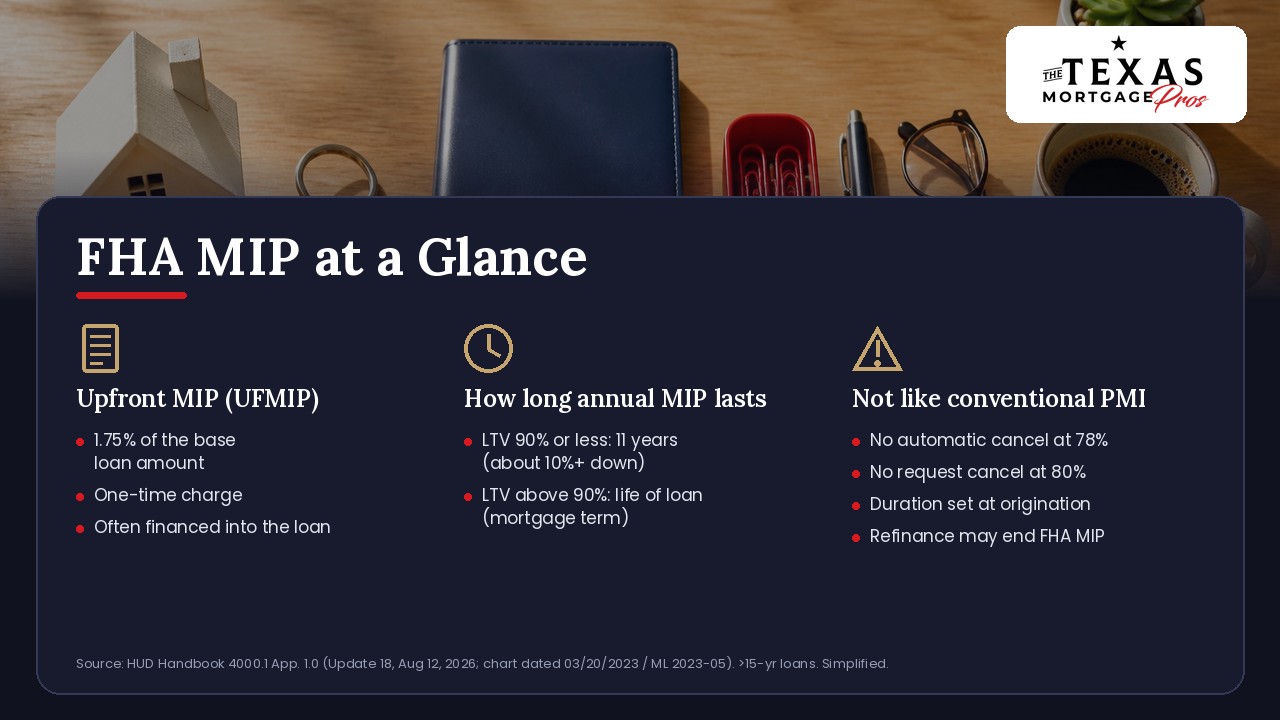
- FHA charges a one-time UFMIP of 1.75% of the base loan amount on most purchase loans (limited exceptions apply).
- FHA also charges annual MIP, collected in monthly installments. The rate and how long it lasts depend on the original LTV, loan term and loan amount.
- For typical loans over 15 years with a base loan of $726,200 or less: at 90% LTV or less (about 10%+ down), annual MIP lasts 11 years; above 90% LTV, it lasts for the mortgage term (life of the loan).
- Unlike conventional PMI, FHA MIP does not cancel automatically at 78% of original value or by request at 80% under the Homeowners Protection Act.
- An FHA-to-conventional refinance can end FHA MIP if you qualify for a new conventional loan, but that is a new transaction with underwriting, not a guarantee.
- Texas buyers can plan cash with gift funds, seller concessions and TSAHC or TDHCA down payment assistance without emptying reserves just to chase a shorter MIP period.
Table of Contents
- What Is FHA Mortgage Insurance?
- How Long Do You Pay Annual MIP?
- How Is FHA MIP Different From Conventional PMI?
- Can an FHA-to-Conventional Refinance End MIP?
- How Can Texas Buyers Plan Cash Without Emptying Reserves?
- Questions to Ask Your Mortgage Broker
- MIP Planning Do’s and Don’ts
- Talk Through Your Options
- Sources
What Is FHA Mortgage Insurance?
FHA mortgage insurance protects the Mutual Mortgage Insurance Fund when a borrower defaults. It is required on most FHA-insured forward mortgages, and it is not the same product as conventional private mortgage insurance, even though buyers often mix up the names.
FHA’s current premium schedule is in HUD Handbook 4000.1, Appendix 1.0. Handbook Update 18 (posted August 12, 2026) still carries that appendix with the chart dated March 20, 2023, from Mortgagee Letter 2023-05. Two charges show up on a typical purchase:
- Upfront MIP (UFMIP). 175 basis points, or 1.75%, of the base loan amount. It is a one-time charge and is often financed into the loan rather than paid in cash at closing. Limited exceptions apply (for example, certain older streamline refinances and loans on Hawaiian Home Lands or Indian Lands).
- Annual MIP. Collected in monthly installments as part of the housing payment. The basis-point rate depends on loan term, base loan amount, and LTV. For loans over 15 years with a base loan of $726,200 or less, the chart lists 50 basis points at LTV of 95% or less and 55 basis points above 95% LTV. Higher loan amounts use higher basis points. This article does not provide sample monthly dollar payments; each file needs its own calculation.
Always confirm the chart that applies to your case number. Program rules can change by mortgagee letter, and a social-media summary is not a substitute for the handbook.
How Long Do You Pay Annual MIP?
Duration is set from the original LTV, not from a later balance that happens to fall below 80% of today’s value. For a mortgage term of more than 15 years and a base loan amount of $726,200 or less, Appendix 1.0 says:
- LTV of 90% or less: annual MIP lasts 11 years.
- LTV above 90%: annual MIP lasts for the mortgage term (the life of that FHA loan).
In plain English, putting less than about 10% down on a typical 30-year FHA purchase usually means planning on MIP for as long as you keep that FHA loan. Starting at 10% down or more can put you in the 11-year column, assuming the loan fits that chart category. At higher base loan amounts, the same duration rule applies, but the chart uses higher annual MIP basis points.
“Mortgage term” does not mean you can never change anything. It means FHA MIP does not drop off just because your unpaid principal reaches a certain percentage of the original value. Paying off the loan, selling the home, or refinancing into a different loan type are separate decisions with their own costs and qualification rules. Our guide to FHA streamline refinance covers staying in FHA; the conventional path is discussed below.
How Is FHA MIP Different From Conventional PMI?

Both products cover mortgage-insurance risk, but the cancellation rights most people know apply to many conventional loans, not to FHA MIP. The Consumer Financial Protection Bureau explains PMI cancellation under the Homeowners Protection Act for many single-family principal-residence mortgages closed on or after July 29, 1999:
- You can generally request cancellation when the principal balance is scheduled to reach 80% of the home’s original value (with a written request, good payment history, current status, and other conditions).
- PMI generally must automatically terminate when the balance is scheduled to reach 78% of the original value if you are current.
- If it hasn’t ended earlier, PMI generally ends at the midpoint of the amortization schedule if you are current.
The CFPB also notes that FHA and VA loans follow different requirements. FHA MIP duration is chart-based at origination. Rising home values alone do not cancel FHA MIP the way some buyers expect after watching conventional PMI drop off.
That does not make FHA “bad” or conventional “always better.” Down payment, credit, debt-to-income ratios, appraisal standards, pricing, and cash to close can favor different programs for different buyers. Compare the full picture.
Can an FHA-to-Conventional Refinance End MIP?
Sometimes, and only when a new conventional loan actually closes. Refinancing from FHA to conventional pays off the FHA loan. If the new conventional loan has no PMI, FHA MIP ends with the old loan. If the new loan includes conventional PMI, that PMI follows conventional cancellation rules instead.
A refinance is a new application. It needs underwriting, a property review or appraisal as applicable, closing costs, and qualification under the rules in force at that time. Equity, income, assets, debts, credit, occupancy, and property type all matter. Do not count on a future refinance when you choose FHA today. Treat it as an option to re-evaluate later with a mortgage broker, not as a promise of savings.
How Can Texas Buyers Plan Cash Without Emptying Reserves?
The 90% LTV line can make MIP duration a real planning point, but it should not push you to empty savings just to hit 10% down. A workable cash plan covers the down payment, closing costs, prepaid items, moving costs, and a reserve cushion after closing.
Gift funds can help eligible FHA buyers when they are properly documented. See our guide to FHA gift funds in Texas. Seller concessions can cover eligible closing costs and prepaid items within FHA limits and the contract; they aren’t the same as the down payment. Our article on Texas seller concessions explains how buyers negotiate those credits.
Down payment assistance can also change the math. TSAHC reported in July 2026 that it raised income limits for Home Sweet Texas to 150% of area median family income and Homes for Texas Heroes to 170% AMFI, which may help more Texas households qualify for assistance. The Texas Department of Housing and Community Affairs also offers homebuyer paths through its Welcome Home / Texas Homebuyer Program. Program rules, funding, and eligibility change, so confirm current terms before you rely on assistance in an offer. A Texas Mortgage Credit Certificate can also be worth asking about alongside DPA; see our Texas MCC overview.
Ask your mortgage broker to model more than one documented path: FHA with a smaller down payment, FHA at or below 90% LTV if you can do it without draining reserves, and a conventional option if it fits. Start with FHA pre-qualification, so you know which programs match your paperwork before you fall in love with a house.
Questions to Ask Your Mortgage Broker
- Based on my planned down payment, will annual MIP last 11 years or the mortgage term?
- Will UFMIP be financed into the loan or paid in cash, and how does that change my cash to close?
- How does my FHA scenario compare with a conventional loan that has PMI I might cancel later?
- Can documented gift funds or seller concessions help without wiping out my reserves?
- Do I qualify for any current TSAHC or TDHCA down payment assistance programs?
- If I start with FHA, what would an FHA-to-conventional refinance later require?
- What cash reserve target should I keep after closing?
MIP Planning Do’s and Don’ts
Do:
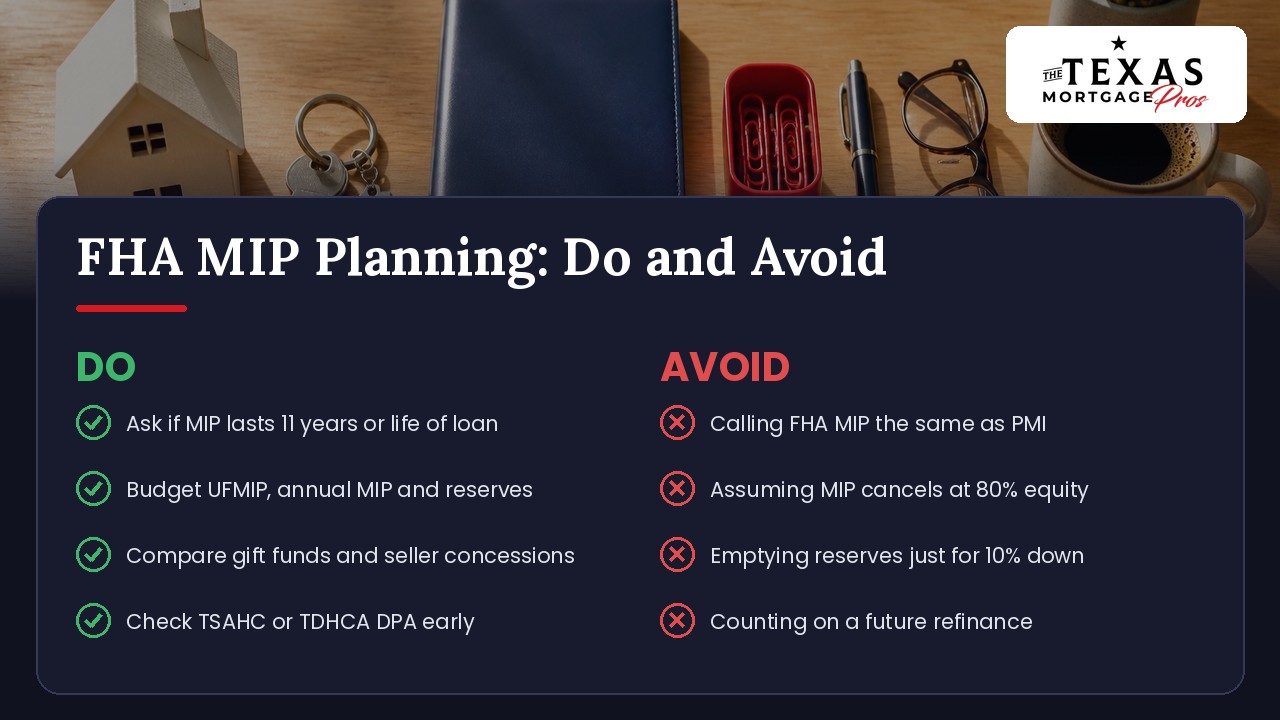
- Ask if MIP lasts 11 years or the life of the loan for your planned original LTV.
- Budget UFMIP, annual MIP, and reserves as separate line items.
- Compare gift funds and seller concessions before you lock a down payment target.
- Check TSAHC or TDHCA DPA early, while you still have time to gather documents.
Avoid:
- Calling FHA MIP the same as PMI. The cancellation rules are different.
- Assuming MIP cancels at 80% equity. Duration is set at origination on the FHA chart.
- Emptying reserves just for 10% down. Keep a post-closing cushion.
- Counting on a future refinance. Treat it as optional, not guaranteed.
— Gerry Nicodemus
Talk Through Your Options
FHA mortgage insurance has a clear structure: a standard 1.75% UFMIP plus annual MIP collected monthly, with duration tied to the original LTV. At 90% LTV or less on a typical longer-term loan, annual MIP usually lasts 11 years; above 90% LTV, it usually lasts for the mortgage term. That line item alone should not decide your loan choice. Compare cash to close, reserves, assistance options, and the realistic possibility, not a promise, of refinancing later. Call (281) 801-6965 to talk with a mortgage professional at The Texas Mortgage Pros, a mortgage broker. You can also review our FHA loan requirements, get FHA pre-qualified, or contact us online.
TexasFHA.org is not affiliated with, endorsed by, or sponsored by HUD, FHA, the Consumer Financial Protection Bureau, the Texas State Affordable Housing Corporation, the Texas Department of Housing and Community Affairs, or any other organization or government agency named in this article. Third-party names are used only to cite their published information.
The Texas Mortgage Pros, LLC | Company NMLS #2665861 | Gerry Nicodemus, NMLS #286371 | Equal Housing Opportunity | www.nmlsconsumeraccess.org | (281) 801-6965
Sources
Each source below is linked once in the article above, except Handbook Update 18’s PDF file name, which is cited by name only.
- U.S. Department of Housing and Urban Development, Single Family Housing Policy Handbook 4000.1 (Appendix 1.0 – Mortgage Insurance Premiums (03/20/2023); Update 18 posted August 12, 2026)
- U.S. Department of Housing and Urban Development, Mortgagee Letter 2023-05, Reduction of FHA Annual Mortgage Insurance Premium Rates (February 22, 2023; effective for case numbers endorsed on or after March 20, 2023)
- Consumer Financial Protection Bureau, When can I remove private mortgage insurance (PMI) from my loan?
- Texas State Affordable Housing Corporation, What Higher Income Limits Mean for Texas Home Buyers (July 10, 2026)
- Texas Department of Housing and Community Affairs, Welcome Home / Texas Homebuyer Program
Recommended
- FHA Gift Funds in Texas: Rules for Using Family Money
- Texas Seller Concessions: How Buyers Can Negotiate as Competition Cools
- Texas Mortgage Credit Certificate: A Fall Tool as Buyers Gain Leverage

Gerry Nicodemus (NMLS #286371) is a licensed Texas loan originator with more than 25 years of mortgage experience. He specializes in FHA loans and explains credit, down payment, gift fund, and appraisal rules in plain English so Texas buyers know exactly where they stand. Gerry is also a digital marketer who builds agentic AI systems that help mortgage and real estate professionals get found online and serve borrowers better.