

Foreign nationals can buy, own, and sell real estate in the United States with virtually no federal restrictions. This fact surprises many international buyers who assume citizenship or a green card is required. The answer to “Can I buy a house in the USA as a foreigner?” is a clear yes, but the process involves real complexities around financing, taxes, and state laws that vary widely. Texas, in particular, attracts significant interest from foreign buyers thanks to its strong economy, no state income tax, and growing cities such as Houston, Dallas, and Austin.
Can foreigners legally buy property in the USA?
No federal law restricts foreign nationals from purchasing, owning, or recording property in the United States. This applies regardless of citizenship, immigration status, or country of origin. A buyer from Mexico, Germany, or South Korea has the same right to purchase a Texas home as a U.S. citizen.
That said, state laws add a layer of complexity. Approximately 25–30 states have enacted restrictions targeting foreign nationals, primarily for agricultural land and property near military installations. Some states ban outright ownership; others require disclosure of foreign ownership interests. Texas currently does not broadly restrict residential property purchases by foreign nationals, which makes it one of the more accessible states for international buyers.
Property ownership is also fully transparent in the United States. All ownership records are public and recorded with county authorities. Buying property does not grant any immigration benefit, and it does not affect your visa status in any way.
Key legal points for foreign buyers:
- No federal citizenship requirement applies to property ownership.
- State restrictions focus mainly on agricultural land and sensitive zones.
- The Agricultural Foreign Investment Disclosure Act (AFIDA) requires foreign buyers of U.S. farmland to report the purchase to the USDA within 90 days.
- Ownership does not equal residency. A deed in your name carries no immigration weight.
- Property rights are recorded publicly, giving buyers full legal protection under U.S. law.
Pro Tip: Before purchasing any land in Texas, confirm with a real estate attorney whether the parcel is subject to any state or federal restrictions. Agricultural parcels near military zones require extra scrutiny.
How can foreigners finance a home purchase in the USA?
Financing is the most challenging part of buying U.S. property as a foreign national. Most government-backed loan programs are not available to non-permanent residents. FHA loans are no longer available to non-permanent residents following policy changes after 2025. VA and USDA loans are also off the table for foreign nationals.

The primary financing path for foreign buyers runs through Non-Qualified Mortgage (Non-QM) loans. These loans focus on assets, property income, and foreign financial documentation rather than a U.S. credit score. Private lenders and specialized mortgage companies offer these products, and they are widely available in Texas.
Here is what the financing process typically looks like for a foreign national:
- Obtain an ITIN (Individual Taxpayer Identification Number). The IRS issues ITINs to foreign nationals who do not qualify for a Social Security Number. An ITIN is not required for purchase but helps with tax filing, and some lenders require it.
- Open a U.S. bank account. Most lenders require proof of U.S. banking activity. This demonstrates financial stability and simplifies the transfer of funds at closing.
- Prepare your documentation. Lenders typically require a valid passport, recent bank statements from foreign accounts, proof of income or assets, and sometimes a letter from your employer or accountant.
- Expect a higher down payment. Down payments for foreign national loans typically range from 20% to 40% of the purchase price. This is significantly higher than the 3.5% minimum for FHA loans available to eligible U.S. residents.
- Understand that visa status matters. Buyers on certain visa types, such as H-1B or L-1 work visas, may qualify for more favorable loan terms than buyers with no U.S. visa at all.
Foreign buyers often mistakenly believe they cannot get financing without a U.S. credit history. Specialized lenders provide multiple financing options using passport documentation and foreign income records instead. The key is to work with a lender experienced in foreign-national transactions.
Pro Tip: Foreign nationals can purchase properties without a U.S. Social Security Number using Non-QM loans supported by passport and foreign income documentation. Ask your lender specifically about their foreign national loan program before applying.
What tax obligations do foreign buyers face in the USA?
Tax rules for foreign property owners in the United States are specific and carry real financial consequences if ignored. Three areas demand close attention: FIRPTA withholding, property taxes, and estate taxes.
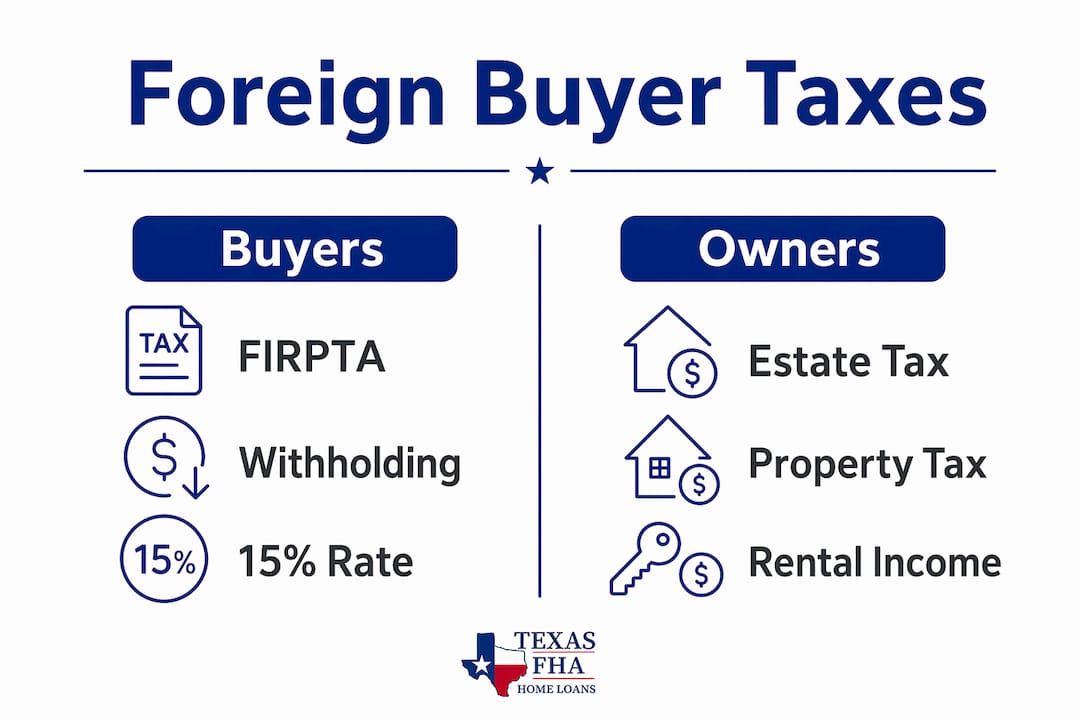
FIRPTA stands for the Foreign Investment in Real Property Tax Act. When a foreign national sells U.S. real property, the buyer must withhold 15% of the gross sale price and send it to the IRS. This is not a tax on the buyer. It is a withholding mechanism to collect taxes owed by the foreign seller. The buyer, however, carries the legal responsibility. Failure to withhold makes the buyer personally liable for the tax penalty. Title companies and closing attorneys typically handle FIRPTA compliance, but the legal obligation stays with the buyer.
| Tax Type | Rate or Limit | Who It Affects |
|---|---|---|
| FIRPTA withholding | 15% of gross sale price | Buyer withholds on behalf of foreign seller |
| Property tax | 0.3%–2%+ of assessed value | All property owners equally |
| Estate tax exemption | $60,000 for non-domiciled foreign nationals | Foreign owners vs. $15 million for U.S. citizens |
The estate tax difference is striking. Foreign nationals face a $60,000 estate tax exemption on U.S. property, compared to roughly $15 million for U.S. citizens. That gap creates serious exposure for foreign owners of high-value properties. Tax treaties between the U.S. and certain countries can increase this exemption, so checking your home country’s treaty status is a necessary step.
Property taxes apply equally to all owners regardless of nationality. Rates vary by county and municipality across Texas, ranging from well under 1% to over 2% of assessed value in some areas.
If you rent out your U.S. property, the rental income is taxable in the United States. An ITIN allows you to file a U.S. tax return and claim deductions for expenses like mortgage interest, repairs, and depreciation.
What are the practical steps for buying property in different U.S. states?
State laws and local rules significantly shape the buying experience. Foreign nationals should treat state law research as a required step, not an afterthought.
- Check state restrictions before selecting a property. State-level restrictions have grown since 2021 and now affect buyers in roughly 25–30 states. Texas remains relatively open for residential purchases, but agricultural land near sensitive zones warrants legal review.
- Consider forming an LLC. Using an LLC can provide liability protection and simplify property management. It may also offer tax planning advantages, though IRS compliance requirements apply. An LLC does not eliminate FIRPTA obligations.
- Understand AFIDA reporting. If you purchase U.S. farmland, federal law requires you to report the transaction to the USDA. Penalties for non-compliance are significant.
- Compare property tax rates by county. Texas has no state income tax, but property taxes vary considerably by county. Travis County (Austin) and Dallas County carry higher rates than many rural Texas counties.
- Choose your ownership structure deliberately. Direct personal ownership is simpler but exposes your estate to the $60,000 exemption limit. Business entity ownership through an LLC or trust can reduce estate tax exposure but requires proper legal setup.
Working with a Texas-based real estate attorney and a tax advisor familiar with foreign national transactions is the most reliable way to avoid costly mistakes.
Can owning property in the USA lead to residency or immigration benefits?
Property ownership in the United States carries no immigration benefits. This is one of the most common misconceptions among foreign buyers, and it is worth addressing directly.
- A deed does not grant a visa. Owning a home in Texas does not give you the right to live there beyond your authorized stay.
- B-2 tourist visas allow stays of up to 180 days. Property ownership alone does not extend that limit or provide any path to permanent residency.
- Investment visas exist but are separate. The EB-5 visa requires a qualifying investment of at least $800,000 in a targeted employment area and the creation of U.S. jobs. The E-2 treaty investor visa requires a substantial investment in an active U.S. business. Neither is triggered simply by buying a home.
- Tax residency is a separate question. Spending more than 183 days in the U.S. in a calendar year can trigger U.S. tax residency under the Substantial Presence Test, regardless of visa type or property ownership.
If your goal is to live in the United States long-term, consult an immigration attorney before purchasing property. Real estate and immigration law operate on entirely separate tracks.
Key Takeaways
Foreign nationals can legally buy property in the United States without federal restrictions, but financing, taxes, and state laws create real obligations that require careful planning.
| Point | Details |
|---|---|
| No federal ownership ban | Foreign nationals can buy U.S. property regardless of citizenship or immigration status. |
| State laws vary | About 25–30 states restrict foreign ownership of agricultural or sensitive land; Texas is relatively open. |
| Non-QM loans are the main path | Foreign buyers typically use Non-QM loans with 20%–40% down payments and asset-based documentation. |
| FIRPTA and estate taxes matter | Buyers must handle FIRPTA withholding at closing; foreign owners face a $60,000 estate tax exemption. |
| Property ownership confers no visa rights | Owning U.S. real estate does not grant residency, extend visa stays, or provide immigration benefits. |
What I’ve learned from watching foreign buyers navigate U.S. real estate
The legal framework for foreign property ownership in the United States is more welcoming than most people expect. The complications show up in the details, and those details catch buyers off guard more often than they should.
The two surprises I see most often are FIRPTA and the estate tax gap. Foreign buyers focus on the purchase and rarely think about what happens when they eventually sell or pass the property to heirs. A $60,000 estate tax exemption on a $500,000 Texas property creates a real exposure problem. Planning the ownership structure before closing, not after, is the move that separates informed buyers from those who pay avoidable costs later.
On financing, the shift away from government-backed loans for non-permanent residents has pushed more foreign buyers toward Non-QM products. These loans work, but the down payment requirements are steep. Buyers who arrive expecting a 5% down payment leave disappointed. Arriving with 30% ready to deploy puts you in a much stronger position with lenders.
My consistent advice is to build your advisory team before you start searching for property. A real estate attorney, a CPA familiar with international tax law, and a lender experienced in foreign national transactions will save you more money than their fees cost. Texas is a genuinely good market for foreign buyers, but the process rewards preparation.
— Gerry Nicodemus
How TexasFHA helps buyers find the right financing path
Foreign nationals exploring home financing in Texas have more options than they realize, and TexasFHA specializes in helping buyers understand exactly where they stand.
While FHA loans are currently available only to eligible U.S. residents, TexasFHA’s specialists understand the full range of flexible financing options in Texas, including Non-QM programs suited to buyers without traditional U.S. credit histories. As a Full Eagle FHA-approved lender, TexasFHA brings the expertise to assess your specific situation and point you toward the loan structure that fits. Review the FHA loan requirements to understand current eligibility criteria, and connect with a TexasFHA specialist to get a clear picture of your financing options before you make an offer.
FAQ
Can I buy a house in the USA without a green card?
Yes. No federal law requires a green card or citizenship to purchase U.S. real estate. Foreign nationals of any immigration status can legally buy and own property in the United States.
What loan options are available to foreign national homebuyers?
Non-Qualified Mortgage (Non-QM) loans are the primary option for foreign nationals. These loans use passports, foreign bank statements, and asset documentation instead of a U.S. credit score, with down payments typically ranging from 20% to 40%.
What is FIRPTA and does it affect me as a buyer?
FIRPTA requires the buyer to withhold 15% of the gross sale price when purchasing property from a foreign seller. The buyer is legally responsible for this withholding at closing, even if a title company handles the paperwork.
Does buying property in Texas give me the right to live there?
No. Property ownership does not grant any visa, residency, or immigration benefit. You must have a valid visa or immigration status to legally reside in the United States, regardless of property ownership.
Do I need a U.S. Social Security Number to buy property?
No. Foreign nationals can purchase U.S. property without a Social Security Number. An ITIN is helpful for tax filing and some lenders require it, but it is not a universal requirement for the purchase itself.
Recommended
- How To Buy A House In 2021 – Texas FHA Home Loans | First Time Buyer Loans
- Texas FHA Prequalify – Texas FHA Home Loans | First Time Buyer Loans
- Is It a Good Time to Buy a House? – Texas FHA Home Loans | First Time Buyer Loans
- Is It A Good Time To Buy A House? – Texas FHA Home Loans | First Time Buyer Loans

Over 25 years of experience in the Mortgage business. A Digital Marketer specializing in Conversion Rate Optimization, Search Engine Optimization, and Artificial Intelligence Overview Optimization for the Mortgage and Real Estate industry.