

Refinancing to an FHA loan means replacing your current mortgage with a new one insured by the Federal Housing Administration, which can offer lower rates, better terms, or cash from your home equity. Texas homeowners with less-than-perfect credit or limited equity often find FHA refinancing more accessible than conventional options. The FHA program, governed by HUD regulations, requires mortgage insurance but compensates with flexible qualification standards. Whether you carry a conventional loan or an existing FHA mortgage, you can refinance with an FHA loan to reduce your monthly payment or change your loan structure entirely.
What types of FHA refinance loans are available?
FHA loan refinancing options fall into three distinct categories, and choosing the wrong one can cost you thousands in unnecessary fees and delays.
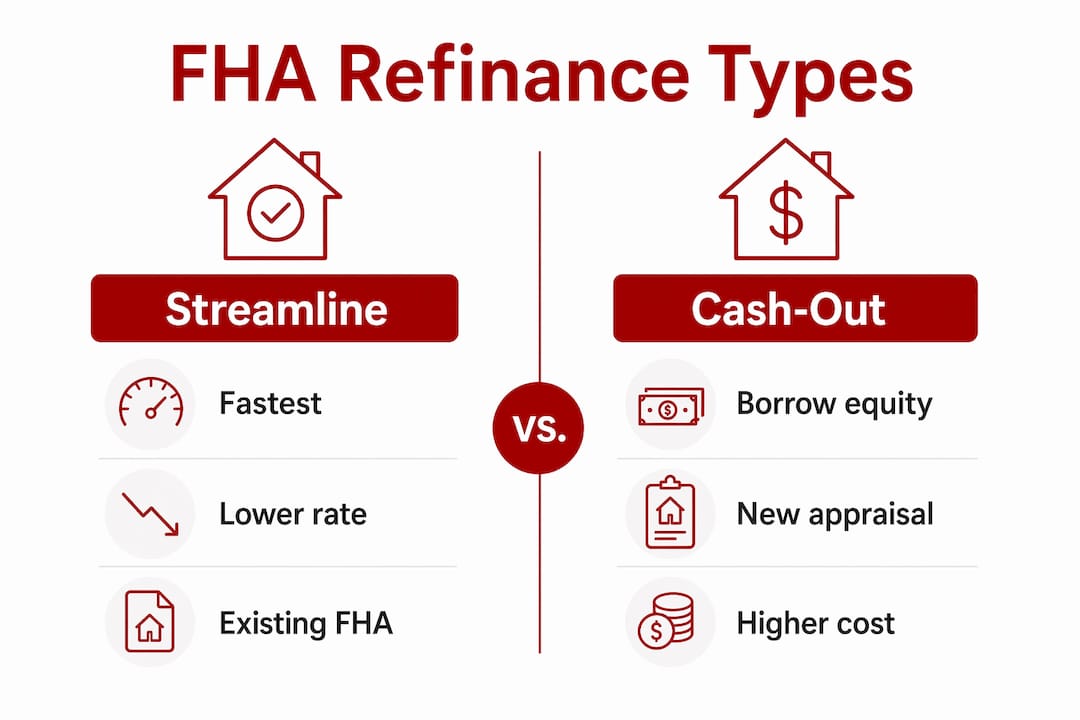
FHA Streamline refinance
The FHA Streamline refinance is the fastest path to a lower rate for homeowners with an FHA loan. It requires minimal documentation and, in most cases, no new appraisal. The trade-off is that you cannot take cash out, and you must demonstrate a clear financial benefit from the new loan terms.
Simple (rate-and-term) refinance
The Simple refinance replaces your existing mortgage with a new FHA loan at a better rate or term. Unlike the Streamline, it requires a full appraisal and complete credit qualification. Homeowners refinancing from a conventional loan to an FHA loan use this path most often.
Cash-Out refinance
The FHA Cash-Out refinance lets you borrow against your home equity and receive the difference as cash at closing. It requires a full appraisal, credit check, and income verification. Texas homeowners use this option to fund home improvements, consolidate debt, or cover major expenses.
The table below summarizes the key differences across all three options.
| Feature | Streamline | Simple (Rate-and-Term) | Cash-Out |
|---|---|---|---|
| Existing FHA loan required | Yes | No | No |
| Appraisal required | Usually no | Yes | Yes |
| Cash at closing | No | No | Yes |
| Full credit check | No | Yes | Yes |
| Documentation level | Minimal | Full | Full |
Pro Tip: If you currently have an FHA loan and only want a lower rate, the Streamline is almost always faster and cheaper than a full refinance. Reserve the Simple or Cash-Out options for when you need to change loan type or access equity.
What are the eligibility requirements for FHA refinancing?
FHA refinance eligibility follows specific rules set by HUD, and meeting all of them before you apply saves significant time.

The most critical timing rule is the 210-day seasoning requirement. Borrowers must have made at least six monthly payments on their current mortgage and waited 210 days from the original closing date before an FHA Streamline case number can be assigned. This rule is strictly enforced with no exceptions.
Payment history matters just as much as timing. No payments more than 30 days late are allowed in the six months before your application. A single late payment within that window can disqualify you from the Streamline program entirely.
Credit score benchmarks apply to full-qualification refinances. Most lenders require a minimum credit score of 580 for standard FHA terms, though some set the bar higher. You can review Texas credit score requirements to understand where you stand before applying.
Property condition is another factor many homeowners overlook. FHA health and safety standards apply at the refinance appraisal, even if your home passed inspection when you originally purchased it. Issues like peeling paint, missing handrails, or damaged roofing must be repaired before closing. Budget time and money for potential repairs if your home has deferred maintenance.
The documentation you need depends on which refinance path you take:
- Streamline: Proof of existing FHA loan, recent mortgage statements, and payment history verification
- Simple or Cash-Out: Full income documentation, tax returns, pay stubs, bank statements, and a new appraisal
Pro Tip: Pull your mortgage statements and payment history at least 60 days before applying. Gaps or errors in your payment record take time to resolve, and catching them early prevents delays at underwriting.
How to refinance to an FHA loan step by step
The FHA refinance process follows a predictable sequence. Knowing each stage helps you set realistic expectations and prepare the right documents at the right time.
- Choose a lender and get pre-qualified. Not all lenders offer every FHA refinance product. Work with a Full Eagle FHA-approved lender like Texasfha, which has direct authority to underwrite FHA loans without routing files through an intermediary. Pre-qualification tells you which program fits your situation and gives you a rate estimate.
- Submit your application and documents. Your lender will open an FHA case number and collect your documentation. For a Streamline, this means payment history and existing loan details. For a Simple or Cash-Out, expect to provide two years of tax returns, recent pay stubs, and bank statements.
- Complete the appraisal (if required). Simple and Cash-Out refinances require a licensed FHA appraiser to assess your home’s current market value and confirm it meets FHA property standards. If the appraiser identifies health or safety issues, you must address them before the loan can close.
- Move through underwriting. The underwriter reviews your file against FHA guidelines and the net tangible benefit rule. This rule requires your new loan to provide a clear financial improvement, such as a lower monthly payment or a switch from an adjustable rate to a fixed rate. Loans that cannot demonstrate this benefit will not receive FHA approval.
- Close the loan. At closing, you sign the new loan documents, pay closing costs, and the new loan pays off your old mortgage. Your first payment on the new loan typically begins 30–60 days after closing.
| Stage | Typical Timeline |
|---|---|
| Pre-qualification | 1–3 days |
| Application and document collection | 3–7 days |
| Appraisal (if required) | 5–10 days |
| Underwriting | 7–14 days |
| Closing | 1–3 days |
| Total | 17–37 days |
What do FHA refinance costs and mortgage insurance look like?
FHA refinancing has specific costs that differ from those of conventional loans, and understanding them up front prevents surprises at closing.
Every FHA loan requires an Upfront Mortgage Insurance Premium, known as UFMIP. UFMIP is set at 1.75% of the loan amount and can be financed into the new loan rather than paid out of pocket. On a $300,000 loan, that equals $5,250 added to your balance. The annual MIP on the same loan at 0.55% adds $137.50 per month to your payment.
Beyond mortgage insurance, FHA closing costs typically range from 2% to 5% of the loan amount. A $300,000 refinance means $6,000 to $15,000 in fees covering origination, title, prepaid interest, and escrow. Streamline refinances often waive the appraisal fee, saving approximately $425 compared to a full refinance. You can review a detailed FHA closing cost breakdown to understand exactly what you will owe at the table.
HUD’s 2026 policy updates have reduced some of these costs. HUD Secretary Turner’s regulatory changes cut appraisal field review requirements and reduced quality control burdens, lowering overall costs for both lenders and borrowers. These changes make FHA refinancing more competitive in the current rate environment.
To determine whether refinancing makes financial sense, calculate your break-even point. Divide your total closing costs by your monthly payment savings. If you plan to stay in your home for more than that number of months, refinancing provides a net benefit. The FHA’s net tangible benefit rule requires lenders to document this calculation before approving your loan, so the math is part of the process regardless.
Key Takeaways
Refinancing to an FHA loan delivers the most value when you match the right program to your specific goal, meet the 210-day seasoning rule, and account for mortgage insurance costs in your break-even calculation.
| Point | Details |
|---|---|
| Match program to goal | Use Streamline for rate reductions, Simple for loan-type changes, and Cash-Out for equity access. |
| Meet the seasoning rule | You must wait 210 days and make six payments before a Streamline refinance qualifies. |
| Budget for MIP | UFMIP at 1.75% and annual MIP at 0.55% add real cost; factor both into your savings calculation. |
| Prepare your property | FHA appraisals check health and safety standards; repair issues before applying to avoid delays. |
| Calculate break-even | Divide the total closing costs by the monthly savings to confirm that refinancing is worth the upfront expense. |
What I’ve learned from watching Texas homeowners refinance to FHA
The biggest mistake I see Texas homeowners make is treating all three FHA refinance options as interchangeable. They hear “FHA refinance” and assume the process is the same regardless of which product they choose. It is not. A Streamline and a Cash-Out refinance are as different as a tune-up and an engine replacement. Confusing them leads to wasted appraisal fees, stalled applications, and missed rate windows.
The second pattern I notice is underestimating the property condition requirement. Homeowners who bought their homes five or ten years ago assume they still meet FHA standards. But refinance appraisals apply current FHA health and safety criteria, and a lot can change in a decade. A cracked driveway or peeling exterior paint that seemed minor at purchase can hold up a refinance for weeks.
My honest advice: get a pre-appraisal walkthrough of your home before you formally apply. Fix obvious maintenance issues first. Then apply with clean documentation and a clear goal. Homeowners who do this close faster and with fewer surprises. The benefits of FHA refinancing are real, but only if you go in prepared.
TexasFHA is ready to guide your FHA refinance
Texas homeowners who want lower payments, better loan terms, or access to their home equity have a clear path forward with FHA refinancing. Texasfha is a Full Eagle FHA-approved lender with specialists who know the Texas market and the full range of FHA refinance programs.
Whether you are considering a Streamline, a Simple refinance, or a Cash-Out option, Texasfha walks you through every requirement, helps you gather the right documents, and works to get your loan closed efficiently. You can review your FHA loan qualifications or request a personalized rate quote to see what your new payment could look like. The right refinance starts with the right lender.
FAQ
Can you refinance a conventional loan to an FHA loan?
Yes. Homeowners with conventional loans can switch to an FHA loan through a Simple rate-and-term refinance, which requires a full appraisal, credit qualification, and income verification.
How long do you have to wait before refinancing an FHA loan?
FHA Streamline refinance rules require at least six monthly payments and a 210-day waiting period from the original closing date before you can apply.
What credit score do you need to refinance to an FHA loan?
Most lenders require a minimum 580 credit score for standard FHA refinance terms, though individual lender overlays may set the threshold higher.
Does an FHA refinance require a new appraisal?
Streamline refinances typically waive the appraisal requirement. Simple and Cash-Out refinances always require a full FHA appraisal that confirms both market value and property condition.
What is the net tangible benefit rule for FHA refinancing?
The net tangible benefit rule requires lenders to document a clear financial improvement from the refinance, such as a lower monthly payment or a switch from an adjustable to a fixed rate, before FHA will approve the loan.
Recommended
- Homeownership Made Attainable: The 2024 Guide to FHA Loans in Texas – Texas FHA Home Loans | First Time Buyer Loans
- FHA Loan Requirements In Texas: A Comprehensive Guide – Texas FHA Home Loans | First Time Buyer Loans
- Texas FHA Blog – Texas FHA Home Loans | First Time Buyer Loans
- A Step-By-Step Guide To Meeting The Texas FHA Loan Requirements – Texas FHA Home Loans | First Time Buyer Loans

Over 25 years of experience in the Mortgage business. A Digital Marketer specializing in Conversion Rate Optimization, Search Engine Optimization, and Artificial Intelligence Overview Optimization for the Mortgage and Real Estate industry.