

FHA refinance loan rates are currently running in the mid-to-upper 6% range nationally, well above the pandemic-era lows that many Texas homeowners locked in during 2020 and 2021. Bankrate’s daily rate tracking shows 30-year FHA refinance rates averaging around 6.27% to 6.36% in recent snapshots. If you’re sitting on a rate above 7%, or you need to access equity or shorten your term, refinancing may still make clear financial sense. The single most useful next step: request personalized rate quotes from an FHA-approved lender and run a break-even calculation before you commit to anything.
Two authorities shape every FHA refinance decision. HUD sets the program rules, including Streamline eligibility, net tangible benefit thresholds, and mortgage insurance requirements. TexasFHA, a fully Eagle FHA-approved lender serving Texas homeowners, translates those rules into a practical path forward for your specific situation.
Table of Contents
- What are current FHA refinance loan rates right now?
- Which FHA refinance type fits your situation?
- Who qualifies for an FHA refinance?
- What drives the FHA refinance rate you’re actually offered?
- When does refinancing actually make financial sense?
- What does refinancing cost, and how long does it take?
- Practical steps to get the best FHA refinance rate you qualify for
- Texas-specific FHA loan limits and local resources
- Key Takeaways
- Why the rate alone won’t tell you whether to refinance
- Ready to see your actual FHA refinance rate in Texas?
- Authoritative sources used in this guide
What are current FHA refinance loan rates right now?
Bankrate’s FHA refinance rate data puts the national 30-year FHA refinance rate at approximately 6.27% to 6.36% in mid-2026 snapshots. The 15-year FHA refinance typically comes in somewhat lower, reflecting the shorter repayment term and reduced lender risk. Texas averages tend to track closely with national figures, though your actual rate will vary based on your county, credit score, loan-to-value ratio, and the lender you choose.
The distinction between quoted interest rate and APR matters more on an FHA loan than on a conventional one. Because FHA loans carry both an upfront mortgage insurance premium (UFMIP) and an annual MIP, the APR will be meaningfully higher than the stated interest rate. When you’re comparing offers from multiple lenders, always compare APRs, not just the headline rate.
| Loan Type | Sample Interest Rate | Notes | Source |
|---|---|---|---|
| 30-year FHA refinance | ~6.27% to 6.36% | National average, mid-2026 | Bankrate |
| 15-year FHA refinance | Typically lower than 30-year | Reflects shorter term | Bankrate |
| FHA Streamline (30-year) | Varies by lender | No appraisal; rate depends on credit/lender | HUD/lender pricing |
Rate snapshots are illustrative and change daily. Request a live quote for your specific profile.
Key factors that shift where your rate lands within these ranges:
- Credit score: Scores above 680 typically access the best pricing tiers; scores in the 580–620 range will see higher rates.
- Loan-to-value (LTV): Lower LTV generally means a lower rate, especially on cash-out refinances.
- Loan term: Shorter terms carry lower rates but higher monthly payments.
- Lender competition: Rates differ across lenders even for identical borrower profiles, which is why shopping matters.
Which FHA refinance type fits your situation?
There are four paths available to Texas homeowners considering FHA mortgage refinancing. Each serves a different goal, carries different underwriting requirements, and affects your mortgage insurance differently.
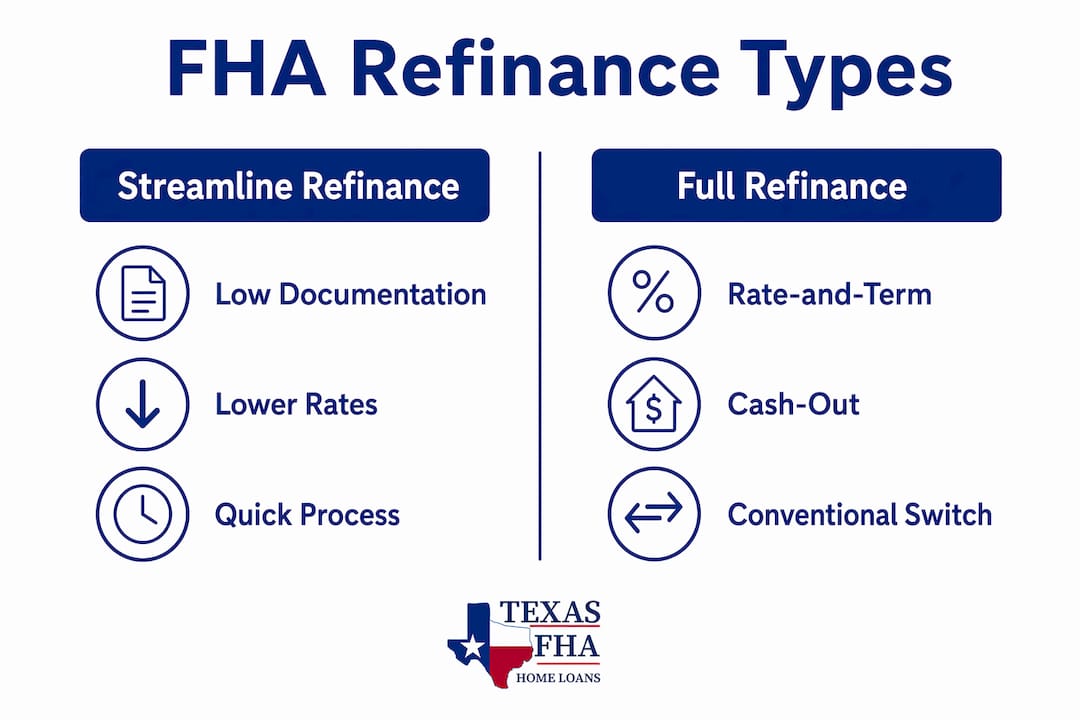
FHA Streamline Refinance is designed for borrowers who already have an FHA-insured loan and want to lower their rate or monthly payment with minimal paperwork. It typically requires no appraisal and limited income verification. The tradeoff: you cannot take cash out (beyond $500), and you cannot roll closing costs into the new loan per HUD’s Streamline guidelines. You will, however, pay a new upfront MIP and continue paying annual MIP.

Simple (Rate-and-Term) Refinance is a full FHA refinance that replaces your existing loan with a new FHA loan at a new rate and term. It requires a full appraisal and complete income/credit verification, but it allows you to finance certain closing costs into the loan amount up to the appraised value limit. This path suits borrowers who want the flexibility of a full underwrite without the restrictions of Streamline.
FHA Cash-Out Refinance lets you tap your home equity, but it comes with the strictest requirements. Lenders typically require a credit score of 600 or higher (with many setting overlays above that floor), a full appraisal, 12 months of clean payment history, and income verification. The maximum LTV is 80%, and rates on cash-out refinances run higher than rate-and-term options. Timeline runs 50–60 days.
Refinancing to a Conventional Loan is worth considering if you’ve built enough equity to drop FHA mortgage insurance entirely. Once you reach 20% equity, a conventional loan eliminates both UFMIP and monthly MIP, which can lower your effective payment even if the stated interest rate is similar. This path requires full conventional underwriting, including a credit score typically at or above 620.
| Feature | Streamline | Simple Rate-and-Term | Cash-Out | Refi to Conventional |
|---|---|---|---|---|
| Appraisal required | Usually no | Yes | Yes | Yes |
| MIP impact | New UFMIP + ongoing MIP | New UFMIP + ongoing MIP | New UFMIP + ongoing MIP | MIP removed at 20% equity |
| Max LTV / cash-out | N/A (no cash-out) | Up to appraised value | 80% LTV max | Lender guidelines |
| Closing costs financed | No (per HUD) | Yes, within LTV limit | Yes, within LTV limit | Lender-dependent |
| Typical timeline | 20–30 days | ~44 days | 50–60 days | 30–45 days |
Quick decision guide:
- Goal is a lower monthly payment with minimal hassle → Streamline (if you have an existing FHA loan)
- Goal is to access equity → Cash-Out FHA or conventional cash-out
- Goal is to eliminate MIP → Refinance to conventional once you have 20% equity
- Need flexibility on closing costs → Simple rate-and-term
You can review the full range of FHA refinance programs TexasFHA offers to see which path aligns with your current loan and goals.
Who qualifies for an FHA refinance?
Eligibility rules differ significantly depending on which refinance path you’re pursuing. Here’s what HUD and lender guidelines require across the main options.
For FHA Streamline Refinance, per HUD’s program requirements:
- Your existing mortgage must be FHA-insured.
- Your loan must be current, with no late payments in the past 12 months (or since origination if less than 12 months old).
- The refinance must deliver a net tangible benefit: typically, a reduction in the combined rate and MIP of at least 0.5% for fixed-to-fixed refinances, or a move from an ARM to a fixed rate.
- Cash back is limited to $500 or less.
- Closing costs cannot be financed into the new loan amount.
For Simple Rate-and-Term and Cash-Out Refinances:
- Full credit and income verification is required.
- A new appraisal establishes the property value and maximum loan amount.
- Cash-out refinances require at least 12 months of on-time payments and a credit score of at least 600 (lender overlays often set this higher).
- Income qualification standards apply, including debt-to-income ratio review.
MIP misconception worth addressing: A Streamline refinance does not eliminate FHA mortgage insurance. You will pay a new upfront MIP at closing and continue paying annual MIP on the new loan. The only way to remove MIP entirely is to refinance into a conventional loan once you meet the equity threshold. This is one of the most common misunderstandings TexasFHA specialists encounter.
For a full breakdown of documentation and eligibility standards for Texas borrowers, the FHA loan requirements page outlines what you’ll need to prepare.
What drives the FHA refinance rate you’re actually offered?
Your rate is not simply the national average. It’s the result of several overlapping factors, some within your control and some tied to broader market conditions.
Borrower-controlled factors:
- Credit score: The single most influential factor in lender pricing. A score of 740+ typically earns the best available rate; scores between 580 and 620 will see a meaningful premium.
- LTV ratio: The lower your outstanding loan balance relative to your home’s value, the less risk the lender carries, and the better your rate.
- Debt-to-income (DTI) ratio: Lenders want to see total monthly debt obligations (including the new mortgage payment) at or below 43% of gross monthly income for most FHA products.
- Loan term: A 15-year term carries a lower rate than a 30-year term, though the monthly payment is higher.
- Occupancy: Primary residences get better pricing than investment properties.
Market-driven factors:
- Treasury yields: FHA mortgage rates track closely with 10-year Treasury yields. When yields rise, mortgage rates follow.
- Lender pricing and competition: Two lenders can offer materially different rates to the same borrower. Bankrate’s rate comparison data illustrates how lender-specific pricing, points, and MIP structures produce different effective costs even at similar stated rates.
- Discount points: Paying points upfront lowers your rate. One point equals 1% of the loan amount and typically reduces the rate by 0.25%.
Consider a practical example. A borrower with a 700 credit score, 75% LTV, and a $280,000 loan might be quoted 6.40% by one lender and 6.55% by another for the same 30-year FHA refinance. After adding UFMIP (1.75% of the loan amount) and annual MIP (typically 0.55% for most 30-year FHA loans), the APR on both offers will be higher than the stated rate. The lender quoting 6.40% may actually have a higher APR if they’re charging more in fees. That’s why comparing APRs, not just interest rates, is the only reliable way to evaluate competing offers.

When does refinancing actually make financial sense?
The honest answer for many Texas homeowners: if you locked a rate between 3% and 4% during 2020 or 2021, refinancing at today’s rates will likely increase your monthly payment, not lower it. Industry analysts note that pandemic-era borrowers rarely find a refinance that pays back closing costs unless they’re also seeking cash-out or a term change.
For everyone else, the break-even calculation is the right starting point.
How to run a break-even calculation:
- Get loan estimates from at least two lenders that show your new rate, monthly payment, and total closing costs.
- Calculate monthly savings by subtracting your new principal and interest payment from your current payment.
- Divide total closing costs by monthly savings. The result is your break-even point in months.
- Compare to your plans: If you expect to stay in the home longer than the break-even period, refinancing makes financial sense.
Example: Closing costs of $5,000 and monthly savings of $180 result in a break-even point of approximately 28 months. If you plan to stay in the home for five or more years, that’s a clear win.
On the “1% rule” and “2% rule”: These are rough guidelines suggesting refinancing is worthwhile when you can lower your rate by 1% or 2%, respectively. They’re useful starting points but not reliable on their own, because they ignore closing costs, MIP resets, and how many years remain on your loan. The break-even calculation above is more accurate.
When to consider a conventional refinance instead: If your home has appreciated enough to give you 20% or more equity, refinancing to conventional eliminates MIP. Even at a similar interest rate, removing monthly MIP can produce meaningful monthly savings. You can use the mortgage calculators and tools at Texas Bank Statement Loans to model different scenarios before requesting quotes.
A few decision guidelines worth keeping in mind:
- Break-even under 24 months and you plan to stay: refinancing is likely worth it.
- Break-even over 48 months: proceed with caution; a lot can change.
- Rate drop under 0.5% with no other goal: the math rarely works in your favor once closing costs are factored in.
- Existing rate above 7%: today’s rates likely offer real savings; run the numbers.
What does refinancing cost, and how long does it take?
Closing costs on an FHA refinance typically include several line items. Knowing what to expect prevents surprises at the closing table.
Typical costs to budget for:
- Upfront Mortgage Insurance Premium (UFMIP): 1.75% of the new loan amount, due at closing (or financed into the loan on Simple and Cash-Out refinances). Streamline refinances also carry UFMIP, though a partial refund of the original UFMIP may offset some of the cost if the original loan is less than three years old.
- Lender origination fees: Vary by lender; typically 0.5%–1% of the loan amount.
- Title, recording, and settlement fees: Usually $1,000–$2,500 depending on the county and transaction complexity.
- Prepaid items: Homeowners insurance, property tax escrow, and prepaid interest.
- Appraisal fee: Required for Simple and Cash-Out refinances; typically $400–$600 in Texas.
For a detailed breakdown of what appears on an FHA closing disclosure, the FHA closing costs guide at TexasFHA walks through each fee category.
One important HUD rule: FHA does not permit closing costs to be rolled into a Streamline refinance loan amount. However, lenders may offer a “no-out-of-pocket” Streamline by increasing the interest rate slightly and applying a lender credit to cover closing costs. You pay nothing upfront, but your rate will be slightly higher than it would be if you paid costs directly.
Timeline by refinance type:
- Streamline refinance: 20–30 days. Minimal documentation and no appraisal mean faster processing.
- Simple rate-and-term refinance: Approximately 44 days. Full appraisal and income verification add time.
- Cash-out refinance: 50–60 days. Stricter underwriting, appraisal scheduling, and income documentation extend the timeline.
Documents to have ready when requesting quotes:
- Most recent mortgage statement (showing current balance, rate, and payment)
- Two most recent pay stubs and W-2s (required for Simple and Cash-Out; often waived for non-credit-qualifying Streamline)
- Two years of tax returns (Cash-Out refinances)
- Homeowners insurance declarations page
- Government-issued ID
Practical steps to get the best FHA refinance rate you qualify for
Getting the best available rate isn’t passive. These five steps give you real leverage.
- Shop at least three FHA-approved lenders. Rate differences of 0.25%–0.50% between lenders are common for identical borrower profiles. On a $300,000 loan, that gap translates to thousands of dollars over the life of the loan.
- Check your credit report before applying. Errors on credit reports are more common than most borrowers expect. Disputing and correcting errors before you apply can improve your score and your rate. Even a 20-point improvement in your score can shift you into a better pricing tier.
- Reduce your LTV if possible. Making a lump-sum principal payment before refinancing lowers your LTV, which can improve your rate and, for conventional refinances, help you cross the 80% LTV threshold to eliminate MIP.
- Compare the buying points against the cost of paying closing costs. Paying one discount point (1% of the loan amount) typically reduces your rate by about 0.25%. Whether that’s worth it depends on your break-even timeline. If you’re staying in the home long-term, buying points often pays off.
- Always compare APR, not just the stated rate. Two offers with the same interest rate can have very different APRs once fees, points, and MIP are factored in. The APR is the true cost of the loan expressed as an annual percentage.
Pro Tip: Ask each lender for a Loan Estimate on the same day. Rates move daily, so comparing estimates from different days introduces noise. Same-day estimates give you a clean apples-to-apples comparison.
On the question of removing MIP through a conventional refinance: if your home has appreciated and your equity is at or above 20%, the math often favors going conventional even if the stated rate is slightly higher. Monthly MIP on a 30-year FHA loan typically runs at 0.55% of the loan balance, which, on a $300,000 loan, is roughly $137 per month. Eliminating that cost can offset a modestly higher conventional rate. TexasFHA’s specialists can model both scenarios for you before you decide.
Texas-specific FHA loan limits and local resources
FHA loan limits in Texas vary by county and are updated annually by HUD. For 2026, the standard FHA loan limit for most Texas counties is set at the national baseline for one-unit properties, while higher-cost metro areas such as Austin, Dallas, and Houston carry elevated limits. You can look up the exact limit for your county using HUD’s loan limit lookup tool.
Why loan limits matter for refinancing: your new loan amount (including any financed UFMIP) cannot exceed the FHA loan limit for your county. If your outstanding balance plus UFMIP exceeds the local limit, you may need to bring cash to closing or consider a conventional refinance instead.
Texas-specific resources worth checking:
- Texas State Affordable Housing Corporation (TSAHC): Offers down payment assistance and mortgage programs for eligible Texas homebuyers and homeowners, including the Homes for Texas Heroes program for public servants.
- HUD-approved housing counselors: Available statewide and can provide free or low-cost guidance on refinance options, particularly useful if you’re navigating financial hardship.
- County appraisal districts: Texas property values vary significantly by market. Your county appraisal district’s assessed value can give you a rough sense of your LTV before ordering a formal appraisal.
TexasFHA is a Full Eagle FHA-approved lender with NMLS-licensed specialists who work exclusively in Texas. That matters because Texas has its own property laws, homestead rules, and market dynamics that affect how refinances are structured and priced. You can verify lender licensing through NMLS Consumer Access.
What to have ready when you contact TexasFHA for a quote:
- Your current loan balance and interest rate
- Your home’s estimated value (county appraisal or recent comparable sales)
- Your credit score range (even a rough estimate helps)
- Your refinance goal: lower payment, access equity, or eliminate MIP
For a complete picture of what Texas borrowers need to qualify, the FHA loan requirements page at TexasFHA covers documentation, credit standards, and program-specific eligibility in detail.
Key Takeaways
FHA refinance loan rates in the mid-6% range can still deliver real savings for Texas homeowners above 7%, but the break-even calculation, not the rate alone, determines whether refinancing makes sense.
| Point | Details |
|---|---|
| Current rate range | National 30-year FHA refinance rates average approximately 6.27%–6.36% in mid-2026 per Bankrate. |
| Break-even first | Divide total closing costs by monthly savings; if break-even is under 24 months and you plan to stay, refinancing is likely worthwhile. |
| Streamline limitations | A Streamline refinance does not remove MIP and cannot finance closing costs into the loan per HUD rules. |
| MIP removal path | Refinancing to a conventional loan with 20% equity eliminates both UFMIP and monthly MIP, often saving more than a rate drop alone would. |
| TexasFHA next step | Contact TexasFHA, a Full Eagle FHA-approved lender in Texas, to get personalized rate quotes and a break-even analysis for your loan. |
Why the rate alone won’t tell you whether to refinance
Most homeowners approach refinancing by asking, “Is the new rate lower than my current rate?” That’s the wrong starting question. The right question is: “Does the total cost of this refinance pay back within my expected time in the home?”
Here’s what gets overlooked consistently. When you do a Streamline refinance, you reset your UFMIP. If your original loan is less than three years old, you’ll receive a partial refund, but you’ll still pay a 1.75% premium on the new loan amount. On a $280,000 refinance, that’s $4,900 added to your loan balance before you’ve saved a single dollar on your monthly payment. A 0.25% rate drop on that same loan saves roughly $45 per month. The math for that scenario shows it takes over nine years to break even, and that’s before factoring in title fees and other closing costs.
The other mistake worth naming: borrowers who refinance into a new 30-year term when they’re already 8 or 10 years into their current loan. You may lower your monthly payment, but you’re extending your payoff date significantly and paying more total interest over the life of the loan. A 15-year or 20-year term refinance often makes more sense for borrowers in that position, even if the monthly payment is higher.
What lenders like TexasFHA look for when pricing an FHA refinance is straightforward: your credit score, your LTV, your payment history, and whether your loan meets FHA case number requirements. NMLS licensing and FHA approval status matter because they determine which programs a lender can actually offer you. Not every lender advertising FHA refinances is a Full Eagle FHA-approved lender, and that distinction affects what products and pricing they can deliver.
The homeowners who get the best outcomes are the ones who come in with a clear goal, have run a rough break-even estimate, and shop at least two or three lenders before committing. That process takes a few hours and can save thousands.
Ready to see your actual FHA refinance rate in Texas?
Knowing the national rate range is useful context, but your actual rate depends on your credit profile, your home’s value, your current loan balance, and which FHA refinance path fits your goal. TexasFHA is a Full Eagle FHA-approved lender with specialists who work exclusively in Texas, which means they understand local market conditions, county-specific appraisal dynamics, and the state’s homestead rules that affect how refinances are structured.

A rate quote appointment with TexasFHA typically takes 15–20 minutes. You’ll walk away knowing your estimated rate, your monthly payment under the new loan, your closing costs, and your break-even timeline. For Streamline refinances, TexasFHA can often close in 20–30 days. For cash-out and Simple refinances, the timeline runs longer, but the process is guided by specialists who handle FHA transactions daily.
To get started, review the FHA loan qualification requirements and then request your personalized rate quote. Bring your current mortgage statement, a rough estimate of your home’s value, and your refinance goal. TexasFHA will handle the rest.
Authoritative sources used in this guide
These are the primary sources behind the rate data, program rules, and eligibility guidance in this article.
- HUD / FHA (hud.gov): The governing authority for all FHA loan programs. Use HUD for official program rules, net tangible benefit requirements, MIP rates, and Streamline eligibility criteria. HUD’s guidance supersedes anything published by third-party aggregators.
- HUD 4155.1 Policy Manual (PDF): The detailed policy manual covering Streamline refinance rules, appraisal requirements, and net tangible benefit thresholds. Use this for precise program-rule language.
- Bankrate FHA Refinance Rates: Daily-updated national rate averages for FHA refinance products. Use Bankrate for current rate snapshots and APR comparisons. Always check the date stamp on any rate table you reference.
- LegalClarity: FHA Refinance Options Compared: A practitioner-level summary of the three main FHA refinance paths, including LTV limits, appraisal requirements, and timeline differences.
- HUD Loan Limit Lookup Tool: Use this to find the current FHA loan limit for any Texas county. Updated annually.
- TSAHC (Texas State Affordable Housing Corporation): Texas-specific housing programs and down payment assistance resources for eligible homeowners and buyers.
- NMLS Consumer Access: Verify lender licensing and FHA approval status for any lender you’re considering in Texas.
- TexasFHA Refinance Programs: TexasFHA’s own overview of available FHA refinance options, program details, and how to get started with a quote.
This article is general information, not professional financial or legal advice. FHA program rules, loan limits, and rate environments change regularly. Confirm current guidelines with HUD directly or speak with a licensed FHA-approved lender for guidance specific to your situation.
Recommended
- Refinance to an FHA Loan: Your 2026 Texas Guide
- News and Blog Articles Archives – Texas FHA Home Loans | First Time Buyer Loans
- FHA Loans in Texas: A Lifeline That Bends With the Market – Texas FHA Home Loans | First Time Buyer Loans
- FHA Loan Requirements in Texas: A Comprehensive Guide – Texas FHA Home Loans | First Time Buyer Loans

Over 25 years of experience in the Mortgage business. A Digital Marketer specializing in Conversion Rate Optimization, Search Engine Optimization, and Artificial Intelligence Overview Optimization for the Mortgage and Real Estate industry.