

If an FHA application stalled because of credit, you may not have to put your homeownership plans on hold while every part of your file catches up. Rent-to-own in Texas, through a structured Earned Equity Program, can let some buyers live in the home they choose while they build a stronger credit and documentation record.
The Rent-to-Own Loan Program is built for Texas homebuyers who don’t qualify for an FHA loan right now but may qualify for this program. It is not a mortgage and not an FHA loan in your name, and a later FHA loan is a possible path, not a guarantee.
TL;DR
- The Rent-to-Own Loan Program is an Earned Equity Program for Texas buyers who don’t qualify for an FHA loan right now but may qualify for this program.
- Tule River, a government entity, buys the home with FHA financing; you sign a separate Homeownership Agreement, move in, and part of each on-time payment is commonly treated as earned equity credit.
- It is not a mortgage and not an FHA loan in your name. A later FHA loan is a possible path, not a guarantee.
- Use the time to rebuild credit: get the denial reason in writing, pull all three free credit reports, dispute errors, and pay every bill on time.
- Keep proof of every payment. HUD lets an FHA file with no credit score use verified rental history over the most recent 12 months as a credit reference.
- Ask in writing whether program payments are reported to credit bureaus and how earned equity credit is earned and could be reduced.
TexasFHA
FHA Said, “Not Yet”?
Talk with The Texas Mortgage Pros, a Texas mortgage broker, about whether the Rent-to-Own Loan Program fits while you rebuild your credit.
A softer Texas market gives buyers time to plan
Texas buyers may have more room to be deliberate than they did in faster markets. The Texas Housing Insight for November 2026, published November 20 by the Texas Real Estate Research Center at Texas A&M, reported that the statewide market continued to soften in September. Statewide home prices were essentially unchanged from a year earlier, inventory stood at a 5.7-month supply that the center described as favorable to buyers, and homes that sold spent an average of 65 days on the market. The center expects the market to stay soft through the rest of the year, with elevated financing costs limiting purchasing power.
A softer market doesn’t make credit requirements disappear. It can, however, give you time to make a plan instead of rushing into the first path you find.
For some buyers, rent-to-own in Texas is worth discussing when the real question isn’t whether they want to own, but whether their FHA file needs more time, better documentation, or a longer record of on-time payments.
How the Earned Equity Program works
The Rent-to-Own Loan Program is an Earned Equity Program, or EEP. It is meant for Texas homebuyers who don’t qualify for an FHA loan right now but may qualify for this program.
You do not take out the FHA loan
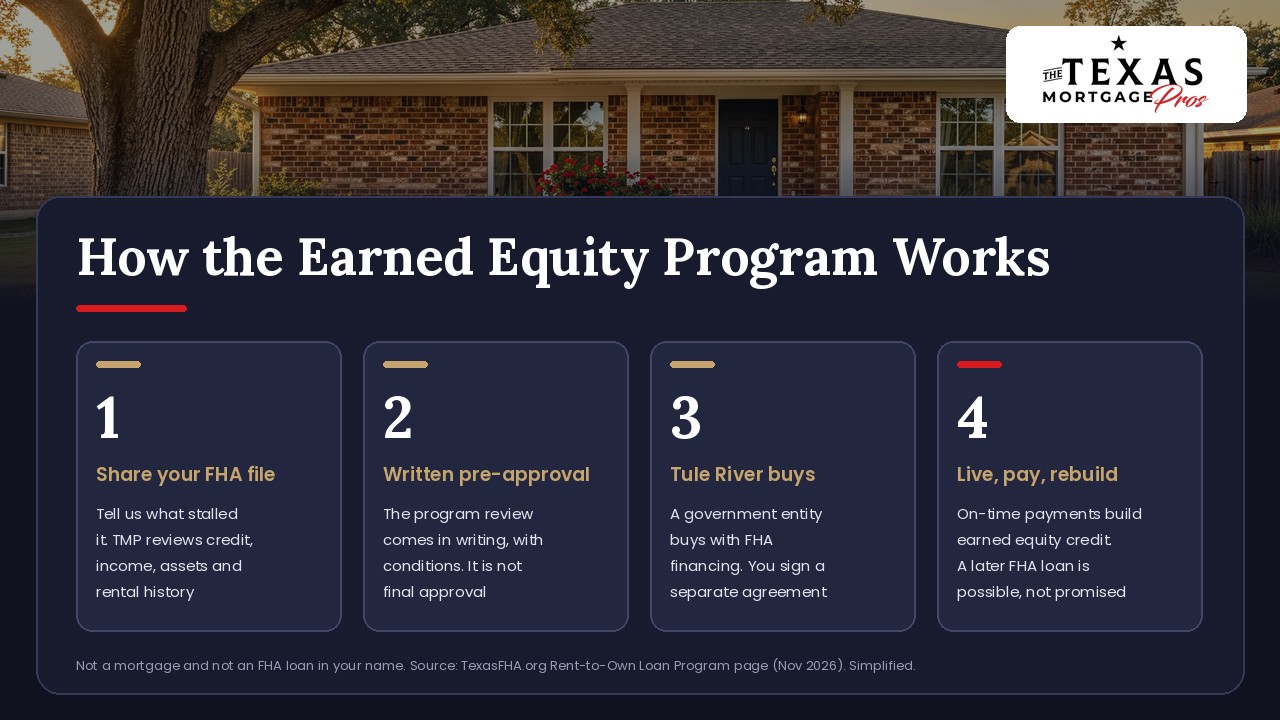
Tule River, a government entity, buys the home you choose using FHA financing. You do not take out that FHA loan.
Instead, you sign a separate Homeownership Agreement, move into the home, and make monthly payments under that agreement. “Rent” is shorthand for those payments. A share of each payment is commonly treated as earned equity credit, tied to on-time payments, and the Homeownership Agreement spells out how that works.
A future FHA application stands on its own
A later FHA loan is one possible route to ownership, but it is not promised. You may work toward FHA requirements over time, but any future financing still has to be qualified for on its own.
That distinction matters. The program isn’t a credit shortcut, and it isn’t a guaranteed path to an FHA loan. Think of it as a structured way to live in the home while you work on the items that held back your FHA file.
It is also one option, not the only one. If you’re weighing your choices, our guide for buyers who aren’t ready for an FHA loan yet compares working the file and returning to FHA later, Texas down payment assistance, non-QM financing, and rent-to-own.
The price is usually set up front
Program homes are usually set at an agreed price, which helps protect you from market increases during the program. How long it takes before you own the home outright depends on the terms of your Homeownership Agreement.
This is not the same as responding to a classified ad for a “rent-to-own home.” The program has its own review process, Texas program disclosures, and agreement terms.
Start with the reason your FHA file stalled
Before deciding whether rent-to-own makes sense, get specific about what stopped the FHA application. “Credit” can mean many different things: a recent late payment, collections, a short credit history, a score issue, a recent bankruptcy discharge, documentation gaps, or a combination. Our article on why FHA loan applications get denied walks through the most common reasons.
Ask for the explanation in writing
If your mortgage application was denied, ask why. The Consumer Financial Protection Bureau says the explanation must be provided in writing if you request it, along with copies of the credit score the denial was based on. The CFPB also suggests checking your credit report for mistakes and talking with a HUD-approved housing counselor. Read the CFPB’s guidance on what to do after a mortgage application is denied.
A written explanation gives you a starting list. It helps separate the issues you can address now from the ones that need time and steady payment history.
Pull all three credit reports
The CFPB explains that you can get free credit reports from Equifax, Experian, and TransUnion once a week at AnnualCreditReport.com. See the CFPB’s page on how to get your free credit reports. The reports don’t include credit scores, but they show the accounts, payment history, collections, and personal information that may need attention.
Look for:
- Accounts you don’t recognize
- Late payments that don’t look accurate
- The same collection listed more than once
- Incorrect balances or account status
- Addresses or identity details that don’t belong to you
- Closed accounts shown as open, or the reverse
If you find an error, dispute it with both the credit reporting company and the company that supplied the information. The CFPB says to explain the problem in writing with copies of supporting documents; the credit reporting company must investigate and report the results back to you. See the CFPB’s steps for disputing an error on your credit report.
Keep every bill on time
For a recovering credit profile, consistent on-time payments matter. Avoid changes that raise new questions in your file, such as letting an account fall behind or ignoring a collection notice.
Rental history can matter too. The CFPB notes that the three nationwide credit reporting companies use rental payment and related collection information, though each handles it differently, and that positive rental payments can help build credit. It suggests asking whether your landlord participates in a rental reporting program and weighing any fees. Read the CFPB’s answer on whether late rent affects your credit score.
On November 19, Experian reported that few landlords report rent payments, so rent seldom shows up on credit reports unless a rent reporting service adds it. When rent does appear, Experian said the newest FICO versions and all VantageScore versions can factor it in, and the potential effect may be larger for someone with a thin credit file or a lower score. Don’t assume that payments under a Homeownership Agreement are reported to any credit bureau. Ask, and get the answer in writing.
How FHA looks at credit scores and payment history
Knowing how FHA reviews credit helps you build a practical plan for a later application.
HUD Handbook 4000.1 defines the Minimum Decision Credit Score. When three scores are reported, it’s the median; when two different scores are reported, it’s the lower one; when only one is reported, that score is used. A borrower is not eligible for FHA-insured financing if that score is below 500. You can read the rules in HUD Handbook 4000.1.
The score is only one part of the file. Credit history, income, assets, the property, and other requirements also matter. Our overview of FHA loan requirements gives the broader picture.
Thin credit is not the same as bad credit
Some buyers have little traditional credit rather than a history of missed payments. For borrowers without a credit score, HUD lets a manually underwritten FHA file build credit from non-traditional references. The file needs three credit references, including at least one of these: rental housing payments, telephone service, or a utility.
HUD’s verification rules look at the most recent 12 months. Rental history is verified with a rental reference from the management company (not a family member) that shows when each payment was made; other references use 12 months of canceled checks or equivalent proof of payment.
That’s why records matter. Save statements, receipts, confirmation emails, and other proof that each payment was made on time.
For more credit education, see our tips on rebuilding your credit score and our guide to FHA credit score requirements.
Who may be a fit for rent-to-own in Texas?
No program is right for every buyer. The Earned Equity Program may be worth a conversation if one of these sounds like you.
Your credit is still recovering
If your scores or recent history stopped an FHA approval, you can live in the home while you keep improving your credit. Under the program, a lower score may be weighed with compensating factors.
You have a thin credit file
Not much on your credit report? Documented payments like rent or utilities can help show your payment habits. Start gathering that proof before you need it.
You are newer to a job or business
If you’ve been at a job or business for less than a year, you may need documented compensating factors. It’s a review item, not an automatic no.
You have a past bankruptcy
A bankruptcy has to be discharged first. After that, the program looks at how you’ve managed money since. Be ready to explain what changed and document it.
Your income is real but uneven on paper
Self-employed and commission income can be reviewed with self-employment records or bank statements. The Texas Mortgage Pros reviews your application, credit, income, assets, and rental history and gives you one list of anything still missing.
What the process looks like
- Share what held up your FHA file. The Texas Mortgage Pros reviews your application, credit, income, assets, and rental history, then gives you one list of anything still missing.
- Program review and written decision. A pre-approval comes in writing with its conditions. It is not final approval.
- Find the home and sign the contract. Getting the written pre-approval before you sign a purchase contract is the preferred order.
- Contract assigned, agreement signed. The contract is assigned to Tule River, which buys the home with FHA financing, and you sign the separate Homeownership Agreement.
- Each file clears on its own. Tule River’s financing file and your program file are reviewed separately, with items like the appraisal, title, and inspections. One approval doesn’t clear the other.
- Coordinated closing, then keys. Both sides close in sequence. Texas program disclosures and a waiting period apply, and your move-in date comes from the transaction’s written instructions.
There is no standard timeline, closing date, or key date. Credit, income, assets, housing history, and other requirements follow the current program version and can change.
Your credit plan while you live in the home
Use your time in the home on purpose. The program gives you structure, but your day-to-day money habits still drive what a future application looks like.
A practical checklist
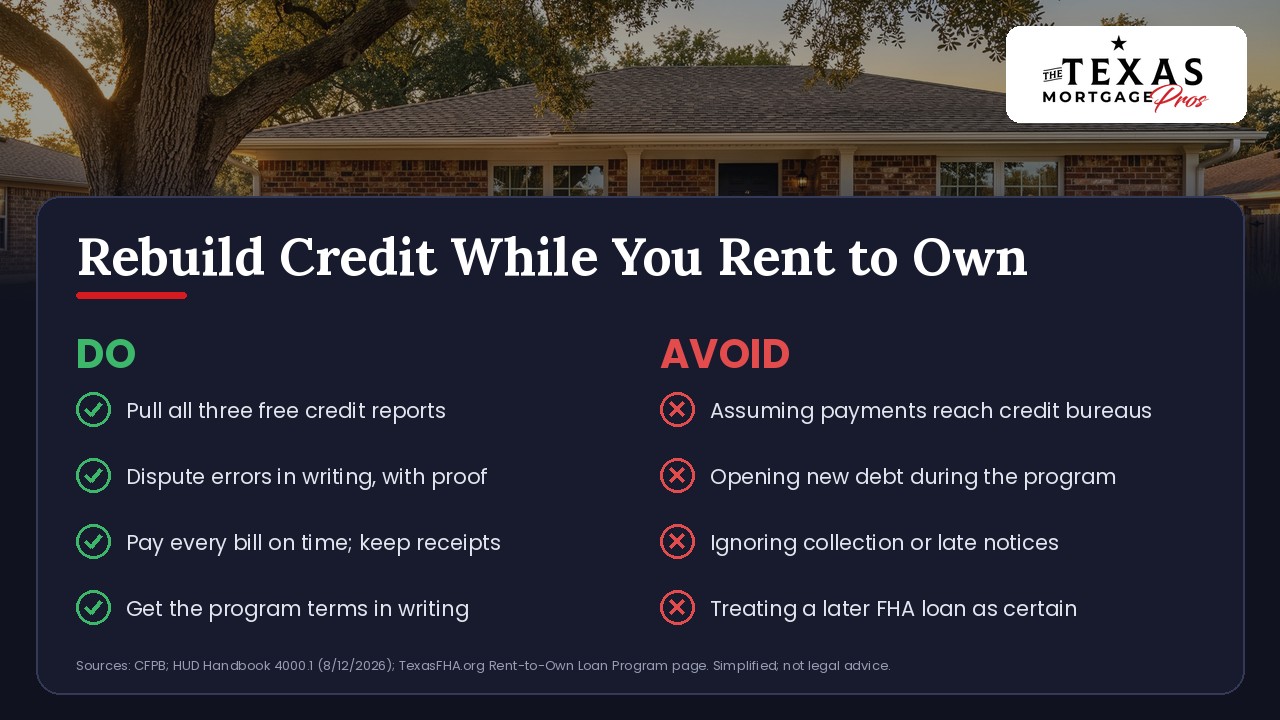
- Get the reason your FHA file stalled in writing.
- Pull and review your reports from all three credit bureaus.
- Dispute errors in writing, with documents.
- Pay every bill on time, including your Homeownership Agreement payment.
- Keep proof of each on-time payment.
- Ask whether program payments are reported to credit bureaus. Don’t assume they are.
- Ask how earned equity credit is earned and what could reduce it.
- Avoid new debts that make your budget harder to document.
- Keep income, asset, and employment records organized.
- Check in with us before a major financial change.
If you’d like help pinpointing what held up your FHA file, start with our FHA prequalification form.
What to get in writing before you sign
The Homeownership Agreement is a long-term commitment. This is not legal advice, and it’s wise to have a Texas real estate attorney review the documents before you sign.
Get written answers to these questions:
- How is earned equity credit earned?
- What could reduce your earned equity credit?
- What does the final step to ownership require from you?
- How is the purchase price set?
- Who is responsible for repairs and upkeep?
- What happens if you need to move before you own the home?
- Are your monthly program payments reported to any credit bureau?
- How can earned equity credit be used at the final step, if at all?
A clear answer now can prevent a misunderstanding later.
Rent-to-own in Texas: FAQs
Is this rent-to-own program an FHA loan?
Not for you. Tule River, the government entity that buys the home, uses FHA financing. Your side of the deal is a separate Homeownership Agreement, not a mortgage in your name.
Will rent-to-own improve my credit score?
Don’t assume it will. Ask whether program payments are reported to credit bureaus and get the answer in writing. Your on-time payments and accurate credit reports are what you control; no score outcome is promised.
Can I get an FHA loan later?
It’s possible, not guaranteed. A later FHA application has to qualify on its own, based on your complete file and the requirements in effect at that time.
What if rent-to-own isn’t the right fit?
Other paths include improving your file and applying for FHA later, Texas down payment assistance if you qualify for a mortgage, or comparing a non-QM loan. The right path depends on why your FHA file didn’t move forward.
Turn an FHA “not yet” into a homeownership plan
A credit setback doesn’t have to end your homeownership plans. For the right buyer, the Earned Equity Program lets you live in the home you chose while you build a cleaner credit report and a documented record of on-time payments.
To see whether it fits, visit the Rent-to-Own Loan Program page and take the quick pre-screen, contact The Texas Mortgage Pros, or call us at (281) 801-6965.
Gerry Nicodemus
Sources
- TexasFHA.org, Rent-to-Own Loan Program and Not Ready for an FHA Loan Yet? Your Texas Options (program descriptions as published November 2026)
- Texas Real Estate Research Center at Texas A&M University, Texas Housing Insight, November 2026 (November 20, 2026)
- Consumer Financial Protection Bureau, Ask CFPB: what to do if a mortgage application is denied; how to get free credit reports; how to dispute a credit report error; does late rent affect my credit score
- U.S. Department of Housing and Urban Development, Single Family Housing Policy Handbook 4000.1 (last revised August 12, 2026): Minimum Decision Credit Score; Non-traditional and Insufficient Credit
- Experian, Is My Rental History on My Credit Report? (November 19, 2026)
Recommended Reading
- Tips for Rebuilding Your Credit Score
- Mortgage Credit Score Changes: What Texas Buyers Should Know About VantageScore 4.0
- FHA Manual Underwriting in Texas: DTI Ratios and Compensating Factors Explained
The Texas Mortgage Pros, LLC is not affiliated with or endorsed by the U.S. Department of Housing and Urban Development, the Federal Housing Administration, the Consumer Financial Protection Bureau, the Texas Real Estate Research Center, Experian, Equifax or TransUnion, and this is not a government document. The Rent-to-Own Loan Program is not a mortgage or an FHA loan in the buyer’s name; program terms follow the current program documents and may change.
The Texas Mortgage Pros, LLC | Company NMLS #2665861 | Gerry Nicodemus, NMLS #286371 | Equal Housing Opportunity | www.nmlsconsumeraccess.org | (281) 801-6965
Equal Housing Opportunity. We do business in accordance with federal fair lending laws.

Gerry Nicodemus (NMLS #286371) is a licensed Texas loan originator with more than 25 years of mortgage experience. He specializes in FHA loans and explains credit, down payment, gift fund, and appraisal rules in plain English so Texas buyers know exactly where they stand. Gerry is also a digital marketer who builds agentic AI systems that help mortgage and real estate professionals get found online and serve borrowers better.