

Texas heat makes the electric bill part of the house. An FHA Energy Efficient Mortgage lets an eligible homebuyer include certain cost-effective energy improvements in an FHA purchase transaction, rather than taking on the project after closing.
That does not mean every upgrade belongs in the loan, or that an improvement is certain to reduce a household’s bills. The starting point is a qualified home energy assessment that estimates each improvement’s cost, expected energy savings, and cost-effectiveness. As a licensed loan originator, I help buyers see how that process fits alongside the rest of an FHA purchase.
TL;DR
- An FHA Energy Efficient Mortgage (EEM) can add cost-effective energy improvements to an FHA purchase loan.
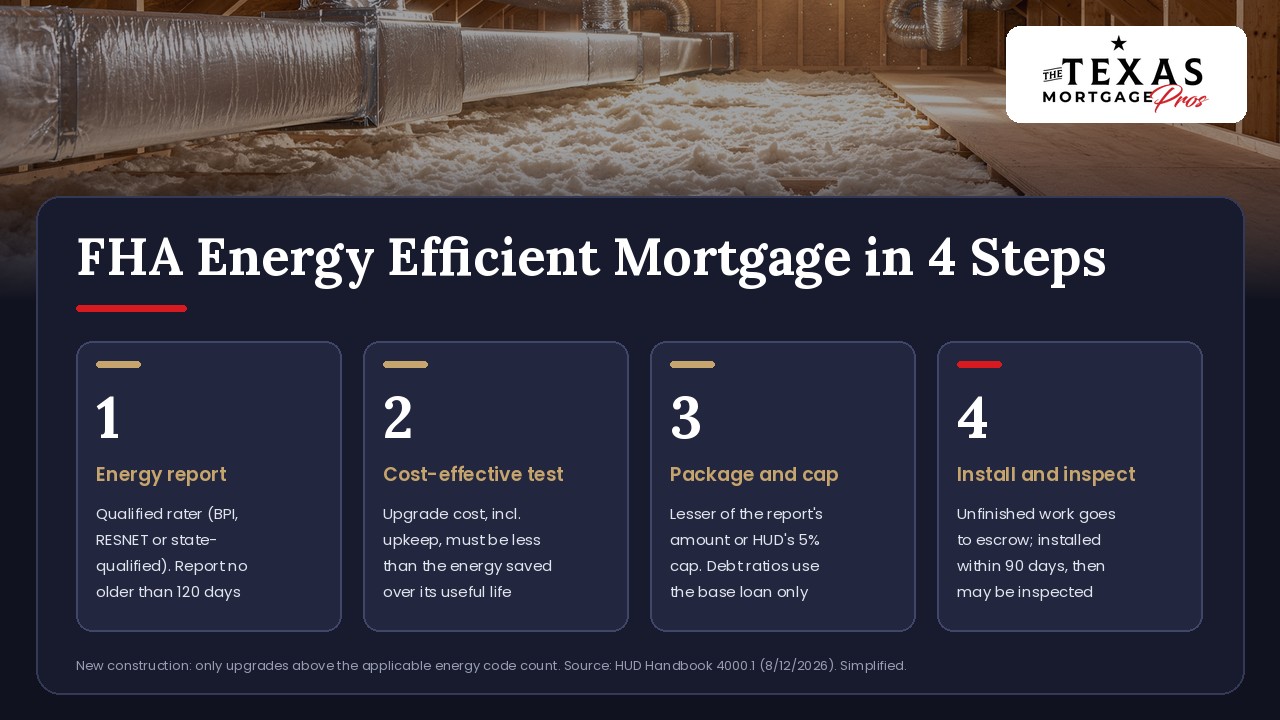
- A qualified energy rater’s report, no more than 120 days old, has to show the upgrades are cost-effective.
- The financed package is the lesser of the report’s cost-effective amount or a HUD cap based on 5% of the property’s value figures, and debt ratios are figured on the base loan without it.
- Unfinished work on an existing home goes into escrow and must be installed within 90 days of loan disbursement.
- FHA can add a new solar system you will own; leased panels and power purchase agreements can’t be financed.
- In Texas, check HOA solar rules and the solar seller’s TDLR registration and contract before you sign.
TexasFHA
Thinking About Energy Upgrades?
Talk with The Texas Mortgage Pros, a Texas mortgage broker, about whether an FHA Energy Efficient Mortgage fits the home you want to buy.
Texas weather makes home efficiency a purchase question
A home’s energy use can change dramatically across a Texas year. A November 19 study from Light reviewed 12,606 electricity bills from 11,470 Texas homes and found that typical monthly usage ranged from roughly 800 kWh in December to about 2,000 kWh in August. The typical August bill was 2.4 times the typical March bill, while August usage was about 2.5 times as high and the price per kWh changed little. About one-third of a bill reflected delivery charges. Read the Light study.
Heat is not the only consideration. In a preliminary winter outlook posted November 4, ERCOT reported that January through September 2026 was Texas’s warmest first nine months on record, and that August and September together were the hottest on record. But last winter, also the warmest on record, still included a January cold snap that brought temperatures to 13°F in Dallas and -2°F in Lubbock. ERCOT’s preliminary winter outlook leaned slightly to moderately warmer than normal while noting it would be wise to prepare for a period of extreme cold. Read ERCOT’s preliminary winter weather outlook.
ERCOT’s January 2027 resource adequacy outlook, posted November 6, identified 8 a.m. as the highest-risk hour, with a 3.2% probability of an energy emergency alert, well below ERCOT’s 10% elevated-risk threshold. For a buyer, that context makes it reasonable to look beyond cosmetic updates and ask practical questions about insulation, ducts, heating and cooling equipment, windows, and the home’s overall energy performance.
What an FHA Energy Efficient Mortgage can finance
An FHA Energy Efficient Mortgage, often called an EEM, lets the FHA Mortgagee finance cost-effective energy improvements to an existing home at the time of purchase, or upgrades above the building code on a newly built home. It can be used with a standard FHA purchase loan and with FHA 203(k) Standard or Limited transactions.
HUD permits an EEM for eligible new or existing one- to four-unit homes, a single condominium unit, and manufactured housing. The energy package is the set of improvements you agree to based on a qualified home energy rater’s recommendations. It can include energy-saving equipment, materials, labor, inspections, the energy assessment itself, and, if you want one, an EEM facilitator who manages the project.
Depending on what the energy report recommends, examples may include:
- Adding or improving insulation
- Air sealing
- Duct sealing or duct repair
- Replacing qualifying heating and cooling equipment, including a heat pump
- Replacing an eligible water heater
- Improving windows or other building-envelope components
- Certain active or passive solar or wind technologies
- A new solar system the buyer will own (FHA also has a separate solar policy, covered below)
The key word is cost-effective. HUD defines a cost-effective improvement as one where the cost of the work, including maintenance and repair, is less than the value of the energy saved over theimprovement’ss estimated useful life.
That is a specific program test, not a promise about a future utility bill. Household behavior, weather, maintenance, electricity use, and many other factors can affect actual consumption and costs. You can review HUD’s Energy Efficient Mortgage and solar rules in HUD Handbook 4000.1.
The energy assessment comes first
The buyer needs a home energy assessment prepared by a qualified rater. HUD recognizes raters with credentials such as:
- BPI Building Analyst Professional
- BPI Home Energy Professional Energy Auditor
- RESNET Home Energy Rater
- A rater who meets applicable state or local requirements
The report must be no more than 120 days old. It identifies recommended improvements, estimates energy savings, and evaluates the cost-effectiveness of each recommendation.
This is why an EEM works best when buyers raise the issue early, before the contract timeline gets tight. A buyer who notices a struggling HVAC system, thin attic insulation, drafty rooms, or high seasonal energy use can ask whether an assessment makes sense before assuming those issues can be added to the transaction.
How the EEM cap works
HUD limits the financeable energy package. The permitted amount is the lesser of:
- The cost-effective amount shown in the energy report; or
- A HUD cap equal to 5 percent of certain property value figures.
The Mortgagee calculates the applicable amount using FHA’s EEM calculator. The exact calculation belongs in the file; it is not something to estimate casually from a listing price or contractor quote.
Qualification and appraisal: two details buyers often misunderstand
An EEM has an important qualification feature: debt ratios are calculated using the base loan amount without the energy package. The underwriter also completes a second FHA transmittal form that identifies the energy package.
That treatment can make the program worth evaluating for a buyer who has a valid, cost-effective improvement package. It does not remove normal FHA documentation, property, underwriting, or eligibility requirements. Start with the broader FHA loan requirements and discuss the specific property and file with a licensed loan originator.
The appraisal also does not have to reflect the value of the energy package. If it does include that value, HUD has the Mortgagee subtract it when computing the value used for the loan. Buyers can review our guide to FHA appraisal requirements in Texas for a clearer picture of the appraisal’s separate role.
No cash back from unused funds
An EEM is for the approved energy package, not a source of cash back to the buyer. If an excess remains, it is applied to the loan principal.
That is another reason to use detailed, supportable bids and make sure the proposed scope matches the energy assessment before closing.
What happens when upgrades are not complete at closing
For an existing home, some approved work may be unfinished at closing. In that case, the Mortgagee sets up an escrow account for the remaining cost of the energy improvements.
The buyer cannot perform the work as unpaid “sweat equity.” Line up your contractors before closing; the energy package must be installed within 90 days of loan disbursement.
The installation may be inspected by the Mortgagee, the energy rater, or an ICC-certified inspector. An inspection fee may apply. If the work changes from the approved package, the file needs a change order and revised energy audit for underwriting review.
If the work is not completed within the required period, remaining EEM funds are applied to the principal balance.
EEM versus FHA 203(k)
An EEM is focused on cost-effective energy improvements. An FHA 203(k) transaction is designed for broader eligible rehabilitation and renovation work. HUD allows an EEM to be used together with a 203(k), with the energy items kept separate from the rehabilitation items in the calculation.
For example, a buyer who wants to address energy efficiency along with more extensive property repairs should understand the 203(k) process before choosing a path. See our overview of FHA 203(k) renovation loans in Texas.
New construction has a different EEM standard
For new construction, the FHA Energy Efficient Mortgage cannot be used to finance features already required by the applicable energy code.
Only improvements above the greater of HUD’s latest adopted energy code or the International Energy Conservation Code edition used by the state or local building code can count. In other words, the builder’s standard code-required package is not automatically an EEM improvement.
A buyer considering upgrades to a new Texas home should ask:
- What energy features are included in the builder’s base home?
- Which proposed upgrades are above the applicable code?
- Can the qualified rater identify and evaluate those upgrades separately?
- Does the builder’s timeline work with FHA documentation and installation requirements?
This conversation should happen before selecting upgrades or finalizing construction choices.
Solar: ownership, HOA rules, and contract review matter
Solar has its own FHA policy. FHA may add the cost and installation of a new solar or wind system the buyer will own to the loan, limited to the lesser of the system’s cost or 20 percent of the property value. Rebates assigned to the contractor are excluded from that cost. A photovoltaic system must provide electricity for the residence and meet applicable fire and electrical codes, and the installation must be completed within 120 days of loan disbursement. Condominium units are not eligible for FHA’s solar policy.
Leased solar systems and solar power purchase agreements, commonly called PPAs, cannot be financed under any FHA program.
Buying a home with leased solar or a PPA
A home with an existing leased solar system or PPA may still be eligible for an FHA purchase, but the agreement needs early review. HUD accepts these agreements only when they don’t restrict your ability to transfer the property later, for example by requiring a third party’s consent, limiting your sale proceeds through a lien or due-on-sale clause, or giving grounds to accelerate the FHA-insured mortgage.
The appraiser must not include the value of leased solar equipment, and the property value can’t include equipment you won’t fully own. Ask the seller for the lease or PPA and the provider’s transfer requirements as early as possible. Waiting until the appraisal or closing stage can create avoidable questions.
HOA rules still apply
Texas Property Code Section 202.010 generally limits an HOA’s ability to prohibit or restrict a homeowner from installing a solar energy device. But there are exceptions, including some installations on common or HOA property, devices that do not conform to roof slope or extend above the roofline, certain yard installations, work that voids a material warranty, and installations completed without required HOA approval. An HOA may also designate certain roof areas. Review Texas Property Code Chapter 202.
This is not legal advice. Buyers should read the subdivision’s declaration, rules, architectural guidelines, and approval process. For a contract or HOA dispute, speak with a Texas real estate attorney.
Texas solar-contract protections
If you plan to buy or lease a new system, Texas law adds consumer protections. The sale or lease agreement must identify the licensed electrical contractor and license number and state that permits and utility interconnection approvals will be obtained.
Texas consumers can cancel a residential solar sale or lease contract in writing by the fifth business day after signing. If a third-party loan connected to or recommended by the retailer is involved, that agreement must be canceled too. Beginning September 1, 2026, solar retailers and salespersons must register with the Texas Department of Licensing and Regulation.
TDLR also advises consumers to get at least two bids, check licensing, be cautious about “free” solar claims, and avoid paying the full amount up front. Read TDLR’s residential solar consumer brochure.
Manual underwriting and energy-efficient homes
For manually underwritten FHA files, HUD provides stretch qualifying ratios for an Energy Efficient Home: 33/45 rather than 31/43.
For an existing home, the property can meet this category with a Home Energy Score of 6 or higher. It can also qualify when documented cost-effective improvements from the Home Energy Score Report would raise the score to 6 or higher and are completed before closing or through FHA’s 203(k), weatherization, EEM, or solar programs.
For new construction, the home may qualify by meeting the applicable energy code, documented on the builder’s HUD-92541 form.
These ratio rules are specific to manually underwritten files and do not replace the full underwriting review. Read more about FHA manual underwriting in Texas if that is part of your homebuying conversation.
A practical EEM checklist before you write an offer
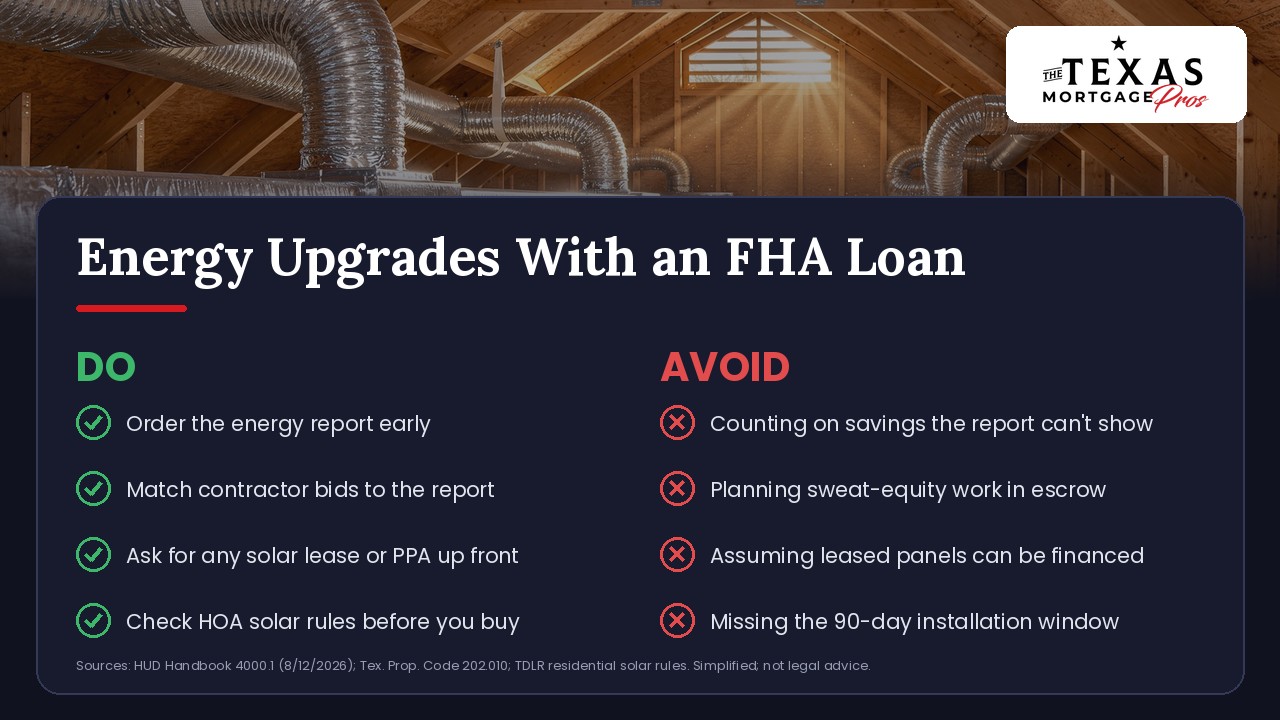
- Look for efficiency clues. Ask about the age and condition of HVAC equipment, insulation, windows, ducts, water heater, and any solar arrangement.
- Request documentation early. Gather utility history when available, contractor records, solar contracts, and HOA documents.
- Discuss the property with your licensed loan originator. Confirm whether an FHA purchase and an EEM are worth evaluating.
- Order a qualified energy assessment. The report must identify recommended improvements and their cost-effectiveness.
- Get specific bids. The scope of work, bids, and energy report should align.
- Plan the timing. Decide whether work can be finished before closing or requires an escrow arrangement after disbursement.
- Keep solar separate until documented. Confirm whether the system is owned, leased, or subject to a PPA before assuming it can be included or transferred.
FHA Energy Efficient Mortgage FAQs
Q: Can I use an EEM to replace an old HVAC system in a Texas home?
A: It can be, if a qualified energy assessment recommends the replacement and shows it is cost-effective under FHA’s rules. The proposed work must also fit the approved energy package and applicable FHA requirements.
Q: Can I finance new windows through an FHA EEM?
A: Windows may be part of an approved energy package when the energy assessment supports them as cost-effective. A contractor quote alone is not the same as the required home energy assessment.
Q: Does an FHA EEM mean the appraisal will be higher?
A: Not necessarily. FHA does not require the appraisal to reflect the value of the energy package. The appraisal and the EEM analysis serve different purposes in the transaction.
Q: Can I use an EEM for solar panels?
A: FHA may allow a new solar system that the buyer will own, subject to its specific solar requirements. Leased panels and PPAs cannot be financed under FHA’s solar policy. A property with existing leased solar or a PPA needs early contract review.
Make energy efficiency part of your Texas home search
An FHA EEM can be a useful option when a home’s energy needs are clear, the assessment supports the proposed work, and the purchase timeline can accommodate the documentation and installation process.
If you are considering a Texas home with an aging HVAC system, limited insulation, inefficient windows, or an owned solar project, I can help you look at the FHA purchase structure and next steps. Pre-qualify for an FHA loan, contact The Texas Mortgage Pros, or call me at (281) 801-6965 to talk through your plans.
— Gerry Nicodemus
Sources
- U.S. Department of Housing and Urban Development, Single Family Housing Policy Handbook 4000.1 (last revised August 12, 2026): Energy Efficient Mortgages; Solar and Wind Technologies; Leased Equipment and Legal Restrictions on Conveyance; Manual Underwriting (Energy Efficient Homes)
- Light, What Texas homes pay for electricity: a study of 11,470 homes (November 19, 2026)
- Electric Reliability Council of Texas (ERCOT), 2026-27 Preliminary Winter Weather Outlook (posted November 4, 2026)
- Electric Reliability Council of Texas (ERCOT), Monthly Outlook for Resource Adequacy, January 2027 (November 6, 2026)
- Texas Property Code, Section 202.010 (Regulation of Solar Energy Devices)
- Texas Department of Licensing and Regulation, Residential Solar Consumer Information; Texas Occupations Code, Chapter 1806 (Residential Solar Retailer Regulatory Act)
Recommended Reading
- FHA 203(k) Renovation Loans in Texas
- FHA Appraisal Requirements in Texas: What the Appraiser Checks
- FHA Manual Underwriting in Texas: DTI Ratios and Compensating Factors Explained
TexasFHA.org is not affiliated with or endorsed by the U.S. Department of Housing and Urban Development, the Federal Housing Administration, the Electric Reliability Council of Texas, the Texas Department of Licensing and Regulation, Light, any energy rater, solar company or utility, the State of Texas or any other government agency, and this is not a government document.
The Texas Mortgage Pros, LLC | Company NMLS #2665861 | Gerry Nicodemus, NMLS #286371 | Equal Housing Opportunity | www.nmlsconsumeraccess.org | (281) 801-6965
Equal Housing Opportunity. We do business in accordance with federal fair lending laws.

Gerry Nicodemus (NMLS #286371) is a licensed Texas loan originator with more than 25 years of mortgage experience. He specializes in FHA loans and explains credit, down payment, gift fund, and appraisal rules in plain English so Texas buyers know exactly where they stand. Gerry is also a digital marketer who builds agentic AI systems that help mortgage and real estate professionals get found online and serve borrowers better.