

Buying a renovated Texas home can be exciting. Fresh flooring, a new roof, updated fixtures, and an attractive listing can make a resale property feel move-in ready.
If you plan to use an FHA-insured purchase loan, though, one detail to check early is when the current seller acquired the property.
FHA has resale restrictions commonly called the 90-day flip rule. The rule doesn’t depend on whether a home looks renovated, whether the seller is an investor, or whether the sales price seems reasonable. It focuses first on the seller’s ownership timeline, measured from the seller’s acquisition settlement date to the date your sales contract is executed.
That distinction matters. Waiting to close until after day 90 does not fix a contract signed too early.
TL;DR
- Measure seller acquisition settlement to the date all parties execute your contract—not closing.
- Resales within 90 days are generally ineligible unless a documented exception applies.
- Days 91–180 plus a resale price at least double the acquisition price trigger an additional appraisal.
- Verify title history, the seller of record and any exception before signing.
TexasFHA
Buying a Recently Renovated Texas Home?
Ask a mortgage broker to review the seller’s ownership timeline before you sign.
The short version: the contract date matters
For an FHA-insured purchase, a property is generally ineligible if it is resold within 90 days of the current seller acquiring it.
The measurement is:
The seller’s acquisition settlement date → the date the new sales contract is executed
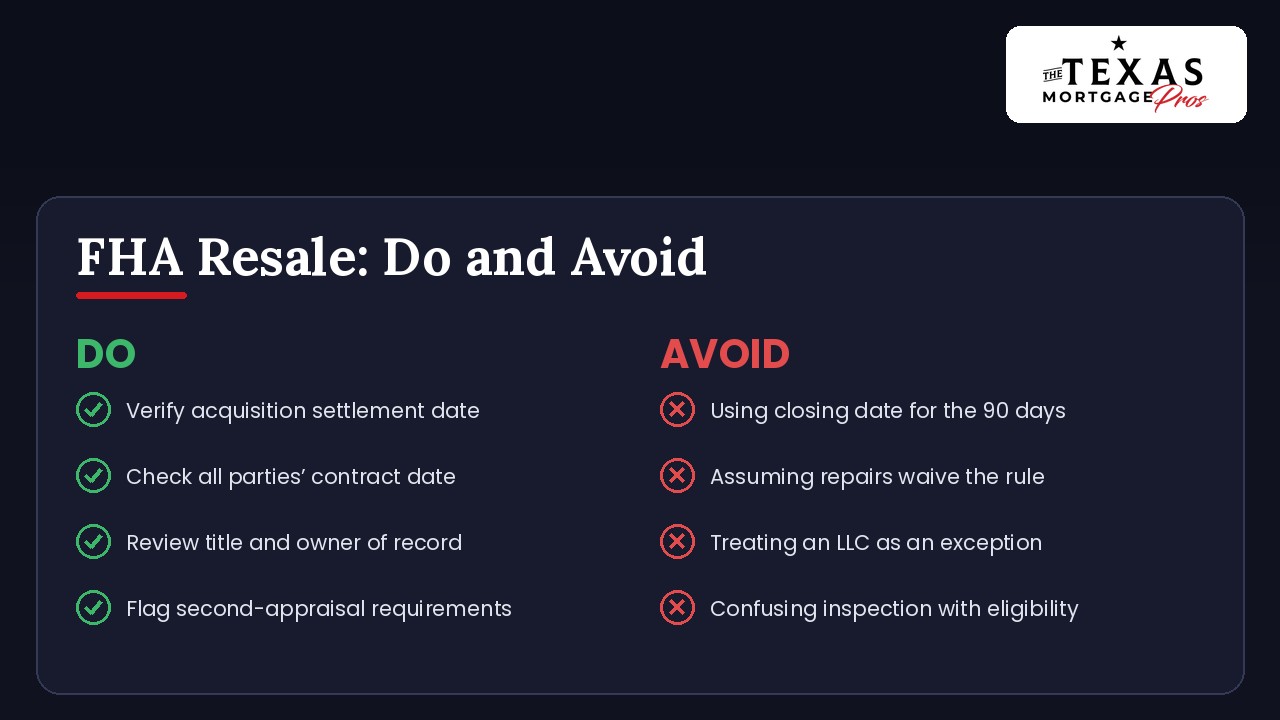
It is not measured from the seller’s purchase date to your closing date.
For example, if all parties execute a sales contract on day 85 after the seller’s acquisition settlement, a planned closing on day 115 does not move that contract outside the restricted period. Ask your mortgage broker to verify the dates rather than estimating them from a calendar.
That is why a buyer using FHA financing should ask about the seller’s acquisition date before signing a contract, especially when the listing looks newly renovated or was recently added to the market.
HUD’s property-flipping rules appear in HUD Handbook 4000.1 and in 24 CFR § 203.37a.
What FHA means by a resale restriction
A resale restriction is not a judgment that a renovated property is defective or that every quick resale is improper. FHA aims to address risks that can arise when a property changes hands rapidly and at a sharply higher price.
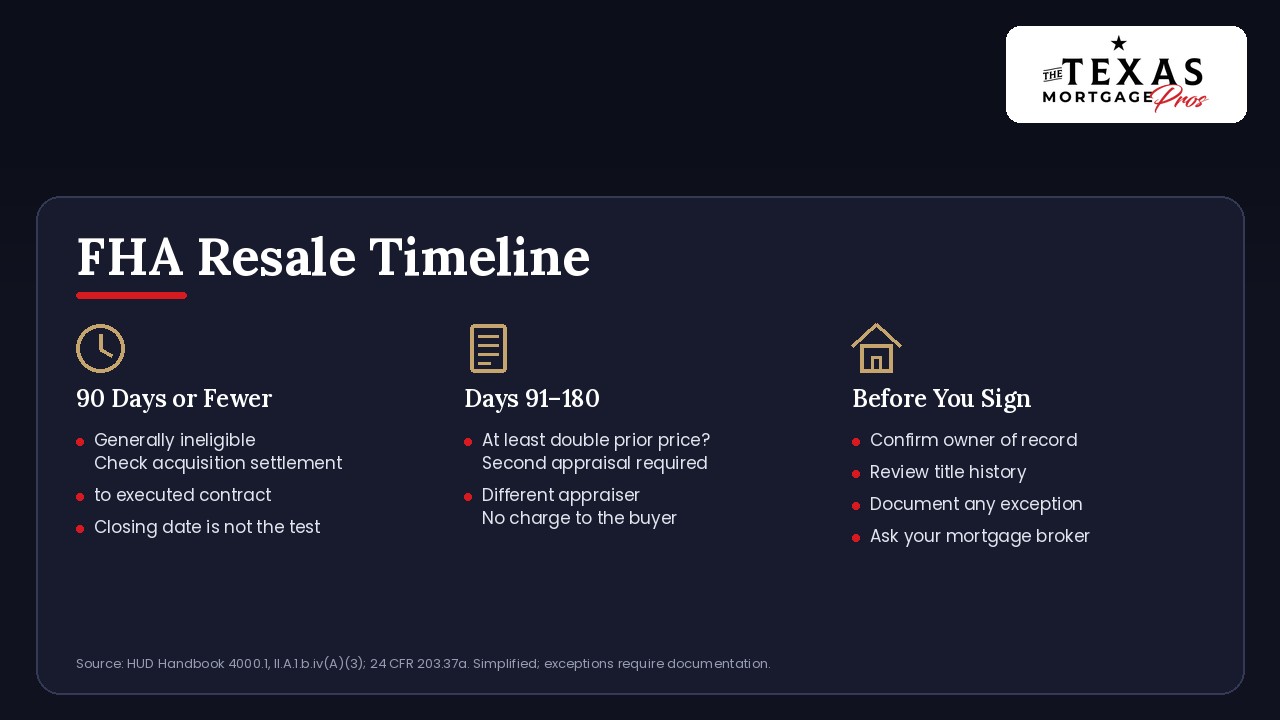
The rule creates different considerations based on how long the seller has owned the property:
- 90 days or fewer: The property is generally not eligible for FHA insurance.
- 91 to 180 days: The transaction may move forward, but a substantial increase in the resale price can trigger an additional appraisal requirement.
- More than 180 days: The specific 91-to-180-day second-appraisal trigger described below generally no longer applies, although the property and transaction must still satisfy all other FHA requirements.
The rule applies to the seller’s actual ownership period, not to the amount of paint, flooring, landscaping, or other work completed during that period.
A seller may have performed legitimate renovations. The home may appraise well. Your inspection may identify no major concern. Those facts do not by themselves override FHA’s resale-timeline requirements.
Days 0–90: generally ineligible for an FHA purchase
If the seller acquired the property 90 days or fewer before the buyer and seller execute the sales contract, the property is generally ineligible for FHA insurance.
This is the point that can surprise buyers who see a renovated home go under contract quickly. A seller might say that closing will happen after the 90-day mark. For FHA purposes, that may not solve the issue if the contract itself was signed within the restricted period.
Before writing an offer, ask your real estate agent to confirm the seller’s acquisition date using available title, deed, listing, or transaction records. If the timing is close, the mortgage broker and the title company should have the information early enough to review the FHA eligibility question before the process gets further along.
Do not assume the date shown on a home-improvement invoice, listing date, renovation completion date, or MLS “year remodeled” field is relevant to the 90-day calculation. The key date is the seller’s acquisition settlement date.
Days 91–180: when a second appraisal may be required
A property resold between 91 and 180 days after the seller acquired it can present another FHA requirement.
If the resale price is 100% or more above the seller’s acquisition price, FHA requires a second appraisal completed by a different appraiser. In plain terms, that means the new sales price is at least double what the current seller paid to acquire the property.
The second appraisal provides an additional valuation review when a property resells quickly at a substantially higher price.
If the second appraisal supports a value more than 5% below the first appraisal, HUD requires the lower value to be used as the property value in determining adjusted value. This is a valuation rule, not a quote or financing promise.
Several details are important:
- It is not the same appraiser repeating the first assignment.
FHA requires a different appraiser to complete the second appraisal. - The borrower cannot be charged for the second appraisal.
If FHA requires the additional appraisal, the homebuyer cannot be charged for that cost. - A renovation does not automatically remove the requirement.
Improvements may help explain a price increase, but they do not erase the timing and price-change test. - The second appraisal is separate from the home inspection.
An appraisal is not a substitute for an inspection, and a satisfactory inspection does not determine whether the FHA resale rule applies.
The appraisers may consider the property’s condition, market data, and documented improvements as part of their professional work. Buyers should not, however, treat a second appraisal as a promise that the agreed price will be supported.

The seller must be the owner of record
HUD also requires a 12-month chain of title documenting compliance with the resale restrictions. A county deed record can help identify a recent transfer, but the title and settlement documentation should establish the actual acquisition date. A deed’s recording date should not automatically be substituted for the settlement date.
FHA also expects the seller to be the owner of record. The sales contract cannot simply be assigned to a new buyer.
This issue can arise when someone puts a property under contract and then seeks to transfer, or assign, their contract rights to another purchaser without taking title. That differs from a seller who acquired title, became the owner of record, and later sold the property.
For an FHA purchase, it is important to understand who actually owns the home being sold. The name on the contract, the vesting information, and the title record should align.
That does not mean every ownership structure is automatically a problem. A property can be held in the name of an individual, company, trust, estate, or other lawful ownership arrangement. But the transaction still needs to meet FHA’s owner-of-record and anti-flipping requirements. An LLC name alone isn’t a blanket exception, and calling a seller an “investor” doesn’t create one either.
Limited exceptions are not a shortcut
HUD rules include limited exceptions in specific circumstances. Two situations buyers may hear about are inherited property and an employer- or relocation-agency resale connected to an employee relocation.
These examples are not the complete exception list. HUD also addresses certain government, approved nonprofit, and financial-institution resales, and treats a builder selling a newly built home separately. An ordinary renovated resale is not automatically new construction.
Those exceptions are narrow and fact-specific. Don’t assume them based on a listing description, a seller’s explanation, or the fact that the property was recently renovated.
For example:
- A property received through inheritance may involve different documentation and review than a typical investor resale.
- A property acquired by an employer or relocation agency as part of an employee relocation may be treated differently under the applicable rules.
- A general claim that the seller is “”ot a flipper” is not an exception.
- A renovation project, no matter how extensive, is not itself a blanket exception.
- Use of an LLC does not itself create an exception.
If an exception may apply, raise the question early with your mortgage broker so they can review the file under the applicable FHA requirements. The answer depends on the actual ownership history and documentation.
Do not confuse the appraisal, inspection, and flip-rule review
These are separate parts of a home purchase. Each answers a different question.
The FHA resale-timeline review
This review asks questions such as:
- When did the current seller acquire the property?
- When was the new purchase contract executed?
- Is the transaction within the 91- to 180-day period?
- Is the resale price 100% or more above the seller’s acquisition price?
- Is a second appraisal required?
- Is the seller the owner of record?
The appraisal
An appraisal is an opinion of value and includes FHA property-condition considerations. It is not a whole-house inspection and does not replace a buyer’s due diligence.
A home may be outside the restricted 90-day period and still have appraisal issues. Conversely, a home may appear to support the contract price but still have an FHA resale-timeline problem if the contract was signed too soon.
The inspection
A buyer’s inspection is a separate opportunity to understand the home’s condition and potential repair needs. On a renovated resale, buyers may want to discuss the scope of recent work with their inspector and agent, including visible repairs, permits when applicable, warranties, receipts, and the age of major systems.
An inspection does not decide FHA resale eligibility. It helps the buyer make an informed purchase decision.
Questions to ask before you sign
Before signing an offer on a recently renovated Texas home, consider asking these practical questions:
- When did the current seller acquire title to the property?
- Can you confirm the acquisition settlement date through the title or deed history?
- Who is listed as the owner of record?
- Will the seller on the purchase contract match the owner shown in title records?
- Is the proposed contract date more than 90 days after the seller’s acquisition settlement date?
- If the property is being resold between 91 and 180 days later, is the sales price 100% or more above the seller’s acquisition price?
- If so, have you identified the FHA second-appraisal requirement?
- What renovation information, invoices, permits, warranties, or receipts are available for review?
- What does your inspector recommend based on the home’s visible condition?
Your real estate agent can help coordinate the property and contract. Your mortgage broker can help identify FHA documentation and eligibility questions. For Texas contract interpretation, title issues, legal rights, or legal deadlines, speak with a qualified Texas real estate attorney.
Why early timing checks help
A buyer may spend time on inspections, negotiations, repair discussions, and appraisal preparation before discovering the property doesn’t meet FHA’s resale-timeline rules. Checking ownership history early can help identify a potential issue before the transaction reaches that point.
This is especially useful with homes marketed as:
- newly renovated;
- investor-owned;
- “move-in ready” after a recent update;
- recently acquired and relisted;
- sold by an entity different from the name a buyer expected to see.
None of those descriptions automatically make a property ineligible. They are simply reasons to verify the seller’s timeline rather than make assumptions.
Check the Seller’s Timeline Before You Fall for the House
For an FHA buyer considering a renovated Texas resale, the seller’s timeline matters before you sign the contract.
Remember the core rule: measure from the seller’s acquisition settlement date to the date the new sales contract is executed, not to the closing date. A resale within 90 days is generally ineligible. Between days 91 and 180, a resale price that is 100% or more above the seller’s acquisition price requires a second appraisal from a different appraiser, and the buyer cannot be charged for it.
Before you sign, ask about the deed history, seller of record, acquisition date, and whether the transaction may trigger FHA’s additional appraisal requirement. A timely review can help you evaluate the home with clearer expectations.
TexasFHA.org is not affiliated with or endorsed by the U.S. Department of Housing and Urban Development or the Federal Housing Administration.
The Texas Mortgage Pros, LLC | Company NMLS #2665861 | Gerry Nicodemus, NMLS #286371 | Equal Housing Opportunity | www.nmlsconsumeraccess.org | (281) 801-6965
Talk with a mortgage broker about your FHA purchase questions: (281) 801-6965
— Gerry Nicodemus
Sources
HUD Handbook 4000.1, II.A.1.b.iv(A)(2)–(3), pages 166–168; 24 CFR §203.37a. Official sources checked November 7, 2026.
Recommended Reading

Gerry Nicodemus (NMLS #286371) is a licensed Texas loan originator with more than 25 years of mortgage experience. He specializes in FHA loans and explains credit, down payment, gift fund, and appraisal rules in plain English so Texas buyers know exactly where they stand. Gerry is also a digital marketer who builds agentic AI systems that help mortgage and real estate professionals get found online and serve borrowers better.